



CCSD code G5100: Bypass of duodenum billing guide
CCSD code G5100 bills a bypass that leaves the duodenum in place CCSD code G5100...

Last Updated: Oct 16, 2026

CPT code 21032 covers excision of maxillary torus palatinus, a benign bony growth on the roof of the mouth.
Medicare pays the code from the physician fee schedule, so the amount depends on your locality and place of service.
CMS set the 2026 conversion factor at $33.4009, or $33.5675 for qualifying alternative payment model participants.
Published RVU figures for the code differ between third-party lookup sites, so pull current values from the CMS look-up tool.
Most denials come from medical necessity: the operative report has to show symptomatic obstruction, not an incidental finding.
CPT code 21032 is the billable code for excision of maxillary torus palatinus. Oral and maxillofacial surgeons report it when a bony growth on the hard palate blocks denture seating or normal oral function.
Denials on this code usually trace back to the wrong anatomy code or an operative note that never names the functional problem. Both are fixable before the claim goes out.
The American Medical Association places the code in the Musculoskeletal System section. It sits under excision procedures on the head, code range 21000 to 21499. The official descriptor reads “Excision of maxillary torus palatinus.”
A torus palatinus is a benign bony protrusion along the midline of the hard palate. Removal becomes medically necessary when it interferes with denture fitting, causes recurrent trauma from food, or obstructs normal oral function.
The surgeon makes an incision along the palatal mucosa, elevates a flap, and removes the bony exostosis with a rotary instrument or osteotome. The mucosal flap is then sutured back into position.
Complexity varies with the size of the torus. Large or multilobulated growths take more bone removal and longer operative time, which is where modifier -22 comes in.
Whichever system holds the chart, the note has to capture growth size and functional impairment. Surgical practices running a plastic surgery EMR can build those fields into the operative template, so the detail is never left to memory.
Modifier selection for CPT code 21032 is simple in most cases, but four modifiers come up regularly in oral surgery billing. Applying the wrong one, or leaving out one that applies, is a leading cause of underpayment and audit exposure.
A note on -50 (bilateral): torus palatinus is a midline structure. True bilateral tori on the palate are uncommon. If a coder appends -50 without confirming two anatomically distinct growths in the operative note, payers will question it. Verify the anatomy with the surgeon before billing.
Relative Value Units, known as RVUs, are set each year by the Centers for Medicare and Medicaid Services (CMS). Three components make up the total for any procedure code. Each is multiplied by its Geographic Practice Cost Index, and the sum is multiplied by the annual conversion factor.
Published RVU figures for 21032 differ between third-party lookup sites, so treat CMS as the only authority. Pull the current values straight from the CMS Physician Fee Schedule Look-Up Tool before you quote a rate to anyone.
The practice expense component is the one that moves most between settings. In a hospital or ambulatory surgery center, the facility absorbs the overhead and bills its own fee, so the physician’s practice expense value drops. In an office, the practice carries those costs, which is why the non-facility total runs higher. Most claim errors are structural rather than clinical, which is why scrubbing rules catch them.
Check your GPCI multiplier before projecting revenue. A practice in San Francisco collects more for CPT code 21032 than one in rural Mississippi, even with identical wRVUs. Pull the locality-adjusted rate from the CMS look-up tool rather than using a national average.
Medicare pays CPT code 21032 through the Resource-Based Relative Value Scale. Each RVU component is multiplied by its geographic index, and the total is multiplied by the annual conversion factor.
CMS finalized a 2026 conversion factor of $33.4009 for most physicians, effective January 1, 2026. Clinicians who qualify as participants in an advanced alternative payment model are paid at $33.5675. Neither figure is the payment for a single code on its own.
What a practice actually collects for 21032 depends on the locality adjustment and the place of service. Run the code through the CMS look-up tool to get your own numbers.
Place of service (POS) code determines which rate applies. POS 11 (physician office) triggers the non-facility rate. POS 22 (hospital outpatient), POS 23 (emergency department), and POS 24 (ASC) all trigger the lower facility rate for the physician component.
Most torus palatinus excisions happen in an office or an outpatient surgical setting. Moving a case to an ASC lowers the physician payment, because the practice expense component shrinks. The ASC collects its own facility fee, and that money does not reach the surgeon.
Check that the POS code matches the actual service location before submission. A mismatch is one of the easiest denials to avoid, and one of the most common.
Medical necessity for CPT code 21032 rests on the diagnosis code you pair with it. Payers expect that diagnosis to reflect documented functional impairment, not an incidental clinical or radiographic finding. The codes below are the ones oral surgery teams reach for most.
K10.0 is the cleanest pairing for CPT code 21032 and is accepted by Medicare and most commercial payers. The chart note still has to document the symptomatic basis for that diagnosis. Interference with prosthesis seating, recurrent trauma, and trouble with speech or swallowing all qualify.
Where a payer does not accept K10.0, M27.8 is the secondary option, and the note must still name the functional problem. An asymptomatic torus found during a routine dental exam will not meet medical necessity for most payers.
CPT code 21032 sits in a cluster of head excision codes. Picking the wrong neighbor is the fastest route to a denial or a compliance audit. The 21031 versus 21032 boundary is where most of that goes wrong, so it is worth knowing cold.
Four neighboring codes are worth knowing:
CPT code 21032 has a specific denial profile, and most of it is preventable with steady documentation habits and a pre-submission checklist. The patterns below follow National Correct Coding Initiative guidance and standard payer policy.
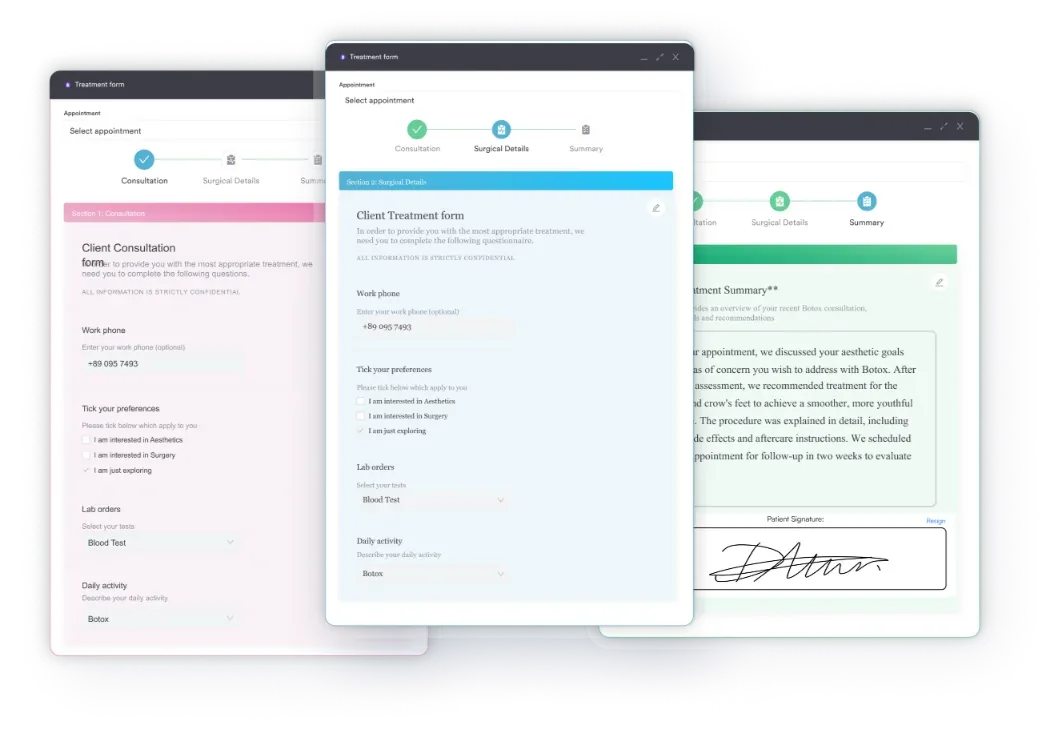
The chart should capture all of the following before submission. Digital intake forms and structured clinical notes keep the detail from going missing at the claim stage. HIPAA-compliant documentation also means records can be produced on audit without delay.
Some commercial payers require prior authorization for CPT code 21032, so confirm the requirement before scheduling. Keeping a medical coding cheat sheet beside the schedule helps the front desk catch that step while the patient is still on the phone.
Oral surgery practices billing CPT code 21032 keep hitting the same three friction points:
A connected practice management platform closes all three in one workflow, and practice management software like Pabau is built around that handoff.
Pabau’s claims management software lets oral surgery teams build procedure-specific billing templates. Each template pre-populates the CPT code, the modifiers that apply, and the linked ICD-10 diagnosis at the point of documentation.
The surgeon finishes the operative note, and the billing team reviews a structured claim rather than transcribing a freehand one. Fewer claims leave the practice missing the detail that CPT 21032 denials turn on.
Templates that enforce a consistent note structure pay off across specialties, from oral surgery to dermatology practices billing lesion excisions. When every torus excision chart follows the same pattern, audit exposure drops and appeals get easier to win.
Build a CPT 21032 billing checklist inside your practice management system. Confirm the POS code, the K10.0 pairing, any modifier, and the global period status. Flag which payers require prior authorization. Run the check before submission, not after the denial.

Pabau’s claims management tools let oral surgery teams attach ICD-10 codes, modifiers, and operative notes to procedure claims in one workflow. See how it works.

The money on CPT code 21032 is won or lost in the operative note, not in the billing software. A note that names the functional problem survives an audit years later. One that records only the presence of a torus will not.
The other decision worth making once is where these cases are done. An office setting pays the practice more for the same work, so moving cases to an ASC for convenience carries a cost worth pricing first.
Set these checks up once and they run themselves on every case after that. Book a demo to see how Pabau keeps the coding, documentation, and claim for a procedure like 21032 in one place.

Billing a segmental mandible osteotomy next? CPT 21199 walks through the descriptor, documentation, and modifier rules for that procedure.
Need the RVU and fee schedule picture for a mandible graft? CPT 21215 covers how the payment is built and what payers look for.
Coding reconstruction rather than excision? CPT 21255 sets out the zygomatic arch and glenoid fossa rules that neighbor this code family.
Checking benefits before you schedule a torus excision? Dental insurance verification form gives your front desk a structured way to confirm coverage first.
Billing a cesarean with no stated indication? ICD-10 code O82 covers the billable code for a cesarean section performed with no documented medical indication.
CPT code 21032 reports the surgical excision of maxillary torus palatinus, a benign bony growth on the hard palate. Oral and maxillofacial surgeons bill it when the torus causes functional problems such as denture obstruction, recurrent mucosal trauma, or speech impairment. The code sits in the Musculoskeletal System section, under excision procedures on the head.
CPT 21031 covers excision of torus mandibularis, a bony growth on the inner surface of the lower jaw. CPT 21032 covers excision of maxillary torus palatinus, a bony growth on the hard palate. The distinction is purely anatomical. Both may be billed in one session when both procedures are performed, using modifier -51 on the secondary code.
The most common modifiers for CPT code 21032 are -22 for increased procedural services, -52 for reduced services, and -50 for a bilateral procedure. Modifier -58 applies when a staged related procedure follows inside the 90-day global period. Verify payer-specific modifier policy before submission, since some payers substitute -RT and -LT for -50.
Medicare pays CPT 21032 from the physician fee schedule, so the rate depends on your locality and place of service. CMS set the 2026 conversion factor at $33.4009, and at $33.5675 for qualifying alternative payment model participants. Published RVU figures for this code differ between third-party sites, so pull the current rate from the CMS Physician Fee Schedule Look-Up Tool at cms.gov.
K10.0, developmental disorders of jaws, is the primary ICD-10-CM code paired with CPT 21032. Secondary options include M27.8 and K08.89 where the documentation supports them. The diagnosis has to reflect a symptomatic, functionally impairing condition rather than an incidental finding, or the claim will fail medical necessity.
Yes, Medicare generally covers CPT code 21032 when medical necessity is documented. That means the torus palatinus causes functional impairment such as denture interference, recurrent trauma, or speech difficulty. Incidentally discovered asymptomatic tori are typically not covered. Some Medicare Advantage plans require prior authorization, so confirm payer requirements before scheduling.



