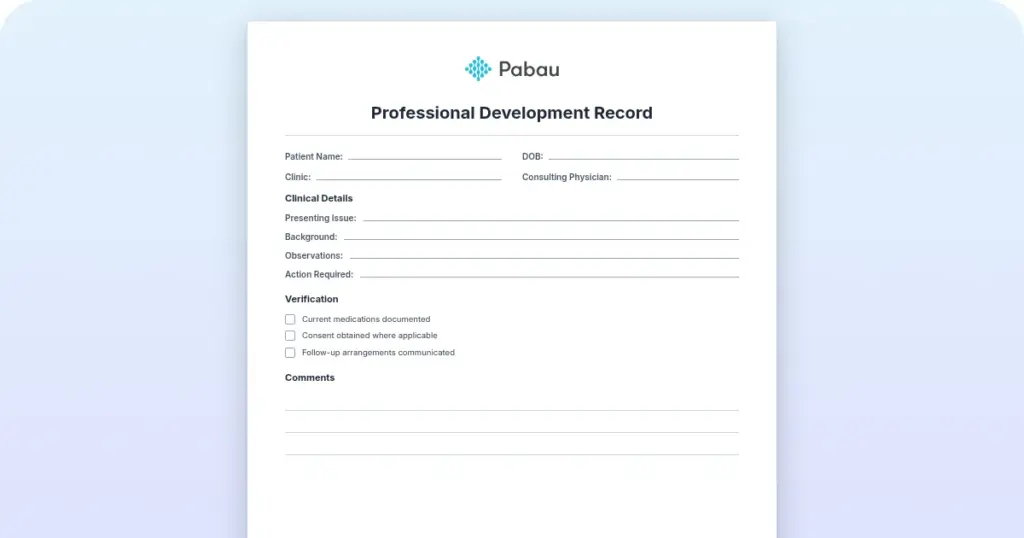
Professional development record
A professional development record is a structured log of a healthcare practition...

8
Last Updated: Oct 8, 2026

A dental insurance verification form is an administrative document that confirms patient coverage, benefits, and financial responsibility before treatment begins.
The form captures seven critical fields: patient/subscriber info, plan details, deductible and annual maximum, coverage percentages by category, frequency limits, waiting periods, and exclusions/coordination of benefits.
Practices that verify insurance before treatment reduce claim denials, billing disputes, and patient surprise costs at the point of care.
Practice management software like Pabau automates insurance verification through digital forms, eliminating manual paper completion and reducing data-entry errors.
A ready-to-use form covering patient details, insurance carrier information, deductible and benefit maximums, coverage percentages by procedure category, frequency limitations, waiting periods, and coordination of benefits – everything you need to confirm eligibility before treatment.
Download templateInsurance verification is one of the highest-impact administrative tasks a dental practice performs. A well-completed dental insurance verification form prevents claim denials, patient billing disputes, and missed revenue. This guide explains what to include on your form, how to use it, and why it matters for your practice workflow.
A dental insurance verification form is an administrative document that confirms a patient’s insurance coverage before treatment begins. The form captures the patient’s policy details, benefit levels, deductible status, and coverage limits – information you need to quote accurate costs, understand what the insurance will pay, and set clear financial expectations with the patient.
For a dental practice, verification protects your revenue. Many practices discover unmet deductibles or excluded services only after treatment is delivered, leading to claim rejections and patient balance surprises. The form centralizes this information in one place, reducing downstream billing errors and improving the patient experience by clarifying out-of-pocket costs upfront.
The form also documents the verification date and who completed it – critical for compliance audits and for defending against claim disputes. HIPAA requires that patient health information (including insurance details) be stored securely, and a written verification form creates an auditable record of your data-handling practices.
A comprehensive form captures seven categories of information. Each category prevents a different type of claim error or patient surprise.
Start with the basics: patient name, date of birth, and contact details. Then record the subscriber (policyholder) name and relationship to the patient – many policies cover dependents, and claims must list the correct primary insured.
Capture the insurance carrier, plan type, group and member ID, and effective dates. The plan type (PPO, HMO, indemnity, DHMO) determines whether patients can see out-of-network providers and affects your claim submission process.
This is the section that directly affects treatment planning and patient quoting. Record the deductible, annual maximum, and the percentage the plan covers for each service category.
Always include: annual deductible (individual and family if applicable), amount of deductible already met, annual maximum benefit, and remaining annual benefits. Many claim denials occur because the practice didn’t verify that the patient’s annual maximum was exhausted.
Plans often limit how many times per year a patient can receive certain services. Frequency limits are a common source of claim denials if not documented.
Note: Frequency limits vary by plan and carrier. Always verify these specific to the patient’s policy.
Many policies include waiting periods (also called “elimination periods”) before major restorative services are covered – often 6-12 months from the policy effective date. Some plans exclude cosmetic procedures or implants entirely. Document these clearly to avoid patient surprises.
A paperless practice that stores verification forms electronically can instantly retrieve this information before treatment, reducing rework and improving compliance.
Insurance verification is a multi-step workflow that works best when integrated into your appointment scheduling process. Here’s the recommended sequence:
Manual verification on paper forms is time-consuming and error-prone. Practice management software like Pabau offers AI-assisted documentation and automated workflow tools that streamline the verification process.
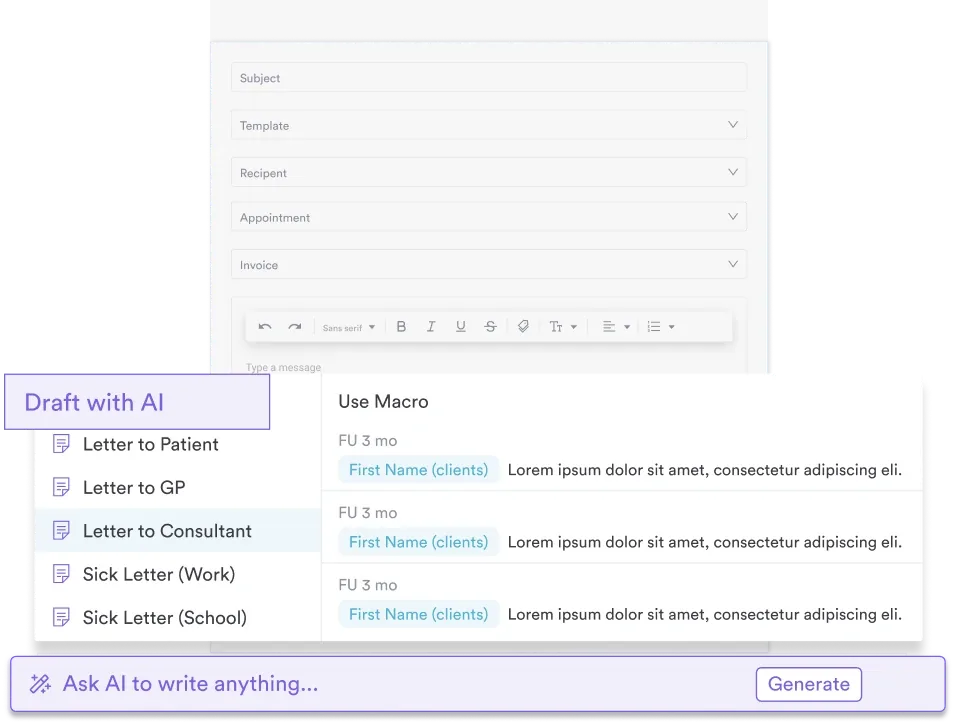
Rather than printing a form and filling it by hand, practices can capture patient insurance information once in a structured digital format, then reuse it across scheduling, billing, and compliance workflows.
Software can flag when verification is overdue, remind staff to follow up, and store the completed form alongside the patient’s clinical record for immediate access during treatment planning.

This approach eliminates duplicate data entry, reduces the risk of transcription errors, and ensures your entire team is working from the same verified information.
This template is built for dental practices of any size – from solo practices to multi-location groups. Front desk staff use it during patient intake; treatment coordinators use it during treatment planning. The form works whether you’re running a paper-based or digital practice.
Dental hygienists and dentists benefit from having the form completed before the patient sits down, so they can focus on clinical care rather than treatment surprises.
Reduces claim denials: Verified information means fewer rejections for missing coverage limits or exceeded frequency. Each piece of documented data (deductible met, annual maximum remaining, frequency count) prevents one claim error.
Improves patient satisfaction: When patients know their out-of-pocket costs upfront, they’re less likely to be surprised by a bill after treatment. Clear financial expectations build trust.
Supports compliance: A signed, dated verification form documents your good-faith effort to confirm coverage. This protects your practice in audits and disputes. Medicare patients may also need a release form authorizing a representative to access their claim and entitlement records.
Streamlines billing: Your billing team can process claims faster when all eligibility information is pre-verified and documented. Practices that standardize this process see measurable improvements in days-to-payment.
Set a reminder to re-verify insurance annually or before major treatment plans. Coverage changes, deductibles reset on January 1st, and annual maximums deplete throughout the year. One quick call prevents claim denials months later.
Insurance details are protected health information under HIPAA regulations. When you collect and store verification forms, follow these safeguards:
Some patients have two insurance plans – for example, coverage through their employer and a spouse’s plan. When this occurs, one plan is “primary” (pays first) and the other is “secondary” (coordinates benefits after the primary pays).
Your verification form should capture both plans and note the coordination-of-benefits rules. Most plans follow the “birthday rule” – the plan of the parent whose birthday falls earliest in the calendar year is primary for dependent coverage. Document this clearly to ensure claims are submitted in the correct order.
A comprehensive dental insurance verification form is one of the highest-ROI investments a dental practice makes. Ten minutes of verification per patient prevents weeks of claim rework, patient billing disputes, and revenue loss.
The template above gives you every field you need to capture coverage information once and use it confidently throughout the treatment journey. Download it today, customize it for your practice, and integrate verification into your standard workflow.
Ready to streamline your insurance verification process? Book a demo to see how practice management software integrates verification into your daily workflow.

Billing a complex facial repair add-on? Complex repair add-on code covers the add-on CPT code for complex repair of the eyelids, nose, ears, or lips.
Have a patient on Medicare needing a service their dental plan won’t cover? A Medicare waiver documents their financial responsibility upfront.
Billing an adjacent tissue transfer? Tissue transfer billing code covers the CPT code for adjacent tissue transfer on the trunk when linear closure is not feasible.
A dental insurance verification form confirms patient insurance coverage, benefits, deductibles, and frequency limitations before treatment begins. It prevents claim denials, reduces patient billing surprises, and creates an auditable record of your data-handling practices for compliance.
The form should capture: patient and subscriber information, insurance carrier details (name, group number, member ID), plan type, effective dates, deductible amount and status, annual maximum, coverage percentages by service category, frequency limitations, waiting periods, exclusions, and coordination-of-benefits information if applicable.
Verify at the first appointment and at the start of each calendar year (when deductibles reset). Re-verify before major treatment plans that span months. If a patient hasn’t been seen in over a year, re-verify at their next visit to ensure coverage is still active.
Many practices use the terms interchangeably. A “breakdown form” typically emphasizes the coverage percentages and out-of-pocket cost breakdown for a specific treatment plan, while a “verification form” is a broader document that captures all insurance details. In practice, a single comprehensive form serves both purposes.
A missing tooth clause (also called pre-existing tooth clause) means the insurance plan will not cover the replacement of teeth that were missing before the policy became effective. If a patient has a gap where a tooth was extracted before their coverage began, they cannot claim benefits for a bridge or implant to replace it. Always note this on the verification form.
Coordination of benefits (COB) occurs when a patient has two insurance plans. The primary plan pays first, and the secondary plan coordinates-paying a benefit amount that together with the primary payment does not exceed 100% of the treatment cost. Document which plan is primary and the COB rules to ensure claims are submitted in the correct order.