



CCSD code G5100: Bypass of duodenum billing guide
CCSD code G5100 bills a bypass that leaves the duodenum in place CCSD code G5100...

Last Updated: Oct 16, 2026

CPT code 15115 covers epidermal autograft procedures on the face, scalp, eyelids, mouth, neck, ears, orbits, genitalia, hands, feet, and/or multiple digits for the first 100 sq cm (or 1% of body area in infants and children)
This is a primary code, not an add-on: Use CPT 15116 for each additional 100 sq cm at the same anatomical sites
Missing square centimeter measurements in the operative report is the most common denial trigger for CPT code 15115 claims
Pabau’s claims management software helps surgical and dermatology practices document wound measurements, track modifier usage, and submit cleaner epidermal autograft claims
CPT code 15115 is a billable procedure code for epidermal autograft placement on the face, scalp, eyelids, mouth, neck, ears, orbits, genitalia, hands, feet, and/or multiple digits, covering the first 100 square centimeters of graft area (or 1% of body surface area for infants and children).
Most denials on this code trace back to documentation, not medical necessity: The wrong body site listed, square centimeters missing from the operative report, or the wrong modifier applied when a second procedure is billed the same date.
This guide covers the official code description, related codes, applicable modifiers, Medicare reimbursement rates, ICD-10 pairings, documentation requirements, and the denial patterns that catch billers off guard.
CPT code 15115 is published by the American Medical Association (AMA) as part of the integumentary system section of the CPT code set. It describes an epidermal autograft procedure performed on a specific list of anatomical sites, covering the first 100 square centimeters of graft area (or 1% of body surface area for infants and children).
The full official AMA description reads: Epidermal autograft, face, scalp, eyelids, mouth, neck, ears, orbits, genitalia, hands, feet, and/or multiple digits; first 100 sq cm or 1% of body area of infants and children.
In an epidermal autograft, the surgeon harvests only the outermost skin layer (the epidermis) from a donor site on the patient’s own body. That harvested tissue is then applied to a prepared wound bed at the recipient site. Because the graft uses the patient’s own tissue, there is no risk of immune rejection.
Common indications include partial-thickness burns, traumatic wounds, chronic ulcers, and post-excision skin defects. Practices specializing in plastic surgery EMR workflows and wound care bill this code regularly alongside reconstructive procedures.
The table below summarizes the key administrative and billing details for this code. Verify reimbursement figures against the current-year CMS Physician Fee Schedule lookup tool before submitting claims, as rates update annually under the Medicare Physician Fee Schedule (MPFS).
The most common coding error in epidermal autograft billing is selecting the wrong primary code based on body site. The 15100-15116 code family covers two distinct anatomical groupings, each with its own primary and add-on pair.
When the graft covers both a trunk site and a face or hand site in the same operative session, bill both primary codes (15110 and 15115) with the appropriate modifier to signal multiple procedures. Payers apply Correct Coding Initiative (CCI) edits to this combination, so modifier usage must be precise.
Teams using dermatology EMR software with built-in coding checks can flag these pairing scenarios before submission.
Modifier selection is where most CPT 15115 claims either sail through adjudication or trigger an immediate audit. The AAPC coding guidelines outline the standard modifier framework, but individual payer contracts introduce additional nuances.
Modifier 51 applicability depends on whether CPT 15115 is currently designated as modifier 51-exempt in the AMA CPT codebook. Verify this status in the current edition before billing. Payer-specific rules also override the AMA default, particularly for Medicare Advantage plans. Always confirm modifier requirements with the applicable payer’s coverage policy before submitting.
Medicare reimbursement for CPT code 15115 is calculated under the Resource-Based Relative Value Scale (RBRVS). The total payment reflects three RVU components: Physician work, practice expense (facility or non-facility), and malpractice. Facility rates apply when the procedure is performed in a hospital or ambulatory surgical center. Non-facility rates apply in office or practice settings.
Always pull current-year figures from the official CMS fee schedule lookup or the FastRVU 2026 RVU lookup tool before citing rates in documentation or patient estimates. The MPFS updates annually on January 1, and rates are subject to geographic adjustment through the applicable Geographic Practice Cost Index (GPCI) for your Medicare Administrative Contractor (MAC) region.
Private payer rates for CPT code 15115 vary by contract. Many commercial insurers benchmark to Medicare rates with a multiplier, commonly ranging from 100% to 180% of the Medicare fee schedule, depending on your payer mix and network negotiation. Confirm contracted rates in your payer agreements before setting patient estimates.
Pull your current-year RVU data directly from the CMS MPFS data file rather than third-party lookup tools for the most accurate baseline. Then apply your MAC locality’s GPCI to calculate the adjusted payment for your specific geographic area. This two-step process takes five minutes and eliminates one of the most common sources of reimbursement estimation errors.
Medicare covers epidermal autograft procedures when the treating physician documents that the procedure is medically necessary. Coverage criteria are specified in Local Coverage Determinations (LCDs) issued by each MAC, so requirements can differ by region. Nationally, CMS considers autograft procedures medically necessary when the wound cannot heal by conservative measures within a reasonable timeframe. First-pass rate measures how often a claim is paid without anyone touching it again.
The most commonly accepted qualifying conditions for CPT code 15115 include:
Always check the applicable MAC’s LCD for CPT 15115 (or the broader skin graft LCD in your region) before submitting. LCDs specify the minimum duration of conservative therapy required before autograft becomes covered, the documentation expected to establish medical necessity, and any diagnosis codes required for coverage. Failure to meet LCD criteria is a common root cause of post-payment audits.
Every CPT 15115 claim requires a supporting ICD-10-CM diagnosis code that establishes medical necessity. The diagnosis must match the clinical indication documented in the operative note.
Using an ICD-10 code that does not align with the procedure description is a fast path to a medical necessity denial. Practices that also bill wound-bed preparation under CPT 15002 apply the same diagnosis-matching discipline to that code.
Grafts placed over an amputation stump take a skin-chapter ulcer code from L97.- or L98.4-, not ICD-10 code T87.89. That code’s Applicable To list stops at stump contracture, flexion, edema and hematoma.
ICD-10-CM codes update annually on October 1. Verify all codes against the current fiscal year’s official code set via the CDC/NCHS ICD-10-CM web tool before publishing them in billing documentation.
Billing teams that also code major burns under T31.94 in multi-specialty settings will recognize this annual verification step as a standard compliance practice.
Payers audit CPT 15115 claims heavily. Complete documentation is the difference between payment and denial on a procedure that may represent several thousand dollars in reimbursement. Practices maintaining HIPAA-compliant documentation practices should ensure every epidermal autograft operative note captures the following elements.
Using digital forms for pre-operative and operative documentation reduces the risk of missing required fields. Templated operative note structures can enforce the square centimeter measurement field, the donor site entry, and the medical necessity statement before the note is signed.
Epidermal autograft claims are denied more often for documentation failures than for coverage exclusions. Understanding the specific denial triggers for CPT code 15115 helps billing teams address them upstream rather than during the appeals process. Effective billing compliance workflows treat denial prevention as a pre-submission function, not a post-denial reaction.
When a denial is received, request the specific denial reason code from the Explanation of Benefits (EOB) or Electronic Remittance Advice (ERA). Most CPT 15115 denials are appealable with a corrected operative note or an additional medical necessity letter from the treating physician.
Maintain an accurate diagnosis code mapping process, and document appeals outcomes to identify recurring payer-specific patterns. Practices that track denial data by payer and code learn quickly which issues are systemic versus one-off errors.

Pabau helps plastic surgery and wound care practices document wound measurements, apply modifiers accurately, and submit cleaner CPT 15115 claims with fewer denials.

Surgical and wound care practices processing multiple CPT 15115 claims per week face a documentation throughput challenge. Each claim requires specific operative note content, a verified ICD-10 match, and modifier selection that varies by payer.
Manual processes create inconsistency. Three or four missing sq cm entries per month, spread across a team of billers, can mean thousands in preventable denials annually.
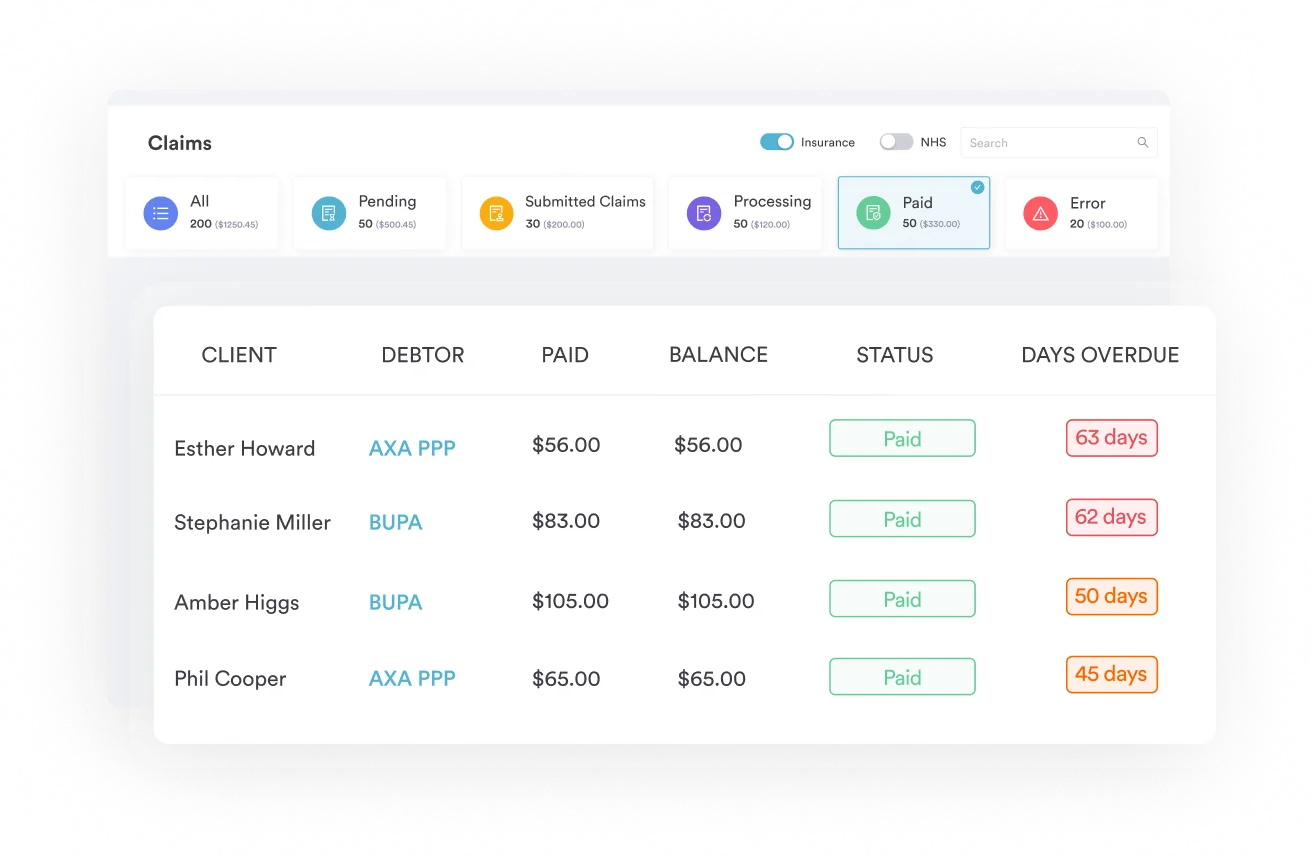
Pabau’s claims management software gives plastic surgery and wound care teams a centralized workflow for tracking claim status, flagging documentation gaps before submission, and managing the appeal queue when denials occur.
Rather than chasing individual claim PDFs across disconnected systems, billers work from a single view of every open CPT 15115 claim: What’s pending, what’s denied, and what needs additional documentation.
Beyond claims management, practices benefit from structured documentation at the point of care.
This upstream intervention is far more efficient than reviewing completed notes for missing fields after the fact.
For practices that handle a mix of procedure types. Consistency in documentation structure, modifier assignment, and ICD-10 crosswalk verification applies to every surgical billing scenario.
Practices that invest in structured documentation workflows report fewer appeals, faster payment cycles, and cleaner audit trails. Explore time-saving features for private practices to see how these workflows apply across the billing cycle.
CPT code 15115 claims fail most often because the operative note doesn’t capture the sq cm measurement or the anatomical site isn’t documented precisely enough to support the code. The clinical work is done; the billing failure is a documentation problem.
Pabau’s claims management tools help surgical and wound care practices build documentation checklists into their operative note workflows, match ICD-10 diagnoses to procedure codes accurately, and catch modifier errors before claims are submitted. Practices billing the related CPT 15152 add-on code face the same documentation demands, and book a demo to walk through the claims workflow with your team.

Billing a full-thickness graft instead of an epidermal autograft? CPT 15200 covers the trunk-specific version of this graft family, including its own reimbursement and modifier rules.
Working with split-thickness grafts on the same high-complexity sites? CPT 15121 covers billing for split-thickness autografts on the face, hands, and feet.
Using a skin substitute rather than an autograft? CPT 15273 covers the billing and documentation requirements for skin substitute grafts.
CPT code 15115 is used to bill epidermal autograft procedures on the face, scalp, eyelids, mouth, neck, ears, orbits, genitalia, hands, feet, and/or multiple digits, covering the first 100 square centimeters (or 1% of body surface area in infants and children). Common indications include partial-thickness burns, traumatic wounds, chronic ulcers, and post-excision skin defects where primary closure is not viable.
CPT 15110 covers epidermal autografts on the trunk, arms, and legs, while CPT 15115 covers the same procedure on the face, eyelids, mouth, neck, ears, orbits, genitalia, hands, feet, and digits. Choosing the wrong code based on anatomical site is one of the most common billing errors in this code family.
CPT 15115 is a primary code. The associated add-on code is CPT 15116, which is reported for each additional 100 sq cm of epidermal autograft at the same anatomical sites. CPT 15116 cannot be billed without CPT 15115 on the same claim.
CPT code 15115 carries a 090 global period (90 days), meaning post-operative follow-up care within 90 days of the procedure is bundled into the surgical fee. Services during this period require modifier 79 if unrelated to the original procedure, or they will be denied as bundled services.
Yes, Medicare covers CPT code 15115 when the procedure is medically necessary and the clinical record supports the indication. Coverage criteria are specified in Local Coverage Determinations (LCDs) issued by the applicable Medicare Administrative Contractor (MAC) for your region. Requirements vary by MAC, so always verify the applicable LCD before submitting.
The operative report must include the wound size in square centimeters, the specific anatomical site, donor site location and harvest method, graft dimensions, operative technique, a medical necessity narrative, and the post-operative care plan. Missing the square centimeter measurement is the most common documentation-related denial trigger for this code.
Prior authorization requirements for epidermal autograft procedures vary by payer. Many commercial insurers and some Medicare Advantage plans require pre-authorization before performing CPT 15115, particularly for non-emergency wound care indications. Confirm authorization requirements with each payer before scheduling the procedure to avoid retrospective denials.



