



HCPCS code E0198: Water pressure pad billing guide
HCPCS code E0198 is a water pad for a standard mattress HCPCS code E0198 is the ...

Last Updated: Oct 13, 2026

CPT Code 11104 describes a punch biopsy of the skin for the first lesion, including simple closure when performed.
Add-on code 11105 must accompany 11104 for each additional punch biopsy lesion billed on the same date.
Modifier -59 separates CPT 11104 from another non-E/M procedure performed the same day. Modifier -25, not -59, applies when a same-day E/M service must be billed separately.
Pabau’s claims management software automates modifier checks and ICD-10 pairing validation to reduce claim rejections for skin biopsy procedures.
CPT Code 11104 is a billable code for a punch biopsy of the skin, first lesion, including simple closure when performed. Getting the code right means matching the technique performed to the correct code family, and pairing 11104 with add-on code 11105 whenever more than one lesion is biopsied.
The American Medical Association (AMA) introduced CPT Code 11104 on January 1, 2019, as part of a full restructuring of skin biopsy codes. Before 2019, a single legacy code covered all biopsy techniques. The revision separated them by method: tangential (11102-11103, e.g., shave, scoop, saucerization, curette), punch (11104-11105), and incisional (11106-11107).
This article covers the official descriptor, applicable modifiers, Medicare reimbursement, ICD-10 pairings, documentation requirements, and the most common billing mistakes coders encounter with this code. For reference on how similar specificity applies in other specialties.
A punch biopsy is indicated when a full-thickness skin sample is needed for histopathologic evaluation. The cylindrical punch tool penetrates through the epidermis, dermis, and into the subcutaneous fat, yielding a core sample that provides more diagnostic information than a shave biopsy in most cases.
Clinical scenarios where CPT 11104 applies include:
Medical necessity documentation must reflect the specific clinical indication. Payers review documentation to confirm that the technique chosen, punch versus shave versus incisional, was appropriate for the lesion type and diagnostic question. A note that says “lesion removed” without specifying technique or clinical rationale frequently triggers a documentation request.
The 2019 biopsy code revision created a six-code family organized by technique and lesion count. Understanding the full family prevents the most common upcoding and downcoding errors. The American Academy of Family Physicians (AAFP) published detailed guidance on the restructuring in 2019 that remains the clearest non-AMA explanation of when each code applies.
CPT 11105 is an add-on code, meaning it cannot be billed alone. It is reported alongside 11104 for each additional punch biopsy lesion performed during the same encounter. If a dermatologist performs punch biopsies on three separate lesions, the claim should show 11104 (first lesion) and 11105 x2 (second and third lesions).
Add-on codes are exempt from multiple-procedure reduction rules, so 11105 does not carry the 50% reduction that applies to standalone codes when billed simultaneously. Billers should confirm their practice management system is configured to recognize this exception. Similar add-on code logic applies in other specialty contexts.
Modifier selection is one of the highest-risk areas in skin biopsy billing. Wrong or missing modifiers are the leading cause of NCCI bundling denials and duplicate-service flags. According to the CMS Physician Fee Schedule, modifier applicability is code-specific and can change annually. Payer-specific rules may differ from Medicare, so always verify the applicable modifier list with each payer before billing.
A key NCCI nuance: modifier -59 should be reserved for situations where no XS, XP, XE, or XU modifier more specifically describes the distinction. Many payers still accept -59 broadly, but CMS guidance prefers the more specific X-modifiers when applicable. Confirming which modifier set each payer accepts avoids downstream audits.
Medicare reimburses CPT Code 11104 at separate rates depending on the place of service. Non-facility rates (office setting) are higher because they include the practice expense component. Facility rates apply when the procedure is performed in a hospital or ambulatory surgical center, where the facility bills its own overhead costs separately.
These figures are national averages. Payment varies by Geographic Practice Cost Indices (GPCIs), which CMS applies to the work, practice expense, and malpractice RVU components based on the Medicare locality. Practices in high-cost urban markets typically receive higher reimbursement than rural localities. Payment for this code arrives with a remittance advice that explains any adjustment line by line.
Use the FastRVU 2026 RVU lookup tool to calculate the exact expected payment for your locality. Always verify rates against the current year Medicare Physician Fee Schedule, since rates update annually on January 1.
Run your locality-specific rate calculation before contract negotiations with commercial payers. Most private insurers benchmark their rates as a percentage of Medicare, so knowing your exact Medicare rate gives you a precise floor for commercial fee negotiations.
Every CPT 11104 claim requires at least one ICD-10-CM diagnosis code that supports medical necessity. The diagnosis must reflect the documented clinical finding, not just a procedure description.
Payers cross-reference the submitted ICD-10 against LCD policies to determine coverage. For context on how accurate ICD-10 coding affects claims across specialties, see our guide to situational anxiety ICD-10 code documentation, which illustrates the same medical necessity logic applied to behavioral health billing.
The diagnosis code submitted must match the documented clinical findings exactly. Coding “malignant melanoma” (C43.9) when the note only describes a pigmented lesion for evaluation does not support the claim and constitutes upcoding.
Proper ICD-10 coding documentation is a core component of HIPAA compliance for medical offices, particularly for audits tied to skin procedure billing. The AAPC CPT code lookup provides crosswalk references that show which diagnosis codes are most commonly paired with CPT 11104 in claims data.
Incomplete documentation is the second-most-common reason for 11104 claim denials, behind modifier errors. A defensible biopsy note must include all of the following elements before a claim is submitted.
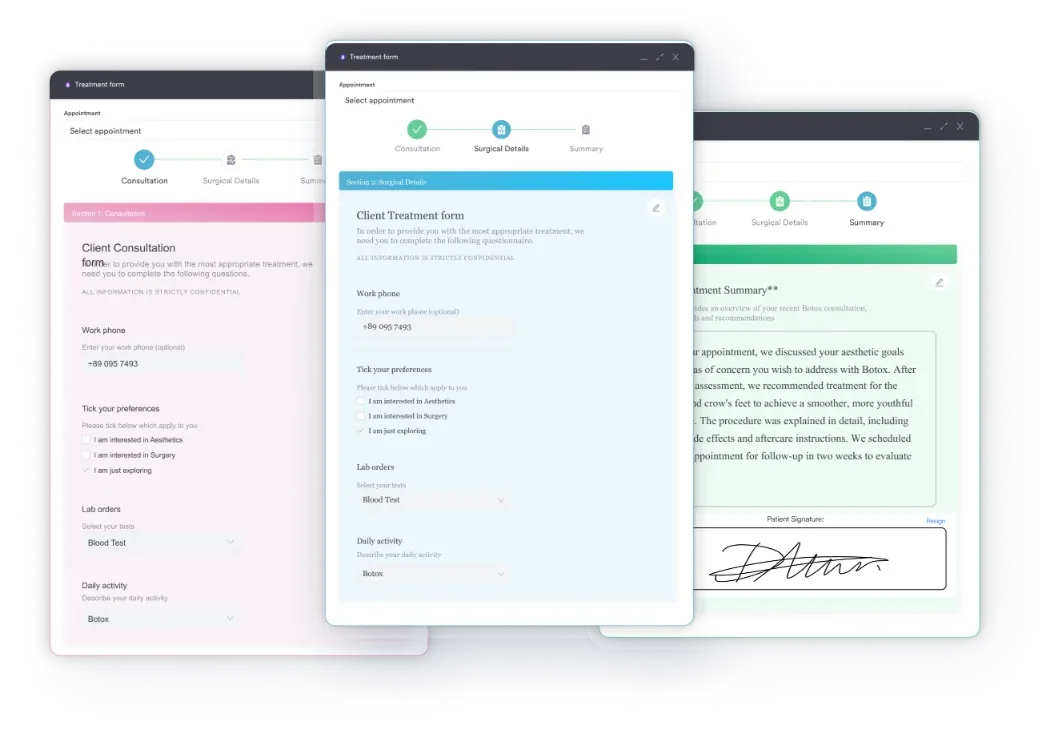
Using digital intake forms pre-configured with dermatology biopsy templates reduces the risk of missing required elements by standardizing the documentation capture at the point of care.
For guidance on building compliant documentation workflows across other procedure types. The same specificity principle applies to diagnosis coding across other complex conditions.
Dermatology billing audits consistently flag the same errors with CPT 11104. Most are preventable with a combination of staff training and systematic claim scrubbing. According to AAPC coding guidance, technique-specific biopsy codes are among the most frequently miscoded in outpatient dermatology.
Skin biopsy billing generates a disproportionate number of denials relative to its procedure complexity. Most errors are not clinical, they are administrative: wrong modifier, missing add-on code, unbundled closure, or mismatched ICD-10. Practice management software purpose-built for clinical settings addresses each of these systematically.
Pabau’s claims management software applies automated pre-submission checks that flag missing modifiers, detect NCCI bundling conflicts, and verify ICD-10 pairing validity before a claim is submitted.
For dermatology practices using dermatology EMR software, add-on code 11105 is automatically prompted when multiple lesions are documented in the same encounter note, closing a common revenue leak. The automated billing workflows also enforce place-of-service accuracy by pulling the appointment location directly from the scheduling module.
Beyond claim scrubbing, structured documentation templates within Pabau’s skin clinic software guide clinicians through the required biopsy note elements at the point of care, closing the loop between clinical documentation and billing accuracy.
For practices evaluating how broader practice management software improvements affect overall billing performance, Pabau’s integrated approach reduces the manual reconciliation steps that create coding errors in siloed systems.

Pabau automates claim scrubbing, modifier validation, and ICD-10 pairing checks so your skin biopsy claims submit clean every time. See how dermatology and skin clinic teams use Pabau to reduce denials and recover lost revenue.

Punch biopsy billing errors cluster around three predictable failure points: technique code selection, modifier application, and ICD-10 specificity. CPT Code 11104 covers the first lesion only, requires add-on 11105 for each additional punch biopsy, and bundles simple closure so it cannot be separately billed.
Missing modifier -25 on a same-day E/M, or applying modifier -59 to the wrong code, are the most common denial triggers.
Pabau’s claims management software eliminates most of these errors automatically, flagging bundling conflicts, prompting add-on codes, and verifying place-of-service accuracy before submission. If your practice regularly performs skin biopsies and wants to reduce denial rates, explore Pabau’s billing automation features or book a demo to see the claim scrubbing workflow in action.

Coding a dengue fever diagnosis? ICD-10 code A90 coding guide covers classical dengue fever and how it differs from the separately coded dengue hemorrhagic fever.
Coding an unconfirmed viral fever? ICD-10 code A94 coding guide covers the fever code used when lab results cannot confirm which arthropod-borne virus caused it.
Coding a smallpox surveillance case? ICD-10 code B03 coding guide covers the smallpox code still maintained for public health surveillance and bioterrorism preparedness reporting.
CPT Code 11104 is used to report a punch biopsy of the skin performed on a single lesion, including simple closure when performed. It was introduced January 1, 2019, as part of the AMA’s restructuring of skin biopsy codes into technique-specific categories covering tangential, punch, and incisional methods.
CPT 11102 describes a tangential biopsy (e.g., shave, scoop, saucerization, curette) that removes a thin layer of skin using a blade or similar instrument, while CPT 11104 describes a punch biopsy using a cylindrical punch instrument that removes a core through the full skin thickness. The technique used determines the correct code. Selecting the wrong one based on reimbursement rather than technique constitutes upcoding.
Yes. Simple closure is bundled into CPT 11104 when performed. Billing a separate closure code such as 12001 for the same lesion on the same date constitutes unbundling and will be denied under NCCI edits. Complex or intermediate closures are not bundled and may be billed separately with documentation supporting the additional complexity.
Commonly used modifiers include -59 (distinct procedural service, to bypass an NCCI bundling edit when 11104 is billed with another non-E/M procedure on the same date), -RT/-LT (anatomical side), -FA through -TA (specific digit), and -76/-77 (repeat procedure). Modifier -25 applies to the E/M code, not to 11104, when both services occur on the same date. Downcoding is as common as upcoding, and both trace back to how the decision-making level was recorded.
CPT 11105 is the add-on code for each additional punch biopsy lesion beyond the first. It must always be billed in conjunction with 11104 and cannot be reported as a standalone code. Add-on codes are exempt from multiple-procedure reduction, so 11105 does not receive the standard 50% reduction applied to additional primary procedures.
Medicare reimbursement for CPT 11104 varies by place of service and geographic locality. National averages range from approximately $110-$130 in a non-facility (office) setting and $35-$40 in a facility setting. Verify the exact rate for your locality using the CMS Physician Fee Schedule lookup or the FastRVU 2026 RVU lookup tool, as rates update each January 1.
Use CPT 11106 when an incisional biopsy technique was performed, meaning the specimen was taken using a scalpel incision rather than a punch instrument. Technique drives code selection. If the operative note describes a punch tool, 11104 is correct. If it describes a scalpel incision through part of the lesion, 11106 applies. Never select based on reimbursement rate alone.
Frequently paired ICD-10-CM codes include D22.9 (melanocytic nevi), C43.9 (malignant melanoma), D23.9 (benign skin neoplasm), L40.0 (psoriasis vulgaris), D04.9 (carcinoma in situ), and R23.8 (other skin changes). The diagnosis code must reflect the documented clinical finding, not the suspected pathology result.



