

CPT Code 52352: Ureteroscopic stone removal billing guide
CPT Code 52352: Official descriptor and procedure overview CPT Code 52352 descri...

Last Updated: Oct 30, 2026
11604 is the CPT code for excision, malignant lesion including margins, trunk, arms, or legs; excised diameter 3.1 to 4.0 cm.
Its neighbors are 11603 (2.1 to 3.0 cm) below and 11606 (over 4.0 cm) above, so auditors check exactly where the measurement falls. The operative note must show the diameter calculation, because a missing or vague measurement is a common reason these claims are denied.
Let Pabau's smart automation suggest the right codes, reduce claim denials, and keep your practice compliant—effortlessly.
Automate repetitive tasks and focus on what matters most—your patients.
Reduce coding errors and ensure compliance with the latest regulations.
Clean claims, fewer denials, and faster reimbursements.
Powerful insights and reporting to help your practice thrive.
HIPAA compliant SOC 2 certified GDPR-compliant Trusted by 4,000+ clinics worldwide

CPT code 11604 covers excision of a malignant lesion on the trunk, arms, or legs with an excised diameter of 3.1 to 4.0 cm.
Excised diameter equals the lesion’s widest dimension plus the narrowest surgical margin on each side, measured before excision.
Simple (linear) closure is bundled into 11604, while intermediate and complex repairs are reported separately.
Every 11604 claim needs a confirmed malignant diagnosis from pathology, so hold the claim until the report returns.
A clearly written diameter calculation in the operative note is the best defense against downcoding and denials.
CPT code 11604 is the procedure code for excising a malignant skin lesion, margins included, on the trunk, arms, or legs.
It applies when the excised diameter is 3.1 to 4.0 cm. The official descriptor from the American Medical Association (AMA) reads: Excision, malignant lesion including margins, trunk, arms, or legs; excised diameter 3.1 to 4.0 cm. In plain terms, the excised diameter has to be over 3.0 cm and no more than 4.0 cm.
The code sits in the Integumentary System section of CPT (10004-19499). Within it, 11600 to 11606 cover malignant lesion excision on the trunk and extremities.
The excised diameter for CPT code 11604 equals the widest diameter of the visible lesion plus the narrowest surgical margin on each side. It is measured before the specimen is removed. This is the AMA’s published method from CPT Assistant guidance. The pathology lab’s specimen measurement is a different number.
A worked example illustrates where 11603 ends and 11604 begins.
The 11604 range starts above 3.0 cm, so an excised diameter of exactly 3.0 cm belongs to 11603. Auditors look for the calculation in the operative note. A note that says “approximately 3 cm” without the margin arithmetic leaves the claim open to downcoding or denial.
Key rule: Use the pre-excision measurement, not the specimen measurement after formalin fixation. Tissue contracts in fixative, so the specimen will typically measure smaller than the pre-excision diameter.
CPT code 11604 applies to malignant lesions on the trunk, arms, and legs, as the AMA defines those regions for coding. Knowing the boundaries prevents a common site-selection error. That error is picking a trunk or extremity code for a lesion on the scalp, face, or hand.
Included sites (use 11600-11606):
Excluded sites (use different code series):
Record the anatomic site in the operative note in the code set’s own terms. Write “left posterior shoulder,” for example, rather than “upper back area.” The coder can then match the site to the right code series without querying the surgeon.
The 11600-series codes for trunk, arms, and legs are selected solely by excised diameter. There are no separate codes for technique, malignancy subtype, or number of margins taken.
There is no 11605 in the code set, so the series jumps from 11604 straight to 11606. A measurement of exactly 4.0 cm still falls under 11604. Only measurements over 4.0 cm shift to 11606. The chart below maps each excised diameter to its code.
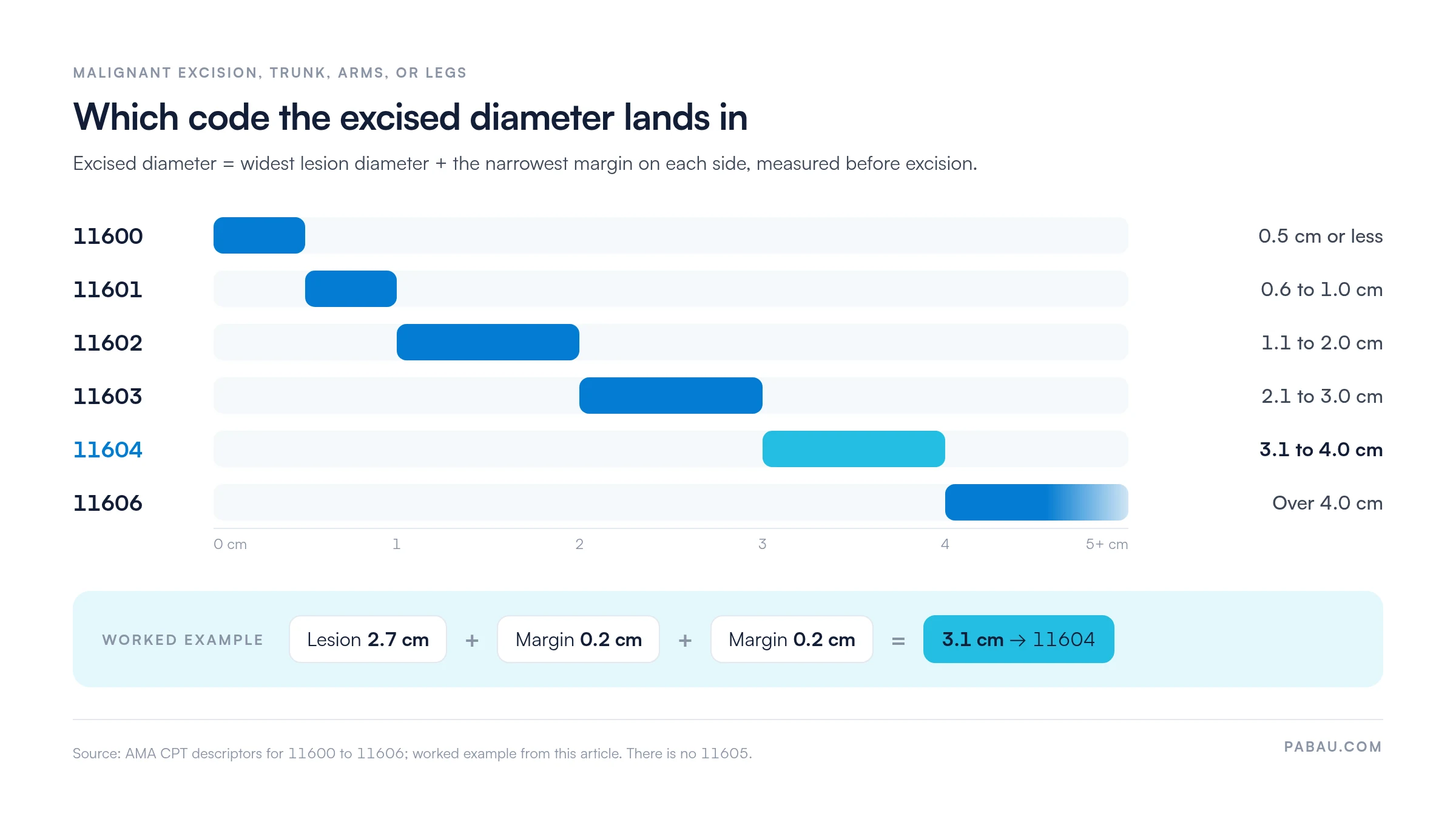
Auditors concentrate on measurements within 1 mm of the 3.0 cm and 4.0 cm boundaries. A documented excised diameter of 3.1 cm sits just 1 mm above 11603, so expect a careful review. The operative note must state the lesion diameter, each margin, and the total, all in centimeters.
For borderline measurements, document the margin selection rationale. Oncologic margins for basal cell carcinoma typically range from 0.3 to 0.5 cm, while squamous cell carcinoma may require 0.5 to 1.0 cm. A note that explains the clinical basis for the margin width gives the auditor context rather than just a number.
Simple (linear) closure is bundled into CPT code 11604 and cannot be billed separately under any modifier. Billing a simple repair code (12001-12021) with 11604 for the same wound breaks National Correct Coding Initiative (NCCI) bundling rules. Payers deny the repair code automatically.
An intermediate or complex repair code only holds up when the note describes the closure. Layered closure, undermining, or other complex technique should be named in the note, along with the length of the repaired wound.
Every CPT code 11604 claim requires a confirmed malignant diagnosis code from the ICD-10-CM code set. Payers will not accept a “rule out” or “suspected” diagnosis for a malignant excision code. The pathology report must confirm malignancy, and the diagnosis code must reflect that finding.
Select the most specific code available by site, laterality, and histologic type. Unspecified codes are acceptable when documentation supports nothing more specific, but some commercial payers send them for medical necessity review. Use the confirmed pathology report, not the pre-operative impression, to select the diagnosis code for the final claim.
Every malignant lesion excision must be accompanied by submission of the specimen to a pathology lab. The standard code for skin lesion specimens is 88305, Level IV surgical pathology with gross and microscopic examination.
A missing excised diameter calculation is a frequent audit finding on CPT code 11604 claims. Payers treat a note that omits the arithmetic like a note with no measurement at all. The claim gets denied or downcoded.
Before billing, confirm the operative note contains all of these elements. Practices focused on submitting a clean claim build this checklist into their pre-submission workflow.
If the note records the lesion as “approximately 3 cm” without margin arithmetic, the claim cannot be defended as meeting the 11604 threshold. Write the calculation explicitly: “Lesion: 2.7 cm. Margin: 0.2 cm each side. Total excised diameter: 3.1 cm.”
Document the excised diameter calculation in the operative note using the exact formula: lesion diameter + narrowest margin + narrowest margin = total excised diameter. Record each figure separately in centimeters. Auditors and payers look for this arithmetic, not just a single total measurement. A claim showing the calculation is defensible; a claim showing only a total is not.
Medicare covers CPT code 11604 for malignant skin lesion excision when medical necessity is documented. Some Medicare Administrative Contractors (MACs) also publish Local Coverage Determinations (LCDs) on skin lesion removal. Check your region’s LCD and articles before billing.
Prior authorization is not routinely required by Medicare for CPT 11604, though commercial payers may impose their own requirements. Always verify payer-specific authorization rules before scheduling larger excisions, particularly for Medicare Advantage plans, which can differ from traditional Medicare.
Medicare reimbursement for CPT code 11604 is calculated using the Resource-Based Relative Value Scale (RBRVS). The CMS Physician Fee Schedule publishes annual RVU values and the national conversion factor used to calculate allowed amounts.
The 2026 rates above apply the $33.4009 conversion factor to the national RVUs. RVUs and the conversion factor change every year, so check the FastRVU 2026 RVU lookup or the CMS PFS Look-Up Tool for your locality. Commercial payers’ rates vary widely by contract, often above the Medicare allowed amount.
Practices that bill from a superbill should confirm CPT 11604 maps to the correct fee schedule entry before billing.
CPT code 11604 sits on a size threshold, which makes it an easy audit target. Moving a claim from 11603 to 11604 takes only a 1 mm difference in the measurement, so payers look closely. Good denial management catches these errors before the claim reaches the payer.
NCCI edits govern which codes can be billed together on the same claim. For CPT code 11604, the rules that matter most cover same-day excisions and repair codes. CMS updates the edits every quarter, so review the tables on the same schedule.
The AAPC Codify CPT lookup shows NCCI edit information alongside each code. Use it to confirm which modifier applies before submission.
Most 11604 denials start before submission, with a missing measurement, an unconfirmed diagnosis, or a payer the patient is no longer covered by. Catching those at the front desk is cheaper than appealing them later.
Pabau, the practice management platform we build, includes claims management software that checks each claim for missing or invalid details before it leaves the practice. In the US, it verifies insurance eligibility through Claim.MD before the visit and submits CMS-1500 claims through the same clearinghouse.
Rejected claims are flagged “Needs action” with the payer’s reason, so your billing team can fix and resubmit them quickly. Payments post straight from electronic remittance advice (ERA) files, matched to the invoice that raised them.
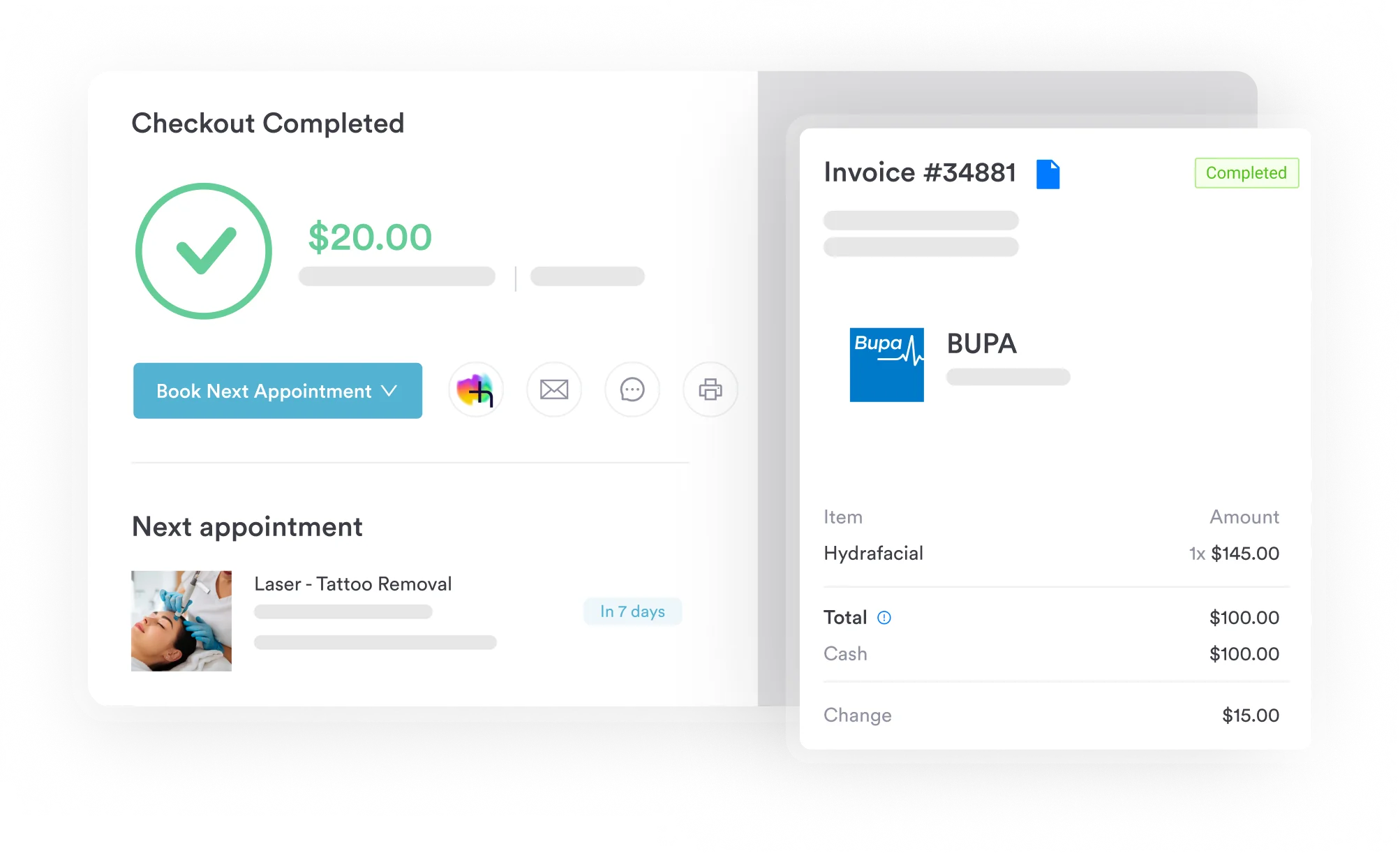
With eligibility, validation, and remittance in one place, an 11604 claim goes out once, with the details a payer checks already attached.

Pabau checks every claim for missing or invalid details, verifies eligibility, and submits through Claim.MD. Your 11604 claims reach payers ready to adjudicate.

CPT code 11604 is easy to select and easy to lose. The 3.0 cm lower threshold, the simple-repair bundling rule, and the site exclusions decide most of what goes wrong with it.
Write the lesion size, both margins, and the total into every operative note, and hold the claim until pathology confirms malignancy. Do that, and a 3.1 cm excision bills as 11604 without an argument.
If your team still chases eligibility and rejections by hand, book a demo to see how Pabau gets excision claims out clean the first time.

Need guidance on managing complex claim denials? Denial codes in medical billing explains the most common CARC and RARC codes and how to respond to each one.
Want to understand how the clearinghouse fits into your billing cycle? Medical claims clearinghouse covers how claims are scrubbed, submitted, and tracked through the payer network.
Looking for a practical overview of the revenue cycle? What is revenue cycle management walks through each stage from patient registration to payment posting.
CPT code 11604 is the procedure code for excising a malignant skin lesion, margins included, on the trunk, arms, or legs. It applies when the total excised diameter is 3.1 to 4.0 cm. It belongs to the 11600-series of malignant excision codes maintained by the American Medical Association (AMA).
The excised diameter must be 3.1 to 4.0 cm. Exactly 3.0 cm falls under CPT 11603, exactly 4.0 cm falls under CPT 11604, and anything over 4.0 cm shifts to CPT 11606.
Yes. Every malignant lesion excision includes specimen submission to pathology, and the operative note must document it. The malignant ICD-10-CM code on the claim must match the pathology report, and payers can request that report on review.
Using the 2026 national RVUs and the $33.4009 conversion factor, the non-facility rate is about $311 and the facility rate about $181. Rates vary by locality and change every year, so check the CMS Physician Fee Schedule Look-Up Tool.
No. Simple (linear) closure is bundled into CPT 11604. Intermediate (12031-12057) and complex (13100-13153) repairs are reported separately without modifier 59 when documented. Modifier 59 or an X modifier applies only when an NCCI edit pairs the codes and the repair is at a separate, distinct site.
The usual reasons are a missing excised diameter calculation, the wrong anatomic site code, or a simple closure billed separately. Claims also fail on an unconfirmed malignant diagnosis code, or an NCCI edit conflict with a same-day procedure.



