



CCSD code G5100: Bypass of duodenum billing guide
CCSD code G5100 bills a bypass that leaves the duodenum in place CCSD code G5100...

Last Updated: Oct 16, 2026

CPT Code 11424 describes excision of a benign lesion (including margins) on the scalp, neck, hands, feet, or genitalia, with an excised diameter of 3.1 to 4.0 cm.
The excised diameter includes the narrowest margin – not the lesion alone – and must be measured and documented in the operative note.
Incorrect size measurement is the leading cause of upcoding or downcoding claims; a 0.1 cm difference can shift the code to 11423 or 11426.
Pabau’s claims management software links diagnosis codes to procedure codes at the point of documentation, reducing modifier errors and supporting cleaner first-pass submissions.
CPT Code 11424 covers excision of a benign lesion, including margins, on the scalp, neck, hands, feet, or genitalia, when the excised diameter measures 3.1 to 4.0 cm.
The measurement includes the narrowest margin taken alongside the lesion itself, so a single millimeter of difference can shift a claim into the wrong size tier.
For dermatology and surgical practices billing dozens of lesion removals each week, consistent measurement matters at volume. As a result, the dermatology EMR software a practice uses directly affects how reliably those measurements flow from the operative note into the claim.
This reference covers CPT Code 11424 – the official descriptor, how excised diameter is measured, applicable modifiers, the 2026 Medicare fee schedule with RVU breakdown, qualifying ICD-10 diagnosis codes, documentation requirements, and the most common billing errors to avoid.
Official descriptor: Excision, benign lesion including margins, except skin tag (unless listed elsewhere), scalp, neck, hands, feet, genitalia; excised diameter 3.1 to 4.0 cm. CPT Code 11424 falls within the Excision-Benign Lesions category of the Surgery section of the AMA CPT code set, which the American Medical Association maintains annually.
What qualifies as a benign lesion? Common examples include nevi (moles), cysts, lipomas, sebaceous cysts, and other growths confirmed or expected to be non-malignant. However, the code does not apply to malignant lesions – those route to the 116xx code series instead (e.g. CPT 11624 for the same anatomical sites).
The measurement rule that matters most: Under AMA CPT guidelines, excised diameter is the widest dimension of the excised specimen, including the narrowest margin of normal tissue removed – not the visible lesion size alone.
For example, a lesion measuring 2.8 cm that requires a 0.2 cm margin on each side gives an excised diameter of 3.2 cm, correctly placing it under CPT Code 11424 rather than 11423. So documenting this calculation clearly in the operative note is what protects the claim.
Modifier selection affects both payment and audit risk. The table below covers the modifiers most commonly applied to CPT Code 11424, with the specific billing scenario each one addresses.
Modifier 59 is verified by the AAPC coding guidelines as applicable when NCCI edits would otherwise bundle a second same-day procedure with 11424. Therefore, always check the National Correct Coding Initiative (NCCI) edit table before appending modifier 59 to confirm a conflict pair actually exists.
Reimbursement for CPT Code 11424 varies by payer, location, and place of service. The figures below reflect the 2026 Medicare Physician Fee Schedule national rates. Verify current rates via the CMS fee schedule lookup, which is updated annually each January.
The relative value unit (RVU) structure for CPT Code 11424 determines the Medicare payment amount. Work RVU reflects physician effort; practice expense RVU covers overhead; malpractice RVU covers liability costs. The FastRVU 2026 lookup tool provides current values by locality.
The place of service determines which RVU set applies. Non-facility rates (office setting, place of service 11) are higher because the practice absorbs overhead costs. By contrast, facility rates (hospital outpatient or ASC, place of service 22 or 24) are lower because the facility separately bills for supplies and overhead.
The reimbursed dollar amount is the total RVU multiplied by the annual Medicare conversion factor ($33.4009 in 2026).
Rates above are approximate estimates based on reported RVU values and the 2026 conversion factor of $33.4009, and should be verified against the CMS Physician Fee Schedule before billing. In addition, private payer contracts may pay above or below Medicare rates depending on location and contract terms.
Run CPT Code 11424 through your MAC’s fee schedule look-up for your specific locality code before quoting reimbursement to a patient. National averages can differ by 20-30% from high-cost urban localities versus rural areas.
Pairing CPT Code 11424 with the correct ICD-10-CM diagnosis code is how practices establish medical necessity to the payer. Symptomatic lesions – those causing pain, bleeding, or functional limitation – are more reliably covered than asymptomatic cosmetic removals. Payer Local Coverage Determinations (LCDs) vary, so check your MAC’s LCD before assuming coverage for a specific diagnosis. The visit level rests on documented history, examination and medical decision making, not on the minutes spent.
The same precision applies to every diagnosis code. The commonly paired codes below cover the most frequent benign lesion diagnoses billed alongside CPT 11424.
Always use the most specific code available. For instance, D23.4 (benign neoplasm of skin, scalp and neck) is more precise – and more defensible – than D23.9 (unspecified site) when billing an excision from the scalp.
The same specificity principle carries across specialties, from ICD-10 Code P53 to routine lesion diagnoses.
Incomplete documentation is the second most common reason CPT Code 11424 claims are denied, after size-tier errors. Every element below must appear in the medical record before the claim is submitted.
Using digital intake forms that prompt for each of these fields at the point of care catches missing documentation before claims are submitted. Structured templates also support HIPAA-compliant documentation practices by ensuring the right data is captured – and retained – consistently.
Good documentation practices carry across specialties too – our guide to coaching CPT codes covers the same principle for a different billing context.

CPT Code 11424 is one of six codes in the 1142x benign lesion excision series, all covering the same anatomical sites (scalp, neck, hands, feet, genitalia) but separated by excised diameter. The series starts at CPT 11420, covering an excised diameter of 0.5 cm or less, and tops out at 11426 above 4.0 cm. Selecting the right code requires measuring the specimen accurately, because size-tier errors create both underpayment and overpayment audit risk.
Three codes generate the most coder confusion for mid-size benign lesion removals: 11423, 11424, and 11402. The anatomical site and excised diameter together determine the correct selection. A 1.1 to 2.0 cm specimen taken from the scalp, neck, hands, or feet maps to 11422, not 11402.
The most common error here is billing 11424 for a lesion on the forearm (which falls under the 1140x series) because the coder focused on size without verifying the anatomical site. See our reference on the ADHD screening CPT code for a broader look at how site-of-service rules affect code selection across categories.
CPT Code 11424 carries a 10-day global surgical period under CMS guidelines, which determines which post-operative services can and cannot be billed separately.
What is bundled into the global period? During the 10-day post-operative window, the following services are considered part of the surgical package and cannot be billed separately:
What can still be billed during the global period? Services that are unrelated to the excision are billable. However, they must carry modifier 24 (unrelated E/M during post-op period) or modifier 79 (unrelated procedure during post-op period) to prevent denial. Pathology review of the excised specimen is also separately billable, as it falls outside the surgical global package.
Practices that track global period windows in their claims management software can flag patients in the post-operative window automatically, prompting the billing team to verify modifier requirements before submission.
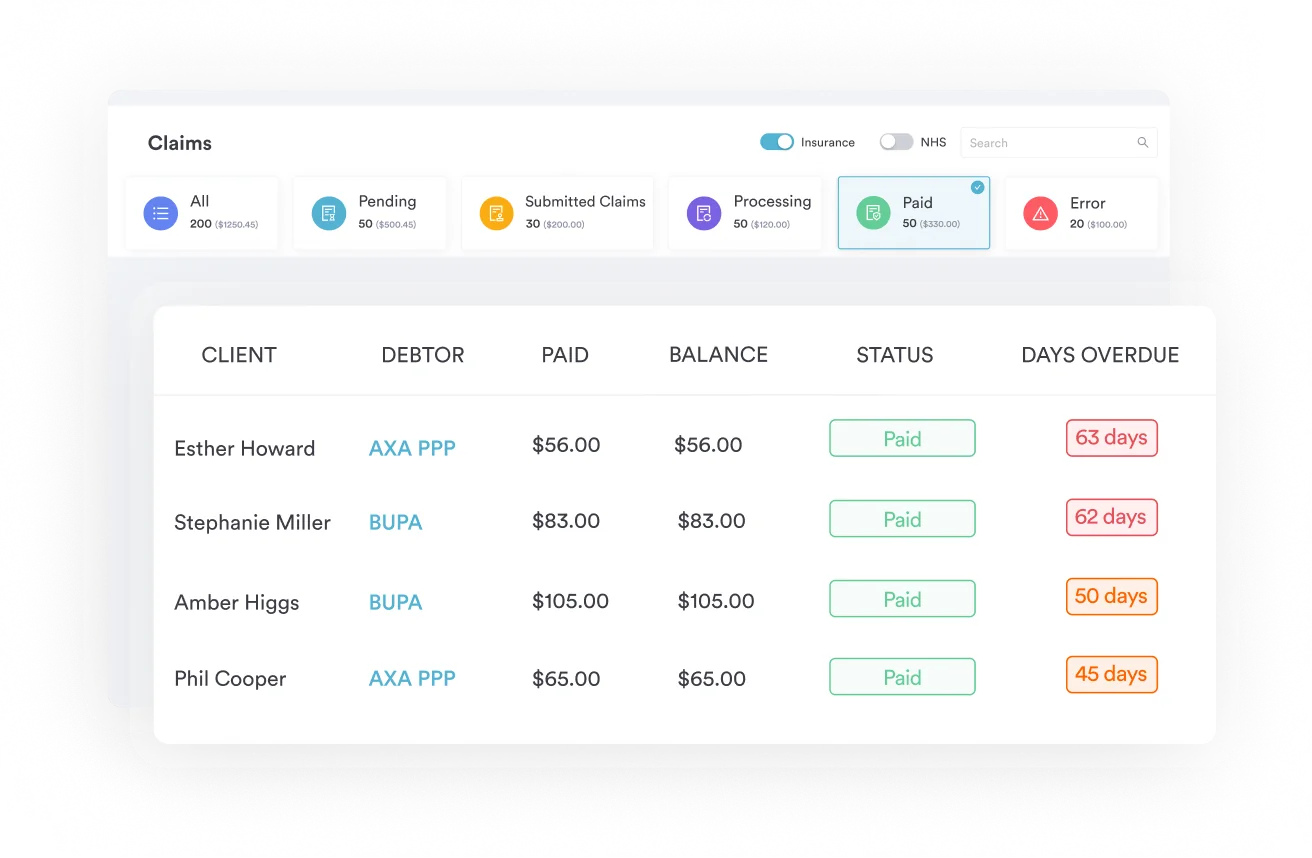
Claim denials for benign lesion excisions follow predictable patterns. The table below maps the most frequent error types, their root causes, and how to prevent them before submission.
Repair code bundling is especially tricky for CPT Code 11424. Simple, intermediate, and complex closure rules differ: a simple closure is always included in the excision fee, while a complex repair (e.g., flap closure) may be separately reportable. So when in doubt, review the NCCI edits for the specific repair code pair before submitting.

Pabau connects clinical documentation to claim submission in one workflow, automatically flagging missing modifiers and linking diagnosis codes to procedures before claims go out the door.

Billing CPT Code 11424 cleanly requires three things to line up:
When those three steps happen across separate systems, the connection between them breaks down and errors reach the claim.
Pabau’s medical records management connects the clinical note, diagnosis code assignment, and claim line in one workflow. Procedure templates can be built to prompt for excised diameter and margin documentation at the point of care, so the measurement is captured before the encounter closes.
For practices managing dermatology and skin clinic caseloads at scale, that structured capture is what keeps the 1142x size tiers accurate across hundreds of claims. Explore how practice management software brings these workflows together for outpatient surgical practices.
For broader procedural billing across specialties.
Measurement accuracy drives everything for CPT Code 11424. A lesion excision that crosses the 3.0 cm threshold belongs here, not in 11423, and the operative note must show the math. In short, pair it with the most specific ICD-10-CM code available, track the 10-day global period, and audit modifier usage before submission.
Pabau’s built-in documentation templates and claims workflow link operative note data directly to claims, reducing the size-tier errors and missing modifiers that generate the bulk of denials on benign lesion excision claims. To see how Pabau handles this in practice, book a demo.

Need another example of anatomical specificity driving reimbursement? CPT Code 11006 covers debridement billing for necrotizing soft tissue infection, where site and extent determine the correct code the same way excised diameter does here.
Want to see how diagnosis specificity changes claim outcomes? ICD-10 Code Q38.5 shows how a single fourth-character difference changes coverage for a congenital diagnosis.
Coding a malignant appendix tumor? ICD-10 code C18.1 guide covers the Excludes1 note that bars pairing this code with the carcinoid code C7A.020.
CPT Code 11424 is used to report the excision of a benign lesion (including margins) on the scalp, neck, hands, feet, or genitalia, where the excised diameter measures 3.1 to 4.0 cm. The excised diameter must include the narrowest margin of normal tissue removed alongside the lesion, not just the visible lesion size.
The approximate 2026 Medicare non-facility rate for CPT 11424 is around $188 and the facility rate around $114, based on a total RVU of 5.63 (non-facility) or 3.42 (facility) multiplied by the 2026 conversion factor of $33.4009. Verify exact rates by locality using the CMS Physician Fee Schedule lookup tool before billing.
The most commonly applicable modifiers are 59 (distinct procedure when bundled with a same-day code under NCCI edits), 51 (multiple procedures on the same date), 25 (significant separately identifiable E/M service on the same date), and RT/LT (laterality when required by payer). X-modifier subsets (XS, XE, XP, XU) may be required by Medicare as more specific alternatives to modifier 59.
The most reliably covered ICD-10-CM codes include D23.x (benign neoplasm of skin, site-specific), L72.0 (epidermal cyst), L72.11 (pilar cyst), D17.0 (benign lipomatous neoplasm, head/face/neck), and D22.x (melanocytic nevi). Use the most site-specific code available, and document symptoms (pain, bleeding, functional limitation) to strengthen coverage for payer review.
The only difference is excised diameter: 11423 applies when the excised diameter (including margins) measures 2.1 to 3.0 cm, and 11424 applies when it measures 3.1 to 4.0 cm. Both cover the same anatomical sites (scalp, neck, hands, feet, genitalia) and the same benign lesion type. The margin must be included in the measurement for both codes.
The operative note must include the excised diameter with the margin calculation shown, the anatomical site, the clinical diagnosis, confirmation that the specimen was submitted for pathology, and the pathology report number. If modifier 25 or 59 is used, the qualifying separate service must also be documented in its own note entry.
Simple closure is included in the CPT 11424 excision fee and cannot be billed separately. A complex repair (such as a flap or graft) may be separately billable – verify the specific repair code against NCCI edits and apply modifier 59 if a separate procedure is confirmed. Do not bill intermediate closure codes alongside 11424 without confirming no NCCI conflict exists.
CPT 11424 carries a 10-day global surgical period under CMS guidelines. Routine post-operative visits related to the excision are bundled into the global fee. Services unrelated to the excision can be billed separately during the global window, but must carry modifier 24 (unrelated E/M) or modifier 79 (unrelated procedure) to avoid denial.



