HCPCS code E0280: Bed cradle Medicare billing guide
HCPCS code E0280 describes the cradle frame, not the bed HCPCS code E0280 is the...

Last Updated: Oct 15, 2026
11422 is the CPT code for excision of a benign lesion, including margins, at an excised diameter of 1.1 to 2.0 cm. It applies to the scalp, neck, hands, feet, and genitalia, and excludes skin tags unless listed elsewhere.
The code sits at the middle size tier of the 11420-11426 series. Using it for a trunk or extremity lesion is the leading cause of denials for this code, because those belong to 11402. Simple closure is bundled into 11422. Intermediate and complex repairs are billed separately. The note must record the excised diameter with margins, the anatomical site, and the indication for surgery.
Let Pabau's smart automation suggest the right codes, reduce claim denials, and keep your practice compliant—effortlessly.
Automate repetitive tasks and focus on what matters most—your patients.
Reduce coding errors and ensure compliance with the latest regulations.
Clean claims, fewer denials, and faster reimbursements.
Powerful insights and reporting to help your practice thrive.
HIPAA compliant SOC 2 certified GDPR-compliant Trusted by 4,000+ clinics worldwide

CPT Code 11422 covers benign lesion excision on scalp, neck, hands, feet, or genitalia only, not trunk or extremities.
The excised diameter including margins must measure 1.1 to 2.0 cm. Below that range use 11420 or 11421, above it use 11423 or higher.
Simple closure is bundled into the code. Intermediate or complex closure (12031-12057, 13100-13160) is billed separately when performed.
Medicare does not cover cosmetic benign lesion removal. Documentation must establish medical necessity with a supported ICD-10 diagnosis.
Pabau’s claims management software keeps CPT code selection, documentation, and claim submission in one workflow, which removes the manual steps behind most 11422 denials.
The American Medical Association publishes the official descriptor for CPT Code 11422. It reads: “Excision, benign lesion including margins, except skin tag (unless listed elsewhere), scalp, neck, hands, feet, genitalia; excised diameter 1.1 to 2.0 cm.” That descriptor carries three separate billing conditions, and failing any one triggers a denial. The procedure must be an excision rather than a destruction, and the lesion must be benign. The excised diameter including margins must then fall between 1.1 and 2.0 cm at one of the five named anatomical sites.
The code belongs to the integumentary system section of the CPT codebook. It is a global-period code: simple wound closure is bundled, and the surgical package includes typical preoperative and postoperative care. Separate billing for a simple repair alongside 11422 violates Correct Coding Initiative (CCI) edits and will be denied. Dermatology and plastic surgery practices meet this code most often for seborrheic keratoses, dermatofibromas, epidermal inclusion cysts, and lipomas on the neck or scalp.
The 11420-11426 series is restricted to five anatomical locations: scalp, neck, hands, feet, and genitalia. These sites are grouped together because they present greater surgical complexity than trunk or extremity skin. Closure and healing considerations differ, and payers reimburse the series at a higher rate than the 11400 trunk and extremity codes.
Excision of benign lesions on the face, ears, eyelids, nose, or lips belongs to a third separate series (11440-11446). Understanding these three parallel series is the foundation of correct code assignment. Grouping errors between the three account for a large proportion of anatomical-site denials.
Size decides which of the six tiers in the 11420-11426 series applies, and 11422 covers 1.1 to 2.0 cm. Smaller excisions fall to 11420 and 11421. Larger ones move up through 11423 and 11424 to CPT 11426, which covers an excised diameter over 4.0 cm.
The excised diameter is measured at the time of surgery and includes the lesion plus the margin of normal tissue removed around it. It is not the size of the lesion itself and it is not the size of the wound after closure. The AMA guidelines specify the greatest excised diameter, measured in centimeters at the time the specimen is removed.
The two most consequential code comparisons for 11422 are against 11402 (same size tier, different site) and against 11421/11423 (same site, adjacent size tiers). Confusing any of these produces either an underpayment or a claim denial. The chart below sets out every condition the claim has to clear, and the code that applies when one of them fails.
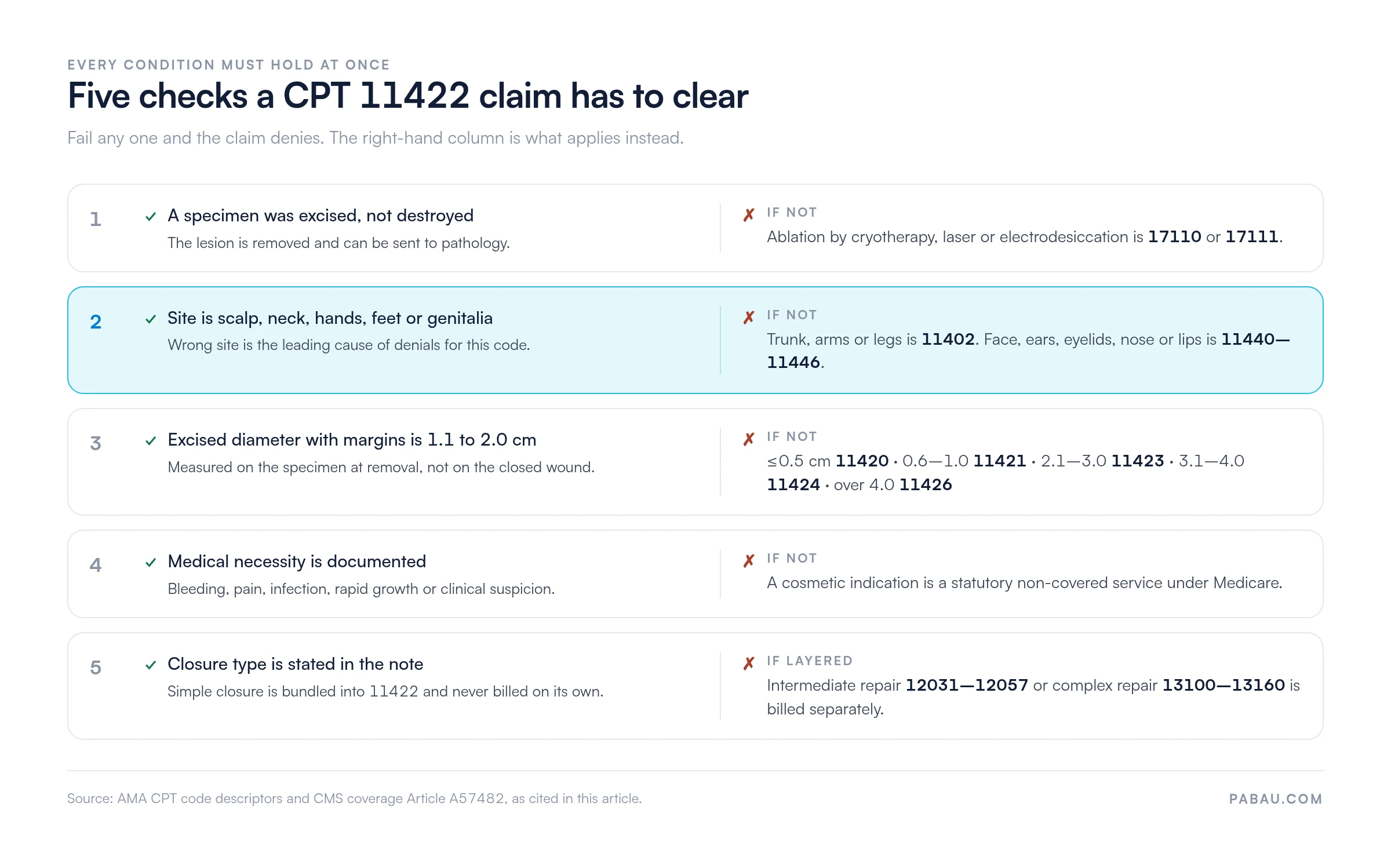
CPT code 11402 covers excision of a benign lesion on the trunk, arms, or legs in the 1.1 to 2.0 cm excised diameter range. It is the direct anatomical counterpart to 11422. Both codes share the identical size tier, and the only distinction is the body region. Assigning 11402 to a neck or hand lesion, or 11422 to a forearm or back lesion, produces a denial or a post-payment audit finding.
Excision codes (11422 and its series) require removal of the lesion as a specimen. Destruction codes 17110 and 17111 cover ablation of benign lesions by any method, including cryotherapy, laser, or electrodesiccation, where no specimen is sent to pathology. Using 11422 when the procedure was a destruction, or the reverse, constitutes miscoding. Payers also cross-reference claim data against pathology billing. If you bill 11422 and no CPT 88305 pathology code follows, some payers flag the claim for review.
Document whether a specimen was submitted to pathology at the time of the procedure note, not as an afterthought. Payers increasingly cross-match excision codes against pathology claims during claims adjudication. A procedure note that clearly states ‘specimen submitted’ supports both the 11422 claim and the separately billed 88305 pathology evaluation.
Modifier selection for CPT Code 11422 decides whether a claim pays, underpays, or denies. Four modifiers come up most often with this code, and each one serves a different function. Payer policy on two of them varies enough that it is worth confirming before the procedure.
When multiple lesions are excised on the same day, each lesion is billed separately at the appropriate size and site code. The first lesion does not require Modifier 59; add Modifier 59 to each additional lesion to indicate they are distinct services. Payers then apply a multiple-procedure reduction to the secondary codes under Modifier 51 rules. That is typically 50% of the fee schedule rate for the second procedure, and 25% for the third and beyond.
Medicare reimburses CPT Code 11422 under the Medicare Physician Fee Schedule (MPFS), with rates varying by geographic locality and practice expense (PE) inputs. The non-facility rate (office-based) is higher than the facility rate for a hospital or ambulatory surgical center. That is because the non-facility PE component reflects the cost of supplies and equipment borne by the practice. Current 2026 rates can be verified through the CMS Physician Fee Schedule lookup tool, which allows searching by code and locality.
The FastRVU 2026 lookup tool breaks the code into its Work RVU, Practice Expense RVU, and Malpractice RVU components. Its figures are sourced from the CMS files. The national Medicare conversion factor for 2026 sets the dollar value of each RVU, and geographic adjustments (GPCIs) then modify that rate by locality. Practices that submit claims electronically get line-item payment details back on the remittance advice. That is the quickest way to confirm 11422 paid at the expected rate.
Commercial payer rates for 11422 are contractually determined and typically expressed as a percentage of the Medicare fee schedule. They cannot be stated as a single figure without payer-specific contract data. Rates in high-cost metropolitan areas may sit well above national averages, while rural locality rates may be lower.
Medicare does not cover benign lesion excision that is cosmetic in nature. CMS Article A57482 sets out the coverage policy, and it turns on medical necessity. The lesion must be symptomatic, with bleeding, pain, infection, rapid growth, or functional impairment, or it must be clinically suspicious. A lesion excised solely for cosmetic reasons is a statutory non-covered service and will deny regardless of documentation quality. Dermatology and plastic surgery practices routinely audit their own 11422 claims to confirm that a covered diagnosis supports each one.
Every 11422 claim needs a supported ICD-10-CM diagnosis before a payer treats the excision as medically necessary. A cosmetic-only or unspecified diagnosis triggers a denial under both Medicare and most commercial policies. The table below lists the ICD-10-CM codes that most often establish medical necessity for benign lesion excision at the qualifying anatomical sites.
Always use the most specific ICD-10-CM code available. D23.x codes require a 4th character that specifies the anatomical site of the skin lesion, and submitting the unspecified parent code risks a specificity denial. Our ICD-10-CM code library lists the site-specific options within each of these families. For a searchable crosswalk between ICD-10 diagnoses and CPT codes, the AAPC CPT-to-ICD-10 crosswalk is a useful reference.
Documentation failures are the second most common cause of 11422 denials, after wrong anatomical-site coding. A procedure note that records the excised diameter, the site, and the clinical indication in specific terms is what gets the claim paid. Anything vaguer invites a request for medical records. A clean claim for this code starts in the operative note, before anyone opens the billing screen.
Structured procedure note templates built in claims management software can pre-populate these required fields, which cuts omission errors. When all seven data points above appear in the note, the claim carries what it needs to survive payer review without a medical records request.
CPT Code 11422 is a surgical package that bundles specific services by definition. Billing separately for bundled components violates CCI edits and exposes the practice to recoupment. Knowing what sits inside the package prevents both underbilling and overbilling.
Knowing the root causes of 11422 denials matters as much as knowing the code’s descriptor. Most denials fall into one of six patterns, and each has a specific prevention step. Practices with structured denial management workflows spot these patterns systematically rather than treating each rejected claim in isolation. The CARC reason code returned on the remittance tells you which category the payer applied.
An evaluation and management service (CPT 99202-99215) can be billed on the same date as CPT Code 11422. The E/M has to represent a separately identifiable service beyond the decision to perform the excision. Modifier 25 appended to the E/M code signals to the payer that the two services are distinct. Without Modifier 25 on the E/M, the payer bundles it into the global surgical package. The E/M is then not separately reimbursed.
The E/M must be documented separately from the procedure note. A note that consists only of the operative record, with no distinct problem-focused assessment, does not support a separate E/M. Payer policies vary here. Some commercial payers follow the CMS Modifier 25 guidance precisely, while others add documentation requirements of their own. Reviewing E/M-plus-procedure claims periodically keeps Modifier 25 usage in line with your payer contracts.
Build a pre-visit checklist for any appointment where 11422 is likely. Confirm the clinical indication is documented before the procedure begins, check whether prior authorization is needed, and note whether an E/M will be billed separately. Settling those three points before the patient leaves the room prevents most post-submission denials.
Most practices record the excision in one system and build the claim in another. A coder reads the operative note, then retypes the site, the excised diameter and the closure type onto the claim form. Every retyped field is another chance to drop the measurement that decides the size tier.
Practice management software like Pabau keeps both steps on the same patient record. The procedure note carries structured fields for anatomical site, excised diameter with margins, closure type and indication. Those values travel with the claim, so the coder reads the clinician’s own entry instead of interpreting free text.
Claims then submit electronically, and the remittance returns against that same record. When a payer denies an 11422 line, you can see which documented value it disagreed with without reopening two systems. Every Pabau subscription includes the full feature set, so claims tooling is never a tier you have to upgrade into.

Pabau keeps your procedure documentation, CPT code assignment, and claim submission in one connected workflow. Teams that document the excision in Pabau can queue the claim without re-entering data or switching platforms.

11422 is narrow by design. Four conditions have to hold at once: the anatomical site, the size tier, benign pathology, and an excision rather than a destruction. Miss any one of them and the claim denies.
The measurement is what goes missing most often. A note reading “lesion excised from scalp”, with no excised diameter, leaves the payer free to assume the smallest tier. The practice absorbs the difference. Writing the number down at the moment of removal costs seconds and protects the whole claim.
Pabau’s claims management software connects procedure documentation directly to claim submission, so the fields that decide code selection are captured at the point of care. Teams that want to bring down 11422 denial rates can book a demo and see the excision workflow run from note to claim.

Is it 11422 or 11402? CPT code 11402: Benign lesion excision, 1.1-2.0 cm sets out the anatomical site split that decides which of the two you bill.
Was the lesion destroyed rather than cut out? CPT Code 17110: Destruction of benign skin lesions billing guide covers the technique and lesion-count rules behind the destruction codes.
Same excision, but on the trunk, arms or legs? CPT code 11400: Excision of benign lesion, trunk, arms or legs handles the site family that 11422 excludes.
Reading a denial on the remittance? Denial codes in medical billing: The top 20 CARC codes and how to fix them explains what each CARC code means and the fix.
Billing an E/M visit on the same day? Medical decision making (MDM): Components, levels, and documentation shows how to document the level that supports a separate visit.
CPT Code 11422 is the billing code for excision of a benign lesion including margins from the scalp, neck, hands, feet, or genitalia. It applies when the excised diameter measures 1.1 to 2.0 centimeters, and simple wound closure is included in the code. The procedure must remove a specimen rather than destroy the lesion, and the lesion must be benign.
The difference is anatomical site only. 11422 applies to the scalp, neck, hands, feet, and genitalia, while 11402 applies to the trunk, arms, and legs. Both codes share the identical excised diameter range of 1.1 to 2.0 cm. Assigning 11422 to a trunk or extremity lesion is the most common denial trigger for this code.
The excised diameter is measured at the time of surgery and includes the lesion plus the margin of normal tissue removed around it. It is stated in centimeters as the greatest dimension of the excised specimen. It is not the size of the lesion alone and not the wound edge after closure. The measurement must be documented in the operative note, because payers otherwise default to the smallest size tier.
The 2026 Medicare rate for CPT Code 11422 varies by geographic locality and by place of service. The non-facility (office) rate is higher than the facility rate for a hospital or ASC, because it includes practice expense components. Current rates should be confirmed using the CMS Physician Fee Schedule lookup tool, which is updated annually.
Yes, simple (non-layered) closure is bundled into CPT Code 11422 and cannot be billed separately. Intermediate closure codes (12031-12057) and complex repair codes (13100-13160) are separately billable when a higher-level closure is actually performed and documented.
The most common reason is a wrong anatomical site, where a trunk or arm lesion is billed as 11422 instead of 11402. The others are a cosmetic indication without documented medical necessity, or a missing excised diameter in the operative note. A simple closure billed separately will also deny, as will a size-tier mismatch between the documentation and the code.