HCPCS code E0372: Powered air mattress overlay billing guide
HCPCS code E0372 covers a powered overlay, not a bed HCPCS code E0372 pays for a...

Last Updated: Oct 15, 2026
11420 is the CPT code for excision of a benign lesion including margins, except a skin tag unless listed elsewhere. It applies to the scalp, neck, hands, feet, and genitalia, at an excised diameter of 0.5 cm or less.
Code selection turns on the excised diameter, which is the widest measurement of the removed specimen including its surgical margins. Payers score the claim against that figure, not the lesion size recorded before the procedure. An excision performed correctly still lands on the wrong code when the operative note reports only the pre-excision measurement.
Let Pabau's smart automation suggest the right codes, reduce claim denials, and keep your practice compliant—effortlessly.
Automate repetitive tasks and focus on what matters most—your patients.
Reduce coding errors and ensure compliance with the latest regulations.
Clean claims, fewer denials, and faster reimbursements.
Powerful insights and reporting to help your practice thrive.
HIPAA compliant SOC 2 certified GDPR-compliant Trusted by 4,000+ clinics worldwide

CPT 11420 covers benign lesion excision on scalp, neck, hands, feet, or genitalia at 0.5 cm or less excised diameter
Code selection is based on the excised diameter (widest measurement including margins), never the pre-procedure lesion size
Medicare covers 11420 only when the lesion is symptomatic — purely cosmetic removals are denied under LCD A57113
Pabau’s claims management software flags size-threshold mismatches and tracks denial reasons for skin procedure codes
CPT code 11420 covers excision of a benign lesion at one of five anatomical sites, with an excised diameter of 0.5 cm or less. The AMA’s CPT code set words it as follows:
Excision, benign lesion including margins, except skin tag (unless listed elsewhere), scalp, neck, hands, feet, genitalia; excised diameter 0.5 cm or less.
The five anatomical sites are non-negotiable. A benign lesion on the forearm uses the trunk/arms/legs series (11400-11406), not 11420. A lesion on the cheek uses the face/ears/eyelids/nose/lips series (11440-11446). Choosing the wrong series is the most preventable upcoding risk in skin lesion billing.
The code covers the full excision episode. That includes local anesthesia, the elliptical or shave-depth incision, specimen removal, margin measurement, and simple closure. It does not cover skin tag removal (CPT 11200-11201), shave removal (11300-11313), or destruction without excision (17110-17111). Destruction rather than excision moves the claim to 17110 or 17111, which carry their own documentation and coverage rules.
Three conditions must hold before 11420 applies. When one of them fails, the code fails with it.
Software that pre-populates code logic can flag a site mismatch before submission. The coder still verifies the measurement written in the operative note.
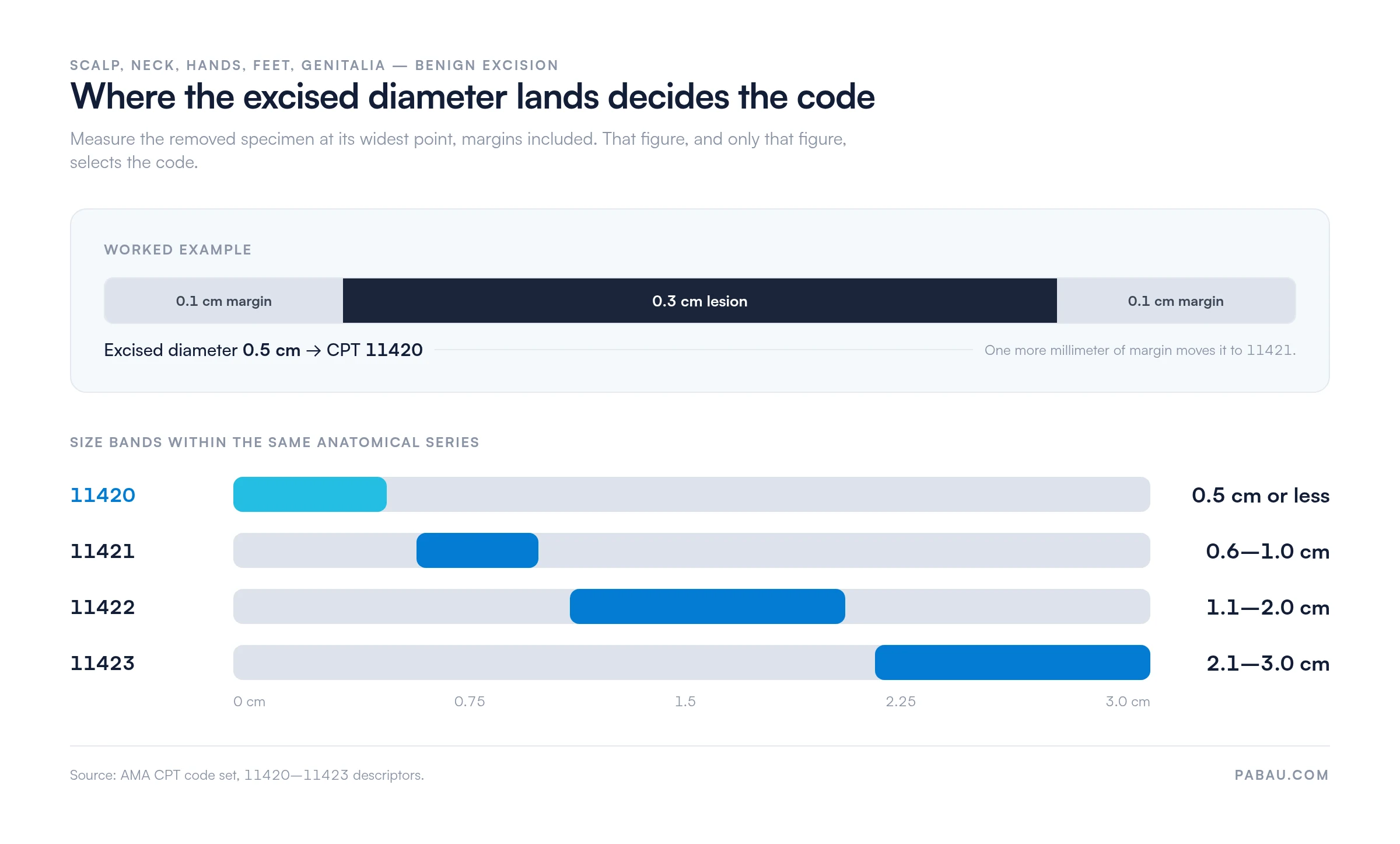
The excised diameter is measured after the specimen is removed, not before. Surgeons mark the planned margins around the visible lesion boundary, then measure the widest diameter of the excised specimen including those margins.
A 0.3 cm lesion removed with 0.1 cm margins on each side produces a 0.5 cm specimen, which lands on 11420. Add one more millimeter of margin and the claim moves to 11421.
Documenting the pre-excision lesion size without the specimen measurement is the primary audit failure point. The size bands below show where each threshold sits.
An incomplete operative note drives more 11420 denials on audit than any other single cause. Payers expect named data points, not a line confirming that a lesion was removed. The note has to stand alone as clinical justification, so the coder never has to infer a measurement or an indication.
The 114xx codes form three parallel series by anatomical site. Size determines the code within a series. Site determines which series to enter, and CPT 11420 is the entry-level code in the scalp/neck/hands/feet/genitalia group. The most common coding error is selecting 11420 when the excised diameter measured 0.6-1.0 cm. That range is 11421, the neighboring code with a higher relative value unit (RVU) weight. When the excised diameter runs from 1.1 to 2.0 cm, the same site group reports CPT 11422.
Above that band, 11423 covers 2.1 to 3.0 cm and 11424 covers 3.1 to 4.0 cm. The series ends at CPT 11426, which covers an excised diameter over 4.0 cm.
Every claim for CPT 11420 must pair with an ICD-10-CM code confirming the benign nature of the lesion and the anatomical site. A diagnosis-procedure mismatch is an immediate denial trigger. Use the most specific code available. A benign neoplasm code beats a symptom code when histology or clinical certainty supports it. All codes below are verified against the current ICD-10-CM tabular list.
Modifier selection for CPT 11420 follows NCCI policy. Misapplied modifiers — particularly modifier 59 where a more specific X-modifier applies — are an active audit trigger. Use the most specific modifier available when the NCCI edit applies, and document the clinical rationale in the operative note.
Medicare’s coverage of CPT 11420 is conditional. A symptomatic removal is covered and a cosmetic one is excluded. CMS LCD article A57113 covers benign skin lesion removal only where the lesion causes a documented symptom:
A dermatofibroma removed because the patient dislikes its appearance is not covered. Document the specific symptom in the clinical note, not just “patient requests removal.”
Before submission, run insurance eligibility verification to confirm that the plan covers benign lesion excision. Check whether prior authorization is required at the same time. Commercial plans vary. Blue Cross and Aetna plans often mirror Medicare’s symptomatic requirement, while some Medicaid plans require prior auth for any elective skin procedure.
Practice management software like Pabau runs those checks through the Claim.MD clearinghouse, which reaches 400+ payers for real-time eligibility. Coverage is confirmed before the patient arrives rather than after the claim is denied.
Print the CMS Medicare Coverage Database article A57113 summary and keep it in your coding reference folder. When documenting medical necessity, match the note’s language to the LCD’s symptomatic criteria. ‘Irritation with clothing contact’ is more defensible than ‘bothersome.’
The 2026 Medicare Physician Fee Schedule puts CPT 11420 at roughly $91 non-facility and $63 facility. Both are national averages published by CMS and retrievable through the CMS Physician Fee Schedule lookup tool.
Those averages sit before geographic practice cost index (GPCI) adjustment, so payment to a practice in San Francisco differs from one in rural Mississippi. Commercial payer contracts are negotiated independently of Medicare. For small-to-mid-sized practices they typically land at 110-160% of the Medicare non-facility amount, depending on payer mix and contract terms.
Verify current rates with the FastRVU 2026 RVU lookup tool and your MAC locality code applied. Accurate superbill documentation keeps the claim’s code, place of service, and modifier combination aligned with the fee schedule entry. Comparing remittance advice against the MPFS rate surfaces systematic underpayments from commercial payers.
Most 11420 denials fall into five categories. Each one has a prevention step that runs before the procedure, in the documentation or the pre-authorization. Chasing the denial after the remittance arrives costs far more staff time than preventing it.
Pabau’s claims management software tracks denial reason codes per CPT code. A practice can see whether its 11420 denials cluster around cosmetic determinations, modifier errors, or missing documentation. That points at the pattern to fix, rather than at each claim in turn.
Reading the denial codes on the remittance turns claim-by-claim rework into a process improvement.
When two or more benign lesions are excised in a single encounter, each lesion gets its own line on the claim. The highest-complexity code, or the highest RVU code, goes on line one without a multiple-procedure modifier.
Each subsequent code gets modifier 51 appended, unless the payer is Medicare. CMS applies the multiple-procedure reduction automatically and does not require modifier 51 on electronic claims.
When lesions sit on separate anatomical structures, modifier XS (separate structure) is more specific than modifier 59 and is preferred by CMS. When lesions sit on the same anatomical structure but are clinically distinct, modifier 59 remains the correct choice.
Either way, the operative note must describe each lesion individually. That means a separate site, a separate excised diameter, and a separate pathology notation. A single note describing “two lesions excised” without individual measurements fails both NCCI review and medical necessity audits.
Review the NCCI Procedure-to-Procedure (PTP) edit table for 11420 before billing multiple skin codes on one date of service. Clearinghouse submission through Claim.MD applies those edits in real time, so a bundling error surfaces before the claim reaches the payer.
For a practice with higher excision volume, first-pass accuracy comes from building the multi-lesion workflow into the operative note template.
Build a two-column operative note template for same-day multiple lesion excisions, one column per lesion. Give it rows for site, excised diameter, clinical description, symptom, closure, and pathology disposition. A structured template catches missing measurements before the note is signed.
Most practices catch an 11420 coding error after the remittance arrives. The claim went out with the pre-excision lesion size, or with no symptom documented, and the correction happens weeks later in a rework queue.
Pabau keeps the operative note, the code, and the claim in one patient record. Charting templates prompt for the excised specimen measurement and the documented symptom, so the coder reads a complete note instead of chasing the surgeon.
Eligibility runs through Claim.MD before the appointment, which settles coverage and prior authorization while there is still time to act. Denials that still land are coded back to the CPT line. The pattern is then visible across a month of 11420 claims, rather than one claim at a time.

Pabau’s claims management software tracks code-level denial reasons, flags size-threshold mismatches before submission, and connects to 400+ payers through Claim.MD for real-time eligibility. See how it works for dermatology and skin procedure billing.

One code, five anatomical sites, one size threshold — 11420 looks simple until the remittance arrives. Cosmetic determinations, excised-diameter confusion, and modifier errors account for most denials, and all three are settled before the patient leaves.
Start with the operative note template. Add a required field for the excised specimen measurement and one for the documented symptom, and the two most common 11420 denials stop appearing.
Pabau brings claims management, Claim.MD clearinghouse connectivity, and denial tracking into one platform, so billing teams spend less time on rework. To see how it handles CPT code 11420 end-to-end, book a demo.

Want the billing workflow end to end? Revenue cycle management for medical practices walks through every stage from eligibility to payment posting.
Not yet contracted with the payers you bill? Getting credentialed with insurance companies covers the enrollment steps that decide whether an 11420 claim is payable at all.
Comparing billing platforms? Best medical billing software for US practices reviews the platforms that support CPT code workflows for dermatology and surgical specialties.
CPT code 11420 covers excision of a benign lesion on the scalp, neck, hands, feet, or genitalia. The excised diameter, including surgical margins, must be 0.5 cm or less. It includes local anesthesia, the excision itself, and simple wound closure. It does not cover malignant lesions, shave removal, or lesions at other anatomical sites.
CPT 11420 and 11421 cover the same anatomical sites (scalp, neck, hands, feet, genitalia) but differ by excised diameter. Code 11420 applies when the excised diameter is 0.5 cm or less. Code 11421 applies from 0.6 to 1.0 cm. Both codes require the excised specimen measurement, not the pre-procedure lesion size, to determine which applies.
Medicare covers CPT 11420 only when the excision is medically necessary. That means the lesion causes documented symptoms such as bleeding, pain, irritation, repeated infection, or functional impairment. Removal for cosmetic reasons alone is excluded under CMS LCD article A57113. Document the specific symptom in the operative note before submitting the claim.
Modifier 59 (distinct procedural service) or XS (separate structure) applies when billing multiple lesion excisions on the same date of service. Modifier 51 (multiple procedures) appends to subsequent codes for non-Medicare payers. Modifier 58 indicates a planned staged re-excision. Modifier 25 is used when a significant, separately identifiable E/M service is provided on the same day.
Not universally. Medicare and most commercial payers do not mandate pathology submission for every benign lesion excision. Some plans require histologic confirmation when malignancy cannot be excluded clinically. Document whether the specimen was sent for pathology, and retain the report if you get one. It strengthens the medical necessity defense on audit.
CPT 17110 applies when benign lesions are destroyed (cryotherapy, laser, electrocautery) rather than excised. If the lesion is surgically cut out with margins and submitted as a specimen, that is excision under 11420. If it is ablated in place without specimen removal, that is destruction under 17110. The two codes describe different procedures and are not interchangeable.