CPT code 59618: Cesarean after attempted VBAC billing guide
CPT code 59618 bills a cesarean after a VBAC attempt CPT code 59618 is the globa...

Last Updated: Nov 4, 2026
M0222 is the CCSD code for nephro-ureterectomy for live donor transplantation. It covers the operation that removes a healthy kidney and its ureter from a living donor for transplant into a recipient.
The code sits in Chapter 12 of the CCSD schedule, under Kidney / Renal Pelvic. It is billed for the donor only, because the recipient's transplant has its own code. CCSD lists laparoscopic and robotic nephroureterectomy codes M0282, M0284 and M0286 as unacceptable combinations with M0222.
Let Pabau's smart automation suggest the right codes, reduce claim denials, and keep your practice compliant—effortlessly.
Automate repetitive tasks and focus on what matters most—your patients.
Reduce coding errors and ensure compliance with the latest regulations.
Clean claims, fewer denials, and faster reimbursements.
Powerful insights and reporting to help your practice thrive.
HIPAA compliant SOC 2 certified GDPR-compliant Trusted by 4,000+ clinics worldwide

CCSD code M0222 is nephro-ureterectomy for live donor transplantation, the surgery that removes a healthy kidney and its ureter from a living donor.
The code covers the donor’s operation only. The recipient’s transplant is billed under its own code, such as M0102 for a first or second transplant.
CCSD lists laparoscopic and robotic nephroureterectomy codes M0282, M0284 and M0286 as unacceptable combinations with M0222.
Confirm in writing which policy funds the donor’s surgery before the operation, because the donor and recipient are two separate patients.
Most major UK insurers expect electronic claims through Healthcode, so check each insurer’s current submission rules before you send.
CCSD code M0222 is the code for nephro-ureterectomy for live donor transplantation. A surgeon removes a healthy kidney, with its ureter, from a living donor so it can be transplanted into a recipient.
The code sits in Chapter 12 of the CCSD schedule, Urinary system and male reproductive organs, under Kidney / Renal Pelvic. It describes the donor’s operation. The recipient’s transplant is a separate procedure with its own code and its own claim.
CCSD stands for the Clinical Coding and Schedule Development Group. It maintains the CCSD code library that UK private medical insurers use. The group sets codes and narratives, while each insurer sets its own fees and rules.
The descriptor and unacceptable combinations above come from the CCSD code page for M0222. The complexity band is set by each insurer, so check the band in your own recognition agreement.
According to NHS Blood and Transplant, the kidney is usually removed using keyhole surgery. The operation notes should still record the approach the surgeon used, because insurers can query it.
The donor is a healthy patient having elective surgery for someone else’s benefit. That makes the donor’s consent, work-up and follow-up a separate clinical record from the recipient’s, even when both operations happen on the same day.
A live donor kidney transplant produces two claims, one for each patient. The donor surgeon bills M0222 for removing the kidney. The transplant surgeon bills the recipient’s transplant code for implanting it.
The recipient codes and descriptors above appear in the National Friendly schedule of fees and the Aetna International doctors’ fee schedule. Never put M0222 on the recipient’s claim, and never put a transplant code on the donor’s claim.
Here is how the two claims run side by side, from authorization to submission.
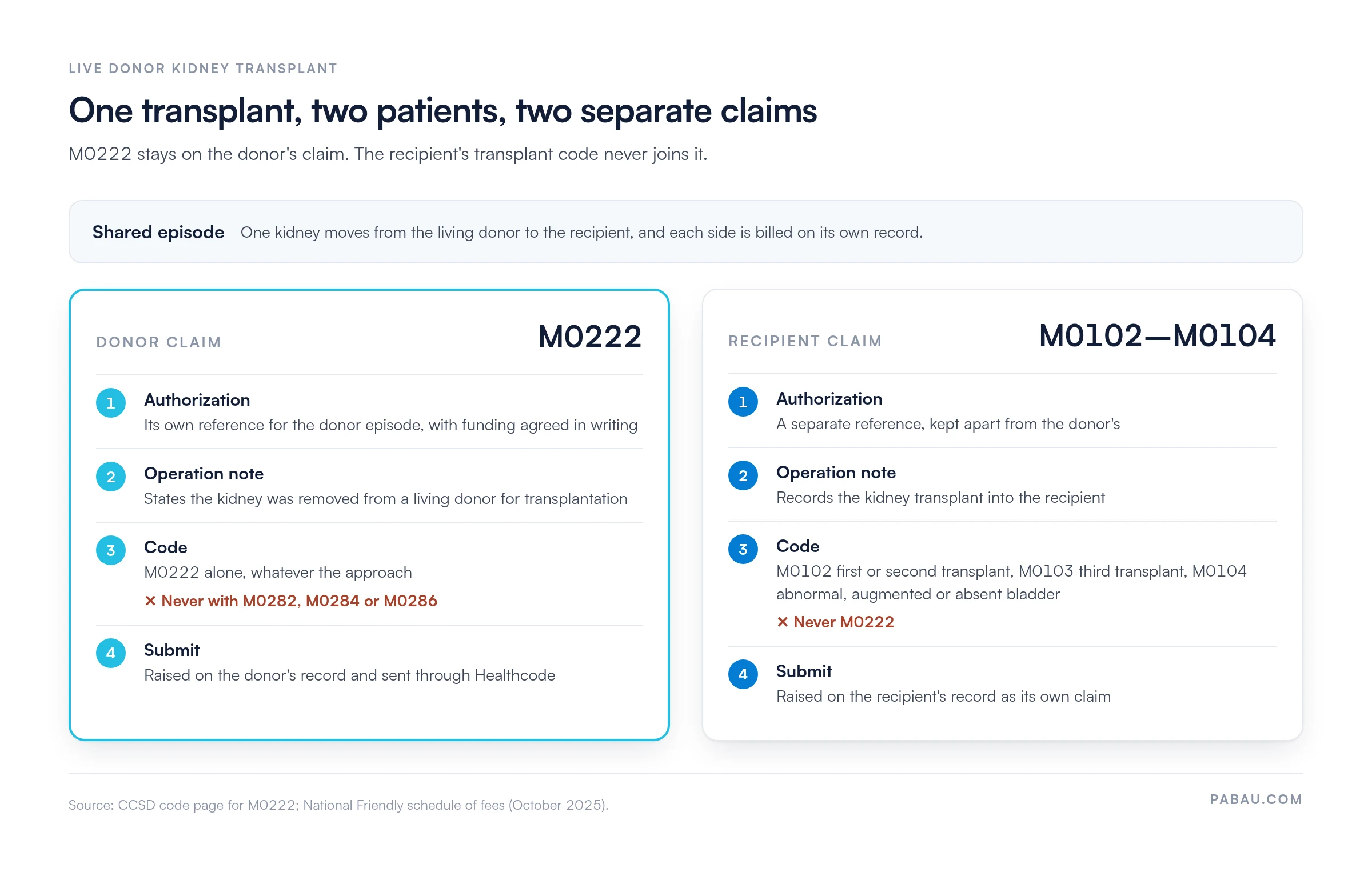
Coding settles which code goes on which claim. It doesn’t settle which policy pays for the donor’s operation. We found no public UK insurer guidance on that point, so ask the recipient’s insurer and, where one exists, the donor’s insurer. Get the answer in writing before surgery.
Chapter 12 has several codes for removing a kidney, with or without the ureter. The right one has to match both the organs removed and the reason for removing them. The table lists M0222’s closest neighbors as published in insurer schedules.
Descriptors are taken from the National Friendly schedule of fees, which lists insurer-specific complexity bands next to each code. If a donor operation is coded as M0220 or M0280, the claim loses the live donor context the insurer needs.
Later surgery on the recipient’s graft has its own codes too. M0260 covers removing a failed transplant kidney, and M2160 covers reconstruction of the transplant ureter.
The CCSD code page for M0222 lists three unacceptable combinations. Each one describes a keyhole or robotic nephroureterectomy, so billing it would charge for the same kidney twice.
So a keyhole or robotic donor operation is still billed as M0222 alone. CCSD describes its coding principles as non-exhaustive guidelines, and each insurer decides whether to adopt them. Check the insurer’s own code lookup before you add a second code to the donor’s claim.
CCSD publishes codes, and each insurer sets its own fees against them. The National Friendly schedule of fees (October 2025) lists M0222 as Major Plus with a procedure fee of £837. The Aetna International doctors’ fee schedule (2019) lists the same band and surgeon fee.
The Aetna International schedule also lists a separate anesthetist fee of £352 against M0222. In that schedule, the anesthetist bills against the same procedure code as the surgeon, under a fee of their own.
Neither schedule lists an assistant surgeon fee for M0222. If a second surgeon assists, confirm with the insurer whether an assistant fee is payable before the operation. Fees change each year, so use the figures in your own recognition agreement.
Ask for authorization before the donor’s operation. With two patients involved, the questions differ from a standard single-patient surgery. Cover these points with the insurer:
If an insurer cannot confirm cover for the donor, agree a self-pay estimate with the donor or the recipient before surgery. Settling it up front avoids a disputed invoice weeks later.
The operation note has to show that this was a live donor procedure. Without that wording, the claim reads like an ordinary nephro-ureterectomy and invites a query. Tick off each point before the claim leaves the practice.
Most major UK private medical insurers expect claims to arrive electronically through Healthcode. Each insurer sets its own rules, so confirm current requirements with every insurer you bill. Once the paperwork is ready, the claim follows five steps.
Each of these problems breaks one of the rules above, and each has a direct fix.
Live donor billing goes wrong when two patients’ episodes end up on one record. Pabau, the practice management software we build for private practices, keeps each patient’s record and invoice separate.
From the donor’s record, your team raises the M0222 claim and sends it to the insurer through Pabau’s claims management software and its Healthcode integration. Each claim’s status then sits in one place, so a query from the insurer gets answered before it stalls payment.

Pabau sends CCSD claims like M0222 to insurers through its Healthcode integration and tracks each claim’s status. Your team sees which donor and recipient claims are still open.

M0222 is a donor code, and that one fact shapes the whole claim. Bill it on the donor’s record, keep the recipient’s transplant on a separate claim, and leave the approach codes off.
The coding is the easy part. Funding is where donor claims stall, so settle in writing which policy pays before the operation. Do that, and the claim itself becomes routine.
Book a demo to see how Pabau keeps donor and recipient claims separate, from booking to Healthcode payment.

Removing a failed transplant kidney? CCSD code M0260 covers transplant nephrectomy, the removal of a previously transplanted kidney.
Repairing the ureter after a transplant? CCSD code M2160 covers reconstruction of the transplant ureter.
Need the wider Bupa code picture? Bupa CCSD billing codes explains how Bupa uses the CCSD schedule for specialist claims.
Coding open kidney surgery with no named code? CCSD code M0800 covers other open operations on the kidney.
It’s the CCSD code for nephro-ureterectomy for live donor transplantation, the removal of a healthy kidney and its ureter from a living donor.
CCSD codes are used on UK private medical insurance claims. NHS hospitals record procedures with OPCS-4 codes, so M0222 applies only when the donor’s surgery is privately funded.
M0222 describes the operation itself. Ask the insurer how it wants pre-donation consultations and tests billed, and under which policy, before the work-up starts.
M0222 still applies, because its descriptor doesn’t name an approach. Record the conversion and the reason for it in the operation note so the insurer can follow it.
National Friendly (October 2025) and Aetna International both list it as Major Plus. Each insurer sets its own bands, so check your recognition agreement.
We found no public UK insurer guidance that settles it. Ask the recipient’s insurer, and the donor’s if they have one, and get the answer in writing before surgery.