HCPCS Code J1110: Dihydroergotamine mesylate injection billing guide
HCPCS Code J1110: Official descriptor and drug overview HCPCS Code J1110 is the ...

Last Updated: Oct 29, 2026
CCSD code L8532 bills a repeat operation on varicose veins that have come back in one leg. The surgeon works without reopening the groin or the popliteal fossa, the hollow behind the knee.
That boundary decides the claim. Re-exploring either junction moves it to L8530, and treating both legs moves it to L8582. Insurers check the operation note against those lines. So the duplex scan, the operation note and the pre-authorization all need to agree on both points before you submit.
Let Pabau's smart automation suggest the right codes, reduce claim denials, and keep your practice compliant—effortlessly.
Automate repetitive tasks and focus on what matters most—your patients.
Reduce coding errors and ensure compliance with the latest regulations.
Clean claims, fewer denials, and faster reimbursements.
Powerful insights and reporting to help your practice thrive.
HIPAA compliant SOC 2 certified GDPR-compliant Trusted by 4,000+ clinics worldwide

CCSD code L8532 bills surgery for recurrent varicose veins in one leg, without reopening the groin or popliteal fossa.
Re-exploring either junction moves the claim to L8530, and operating on both legs moves it to L8582.
The operation note must name the side and confirm that neither junction was re-explored.
Get pre-authorization for L8532 itself before surgery, because an approval for a different code will not cover it.
Whether L8532 survived CCSD’s 2025 schedule changes is not publicly confirmed, so check the live schedule before you bill.
CCSD code L8532 bills an operation on varicose veins that have come back in one leg. The surgeon works without reopening the groin or the popliteal fossa, the hollow behind the knee.
Its official CCSD descriptor reads “Operations for recurrent varicose veins without re-exploration of groin or popliteal fossa – unilateral”. The code sits in chapter 9 of the schedule, Vascular system, under varicose veins. For neighboring codes in the same schedule, see our CCSD codes library.
Three conditions have to hold before L8532 fits:
Break any one of them and a different code applies. CCSD sets the codes and their narratives, while each insurer sets its own fee. For example, Bupa’s 2026 schedule groups L8532 in fee category INTER 2.
Treat this as an open question. CCSD’s own page for L8543 lists L8532 as a code not to bill alongside it, dated “Pre 2025”. CCSD has not publicly confirmed whether L8532 stayed active after its 2025 schedule changes.
The full schedule sits behind a free CCSD login. So check the CCSD website and the insurer’s own code search before you quote or book the case.
Recurrent varicose vein codes split on two questions. Did the surgeon reopen a junction, and how many legs were treated? Answer both from the operation note. The grid below maps the four answers, and the table after it adds the related codes.
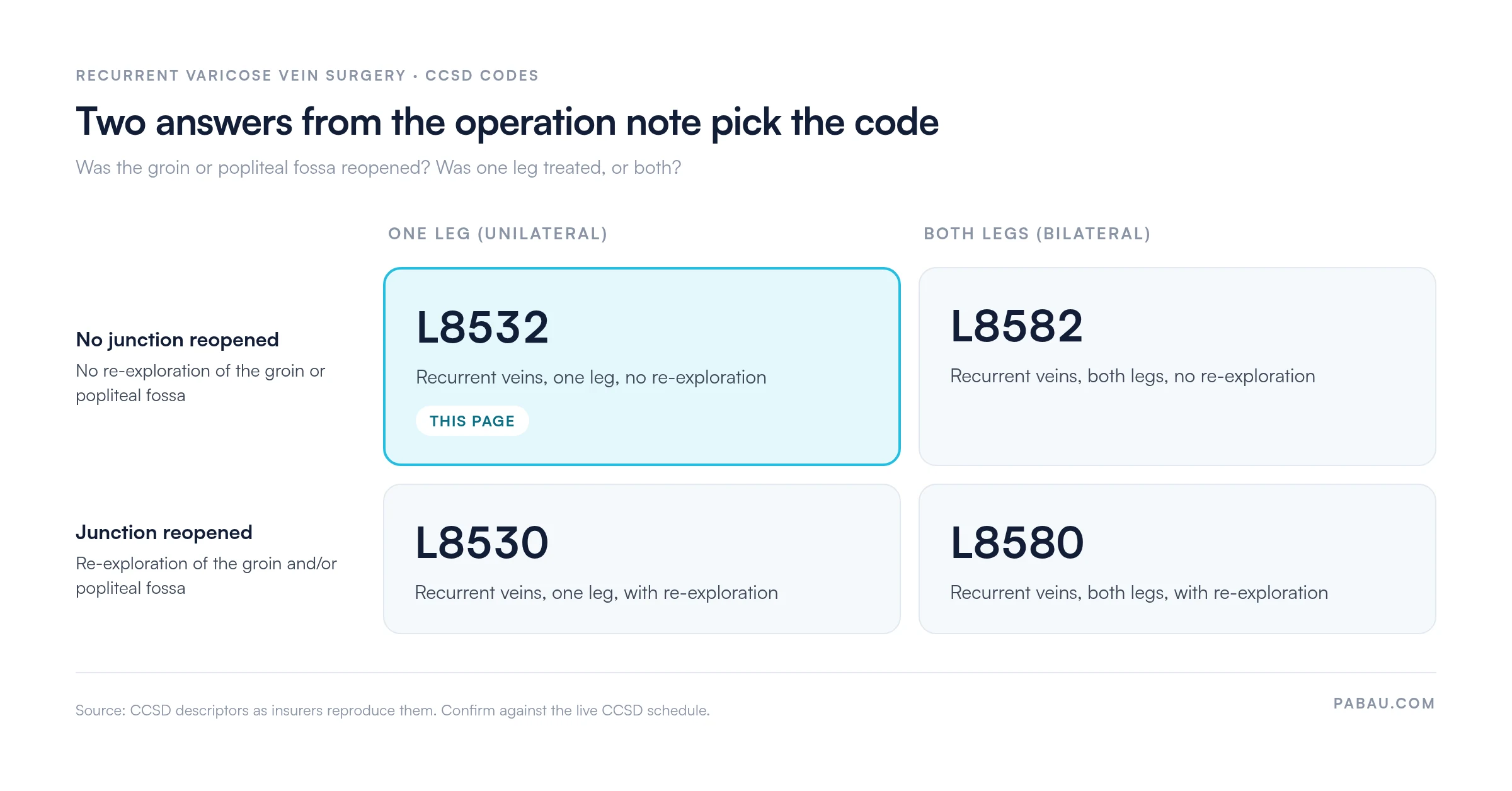
Descriptors above follow CCSD wording as insurers reproduce it, so confirm them against the live schedule. Payers sometimes shorten them, so match on the code, not the text.
Picture a patient who had her left great saphenous vein stripped some years ago. Now new varicosities bulge across her left calf.
Duplex shows no reflux returning at the groin junction. Instead, the veins fill from a calf perforator. The surgeon removes them through small calf incisions and leaves the groin alone.
That case is L8532. If the scan had shown recurrence at the groin, and the surgeon reopened it, the claim would move to L8530. Had she needed the same work on both legs, it would be L8582. Reopening the groin on both legs would make it L8580.
Recurrent veins rarely follow the original anatomy. That is why imaging drives both the clinical plan and the code choice.
NICE guideline CG168 recommends duplex ultrasound to confirm the diagnosis and plan treatment for suspected primary or recurrent varicose veins. The scan shows whether a junction has recurred, which decides between L8532 and L8530.
The same guideline puts endothermal ablation first and ultrasound-guided foam sclerotherapy second. It offers surgery when both are unsuitable. As a result, an insurer reviewing a surgical request may ask why the less invasive options were ruled out.
Keep the duplex report on file, dated before the operation. Also record the reason surgery was chosen over ablation or foam.
On a recurrence claim, the operation note carries more weight than the invoice. It is where an auditor checks the side, the incisions and what the surgeon left alone.
Consent deserves extra care here. NICE CG168 advises telling patients that recurrence after treating recurrent veins is more likely than after a first operation. Recording that discussion protects the practice if the veins return again.
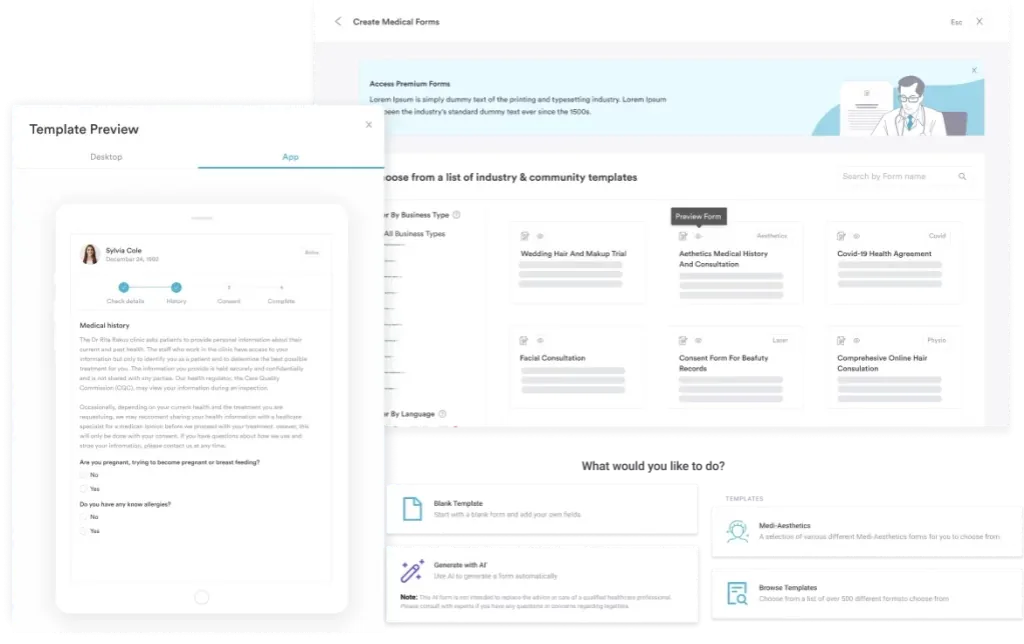
Add a required yes or no field to your operation note template asking whether the groin or popliteal fossa was re-explored. Your coder then picks between L8532 and L8530 from one answer, without decoding free text.
UK private medical insurers generally expect surgery to be authorized before it happens. So treat authorization as part of booking the surgery, not as paperwork for afterwards.
Each insurer runs its own process and portal. Bupa, AXA Health, Aviva and Vitality all set their own rules on recognition, referral and fees. Confirm the current terms with each one rather than relying on last year’s experience.
Three details matter most when you request it:
If the plan changes during surgery, call the insurer again. A surgeon who ends up reopening the groin has performed L8530, and the original authorization will not match. Bupa-insured patients follow Bupa’s own steps, set out in our Bupa CCSD codes guide.
Most private practices send CCSD-coded invoices through Healthcode, the UK’s main clearing service for insurance claims. Here is the usual path for one L8532 case.
The anesthetist usually bills the insurer separately for their own work. So keep both invoices tied to the same date and authorization.
Most rejections on recurrence codes trace back to a mismatch between the note, the authorization and the invoice. The table shows the common ones.
Sometimes, but check every pairing first. CCSD publishes lists of codes that should not be billed together, and insurers decide how strictly to apply them.
Here are the questions that come up most:
Recurrence claims fail on small mismatches. One file holds the authorization, another holds the operation note, and the invoice is typed from memory. Pabau keeps those pieces in one patient record instead.
Pabau connects with Healthcode, so the team can send CCSD-coded claims straight from that record. Before a claim goes, Pabau checks that required fields such as the membership and authorization numbers are filled in. Afterwards, the team follows each claim’s status and reconciles payments in the same place. Read more about our claims management software.
Digital forms cover the clinical side. Patients sign side-specific consent before the day of surgery, and the signed form stays attached to their record for any audit.
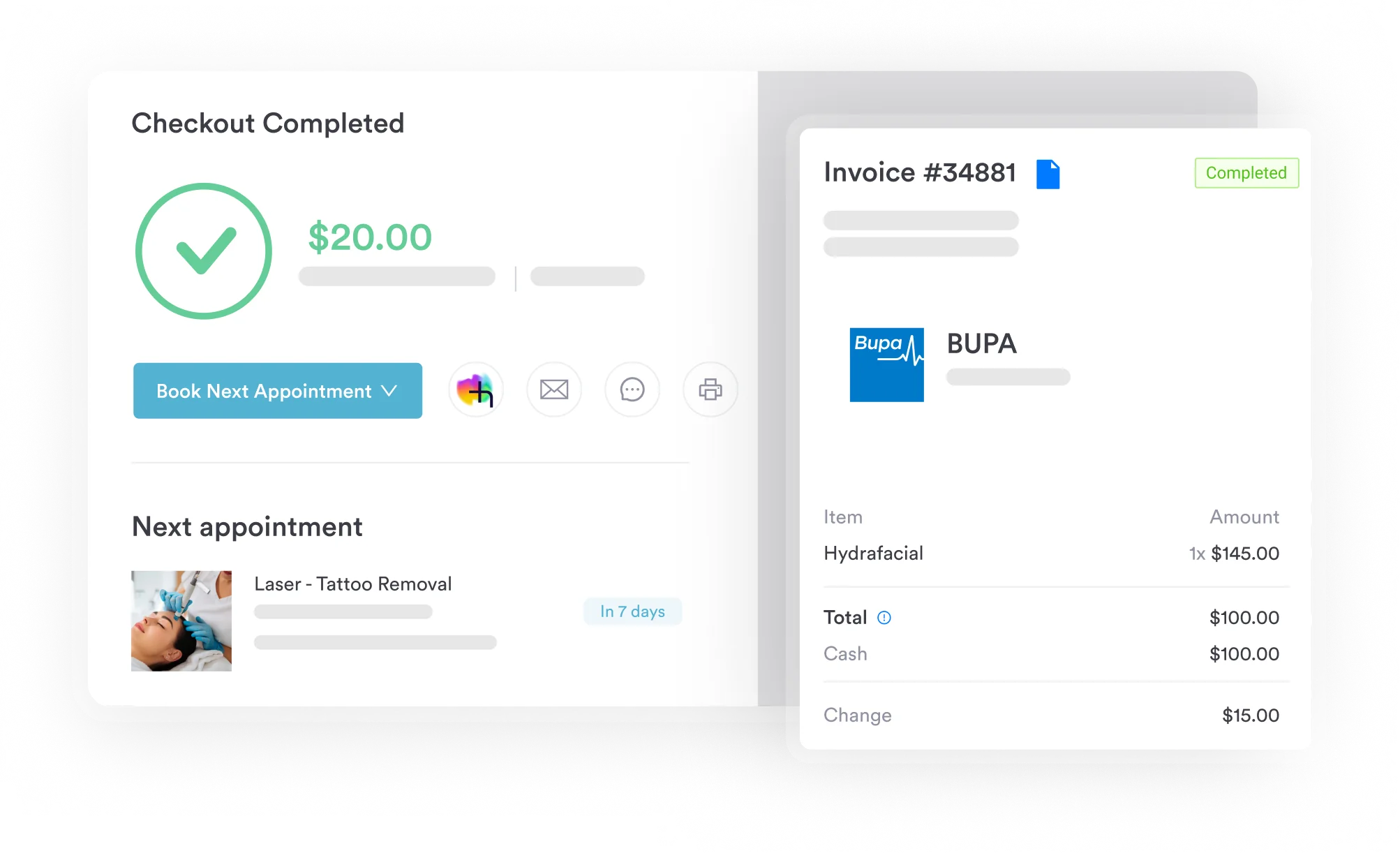

Pabau keeps authorization numbers, consent forms and Healthcode claims in one patient record. Your team can send recurrent varicose vein claims with the details already in place.

CCSD code L8532 rewards practices that code from the operation note, not from the booking. Settle the side and the approach during surgery, write both down, and the code follows.
The trade-off is upfront effort. A yes or no field in the note and a phone call when the plan changes cost minutes. A mismatched claim can cost weeks of queries.
Also confirm the code is still live before you rely on it. Book a demo to see how Pabau keeps authorizations, consent and Healthcode claims together for vascular practices.

Treating recurrent veins on both legs? CCSD code L8580 explains the bilateral recurrence code when the groin or popliteal fossa is reopened.
Using radiofrequency ablation instead? CCSD code L8540 walks through choosing between the ablation codes for one or more venous trunks.
Offering sclerotherapy as well? CCSD code L8600 covers unilateral injection sclerotherapy billing.
Billing Bupa patients? Bupa CCSD codes guide sets out recognition, fees and submission for Bupa-insured patients.
Treating both legs with injections? CCSD code L8680 covers bilateral varicose vein sclerotherapy billing.
It means reopening the groin to operate again where the great saphenous vein joins the deep vein. Re-exploring the popliteal fossa means the same behind the knee, at the small saphenous vein junction. Scar tissue makes both harder, which is why they carry separate codes.
Where a claim needs a diagnosis, varicose veins of the leg fall in the ICD-10 I83 group. I83.9 covers veins without ulcer or inflammation. I83.0, I83.1 and I83.2 cover ulcer, inflammation, or both.
No. Ultrasound-guided foam sclerotherapy has its own codes, which insurer listings give as L8620 for one leg and L8621 for both. Confirm laterality with the insurer. Injection sclerotherapy uses L8600 or L8680.
A consultant recognized by the patient’s insurer for vascular surgery. Check recognition before booking, because the insurer can decline a claim from an unrecognized consultant however well it is coded.
No insurer claim is made, so the code is optional. Recording L8532 anyway keeps activity reports consistent across insured and self-pay cases.