HCPCS Code J1110: Dihydroergotamine mesylate injection billing guide
HCPCS Code J1110: Official descriptor and drug overview HCPCS Code J1110 is the ...

Last Updated: Oct 29, 2026
L8580 is the CCSD code for operations for recurrent varicose veins with re-exploration of groin and/or popliteal fossa – bilateral. It covers redo surgery on both legs in one operative episode, after earlier varicose vein surgery.
On each side, the surgeon reopens the groin, the popliteal fossa behind the knee, or both. Use L8530 when only one side is re-explored, and L8582 for bilateral recurrent surgery without re-exploration. UK private insurers usually require pre-authorisation backed by a duplex scan.
Let Pabau's smart automation suggest the right codes, reduce claim denials, and keep your practice compliant—effortlessly.
Automate repetitive tasks and focus on what matters most—your patients.
Reduce coding errors and ensure compliance with the latest regulations.
Clean claims, fewer denials, and faster reimbursements.
Powerful insights and reporting to help your practice thrive.
HIPAA compliant SOC 2 certified GDPR-compliant Trusted by 4,000+ clinics worldwide

CCSD Code L8580 covers operations for recurrent varicose veins with re-exploration of the groin and/or popliteal fossa on both sides in one episode.
The unilateral equivalent is L8530, so never bill L8530 twice for a bilateral procedure, because L8580 is the single correct code.
Most UK private medical insurers require pre-authorisation supported by a duplex scan confirming bilateral recurrence before they will fund the procedure.
Vague or one-sided operative notes are a leading cause of L8580 denials, so the note must name the site re-explored on each leg.
Pabau, the practice management software we build, sends L8580 claims to Healthcode from the same system that holds the patient’s clinical records.
CCSD Code L8580 is the procedure code for operations for recurrent varicose veins with re-exploration of groin and/or popliteal fossa – bilateral. It belongs to the Clinical Coding and Schedule Development (CCSD) schedule used across UK private healthcare. The code applies when a patient who has had varicose vein surgery before needs a return operation on both legs. On each side, the surgeon reopens the groin, the popliteal fossa behind the knee, or both.
The CCSD is the standard coding system for private medical insurance billing in the UK. Insurers including Bupa, AXA Health, Aviva and Vitality require CCSD codes on surgical invoices. Healthcode validates submitted codes against the current CCSD schedule at the point of e-claim submission. A deprecated or incorrect code triggers an instant validation rejection before it ever reaches the insurer.
L8580 sits in the vascular chapter of the schedule, in the sub-group of operations for recurrent varicose veins: L8530, L8532, L8580 and L8582. The bilateral designation is built into the code descriptor, so the second side is already priced into the code. CCSD has no bilateral modifier, and no add-on should be appended to show it. Our library of CCSD codes for practices covers the other procedures in the schedule.
Re-exploration is surgically more demanding than a primary varicose vein operation. Scar tissue from the original procedure obscures the saphenofemoral junction (SFJ) in the groin, or the saphenopopliteal junction (SPJ) behind the knee. That raises the risk of injury to the deep veins, nearby arteries, nerves and lymphatic channels. For L8580 to apply, both sides must be re-explored at the groin and/or popliteal fossa in the same operative episode.
The typical operative sequence for bilateral re-exploration includes:
The operative note must document both sides explicitly, naming the site reopened on each leg: the groin, the popliteal fossa, or both. A note describing only one side will not support an L8580 claim, whatever code appears on the invoice.
Understanding why recurrence happens matters for coding because it decides whether L8580 or a primary varicose vein code is appropriate. The two are not interchangeable.
The main causes of recurrence following primary varicose vein surgery include:
Only recurrence that needs the groin or popliteal fossa reopened on both sides justifies L8580. Recurrence managed solely by foam sclerotherapy, ultrasound-guided ablation of tributaries, or perforator surgery without re-exploration falls under different CCSD codes. Bilateral recurrent surgery that reopens neither site is coded L8582.
L8530 covers the unilateral equivalent of this procedure: operations for recurrent varicose veins with re-exploration of groin and/or popliteal fossa on one side only. L8580 must be used when both sides are re-explored in a single anaesthetic episode. Billing L8530 twice for a bilateral procedure is incorrect, and double-billing it is a recognised audit trigger.
When only one side is re-explored despite a bilateral presentation, use L8530 and document clearly why the other side was not explored. Insurers will query a bilateral code if the duplex scan or clinical picture shows unilateral disease.
L8580 is one of four codes for operations on recurrent varicose veins. The schedule splits them by side count and by whether the groin or popliteal fossa is re-explored, as the grid below shows.
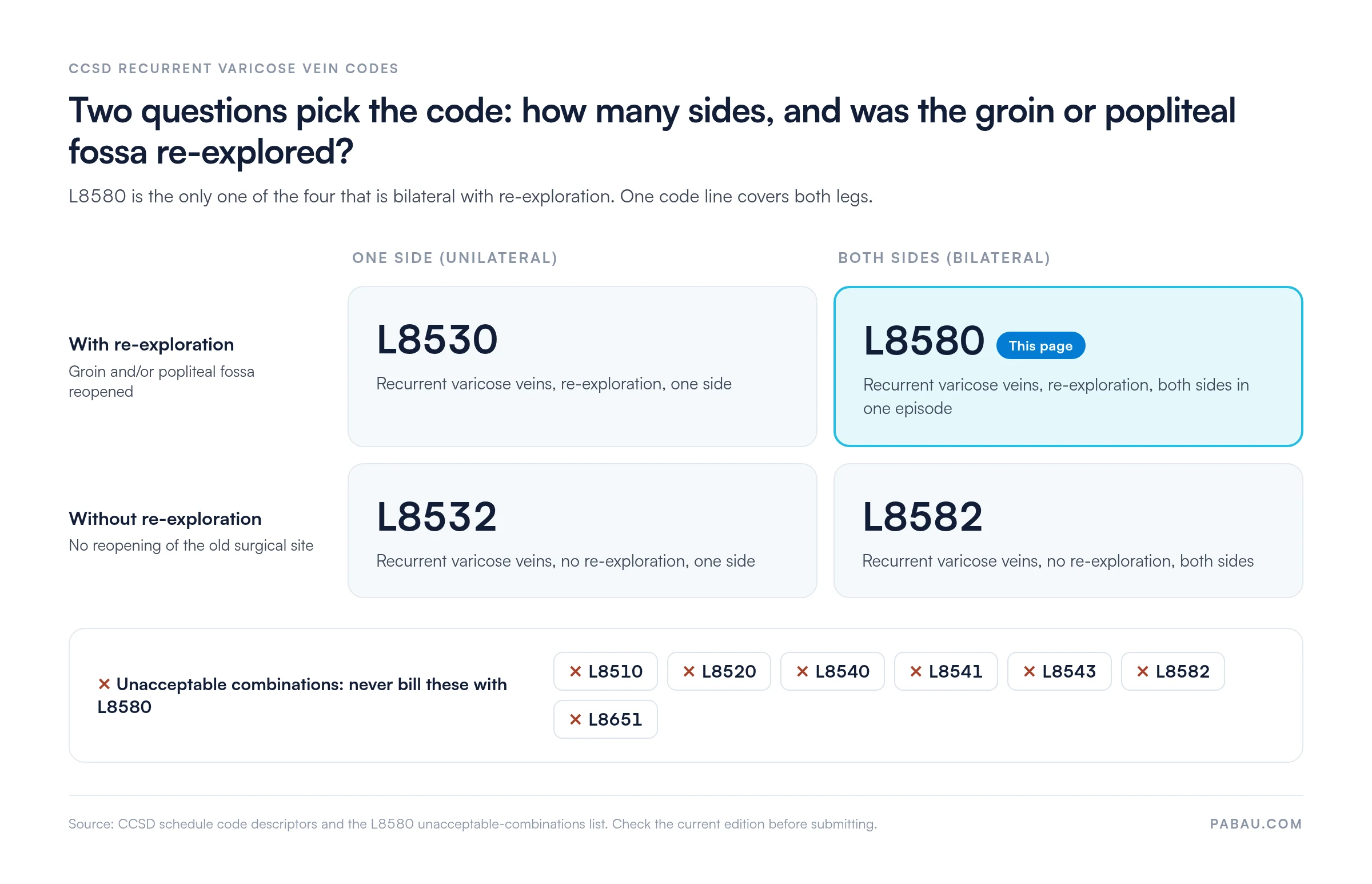
The schedule lists L8510, L8520, L8540, L8541, L8543, L8582 and L8651 as unacceptable combinations with L8580. A claim that pairs L8580 with any of them will be rejected or recoded, so check the current list before adding a second procedure line. Endovenous laser treatment has its own codes, from L8512 to L8515.
Important: Always verify bundling rules and unacceptable combinations against the active CCSD edition and the specific insurer’s schedule. Code descriptors and fee arrangements are updated periodically, and payers such as Bupa and AXA Health may apply their own restrictions. For Bupa-specific coding, our Bupa CCSD codes reference covers fee schedule structure and submission requirements in detail.
Every CCSD procedure code on a private insurance claim needs a relevant ICD-10 diagnosis code. For L8580, the diagnosis comes from the I83 category, varicose veins of lower extremities. No I83 code separates recurrent disease from primary disease. Recurrence is shown by the procedure code itself, the previous operative notes and the surgeon’s justification letter.
Because L8580 is a bilateral procedure, some insurers need the diagnosis entered for each limb. That applies when the payer’s Healthcode setup does not accept a single bilateral entry. Check the specific insurer’s submission requirements. Verify all ICD-10 code assignments against the NHS Classifications Browser, the authoritative source for UK ICD-10 fifth edition codes.
When a patient has previous operative notes from another surgeon, obtain copies before submitting the L8580 claim. Insurers increasingly ask for the original procedure report. It confirms that the current presentation is recurrence rather than a primary varicose vein procedure that was never completed.
Most UK private medical insurers require pre-authorisation for varicose vein surgery. For recurrent cases that need the groin or popliteal fossa re-explored, the evidence threshold is higher than for primary procedures. The insurer needs to establish that the original surgery was a covered event and that the recurrence warrants a return to theatre.
Standard documentation required for pre-authorisation includes:
Payer-specific notes: Bupa’s code search portal lets practitioners check current procedure codes and attached guidance notes before submitting a pre-authorisation request. The Vitality fee finder lists applicable CCSD codes and fee rates. AXA Health and Aviva may apply additional medical necessity criteria for bilateral recurrent cases. Always check directly with the insurer before the procedure, because pre-authorisation policies are updated independently of the CCSD schedule.
An L8580 claim that reaches the insurer without complete supporting documentation will be queried or denied. Because the code is bilateral, every document in the bundle must reflect both sides of the procedure.
The following documents should be assembled before submission:
L8580 denials tend to cluster around a small number of recurring errors. Knowing these in advance prevents most of them.
The most recoverable denials are the ones caught before submission. A pre-submission checklist covering the authorisation reference, documentation for both sides, unacceptable combinations and current code validation removes most of these errors.
Healthcode is the principal e-claims platform for UK private healthcare billing, used by the major insurers including Bupa, AXA Health, Aviva and Vitality. It validates CCSD codes against the current edition at the point of submission.
The submission steps for an L8580 claim are:
Complete the documentation before the claim is created, rather than assembling it afterwards, and you’ll make fewer corrections at the submission stage.
CCSD fees for L8580 are set within each insurer’s own fee schedule rather than a single universal rate. The bilateral element is already built into the L8580 descriptor and its fee banding. No bilateral modifier or add-on should be appended to the surgeon’s fee line, because doing so is over-coding and an audit risk.
Key fee and coding points for L8580 claims:
Always check the current CCSD edition for the authoritative code notes. For a given payer’s rates, its own published fee schedule takes precedence over any third-party source. The AXA Health specialist procedure codes portal is one example.
Fee schedules are updated independently by each insurer and are not always synchronised with CCSD edition updates. Before invoicing, verify the applicable fee against the current payer schedule rather than a previous claim or a colleague’s rate. A fee billed above the payer rate will be paid at the scheduled rate, not the invoiced amount.
Many vascular practices still keep the duplex report in one place and the operative notes in another, then key the claim into Healthcode by hand. That is how a one-sided note or a missing authorisation number reaches the insurer.
In Pabau, the patient’s Client record holds treatment notes, digital consent forms and medical questionnaires in one file. Surgical teams can record the findings for each leg in a digital form, so the bilateral detail is on file before anyone starts the claim.
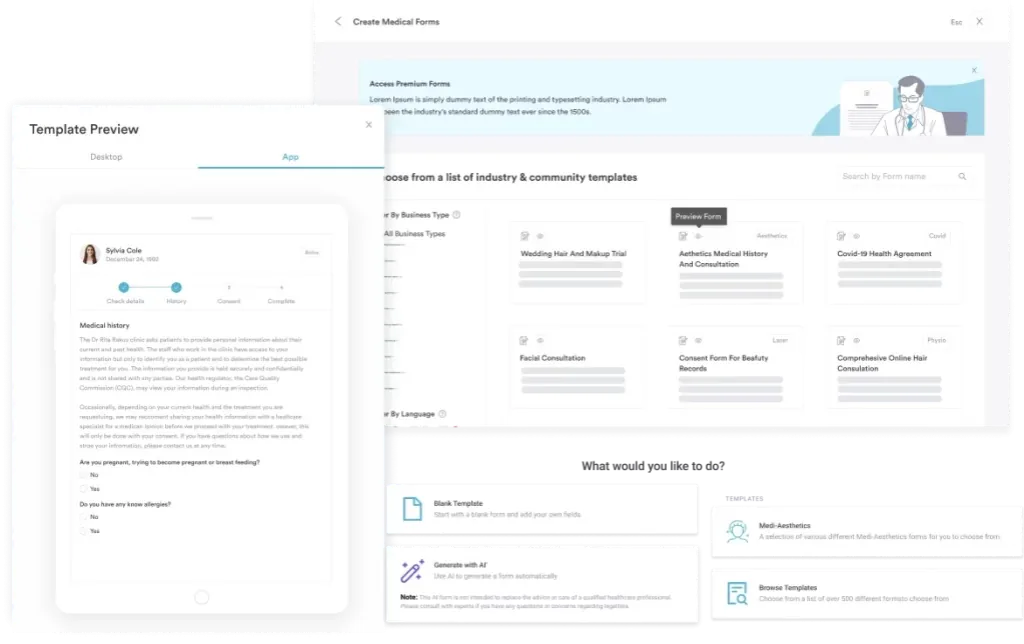
With Pabau’s private practice claims management, the finished claim goes to Healthcode from the same system, and your team tracks its status there. Patient details already in the record carry into the claim, so nobody retypes them into a second portal.
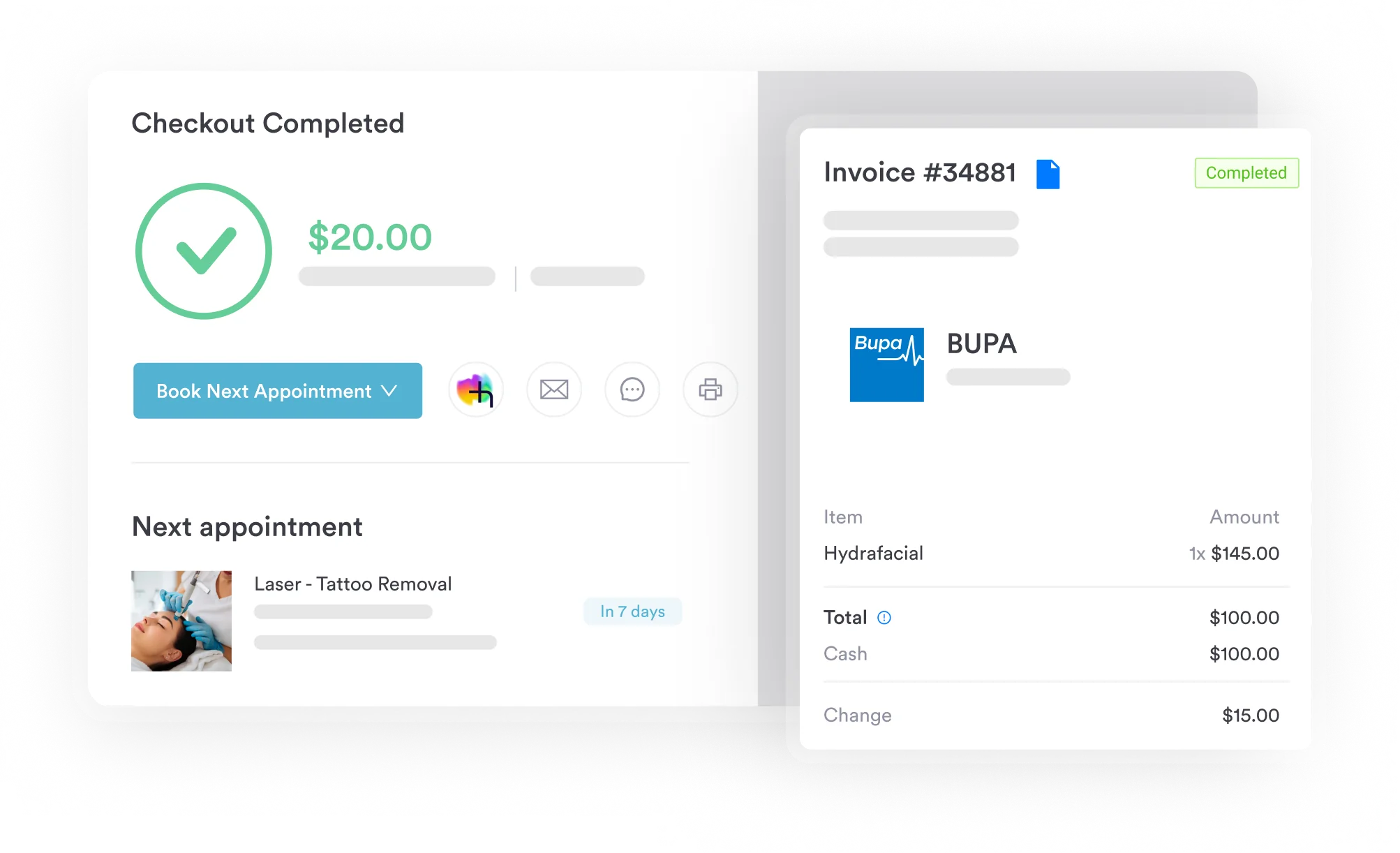

Pabau keeps operative notes and consent forms in the patient’s record and sends the claim to Healthcode. Each L8580 submission leaves with its paperwork in one place.

L8580 claims rarely fail on the code itself. They fail when the paperwork can’t show that both sides were re-explored, or when a barred second code rides along on the same claim.
So build the bundle before the operation, not after it. Get the duplex scan inside the insurer’s window, secure the authorisation number, and make sure the note names the site reopened on each leg. If only one side ends up re-explored, switch to L8530 rather than defending a bilateral code.
Book a demo to see how Pabau keeps clinical records and Healthcode claims together for recurrent varicose vein surgery.

Billing Bupa procedures in private practice? Pabau’s Bupa CCSD codes reference covers the Bupa fee schedule structure, code submission requirements, and how to look up current procedure rates.
Treating recurrence with laser instead? CCSD code L8513: Endovenous laser treatment bilateral covers coding and claims for bilateral endovenous laser treatment.
Managing recurrence with sclerotherapy? CCSD code L8680: Bilateral varicose vein injection sclerotherapy explains how bilateral injection sclerotherapy is coded and billed.
CCSD Code L8580 is the procedure code for operations for recurrent varicose veins with re-exploration of groin and/or popliteal fossa – bilateral. It applies when a patient with previous varicose vein surgery has return surgery on both legs in one operative episode. The groin, popliteal fossa or both are reopened on each side.
L8530 covers operations for recurrent varicose veins with re-exploration of groin and/or popliteal fossa on one side only. L8580 covers the same procedure on both sides in the same anaesthetic episode. Never bill L8530 twice for a bilateral procedure, because L8580 is the single correct code.
Yes. Most UK private medical insurers, including Bupa, AXA Health, Aviva and Vitality, require pre-authorisation for recurrent varicose vein surgery. Practitioners should submit a duplex scan report confirming bilateral recurrence, a clinical justification letter and previous operative notes before the procedure. Verify the current requirements with each insurer, as policies are updated independently.
Neovascularisation at the saphenofemoral junction is the most common cause, producing new vessels at the site of the original ligation. Other causes include a residual junction stump with patent tributaries, and disease progression in a different anatomical territory. Only recurrence that needs the groin or popliteal fossa reopened justifies L8580. Recurrence managed by foam sclerotherapy or ablation alone uses different CCSD codes.