HCPCS code G0257: Unscheduled or emergency dialysis billing guide
HCPCS code G0257: Official descriptor and code overview HCPCS code G0257 is defi...

Last Updated: Oct 27, 2026
L8540 is the CCSD code for radiofrequency ablation of more than one venous trunk +/– phlebectomies – unilateral. It applies when a surgeon closes two or more truncal veins in one leg in a single session. Any phlebectomy done at the same visit is included in the code.
L8540 sits in section 9.7 (varicose veins) of Chapter 9 of the CCSD schedule. Both legs treated in one session take L8541, and a single trunk takes L8542 (one leg) or L8543 (both legs).
Let Pabau's smart automation suggest the right codes, reduce claim denials, and keep your practice compliant—effortlessly.
Automate repetitive tasks and focus on what matters most—your patients.
Reduce coding errors and ensure compliance with the latest regulations.
Clean claims, fewer denials, and faster reimbursements.
Powerful insights and reporting to help your practice thrive.
HIPAA compliant SOC 2 certified GDPR-compliant Trusted by 4,000+ clinics worldwide

CCSD Code L8540 covers radiofrequency ablation of two or more venous trunks in one leg, with or without phlebectomies, in a single session.
Use L8540 instead of L8542 when the great saphenous vein and a second trunk are ablated in the same leg on the same day.
Treating both legs in one session is billed once under L8541, the bilateral code, never as L8540 twice.
UK private medical insurers such as Bupa, AXA Health, Aviva and Vitality expect pre-authorisation against the exact CCSD code before treatment.
Pabau’s claims management software helps UK private practices track pre-authorisation numbers and submit insurer claims for CCSD codes.
CCSD Code L8540 is defined as: Radiofrequency ablation of more than one venous trunk +/– phlebectomies – unilateral. It covers two or more venous trunks closed in one leg in one session.
CCSD stands for Clinical Coding & Schedule Development. It is the UK procedure schedule used for private medical insurance claims. A board of UK insurers, including Bupa, AXA Health, Aviva and Vitality, maintains it with the UK private hospital groups.
The code applies when a vascular surgeon uses a radiofrequency catheter to close two or more venous trunks in one leg in one session. It sits in section 9.7 (varicose veins) of Chapter 9, the vascular system chapter of the CCSD schedule. Freedom Health Insurance’s Chapter 9 schedule grades L8540 as an Intermediate procedure.
Each element of the descriptor carries a specific billing meaning. “More than one venous trunk” means at least two distinct truncal veins are ablated. That is most often the great saphenous vein (GSV) with the small saphenous vein (SSV) or an accessory saphenous vein.
“+/- phlebectomies” means ambulatory phlebectomy is already included in the code when performed in the same session. “Unilateral” limits L8540 to one leg. Both legs in the same session take the bilateral code, L8541.
Radiofrequency ablation uses a catheter-delivered thermal energy source to collapse and occlude incompetent venous trunks. When two or more trunks are treated, the procedure follows the same fundamental sequence for each vessel.
Understanding the scope of L8540 prevents both undercoding and overbilling. The table below summarises what is inside and outside the code’s descriptor.
The “+/-” notation for phlebectomy is often misread. It means phlebectomy may be included without an extra code when it is done in the same session, not that every L8540 claim assumes one. The phlebectomy section below sets out the billing and documentation rules.
Section 9.7 of the CCSD schedule has four radiofrequency ablation codes. They share the same modality and the same “+/- phlebectomies” element. They differ on two criteria: how many venous trunks are ablated, and whether one leg or both are treated. Answer both questions from the operative note and the code follows.
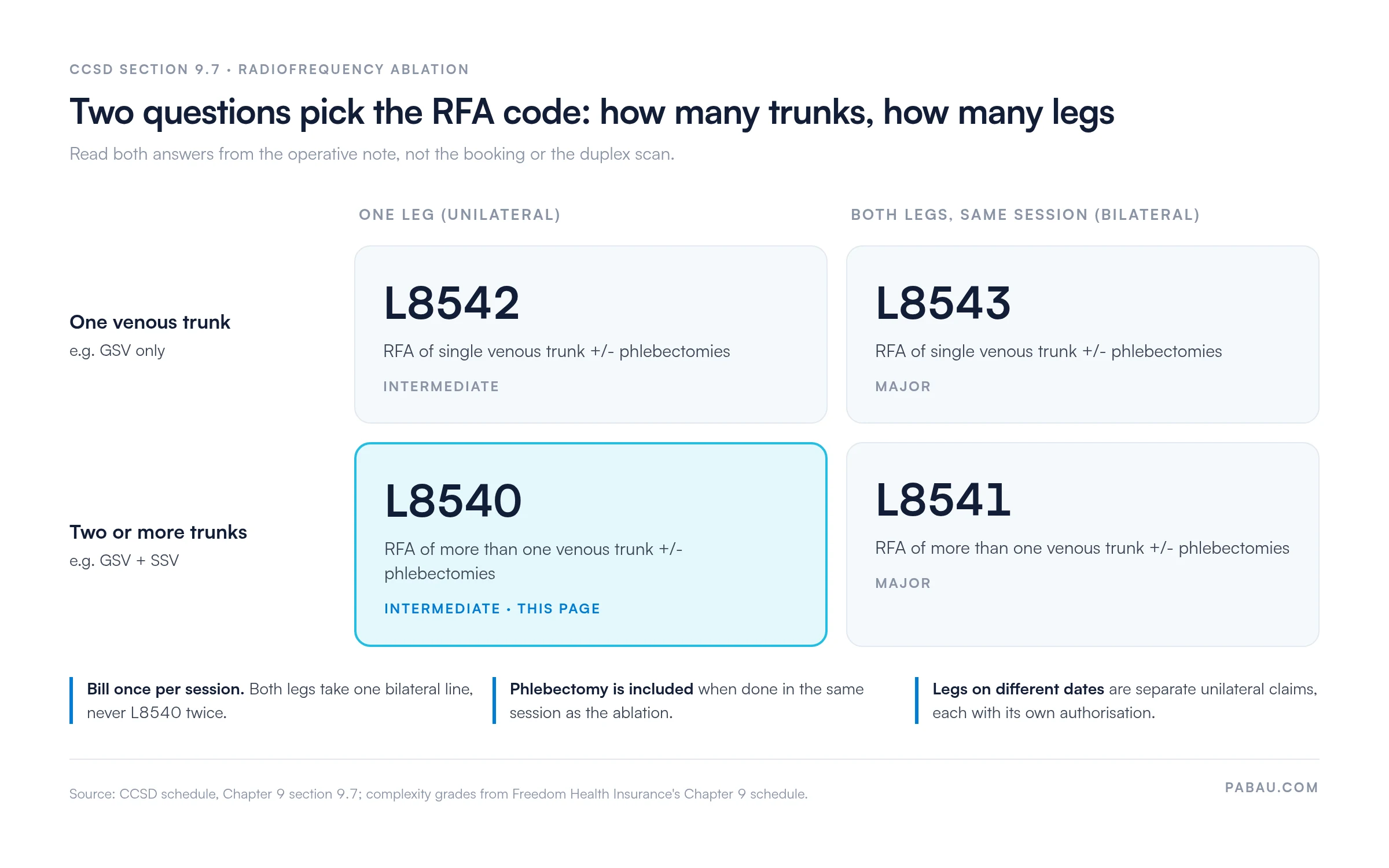
The operative note decides the code. If the surgeon ablated the GSV and SSV in the right leg only, L8540 is correct. If only the GSV was treated, L8542 applies, whatever the patient’s anatomy. The code follows the number of trunks ablated, not the number showing reflux on the pre-procedure duplex.
The laser equivalents follow the same pattern in the same section. L8514 and L8515 cover endovenous laser treatment of more than one trunk, in one leg and in both legs. If the surgeon switched from radiofrequency to laser, code the modality the surgeon used.
Every L8540 claim must be supported by an ICD-10 diagnosis code that reflects the patient’s documented clinical findings. UK insurers use the WHO ICD-10 classification, and the appropriate codes fall within the I83 family (varicose veins of lower extremities).
The WHO ICD-10 I83 codes do not carry laterality, so the CCSD code and the operative note must show which leg was treated.
Submitting I83.9 for a patient whose notes describe active inflammation will be flagged on clinical audit. Conversely, using I83.1 without supporting documentation of inflammation is a misrepresentation. Select the code that most accurately reflects the documented clinical findings on the date of service.
Keep a short crosswalk card in your billing workspace for section 9.7. Before submitting, check the operative note for the number of trunks ablated and whether one leg or both were treated. Then confirm the CCSD code (L8540, L8541, L8542 or L8543) and the ICD-10 code both match it.
UK private medical insurers expect pre-authorisation before L8540 is performed. The patient usually calls their insurer for an authorisation number, and the insurer checks the CCSD code and the planned date. Requirements vary between Bupa, AXA Health, Aviva, Vitality and other insurers, so check each insurer’s criteria. The prerequisites below are the common ones.
Authorisation is issued against a specific CCSD code. If one leg is planned, authorise L8540. If both legs will be treated in the same session, authorise L8541. If the plan changes on the day, contact the insurer to update the authorisation before the claim goes in.
The Bupa procedure code lookup and similar insurer tools let practices check code-specific rules and fees before booking.
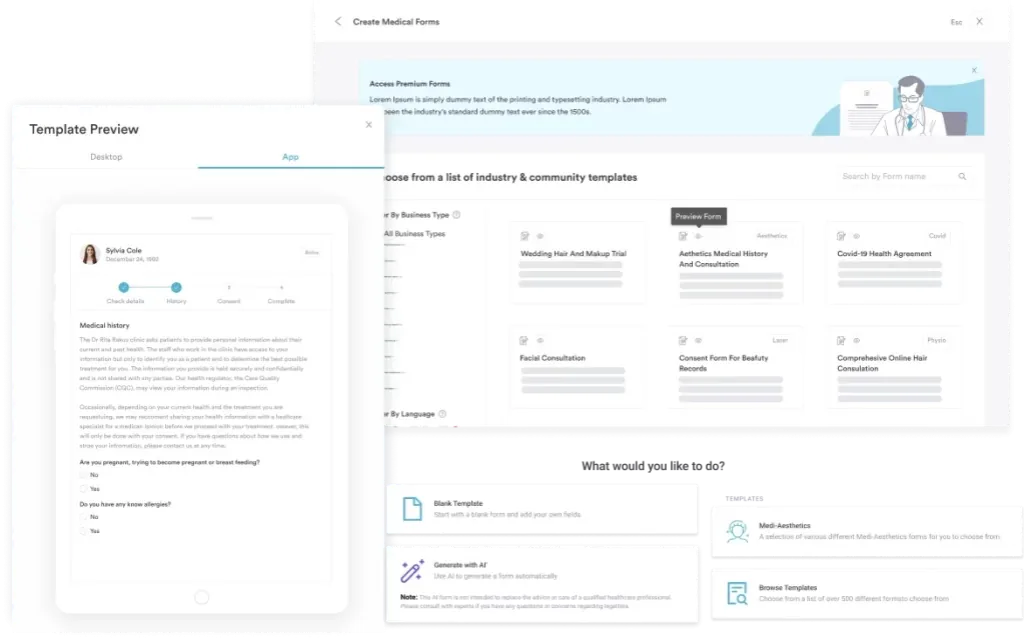
Complete clinical documentation is the main defence against a CCSD Code L8540 denial. Every item below must be present in the patient record before the claim is submitted. Structured digital forms reduce the risk of incomplete records reaching the billing team.
The “+/-” notation in the L8540 descriptor means phlebectomy is optional. When it is performed in the same session, it is bundled into the code. In practical billing terms, this means the following rules apply.
When phlebectomy is performed alongside RFA: Bill L8540 only. Do not add a separate phlebectomy code alongside L8540. The concurrent phlebectomy is included in the L8540 tariff. Adding a standalone phlebectomy code on the same claim date will be considered duplicate or unbundled billing and will be declined or reversed on audit.
When phlebectomy is performed without RFA: Standalone phlebectomy has its own CCSD codes, L8750 (unilateral) and L8751 (bilateral). L8540 must not be used when no radiofrequency ablation has been performed. The code’s descriptor requires ablation as the primary procedure.
Documentation requirement: Even though phlebectomy is bundled, the operative note must describe it specifically. Record the number and anatomical distribution of stab incisions and the veins removed. Without this documentation, an insurer reviewing the claim cannot confirm the “+/-” element was performed, which creates grounds for clawback.
Check the insurer’s own billing guidance before claiming for any other procedure performed at the same visit, as bundling rules differ between insurers. Our CCSD guides for coders cover the codes for those other procedures. The Bupa CCSD codes guide sets out the general submission framework used across UK private insurers.
L8540 is a unilateral code. When more than one trunk is ablated in each leg in the same session, CCSD has a dedicated bilateral code. That code is L8541, “Radiofrequency ablation of more than one venous trunk +/- phlebectomies – bilateral”. It is billed once for both legs.
Most L8540 rejections trace back to a handful of avoidable errors. The table below maps the most frequent denial triggers to the action that prevents each one.
When a claim is rejected or part-paid, ask the insurer for its reason in writing. Each insurer pays against its own fee schedule, so a shortfall may reflect the schedule rather than a coding error. A written reason shows whether the denial is administrative (missing documentation) or clinical (a medical necessity query).
You can then route the appeal to the correct team.
Run a monthly L8540 denial audit. Export all L8540 claims from the past 90 days and group declines by denial reason. A cluster of wrong-code rejections points to an operative note problem. A cluster of missing-authorisation rejections points to the booking step. Fixing the upstream process takes less time than managing individual appeals.
L8540 claims have more moving parts than a standard procedure claim. There are two trunks to document, a phlebectomy decision to record, and a choice between unilateral and bilateral codes. An authorisation number must also be linked before the claim goes out. A manual workflow can drop any one of them between theatre and the claim form.
Pabau, the practice management platform we build, keeps those steps in one patient record. Its private practice claims software stores the pre-authorisation number against the booking and the CCSD code.
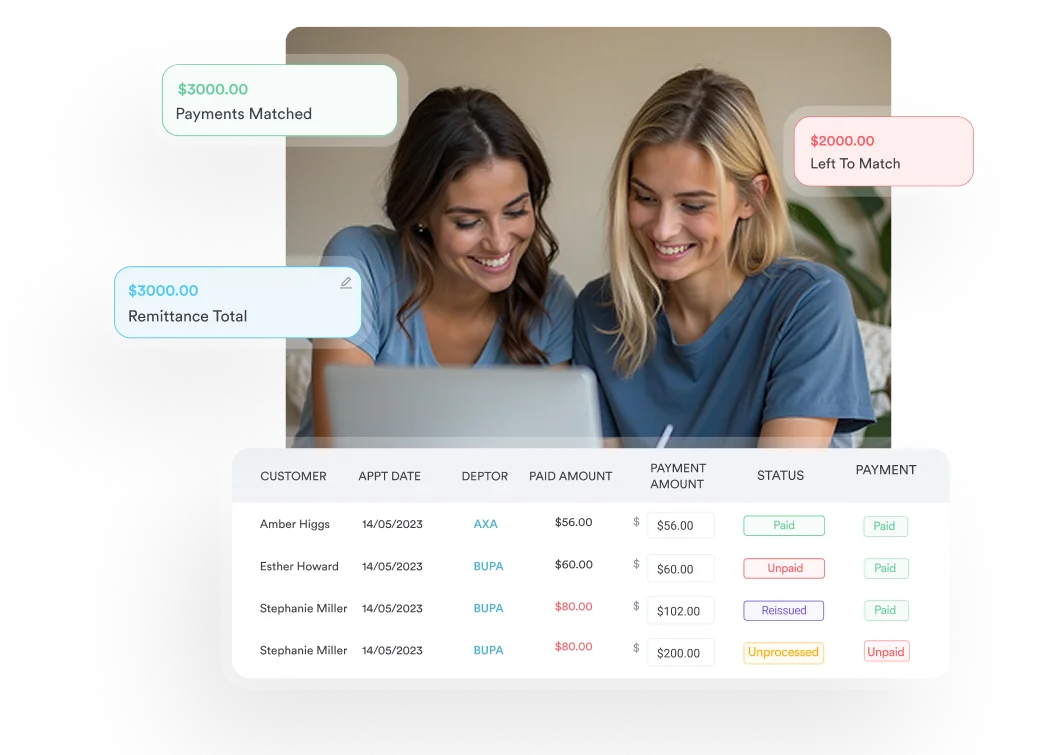
It also tracks each insurer claim from submission to payment. Most UK insurers accept electronic claims through Healthcode, so a clean claim reaches the insurer without paper resubmissions.
Structured operative note templates help surgeons record each trunk, each leg and any phlebectomy at the point of care. The billing team then picks the right section 9.7 code from the note, not from memory.

Pabau helps UK private practices track pre-authorisation numbers, document procedures in structured notes and submit insurer claims. See how it handles L8540, L8541 and related vascular codes in a live walkthrough.

CCSD Code L8540 rewards practices that code from the operative note, not from the booking. The two costliest errors are billing L8542 when two trunks were ablated, and billing L8540 twice instead of L8541 for both legs. Both start before the coder sees the claim, when the note fails to record trunks and legs clearly.
Fix the note template and the authorisation step, and the right section 9.7 code follows on its own. Pabau gives UK vascular practices one place to hold the note, the authorisation number and the insurer claim. To see it handle L8540 and L8541 claims, book a demo.

Treated both legs in the same session? CCSD code L8541 is the bilateral radiofrequency ablation code to bill once in place of L8540 twice.
Did the surgeon use laser in place of radiofrequency? CCSD code L8513 covers bilateral endovenous laser treatment and the laterality errors that get those claims rejected.
Is the patient having injection sclerotherapy on one leg? CCSD code L8600 covers unilateral varicose vein sclerotherapy, including pre-authorisation and documentation.
Are both legs being treated with sclerotherapy? CCSD code L8680 covers bilateral injection sclerotherapy and when to use it in place of L8600.
CCSD Code L8540 covers radiofrequency ablation of more than one venous trunk, with or without phlebectomies, in one leg in a single session. It applies when two or more trunks are ablated in the same leg. These are typically the great saphenous vein with the small or an accessory saphenous vein.
L8542 applies when a single venous trunk is ablated by radiofrequency in one leg. L8540 applies when two or more trunks are ablated in the same leg in the same session. Both are unilateral and both include the “+/- phlebectomies” element. Their bilateral versions are L8543 and L8541.
Yes. When phlebectomy is performed in the same session as the radiofrequency ablation, it is included in L8540 and no separate phlebectomy code is added. The “+/-” notation means phlebectomy is optional, not automatic. If it is performed, document it fully in the operative note.
L8540 is billed per leg, not per vein. One L8540 covers every trunk ablated in that leg in the session. If both legs are treated in the same session, bill the bilateral code L8541 once instead of L8540 twice.
Yes. UK private medical insurers such as Bupa, AXA Health, Aviva and Vitality expect pre-authorisation against the CCSD code before treatment. Typical requirements are a duplex report confirming reflux, documented symptoms and a GP referral. Criteria vary by insurer and policy, so check before booking.
The ICD-10 codes for L8540 come from the I83 family of varicose veins of the lower extremities. They are I83.0 (with ulcer), I83.1 (with inflammation), I83.2 (with both) and I83.9 (with neither). Choose the code that matches the documented clinical findings on the date of service.
No. L8540 is a unilateral code. When more than one trunk is ablated in each leg in the same session, bill L8541, the bilateral code, once. Submitting L8540 twice for the two legs is a coding error and is likely to be rejected.
Tumescent local anaesthesia given by the operating surgeon is part of the L8540 procedure and has no separate CCSD code. Where a separate anaesthetist attends, they bill their own fee against the same CCSD code under the insurer’s anaesthetist schedule. Check the insurer’s guidance if you are unsure.