CPT code 22533: Lateral extracavitary lumbar arthrodesis billing guide
CPT code 22533: official descriptor and what it covers CPT code 22533 describes ...

Last Updated: Nov 11, 2026
L8700 is the CCSD code for ligation/stripping of long and short saphenous veins (including local excision/multiple phlebectomy).
Let Pabau's smart automation suggest the right codes, reduce claim denials, and keep your practice compliant—effortlessly.
Automate repetitive tasks and focus on what matters most—your patients.
Reduce coding errors and ensure compliance with the latest regulations.
Clean claims, fewer denials, and faster reimbursements.
Powerful insights and reporting to help your practice thrive.
HIPAA compliant SOC 2 certified GDPR-compliant Trusted by 4,000+ clinics worldwide

CCSD code L8700 covers ligation and stripping of both the long and short saphenous veins in one leg, with local excision and multiple phlebectomy included.
A single trunk is coded L8510, and both trunks on both legs in one session are coded L8780.
Phlebectomy on the same leg in the same session is bundled into L8700, and a separate line is typically rejected by UK private insurers.
UK private insurers generally require a pre-operative duplex ultrasound and pre-authorization before they accept an L8700 claim.
Pabau, the practice management platform we build, keeps the duplex report, operative note and claim in one patient record, so the claim matches the note.
CCSD code L8700 covers ligation and stripping of both the long and short saphenous veins in one leg. CCSD stands for Clinical Coding and Schedule Development. Local excision and multiple phlebectomy on that leg are included. The official CCSD schedule defines its descriptor as: Ligation/stripping of long and short saphenous veins (including local excision/multiple phlebectomy).
The code applies when the surgeon treats both trunks on the same leg in one operative session. Stripping a single trunk, long or short, is a different code, L8510. Treating both trunks on both legs in one session is L8780.
L8700 sits in the varicose veins section of the vascular system chapter in the CCSD code library. It applies to procedures performed under general or regional anesthesia in a private hospital or day-surgery unit. Endothermal techniques such as endovenous laser ablation (EVLA) and radiofrequency ablation (RFA) carry their own CCSD codes. L8700 covers open ligation at the junction, mechanical stripping of both trunks, and stab avulsion of branches.
Saphenous vein ligation and stripping under L8700 follows the same surgical sequence on each trunk. Knowing the steps helps billing teams confirm that the operative note supports the code.
When both trunks are treated on both legs under the same anesthetic, the claim moves to the bilateral code, L8780. That scenario is covered in the bilateral section below.
Private insurers approve L8700 only when varicose vein surgery is medically necessary, not cosmetic. NICE guideline CG168 recommends endothermal ablation as the first-line treatment where the anatomy is suitable. That shapes L8700 billing. Insurers increasingly want documented evidence that thermal techniques were considered and found unsuitable before they authorize open surgery.
The standard clinical justification criteria are:
CEAP classification C1 (telangiectases only) does not qualify as a surgical indication. Claims supported only by cosmetic concern are excluded under most policy wording, whatever CEAP score is documented.
The bundling rule is the most common source of coding errors on L8700 claims. Multiple phlebectomy and local excision of varicose tributaries are written into the L8700 descriptor. When they happen in the same session on the same leg, they cannot be billed as separate line items. A separate phlebectomy line for that leg will trigger an unbundling query or a denial.
Separate coding can apply in two situations:
If two procedures are claimed, the operative notes should state clearly which leg each one was performed on.
L8700 is one of several CCSD codes for varicose vein procedures, and picking the wrong one is a common cause of adjudication queries. The table below summarizes the adjacent codes:
The most common selection error is using L8700 when only one trunk was stripped. Single-trunk stripping is L8510 on one leg and L8520 on both, with or without phlebectomy. Endothermal cases move to their own ranges, such as L8512 for laser treatment.
Radiofrequency ablation of more than one trunk is L8540. The grid below sorts the open-surgery codes by trunks treated and legs operated on, so you can check the operative note against it.
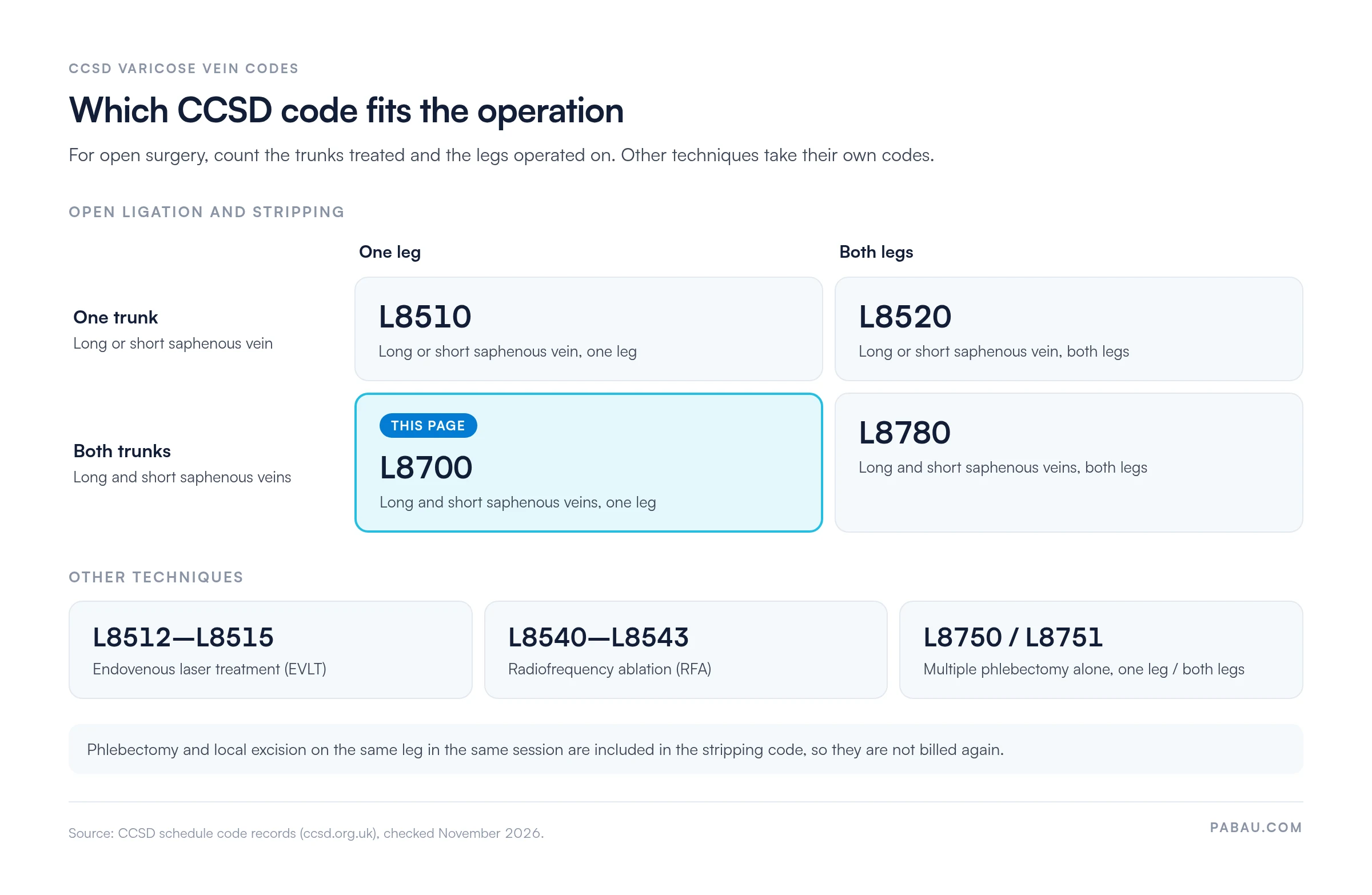
Read the operative note before choosing between L8700, L8510 and L8780. What counts is which veins were treated and documented, not which were planned. A note that describes stripping of the long saphenous vein only supports L8510, whatever the consent form listed.
L8700 is a one-leg code. When both long and short saphenous veins are treated on both legs in the same session, the CCSD code is L8780. That is the bilateral version of the same procedure. Insurers still differ on how they authorize and pay bilateral surgery, so a universal rule will cause denials.
These conventions change between policy years. Check each insurer’s current provider guide rather than relying on what worked in a previous claims cycle. Where the two legs need different procedures, confirm the coding with the insurer before submission.
UK private insurers generally require pre-authorization before varicose vein surgery. An L8700 claim without a valid pre-auth reference is normally rejected. This applies whether the procedure is a day case or an overnight admission.
The documentation package for the authorization request typically includes:
Bupa and AXA Health both specify duplex evidence in their clinical criteria for varicose vein procedures. Pabau’s Bupa CCSD codes guide covers Bupa’s coding conventions. Use the AXA Health procedure codes portal to verify current AXA criteria before submission.
Beyond the pre-auth package, the claim itself needs complete clinical documentation. Missing documentation is one of the most frequent reasons L8700 claims are queried after submission. Make sure the patient record contains:
L8700 denials follow predictable patterns. Most trace back to one of these causes:
The Healix fee schedule and similar insurer tools publish unbundling guidelines. Billing teams can use them to check which components are included and which are payable separately before submission.
Run a pre-submission check before every L8700 claim. Confirm the pre-auth reference, the dated duplex report, the CEAP score, the ICD-10 code and the leg treated. Make sure the operative note describes ligation and stripping of both trunks. Five minutes here saves a six-week adjudication cycle.
CCSD claims submitted through Healthcode must include an ICD-10 diagnosis code alongside the procedure code. The right code depends on how the varicose veins present clinically.
I83.9 is the code most often used for elective saphenous vein surgery in the private sector. Most patients present at CEAP C2-C3, before skin changes develop. No ICD-10 code turns a purely cosmetic episode into a medically necessary claim. The diagnosis code must reflect what the clinical record documents.
Most UK private practice billing teams submit CCSD claims electronically through Healthcode, the standard clearinghouse for UK private healthcare. Getting the submission structure right prevents a system-level rejection before the claim reaches the insurer’s adjudicator.
In many vascular practices the duplex report sits in one system, the operative note in another, and the claim is keyed into Healthcode by hand. The billing team then rebuilds the trunk count, the leg treated and the procedure date from the notes. Each retyped field is a chance to submit L8700 where L8510 or L8780 was due.
Pabau keeps the duplex report, consent form, operative note and claim in the same patient record. Its claims management software draws the operative date, diagnosis code and laterality from that record. The team checks the code against the note instead of retyping it.
The result is a claim that agrees with the note it came from. When an insurer queries an L8700 claim, the evidence is already filed against the episode.
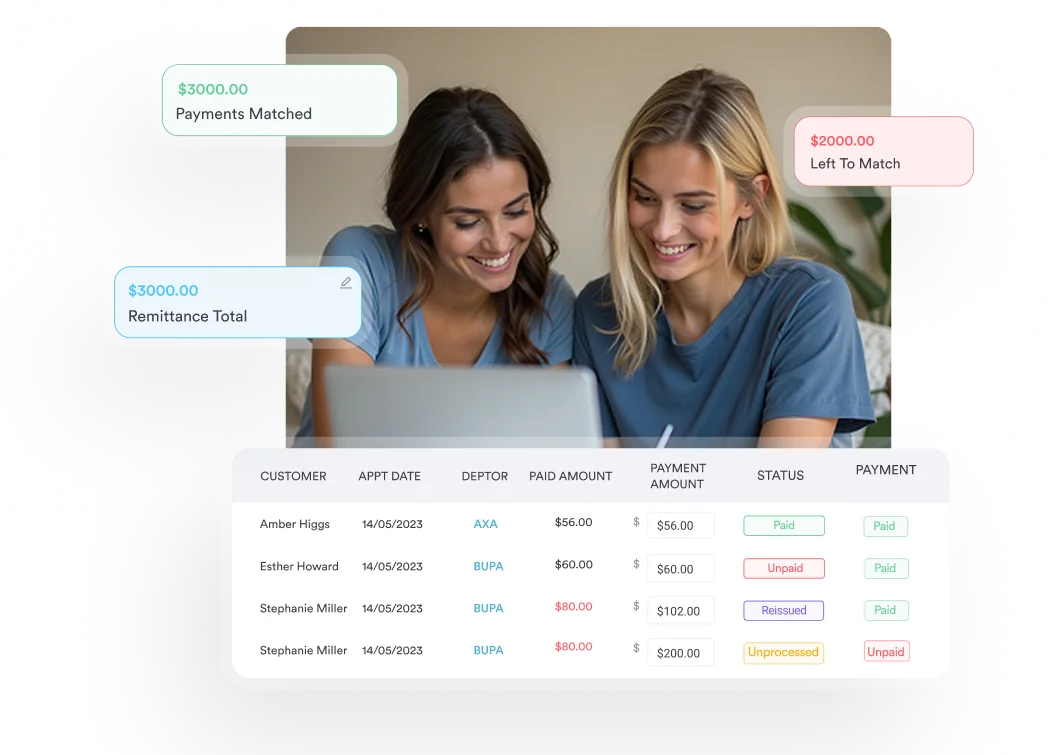

Pabau connects your operative notes, consent records, and CCSD claim submission in one workflow, so the documentation insurers audit stays complete and consistent.

Before an L8700 claim goes out, read the operative note for two facts: how many trunks were stripped, and on how many legs. One trunk is L8510, both legs is L8780, and only both trunks on one leg is L8700. Get that right and the remaining checks are routine paperwork.
The trade-off is time spent before submission against weeks lost to a query afterward. A practice that files the duplex report, CEAP score and phlebectomy detail with the note rarely has to defend the claim. Book a demo to see how Pabau links vascular operative notes to CCSD claims.

Need a full reference for Bupa CCSD codes? Bupa CCSD codes covers Bupa’s procedure code schedule, billing conventions, and fee submission requirements for UK private practice.
Billing single-trunk stripping on both legs? CCSD code L8520 explains the bilateral code for ligation and stripping of one saphenous trunk on each leg.
Treating the trunk with laser instead of open surgery? CCSD code L8512 covers endovenous laser treatment of a single venous trunk and what the claim needs.
Using radiofrequency ablation on more than one trunk? CCSD code L8540 sets out the code for radiofrequency ablation of multiple venous trunks.
Looking to streamline your private practice billing workflow? Claims management software outlines how Pabau supports CCSD claim submission and adjudication management.
CCSD code L8700 covers ligation and stripping of both the long and short saphenous veins in one leg, in one operative session. Local excision and multiple phlebectomy on that leg are included. It does not apply to endothermal ablation such as EVLA or RFA, which carry their own CCSD codes.
Multiple phlebectomy and local excision are included in L8700 when performed in the same session on the same leg. They cannot be submitted as separate line items alongside L8700. A separate phlebectomy line is typically rejected by UK private insurers as unbundling.
Yes. Bupa, AXA Health, and other UK private insurers want a pre-operative color duplex ultrasound confirming venous reflux before they authorize varicose vein surgery. The report should be dated within the insurer’s window, typically six to twelve months before the operation.
No. L8700 covers one leg only. When both long and short saphenous veins are treated on both legs in one session, the CCSD code is L8780. Insurers still differ on pre-authorization and fees for bilateral surgery, so confirm the convention in each insurer’s provider guide before submission.
CEAP C2 or above is the standard surgical threshold UK private insurers apply, though exact thresholds vary by insurer and policy version. The CEAP score must be documented explicitly in the clinical notes, not implied. CEAP C1 (telangiectases only) is not normally accepted as a surgical indication.
Insurers apply a cosmetic exclusion when the documentation does not show medical necessity. If the clinical letter or operative note mentions appearance or patient preference without symptoms, CEAP class, and duplex-confirmed reflux, the claim is denied as cosmetic. Record all three in the clinical notes before you request pre-authorization.