HCPCS code G0257: Unscheduled or emergency dialysis billing guide
HCPCS code G0257: Official descriptor and code overview HCPCS code G0257 is defi...

Last Updated: Oct 27, 2026
L8541 is the CCSD code for radiofrequency ablation of more than one venous trunk +/– phlebectomies – bilateral. It covers endovenous radiofrequency closure of two or more truncal veins, such as the great and small saphenous veins. Both legs are treated in the same session.
Phlebectomies performed at that session sit within the code and are not billed separately. One leg treated codes to L8540, a single trunk on each leg codes to L8543, and laser ablation uses the EVLT codes.
Let Pabau's smart automation suggest the right codes, reduce claim denials, and keep your practice compliant—effortlessly.
Automate repetitive tasks and focus on what matters most—your patients.
Reduce coding errors and ensure compliance with the latest regulations.
Clean claims, fewer denials, and faster reimbursements.
Powerful insights and reporting to help your practice thrive.
HIPAA compliant SOC 2 certified GDPR-compliant Trusted by 4,000+ clinics worldwide

CCSD Code L8541 covers bilateral radiofrequency ablation of more than one venous trunk in a single session, distinguishing it from the unilateral code L8540.
The “+/-” in the descriptor means same-session phlebectomies are included in the code. Billing them separately often triggers a bundling denial.
Duplex ultrasound confirming bilateral venous reflux, an operative note naming each trunk treated, and tumescent anaesthesia records are required for every L8541 claim.
Claims software such as Pabau tracks pre-authorisation status, attaches procedure documentation and validates L8541 claims before they reach Healthcode.
CCSD Code L8541 is the Clinical Coding and Schedule Development code for bilateral radiofrequency ablation of more than one venous trunk, with or without phlebectomies.
The CCSD group publishes and maintains the code set. UK private medical insurers use it to reimburse bilateral endovenous thermal ablation, including Bupa, AXA Health, Aviva, Vitality and WPA.
Four elements define L8541 and decide when it is the correct code to use:
Billing the correct CCSD code starts with knowing what happens clinically. A typical bilateral RFA session follows these steps:
The coder’s task is to verify that the operative note confirms each of these steps and names both legs and every trunk explicitly. A note that describes only one leg defaults to a unilateral code, whatever the surgeon intended.
CCSD Code L8541 claims must be supported by a diagnosis code that establishes medical necessity. The most common ICD-10 codes accepted by UK private insurers for bilateral RFA are:
NICE guideline CG168 recommends endothermal ablation as the first treatment for confirmed truncal reflux. It reserves compression hosiery for patients whose intervention is declined or unsuitable, so it sets no hosiery trial before ablation.
Some insurers still require a trial under their own policies, often six weeks of compression hosiery, before approving ablation for I83.9 or I87.2.
Codes I83.0 to I83.2 indicate advanced disease and generally face fewer conservative-treatment hurdles. Always pair the diagnosis code to the documented clinical presentation, not to the code most likely to be approved.
L8540 covers radiofrequency ablation of more than one venous trunk on a single leg, and L8541 is its bilateral equivalent. Choosing the wrong one is among the most frequent billing errors in phlebology practices. Three questions about the session, answered from the operative note, settle which radiofrequency code applies.
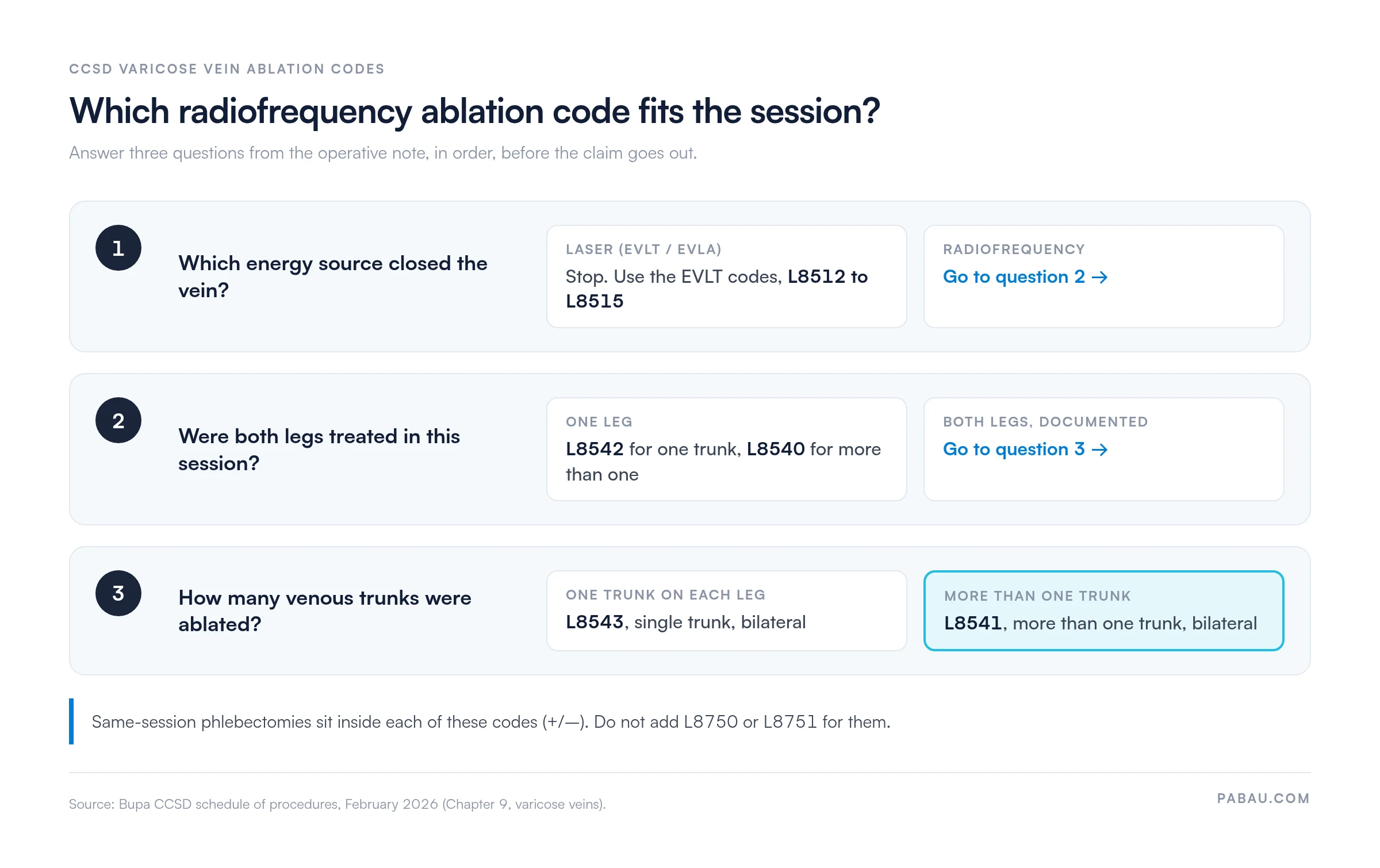
Default to a unilateral code if the operative note does not clearly document bilateral access and catheter placement in the second leg. The same applies when tumescent delivery on the contralateral side is missing. Submitting L8541 without that bilateral record is an upcoding risk.
The “+/-” notation in the L8541 descriptor governs phlebectomy billing. It means phlebectomies are within the scope of L8541 when performed at the same session.
This creates a default bundling rule. A claim that lists L8541 and a separate phlebectomy code for the same date of service will typically be flagged by insurer adjudication systems. It is then either auto-denied or sent for manual review. The practical positions are:
Document all phlebectomy sites in the operative note even when bundled under L8541. Detailed documentation shows the complexity of the session and supports medical necessity if the claim is reviewed. A note that mentions only the ablation and omits the phlebectomies leaves the insurer asking whether they were performed at all.
Every L8541 claim needs a clinical record that supports the bilateral procedure and the medical necessity of treating both legs at once. Missing any of these elements is the fastest route to a denial.
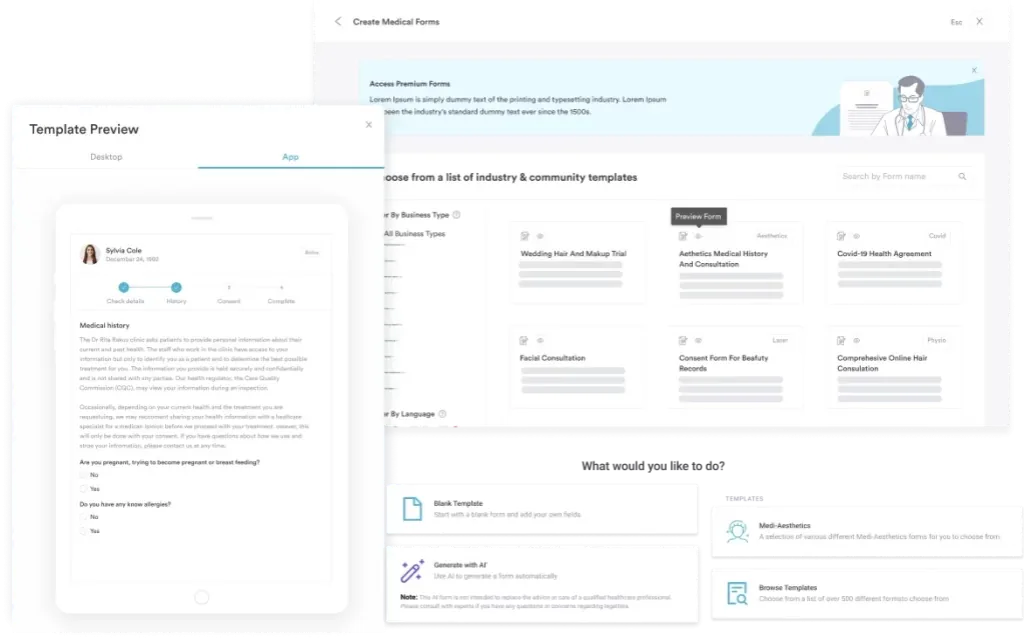
Completing procedure documentation digitally, inside the patient record, lowers the risk of incomplete notes reaching the claims stage. Required documentation includes:
Most major UK private medical insurers require pre-authorisation for bilateral radiofrequency vein ablation before the procedure takes place. Submitting without it is a leading reason L8541 claims are declined outright, with little room to appeal on technical grounds.
The pre-authorisation pathway varies by insurer. A typical request to Bupa, AXA Health or Aviva includes:
Each insurer sets its own pre-authorisation rules for vascular procedures, and those rules can change between policy years. Check the current fund rules for each insurer before booking the session. Recording the authorisation reference against the booking stops a bilateral RFA from going ahead before approval is confirmed.
Submit pre-authorisation requests at least five working days before the procedure date. Insurers can decide faster when the duplex report and CEAP classification arrive with the first submission. Late or incomplete requests are a common cause of same-day cancellations at private phlebology practices.
L8541 sits within a family of CCSD procedure codes for endovenous ablation and phlebology. Coding accurately means knowing which neighbouring code applies and how the bundling rules interact.
The energy source decides the code family first. Laser ablation of more than one trunk on both legs bills under L8515, which Bupa grades as major rather than intermediate complexity.
The CCSD technical guide, available from the CCSD official site (October 2025 edition), sets out the unbundling rules for these adjacent codes. Bupa publishes its current code list on its code search portal.
For the wider vascular chapter, the Bupa CCSD billing guide lists every varicose vein code with its complexity grade.
L8541 claims are denied more often than unilateral RFA claims, because the bilateral element adds complexity to both the clinical justification and the documentation review. The most common denial patterns are:
Appeals to Bupa, AXA Health, and Aviva follow a written process. Most insurers accept the standard Healthcode appeal submission format. Always include the original claim reference, the denial reason code, the operative note, and any supporting diagnostic reports.
The checklist below takes a bilateral RFA claim from the cover check to payment. Medical billing software that tracks each step shortens the time between procedure and payment.
Many phlebology practices still run pre-authorisation through email and spreadsheets. The authorisation reference, the duplex report and the operative note end up in three places. A claim rebuilt from them by hand picks up missing fields and wrong codes.
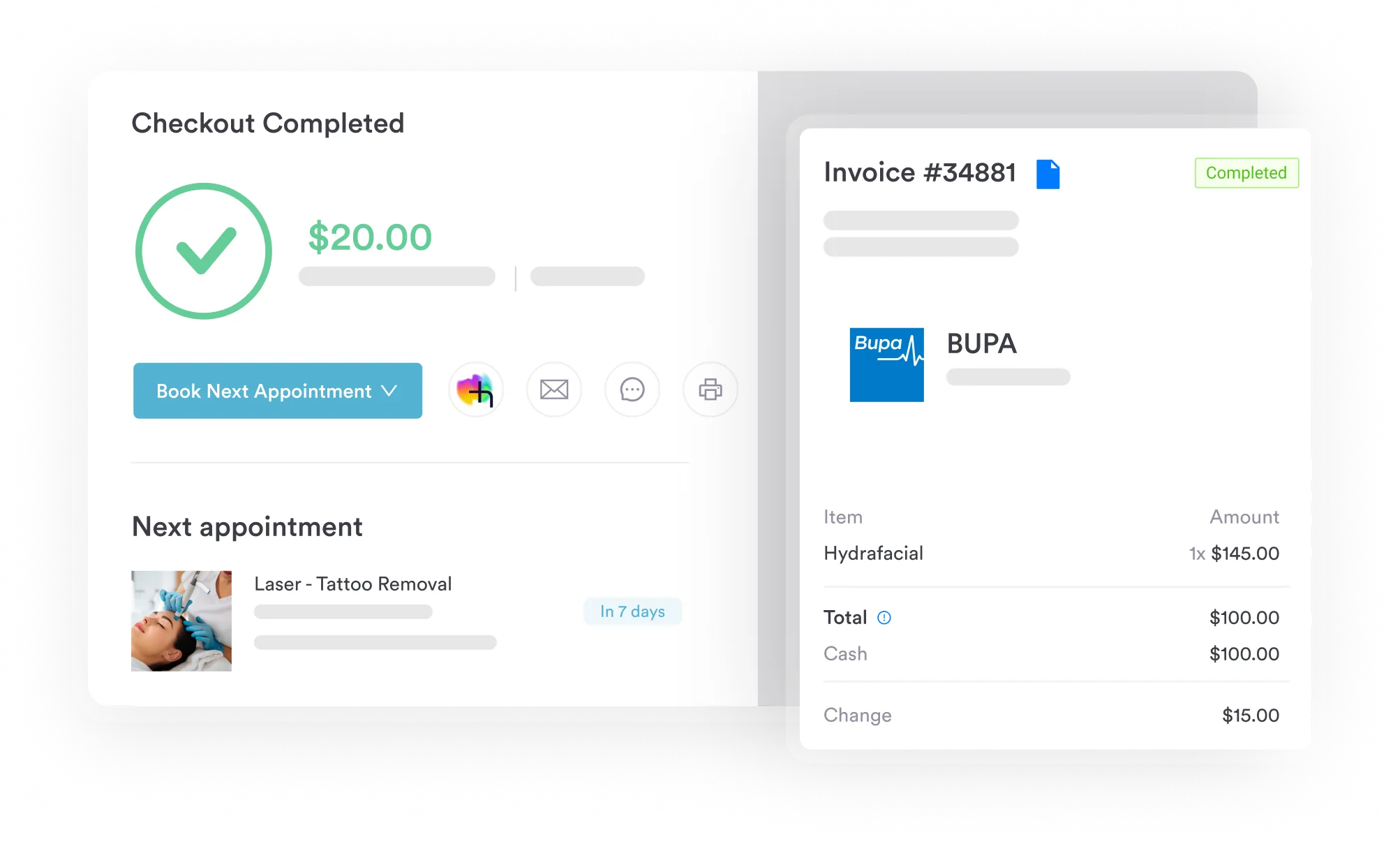
Pabau, the practice management platform we build, stores each pre-authorisation as a case and attaches it to the booking. The authorisation code then follows the appointment through to the invoice and the claim. Claim validation checks for missing or invalid details before the claim leaves Pabau for Healthcode.
Once a claim is submitted, the claims dashboard shows its status from Pending to Paid. A rejected claim is flagged Needs action, with a link to the field that needs fixing. Your team spends less time chasing insurers, and bilateral sessions get paid sooner.

Pabau helps phlebology and vascular practices track L8541 pre-authorisations, attach procedure documentation, and validate claims before they go out. See how it fits your billing workflow.

L8541 rewards practices that code from the operative note rather than from the booking. If the note names both legs, more than one trunk and radiofrequency as the energy source, the code holds. If any of those three is missing, a unilateral or single-trunk code is the safer claim.
The trade-off is a few extra minutes on the day of the procedure. Writing the full bilateral note and filing the authorisation reference before the patient leaves costs far less than chasing a declined claim for weeks.
Book a demo to see how Pabau links pre-authorisations, procedure notes and Healthcode claims for bilateral vein ablation.

Need a complete overview of Bupa CCSD codes for vascular procedures? Bupa CCSD billing reference covers the full vascular chapter, code families, and Bupa-specific submission requirements.
Planning injection sclerotherapy on both legs? CCSD code L8680 explains how bilateral varicose vein injection sclerotherapy is coded and documented.
CCSD Code L8541 covers radiofrequency ablation of more than one venous trunk, with or without phlebectomies, performed bilaterally in a single session. Both legs must be treated in that session using radiofrequency. Endovenous laser treatment has its own codes, L8512 to L8515.
L8540 is the unilateral code, used when radiofrequency ablation of more than one venous trunk is performed on a single leg. L8541 is the bilateral equivalent, used when both legs are treated in the same operative session. The operative note must document bilateral access, catheter placement in each leg, and tumescent anaesthesia on both sides to support L8541.
Phlebectomies performed at the same session as the bilateral RFA are included within L8541 under the “+/-” language in the official descriptor. Billing a separate phlebectomy CCSD code for the same date of service will typically trigger a bundling denial. Phlebectomies performed on a distinct, separate date may be separately billable, subject to individual insurer fund rules.
The most commonly accepted diagnosis codes are I83.0 (with ulcer), I83.1 (with inflammation), I83.2 (with both), I83.9 (without ulcer or inflammation) and I87.2 (venous insufficiency). Some insurer policies ask for documented conservative treatment before approving I83.9 or I87.2. Always pair the diagnosis code to the documented clinical presentation and the CEAP classification in the referral letter.
Yes, most major UK private medical insurers require pre-authorisation before bilateral radiofrequency vein ablation. Requirements vary by insurer and policy year, so verify current fund rules directly with each payer. A claim submitted without a valid authorisation reference is typically declined outright, and that kind of technical decline is hard to appeal.
A standalone diagnostic duplex performed as a pre-assessment on a different date from the procedure is generally separately billable. A duplex on the day of the ablation may fall under bundling rules. That is most likely when it guides the procedure rather than standing alone as a diagnostic study. Verify with the relevant insurer before submitting both codes on the same date.