CPT Code 19361: Latissimus dorsi flap breast reconstruction
CPT code 19361: Official descriptor and payment basics CPT code 19361 is the Cat...

Last Updated: Nov 18, 2026
L8750 is the CCSD code for local excision (multiple phlebectomy) of varicose vein(s) of leg – unilateral. UK private insurers use it when a surgeon removes varicose tributaries from one leg through small stab incisions, with no saphenous trunk treated.
Both legs in one session take the bilateral code L8751 instead. Saphenous ligation and stripping codes such as L8700 already include phlebectomy, so L8750 is not added to them.
Let Pabau's smart automation suggest the right codes, reduce claim denials, and keep your practice compliant—effortlessly.
Automate repetitive tasks and focus on what matters most—your patients.
Reduce coding errors and ensure compliance with the latest regulations.
Clean claims, fewer denials, and faster reimbursements.
Powerful insights and reporting to help your practice thrive.
HIPAA compliant SOC 2 certified GDPR-compliant Trusted by 4,000+ clinics worldwide

CCSD code L8750 covers local excision (multiple phlebectomy) of varicose veins on one leg, with no saphenous trunk treated in the same session.
Both legs in one session take the bilateral code L8751, while a second leg treated on a later date gets its own L8750 claim.
Saphenous ligation and stripping codes L8700 and L8780 already include phlebectomy, so adding L8750 to them risks an unbundling query.
UK private insurers expect pre-authorization and a duplex ultrasound report showing reflux before they approve a phlebectomy claim.
Pabau, the practice management platform we build, tracks the authorization code on the case and sends UK private claims through Healthcode.
CCSD code L8750 is the UK private healthcare code for local excision (multiple phlebectomy) of varicose vein(s) of the leg, on one leg only. It sits in chapter 9.7.0 (Varicose Veins) of the CCSD Schedule, the standard code set for procedures and diagnostic tests in UK private healthcare. The CCSD Group that maintains it includes representatives of four major private insurers.
The official descriptor reads “Local excision (multiple phlebectomy) of varicose vein(s) of leg – unilateral.” “Multiple phlebectomy” means a stab avulsion technique through several small incisions, not a single-site excision. “Unilateral” sets the scope at one leg per code.
L8750 applies when phlebectomy is the whole procedure on that leg. If a saphenous trunk is ligated, stripped or ablated in the same session, the trunk code’s descriptor already covers the phlebectomy.
Multiple phlebectomy, also called ambulatory or stab avulsion phlebectomy, removes superficial varicose veins through tiny stab incisions. Each incision is typically 1 to 3 mm long. The surgeon uses a phlebectomy hook to tease out segments of the varicosity through each incision. Most sites need no sutures, and the skin is closed with adhesive strips or left to heal by secondary intention.
The procedure targets tributary varicosities, the visible tortuous branches off the main saphenous trunk. The great saphenous vein (GSV) and small saphenous vein (SSV) are treated by endovenous ablation or stripping instead. Those procedures carry their own CCSD codes.
For coding, the operative note must document the technique (stab avulsion), the number of sites, the vessels treated and the leg treated. A note missing any of these gives the payer grounds to query or deny the claim.
L8750 applies when phlebectomy is performed for a clinical rather than cosmetic reason. UK private insurers do not fund purely cosmetic varicose vein removal, and the line between the two is a frequent source of denials and appeals.
Accepted clinical indications, supported by venous duplex ultrasound findings, include:
NICE guideline CG168 (Varicose veins: diagnosis and management, 2013) recommends endothermal ablation first for confirmed truncal reflux. Foam sclerotherapy comes next if ablation is unsuitable, then surgery. Where incompetent tributaries are to be treated, NICE says to consider treating them at the same time. Documentation that shows where phlebectomy fits in that pathway gives a clinical assessor what they need.
Purely cosmetic presentations, with no symptoms and no duplex-confirmed reflux, will almost always be declined by Bupa, AXA Health and Aviva, whatever code is submitted. Referral wording such as “patient wishes to improve appearance of legs” signals cosmetic intent and is a straightforward trigger for rejection.
Chapter 9.7.0 of the CCSD Schedule holds more than 30 varicose vein codes, and picking the wrong one is a common billing error. The first question is whether a saphenous trunk was treated on the same leg in the same session, as the decision path below shows.
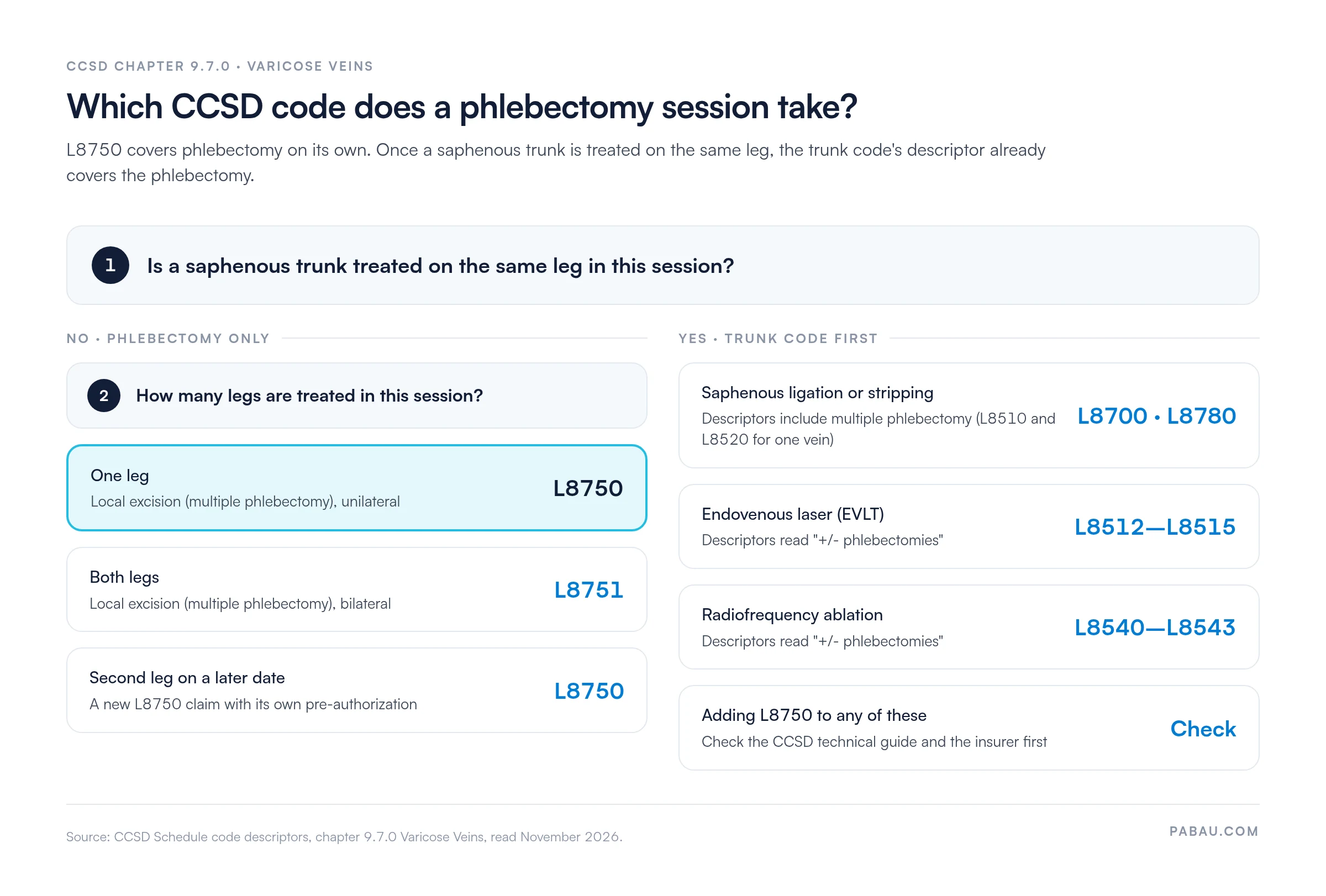
If the surgeon also ligated or stripped both saphenous veins, the episode belongs under L8700 for one leg or L8780 for both. Both descriptors include multiple phlebectomy.
The OPCS-4 crosswalk matters for practices that treat both NHS-funded and privately insured patients. In OPCS-4, categories L84 to L87 cover operations on varicose veins of the leg, and avulsion phlebectomy codes to L87.4. Private claims always use CCSD codes, so coders working across both systems should check they have not mixed the two on one claim.
Other CCSD codes, from sclerotherapy to recurrent-vein surgery, are listed in our UK private billing reference.
L8750 covers one leg, and L8751 covers both legs treated in the same operative session. Submitting L8750 for a bilateral session, or two L8750 lines for one session, will trigger a query or denial from most payers.
The less obvious case is staged treatment, with the right leg done in January and the left in March. Each session is unilateral, so each gets its own L8750 claim. Each also needs its own pre-authorization, because payers do not extend one authorization across two separate admissions. A second claim filed under the first leg’s authorization will be rejected.
The operative note must state which leg was treated, and that leg must match the one named in the pre-authorization. A note reading “varicose vein surgery performed”, with no side given, lets the payer hold the claim pending more information.
All major UK private medical insurers require pre-authorization before phlebectomy is performed. Proceeding without it usually means the insurer will not fund the procedure, even when it was clinically appropriate. Our guide to Bupa CCSD codes explains how Bupa’s code lookup and fee schedule work for surgical claims.
Requirements vary by insurer and change over time, so confirm them with each payer before submission. The table below reflects common requirements across the main UK private medical insurers. Treat it as a starting framework, not a policy statement.
Venous duplex ultrasound is the cornerstone of the pre-authorization case at every major payer. The report must show hemodynamically significant reflux in the relevant vein segment, with the reflux duration, affected vessels and affected leg documented. A duplex report that only describes “visible varicosities”, without reflux measurements, is unlikely to satisfy a clinical assessor.
Request pre-authorization before booking the operating room slot. Decisions on varicose vein surgery can take 5 to 10 working days at busy insurer periods. Booking without authorization exposes the practice to the full procedure cost if the request is declined.
A complete L8750 claim file holds several distinct documents. Missing one can trigger a payer query that delays payment by weeks, or a denial that needs a full appeal.
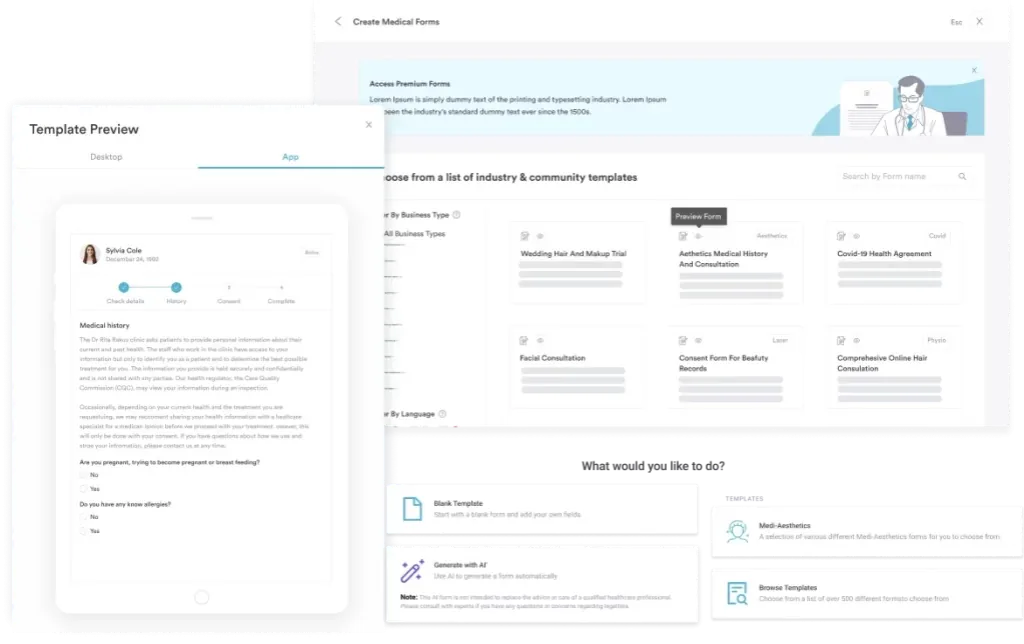
The operative note is the document payers scrutinize most closely on a vascular surgical claim. A one-line note such as “varicose vein phlebectomy performed, no complications” is not enough. The note should stand alone as a record of what was done, to which leg and by what technique.
Denials for L8750 cluster around a small number of recurring causes, and most can be prevented before submission.
Before submitting an L8750 claim, run a three-point check. Is the pre-authorization reference on the invoice? Does the operative note name the same leg as the authorization? Is the duplex report dated within 12 months of the procedure? These three checks catch the most common avoidable denials.
Phlebectomy of tributaries is often done in the same session as a truncal procedure. Whether L8750 can sit on the same invoice depends on the truncal code’s descriptor and the insurer’s bundling rules.
Check the CCSD technical guide and insurer rules for any truncal procedure billed with L8750. Several truncal codes in chapter 9.7.0 already describe the phlebectomy. L8700 and L8780 include local excision/multiple phlebectomy, so billing L8750 alongside them would be unbundled. The EVLT and RFA codes read “+/- phlebectomies”, which points the same way.
Sclerotherapy has its own CCSD codes, including L8600 for unilateral injection sclerotherapy and L8620 for ultrasound-guided foam sclerotherapy. Some payers treat sclerotherapy and phlebectomy on the same leg and date as alternatives. If both are performed, the operative note must explain why the presentation needed both techniques.
CCSD codes and bundling rules are updated periodically. Check the current CCSD technical guide and insurer guidance before billing any combination episode.
Recording L8750 accurately in a practice management system is where many preventable billing errors start. The pre-authorization reference does not link itself to the code. The leg named in the operative note does not reach the invoice line on its own either. Each connection has to be set up deliberately, in five steps:
In many vascular practices, the authorization, the operative note and the invoice live in three different places. Someone at the billing desk compares them by eye. A mismatched leg or a missing reference then surfaces only when the payer queries the claim.
Pabau records the authorization code, dates and sessions on the patient’s case and warns you when one is missing. Its private healthcare claims management sends UK claims through Healthcode and BUPA, so the CCSD code leaves with its reference attached.
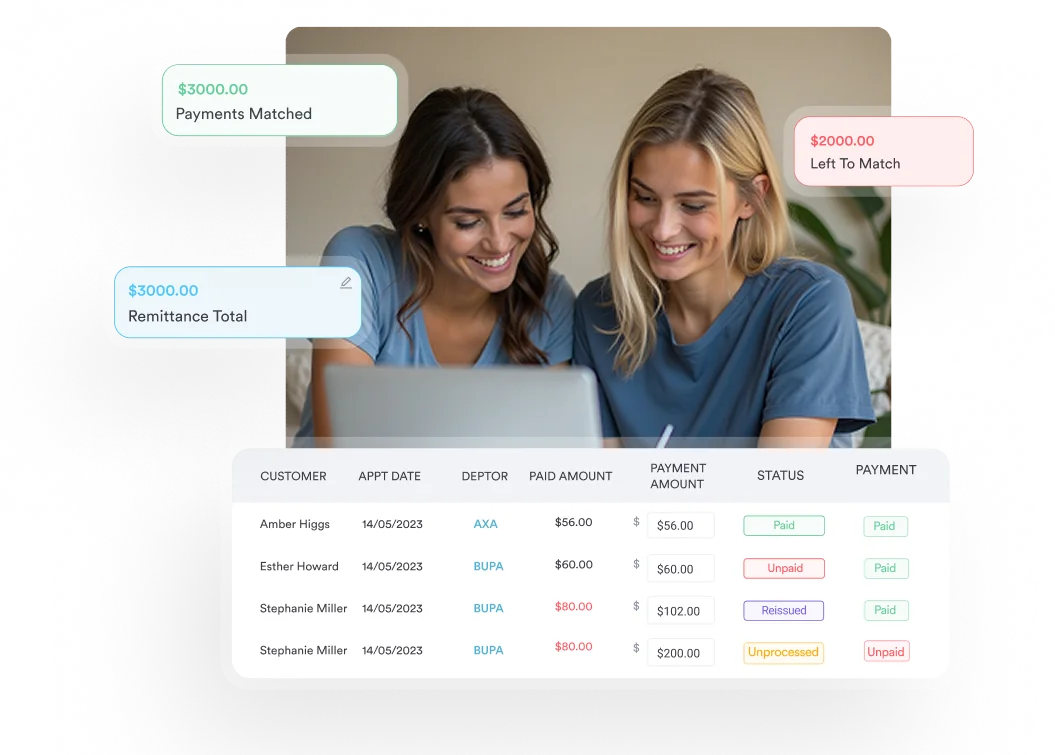
The duplex report, the referral letter and the signed operative note sit on the same patient record as the invoice. When an insurer asks for evidence, your billing team sends it the same day instead of waiting on the surgeon.
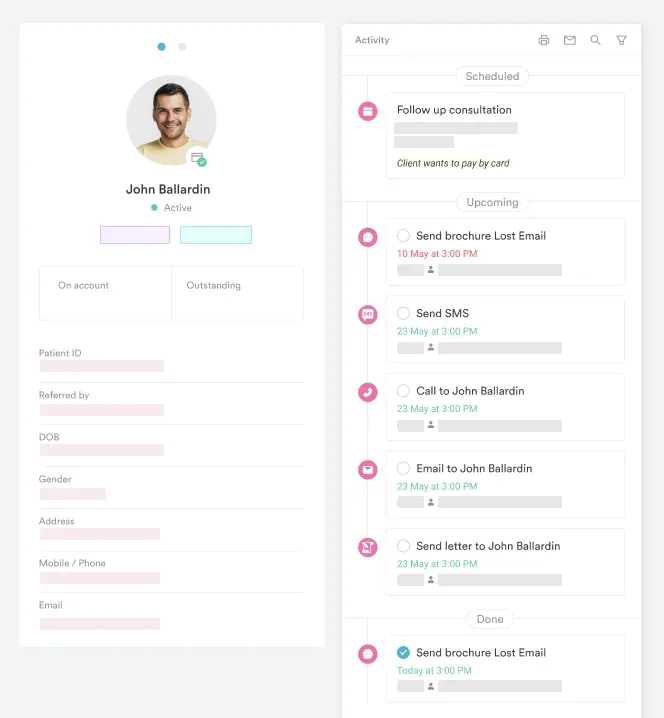

Pabau tracks pre-authorization references, links operative notes to billing episodes and sends UK private claims through Healthcode. L8750 claims go in matched to the leg that was authorized.

Code L8750 by leg and by session. One leg is L8750, both legs in one session is L8751, and a staged second leg is a new claim with its own authorization.
The bigger risk sits next to the code. When a saphenous trunk is stripped or ablated on the same leg, the trunk code’s descriptor usually covers the phlebectomy already. Adding L8750 there invites an unbundling query, so check the CCSD technical guide and the insurer before you do.
Matching the leg across the authorization, the note and the invoice before submission is the habit that keeps these claims paid. To see how Pabau keeps those three records in step for UK private vascular work, book a demo.

Need a full reference for Bupa procedure codes and fees? Bupa CCSD codes covers the Bupa billing framework, fee schedule structure and how to look up procedure codes for UK private claims.
Treating recurrent varicose veins after earlier surgery? CCSD code L8530 covers recurrent varicose vein operations with re-exploration of the groin or popliteal fossa.
Recurrent veins without groin re-exploration? CCSD code L8532 explains the unilateral code for that operation and the documentation insurers expect.
Billing injection sclerotherapy on both legs? CCSD code L8680 covers the bilateral sclerotherapy code and how it differs from phlebectomy.
CCSD code L8750 covers local excision (multiple phlebectomy) of varicose veins on one leg. It applies when tributary varicosities are removed through small stab incisions, usually as a day case under local or general anesthesia.
L8750 covers phlebectomy on one leg, and L8751 covers phlebectomy on both legs in the same operative session. Submit separate L8750 claims only when each leg is treated on a different date, each with its own pre-authorization.
Yes. Bupa requires pre-authorization for elective varicose vein surgery, including procedures billed under L8750. The request should include a venous duplex ultrasound report and a GP referral. It also needs evidence of failed conservative care, such as at least three months of compression hosiery.
A complete L8750 claim needs a venous duplex ultrasound report and an operative note naming the technique, the leg and the number of sites. Add the pre-authorization reference, the GP or specialist referral and, where relevant, the anesthesia record. A missing operative note or authorization reference is the most common trigger for payer queries.
Only after checking the CCSD technical guide and the insurer’s rules, because several truncal codes already include phlebectomy. The CCSD codes for endovenous laser and radiofrequency ablation read “+/- phlebectomies”, and L8700 includes multiple phlebectomy. Sclerotherapy on the same leg and date draws extra scrutiny, so the operative note must justify both procedures.
Medical necessity for L8750 rests on a venous duplex ultrasound showing significant reflux, plus documented symptoms such as aching, skin changes or superficial thrombophlebitis. The file should also show that conservative care failed. NICE guideline CG168, Varicose veins: diagnosis and management, is the clinical framework UK payers commonly reference.