HCPCS code V5259: Digital binaural ITC hearing aid billing
HCPCS code V5259 reports a digital ITC hearing aid pair HCPCS code V5259 reports...

Last Updated: Oct 22, 2026
K6100 is the CCSD code for insertion of a single chamber implantable cardioverter defibrillator (ICD). It covers the consultant's procedural fee for a new transvenous implant with one right ventricular lead, from venous access through to wound closure.
The ICD generator and lead hardware, the anaesthetist and the hospital facility are billed separately. A second atrial lead moves the claim to K6105, while generator replacement, lead revision and subcutaneous ICD implants each take their own codes.
Let Pabau's smart automation suggest the right codes, reduce claim denials, and keep your practice compliant—effortlessly.
Automate repetitive tasks and focus on what matters most—your patients.
Reduce coding errors and ensure compliance with the latest regulations.
Clean claims, fewer denials, and faster reimbursements.
Powerful insights and reporting to help your practice thrive.
HIPAA compliant SOC 2 certified GDPR-compliant Trusted by 4,000+ clinics worldwide

CCSD code K6100 covers single chamber ICD insertion only, not dual chamber (K6105), CRT-D, or generator replacement procedures.
Prior authorisation from the patient’s private insurer is mandatory before implantation, and the authorisation reference number must appear on the claim.
The ICD device hardware cost is billed separately from K6100, which covers the surgeon’s procedural fee only.
Count the leads in the operative note before you pick the code, because a second lead moves the claim to K6105.
Pabau’s claims management software keeps the authorisation reference, operative note and invoice in one patient record for UK cardiology teams.
CCSD code K6100 describes the surgical insertion of a single chamber implantable cardioverter defibrillator. The CCSD schedule defines it as the complete implantation procedure performed by the electrophysiologist, from venous access through to wound closure. The code applies to a de novo implant, where no existing device or lead is in situ.
A single chamber ICD uses one transvenous lead, positioned at the right ventricular apex or septum. The generator sits in a subcutaneous or submuscular pocket, typically below the left clavicle.
The K6100 procedural fee covers the surgeon’s work in that session. That means lead placement, pocket creation, intra-operative defibrillation threshold testing and wound closure.
The code has two scope limits. First, CCSD code K6100 covers the procedural work only. The physical ICD generator and lead hardware are billed separately under device supply codes or negotiated directly with the hospital facility.
Second, K6100 is a de novo code. Generator replacement, lead revision, and device upgrade procedures each have their own CCSD codes and cannot be billed under K6100.
The operative note that supports a K6100 claim follows the procedure step by step. A single chamber ICD implantation runs in the same sequence whatever the device manufacturer.
The operative note must document each of these steps for K6100 to withstand insurer scrutiny. Missing any element, particularly device model and serial number or lead impedance values, is a common trigger for documentation-based denials.
UK private insurers link prior authorisation for CCSD code K6100 to evidence-based clinical criteria. Most of these mirror NHS England specialised commissioning guidance and NICE technology appraisals on ICD therapy.
Billing teams should be familiar with these indications because the pre-authorisation request must demonstrate clinical justification.
Single chamber ICD implantation is indicated across two categories: primary prevention and secondary prevention.
The pre-authorisation request should include the relevant echocardiographic report confirming LVEF, the documented arrhythmia history, and the referring cardiologist’s clinical letter confirming the indication. Submitting this evidence upfront reduces the risk of the insurer requesting additional clinical information after the procedure.
Unbundling errors and claim disputes on K6100 usually trace back to its scope. The table below sets out what the code covers and what is billed elsewhere.
Always verify the current CCSD schedule year before submission. The CCSD updates its schedule annually, and bundling rules for add-on procedures can change between editions. Check the CCSD technical guide for the applicable schedule year.
Picking the wrong code within the cardiac device range is a frequent ICD coding error. The table below covers the codes most often confused with CCSD code K6100. For Bupa-specific fees and rules, check our Bupa CCSD codes reference.
The operative note decides which code applies. If it documents a single RV lead placed de novo, K6100 is correct, and any additional lead or a subcutaneous approach changes the code.
Confirm K6105 and its neighbours against the schedule edition in force on the date of procedure, using our CCSD code library. The diagram below maps each lead configuration to its code.
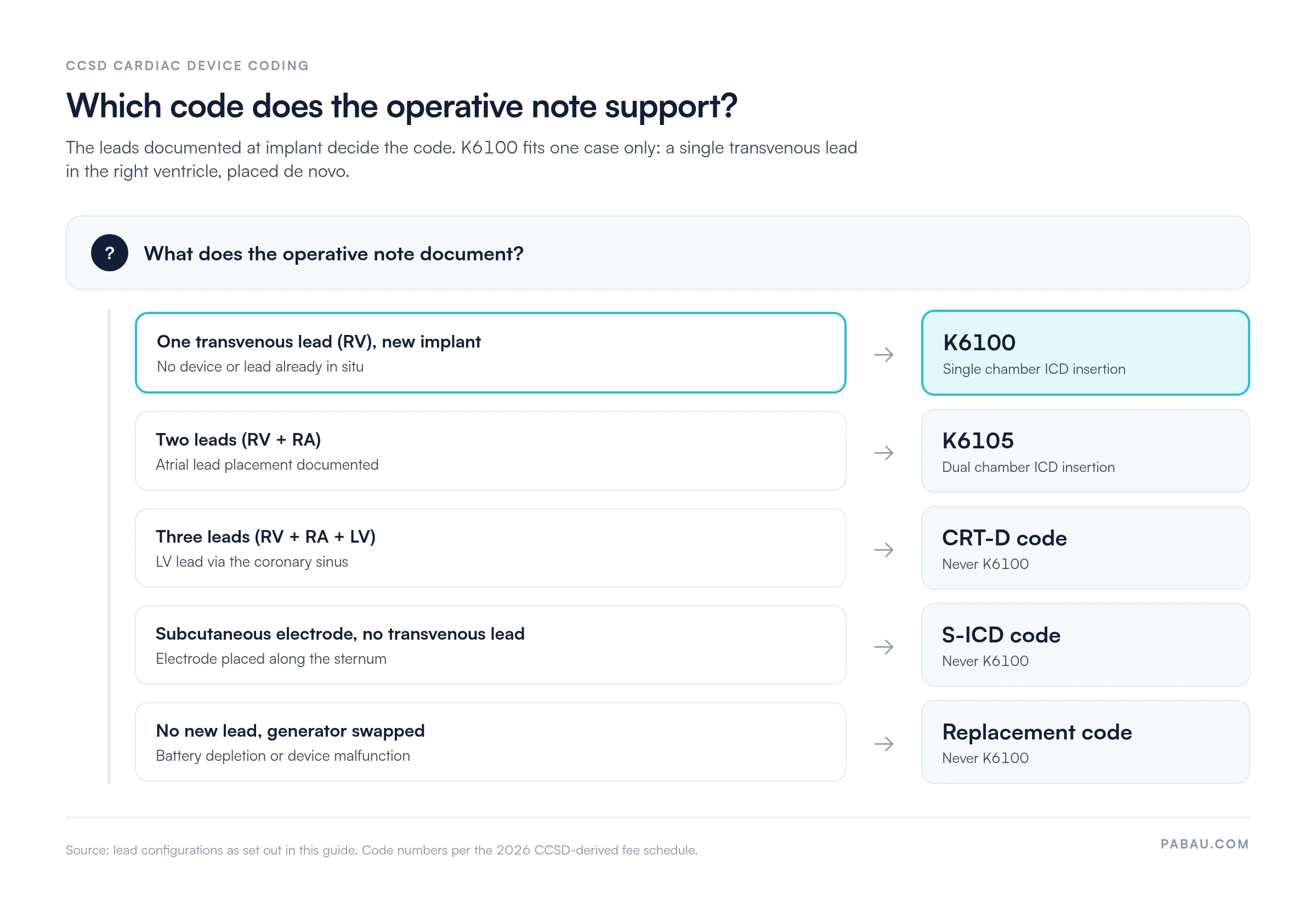
Before submitting any cardiac device claim, count the leads documented in the operative note. One transvenous ventricular lead means K6100. Two leads mean K6105. A subcutaneous approach means neither. Matching the lead count to the code prevents a frequent cardiac device coding error in UK private practice.
UK private insurers routinely request operative notes for high-value cardiac procedures, and an incomplete note is a straightforward denial trigger. The operative note for a K6100 claim must include all of the following.
Supporting documents required at submission typically include:
Some insurers also require a device implant registration form, particularly Bupa and AXA Health.
A standardised post-procedure checklist in the patient record stops a claim going out with a required field missing.
Every major UK private medical insurer requires prior authorisation before an ICD implantation. Without an authorisation reference number, the claim will be denied on submission regardless of how well the procedure is documented. Authorisation must be obtained before the procedure, not after.
The pre-authorisation request to insurers such as Bupa, AXA Health, Aviva, and Vitality typically requires the following clinical evidence.
Once authorisation is granted, record the reference number in the patient record immediately. The reference number must appear on the invoice submitted to the insurer.
Authorisations are time-limited, typically valid for 90 days, so confirm the procedure date falls within the approved window. An authorisation that has expired is a denial that cannot be appealed on clinical grounds.
Vitality Health provides a fee finder tool at vitality.co.uk/healthcare-providers/fee-finder/ where the applicable K6100 fee can be confirmed before submission. Healix publishes its CCSD fee schedule at hsp.healix.com/hfs, including unbundling guidance relevant to cardiac device codes.
ICD implantation claims draw close insurer scrutiny because of their value and the number of documentation requirements. The table below covers the most frequent K6100 denial reasons and how to resolve each one.
Automated claim submission checks can flag a missing authorisation number or an incomplete documentation field before the invoice leaves the system. We compare the platforms that run these checks in our roundup of UK medical billing software.
The checklist below runs from referral to confirmed payment, in the order the billing team meets each task.
Many cardiology billing teams run this checklist across separate tools. The authorisation reference sits in an email, the operative note in a hospital system, and the invoice in a spreadsheet. Each hand-off is a chance for the serial number or the reference to drop out.
Pabau, the practice management platform we build, holds the patient record, treatment notes and invoices in one place. Its claims management software lets you keep the authorisation reference on the patient record and build an operative note template with every required K6100 field.
The result is a claim that leaves with its evidence attached, so your team spends less time answering insurer queries and resubmitting.
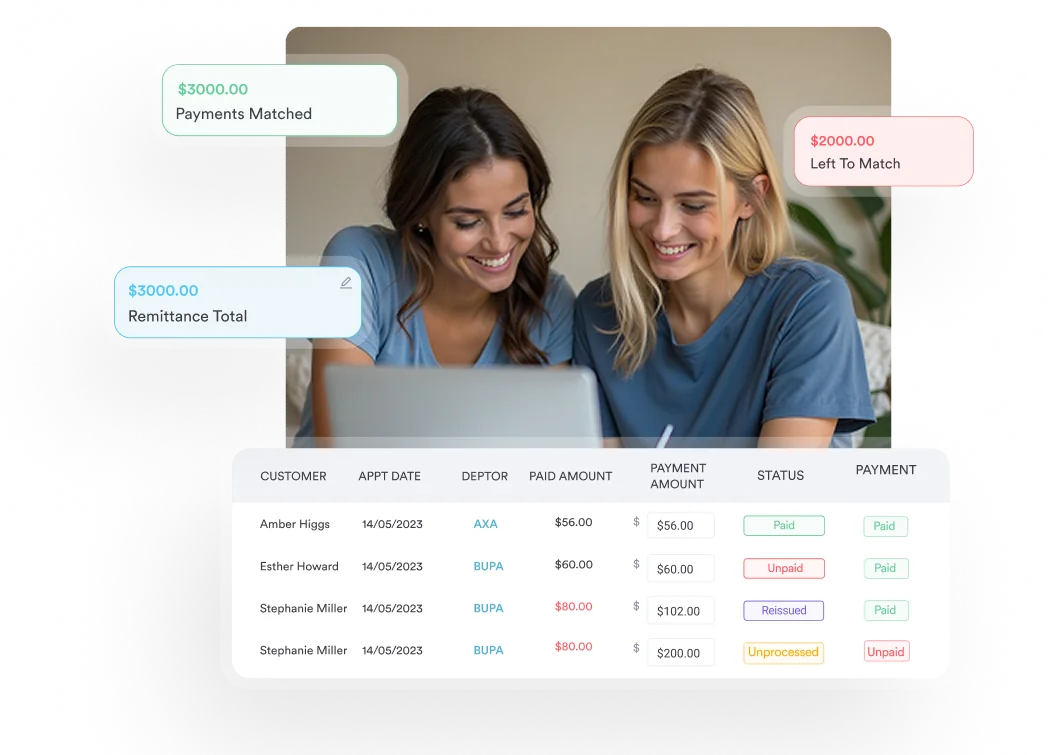

Pabau supports UK private practice billing teams with CCSD documentation workflows, claim submission and automated follow-up tools. Your team spends less time chasing payments and more time on patient care.

Count the leads before you pick the code. One transvenous ventricular lead placed de novo is K6100. A second atrial lead, a CRT-D system or a subcutaneous device each moves the claim to another code.
The bigger risk sits outside theatre. An expired authorisation or a note without the device serial number takes far longer to recover than to prevent. Build both checks into the routine before and after every implant, and the claim rarely comes back.
Want the authorisation, operative note and invoice to travel together on every cardiac device claim? Book a demo to see how Pabau handles CCSD billing for private cardiology practices.

Billing coronary procedures as well as device implants? CCSD code K4910 explains coronary angioplasty with stent insertion and its documentation requirements.
Coding cardiac surgery in the same chapter? CCSD code K3210 covers closed mitral valvotomy billing for private cardiac practices.
Choosing a billing system for UK private claims? Best medical billing software in the UK compares the platforms built for insurer and self-pay billing.
CCSD code K6100 covers insertion of a single chamber implantable cardioverter defibrillator. The surgeon’s procedural fee includes venous access, right ventricular lead placement, pulse generator pocket creation and intra-operative device testing. It does not cover the ICD hardware, the anaesthetist fee, or the hospital facility cost.
K6100 covers a single chamber ICD insertion with one transvenous ventricular lead. K6105 covers dual chamber ICD insertion, which requires a second atrial lead in addition to the ventricular lead. Use K6105 only when the operative note explicitly documents placement of both leads. Verify K6105 against the current CCSD schedule year, as code descriptors are subject to annual revision.
No. K6100 covers the surgeon’s procedural fee only. The ICD generator and defibrillation lead hardware are billed separately, typically by the hospital facility under device supply arrangements. Submitting K6100 with an expectation that it covers device costs will result in a shortfall on the hardware component of the claim.
Yes. All major UK private medical insurers, including Bupa, AXA Health, Aviva, and Vitality, require prior authorisation before ICD implantation. The authorisation reference number must appear on the claim invoice. Procedures performed without a valid authorisation reference are denied on submission and retrospective authorisation is not guaranteed.
K6100 covers a transvenous ICD, where the lead passes through the venous system into the right ventricle. A subcutaneous ICD (S-ICD) uses an electrode placed entirely under the skin along the sternum, with no intravascular lead. The two procedures involve different anatomy, techniques, and CCSD codes. K6100 must not be used for an S-ICD implant.
Generally, no. Pacing functions are built into a single chamber ICD and any pacing performed as part of the same implant session is bundled within K6100. Billing a separate pacing code alongside K6100 for the same session will typically trigger an unbundling denial. Confirm with the relevant insurer’s fee schedule guidelines before adding any companion codes to a K6100 claim.