CPT Code 99418: Prolonged E/M services billing guide
What CPT code 99418 covers CPT code 99418 is the add-on code for prolonged inpat...

Last Updated: Oct 22, 2026
K6020 is the CCSD code for resiting of a pacemaker or implantable cardioverter defibrillator (ICD). It covers surgery that moves an existing generator out of its pocket and re-implants it at a new anatomical site. A typical move is from the left to the right pectoral region.
K6020 applies to single-chamber and dual-chamber pacemakers and to ICDs of any configuration. Work that stays in the original pocket is coded differently. A generator swap without lead change is K6030, and local wound work is a pocket revision.
Let Pabau's smart automation suggest the right codes, reduce claim denials, and keep your practice compliant—effortlessly.
Automate repetitive tasks and focus on what matters most—your patients.
Reduce coding errors and ensure compliance with the latest regulations.
Clean claims, fewer denials, and faster reimbursements.
Powerful insights and reporting to help your practice thrive.
HIPAA compliant SOC 2 certified GDPR-compliant Trusted by 4,000+ clinics worldwide

CCSD Code K6020 covers surgical relocation of a pacemaker or ICD generator to a new anatomical site, not local wound revision.
A generator swapped within the same pocket is K6030, so the operative note must name the new site to support K6020.
The primary clinical triggers are pocket infection, skin erosion, lead failure requiring new venous access, and radiation field conflicts.
Most UK private insurers (Bupa, AXA Health, Aviva, Vitality) require prior authorisation before K6020 is billed for elective resiting.
Pabau, the practice management platform we build, keeps CCSD codes, operative notes and insurer documentation on one patient record.
CCSD Code K6020 is the procedure code for resiting of a pacemaker or implantable cardioverter defibrillator (ICD). It sits in the Clinical Coding and Schedule Development (CCSD) schedule, the billing framework used across UK private health insurance.
“Resiting” means the existing generator is surgically removed from its subcutaneous pocket and re-implanted at a new anatomical location.
Typical moves are from the left pectoral region to the right, or from a pectoral site to an abdominal position. Revising or exploring the original pocket is a different procedure, and insurers treat that distinction as material when assessing claims.
K6020 applies to both single-chamber and dual-chamber pacemakers, and to ICDs of any configuration. The code does not differentiate by device type, but the documentation burden does. An ICD resiting may need defibrillation threshold (DFT) testing at the new site, which a pacemaker resiting does not.
Resiting is a surgical procedure performed by a cardiac electrophysiologist, typically under general anaesthesia or deep sedation with local augmentation. The operative sequence differs from a straightforward generator replacement because the device must be physically moved rather than swapped in place.
The core steps are:
For ICD resiting, the electrophysiologist will also perform DFT testing to confirm the device can deliver an effective shock from the new position. This testing adds procedural time and a separate documentation requirement.
UK private insurers assess medical necessity against accepted clinical indications. The following are recognised across Bupa, AXA Health, and Aviva policy frameworks. Each insurer’s accepted list may differ, so confirm it at the pre-authorisation stage.
The operative note must name the specific indication and explain why it makes the original site unsuitable. A general statement that the device was resited is not sufficient for most UK insurer claims.
K6020 sits within the K60-series of the CCSD schedule, which covers cardiac pacemaker and ICD procedures. Neighbouring codes describe similar operations, so check where K6020 sits relative to them before you submit a claim. The table below lists the principal K60-series codes and how each differs from K6020.
Verify current descriptors against the live CCSD schedule before submitting claims, as code descriptors are subject to periodic update by the CCSD working group. Cardiac procedures outside the K60 series, such as coronary angioplasty, are listed in the CCSD code library.
The most common coding error on K6020 claims is conflating resiting with pocket revision or generator replacement. The table below clarifies the operative and coding distinction between the three.
The critical test for K6020 is whether the generator ends up in a different anatomical location after the procedure. Moving from the left pectoral region to the right pectoral region qualifies.
Repositioning within the same pocket following wound exploration does not. The flow below applies that test first, then rules out the neighbouring codes in order.
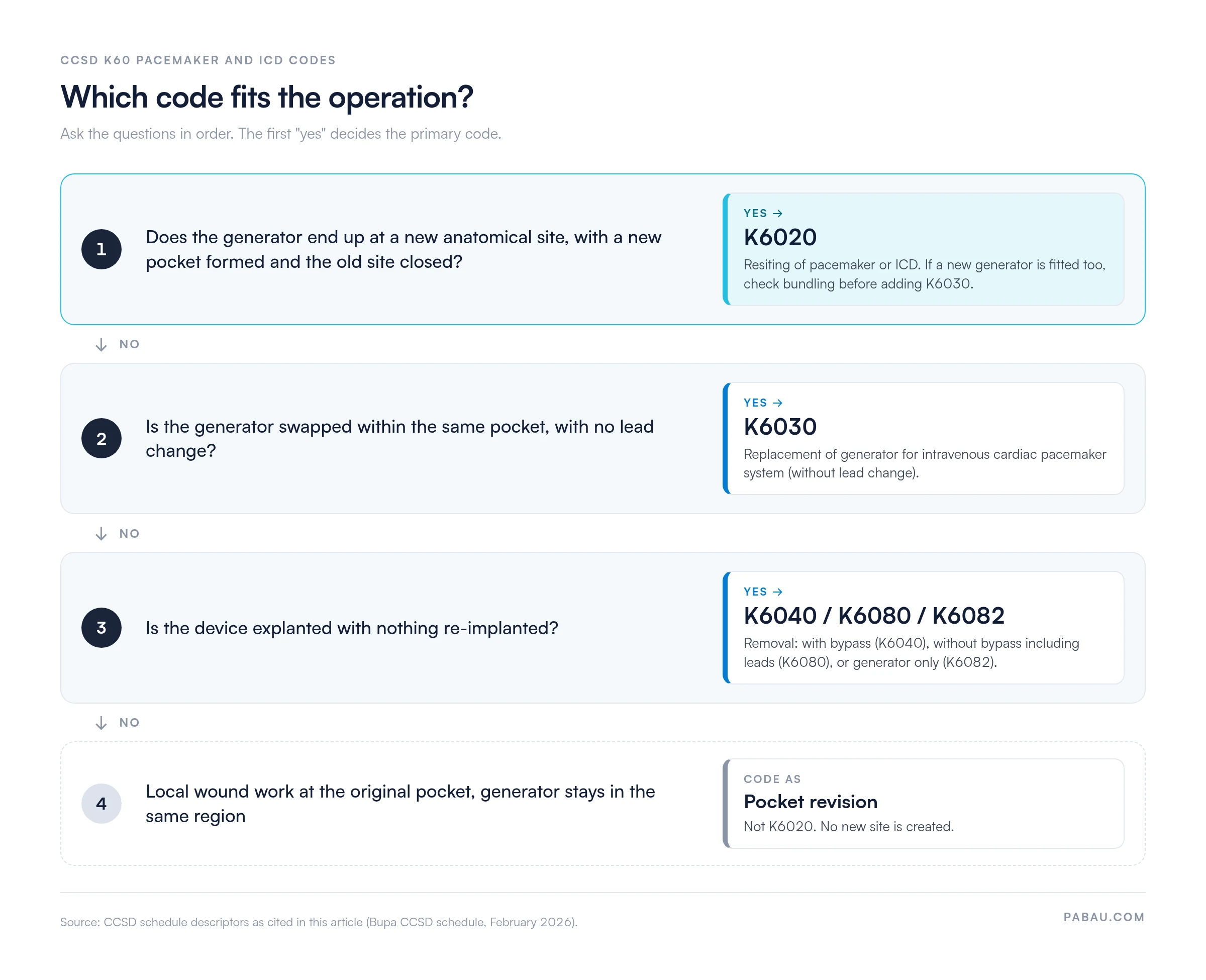
Some operative notes describe work at two sites, and the procedure is classified as resiting plus pocket revision. Billing both codes then risks an unbundling denial. Check the CCSD technical guide for bundling rules specific to the K60 series before submitting dual codes in the same episode.
Insurers scrutinise K6020 claims more closely than straightforward generator replacements because the clinical rationale for moving a device is less self-evident than a battery change. The operative note and supporting documents must collectively answer four questions:
Additional documents that strengthen a K6020 claim include:
Private practices using claims management software can build structured operative note templates that capture each of these elements as the note is written. That saves rebuilding a K6020 supporting pack from memory after the fact.
Elective K6020 procedures almost universally require prior authorisation from the patient’s insurer. The major UK private insurers for cardiology practices include Bupa, AXA Health, Aviva, and Vitality Health. All four treat cardiac device surgery as a pre-authorisation category. Confirm the current requirement directly with each insurer, as pre-auth policies are updated periodically.
A typical prior authorisation request for K6020 includes:
Emergency resiting may proceed without prior authorisation, for example where acute pocket sepsis threatens systemic infection. In that case, notify the insurer within 24 to 48 hours and send retrospective documentation as soon as possible to preserve the claim.
The following denial patterns appear consistently across Bupa CCSD billing and other UK private health insurer workflows. Catching them at the documentation and submission stage prevents the most frequent K6020 claim failures.
Several CCSD codes may be legitimately billed in the same episode as CCSD Code K6020, depending on what was performed. Whether each is separately billable or bundled within K6020 must be confirmed against the current CCSD technical guide, as bundling rules are subject to update.
The safest approach is to contact the patient’s insurer before submission when billing multiple codes in the same K6020 episode. An upfront bundling query takes minutes and prevents a denial that may take weeks to appeal.
For ICD resiting specifically, include the post-procedure DFT test report as a separate attachment to the insurer claim pack. Some insurers flag ICD K6020 claims for manual review when DFT results are absent. They do this even when their policy documentation does not require DFT.
A K6020 claim is often assembled after the operation. The coder chases the operative note, the microbiology result, the device serial numbers and the authorisation reference from different systems. When one is missing, the claim goes out thin and comes back denied.
In Pabau, the operative note template can prompt for the indication, the new anatomical site and the imaging confirmation as the note is written. Insurer details and the authorisation reference sit on the same patient record. Claims then go to Bupa, AXA Health and other insurers through Healthcode.
Your team stops rebuilding supporting packs by hand, and each resiting claim reaches the insurer with the evidence that matches its code.

Pabau helps private healthcare practices track procedure codes, build compliant operative note templates, and manage insurer documentation packs without the administrative overhead. See how it works for cardiac device billing.

Code K6020 only when the operative note proves the generator now sits at a new anatomical site. Every other version of the operation belongs to a neighbouring code, and insurers are quick to re-code a vague note to K6030.
The trade-off is time spent before the procedure. Securing prior authorisation for resiting specifically, and writing the note around the four documentation questions, takes minutes up front. It saves weeks of appeals later. For ICD resiting, attach the DFT report even when the policy does not ask for it.
Book a demo to see how Pabau keeps CCSD claims, operative notes and insurer authorisations on one patient record.

Billing a coronary angioplasty as well? CCSD Code K4900 covers percutaneous transluminal coronary angioplasty and what insurers expect in the note.
Was a stent placed during the procedure? CCSD Code K4910 explains billing for coronary angioplasty with stent under the Bupa schedule.
CCSD Code K6020 is the UK private healthcare billing code for resiting of a pacemaker or implantable cardioverter defibrillator (ICD). It covers procedures in which the device generator is surgically relocated to a new anatomical site. It is part of the K60-series within the CCSD schedule maintained by the Clinical Coding and Schedule Development group.
K6020 applies when the generator is moved to a new anatomical location, not when it is swapped within the same pocket. Generator replacement in the same pocket is K6030. Some episodes involve both a new site and a new device. In that case, check the CCSD technical guide for bundling rules before billing K6020 and K6030 together.
Resiting (K6020) moves the entire generator to a new anatomical site. Lead repositioning adjusts the lead position within the same venous or cardiac route without relocating the generator. If lead work happens during a resiting, document it separately. Check the current CCSD schedule and the insurer’s rules before billing it under a second code.
The operative note must state the specific indication for resiting, name the original site and why it became unsuitable, and describe the new anatomical site. It should also reference fluoroscopic confirmation of lead and device position. Supporting documents include device serial numbers, evidence of the indication (such as microbiology results for infection), and a DFT test report for ICD resiting.
The most common denial reasons are missing prior authorisation and an operative note that fails to document the new anatomical site. Insurers also deny claims where the narrative does not clearly separate the resiting from a generator replacement. ICD K6020 claims are denied when post-procedure DFT test documentation is absent from the claim pack.
Accepted indications include pocket infection, skin erosion of device hardware, lead failure requiring new venous access, and radiation field conflict with the original implant site. Significant changes to patient anatomy and chronic pain unresponsive to conservative management also qualify. Each indication must be documented with supporting clinical evidence in the operative note and claim pack.