CCSD Code K5380: Repair of ventricular aneurysm
What is CCSD code K5380? Definition and official descriptor CCSD code K5380 is t...

Last Updated: Oct 22, 2026
K4910 is the CCSD code for percutaneous transluminal angioplasty of coronary artery(ies) with stent insertion via femoral or brachial access. It covers balloon dilation of a narrowed coronary artery followed by deployment of a stent in the same procedure.
The same procedure via the radial artery is billed as AA959. Balloon angioplasty without a stent is K4900 for femoral or brachial access, or AA957 for radial access.
Let Pabau's smart automation suggest the right codes, reduce claim denials, and keep your practice compliant—effortlessly.
Automate repetitive tasks and focus on what matters most—your patients.
Reduce coding errors and ensure compliance with the latest regulations.
Clean claims, fewer denials, and faster reimbursements.
Powerful insights and reporting to help your practice thrive.
HIPAA compliant SOC 2 certified GDPR-compliant Trusted by 4,000+ clinics worldwide

CCSD Code K4910 is a single code for PTCA plus coronary stent insertion via femoral or brachial access. Radial-access stenting is AA959, and balloon-only angioplasty is K4900.
Stent type (drug-eluting or bare metal) does not change the K4910 code. Payers may still apply different coverage or implant cost rules by stent type.
Most major UK PMI payers require prior authorisation before elective PCI under K4910. Missing pre-auth is the leading cause of claim denial for this procedure.
Pabau’s claims management tools help private cardiology practices track authorisation status, attach cath lab documentation, and submit clean K4910 claims to UK insurers.
CCSD Code K4910 is the Clinical Coding and Schedule Development code for coronary angioplasty with stent insertion through femoral or brachial access. It is maintained by the CCSD Group as part of the UK private healthcare procedure schedule.
It covers inflating a balloon catheter inside a narrowed coronary artery to restore blood flow. A coronary stent is then deployed to hold the vessel open. K4910 applies only when both steps happen in the same procedure.
The code sits in the heart and cardiology section of the CCSD schedule. It is submitted to UK private medical insurers (PMI payers) when a consultant interventional cardiologist performs the procedure privately.
That may be at a private hospital or an independent sector treatment centre. The procedure is also referred to as percutaneous coronary intervention (PCI) with stenting, and the terms PTCA and PCI are used interchangeably in clinical practice.
The official CCSD descriptor for K4910 is: Percutaneous transluminal angioplasty of coronary artery(ies) with stent insertion – femoral or brachial access.
This descriptor is the definitive reference for billing purposes. The access route is part of the code, so the same procedure via the radial artery is billed as AA959. Balloon angioplasty without a stent is K4900 (femoral or brachial) or AA957 (radial).
Percutaneous transluminal coronary angioplasty with stenting is performed by a consultant interventional cardiologist in a catheterisation laboratory (cath lab). It treats coronary artery disease, including stable angina, unstable angina and acute coronary syndrome. The balloon and stent mechanically relieve stenosis in one or more coronary arteries.
The procedural steps that must be documented to support a K4910 claim are:
To satisfy insurers, the cath lab report must capture all six steps. That includes access route, vessel(s) treated, stent type and dimensions, balloon pressures, fluoroscopy time, and operator name.
K4910 is a procedural code with a defined scope. Queries often follow when billers fold extra services into the K4910 fee. They also follow when a separately billable code is left off the claim.
No. K4910 does not differentiate between drug-eluting stents (DES) and bare metal stents (BMS), so both fall under the same procedural descriptor. DES make up the large majority of coronary stents used in UK PCI, according to the British Cardiovascular Intervention Society (BCIS) national audit.
Stent type still affects billing in three ways:
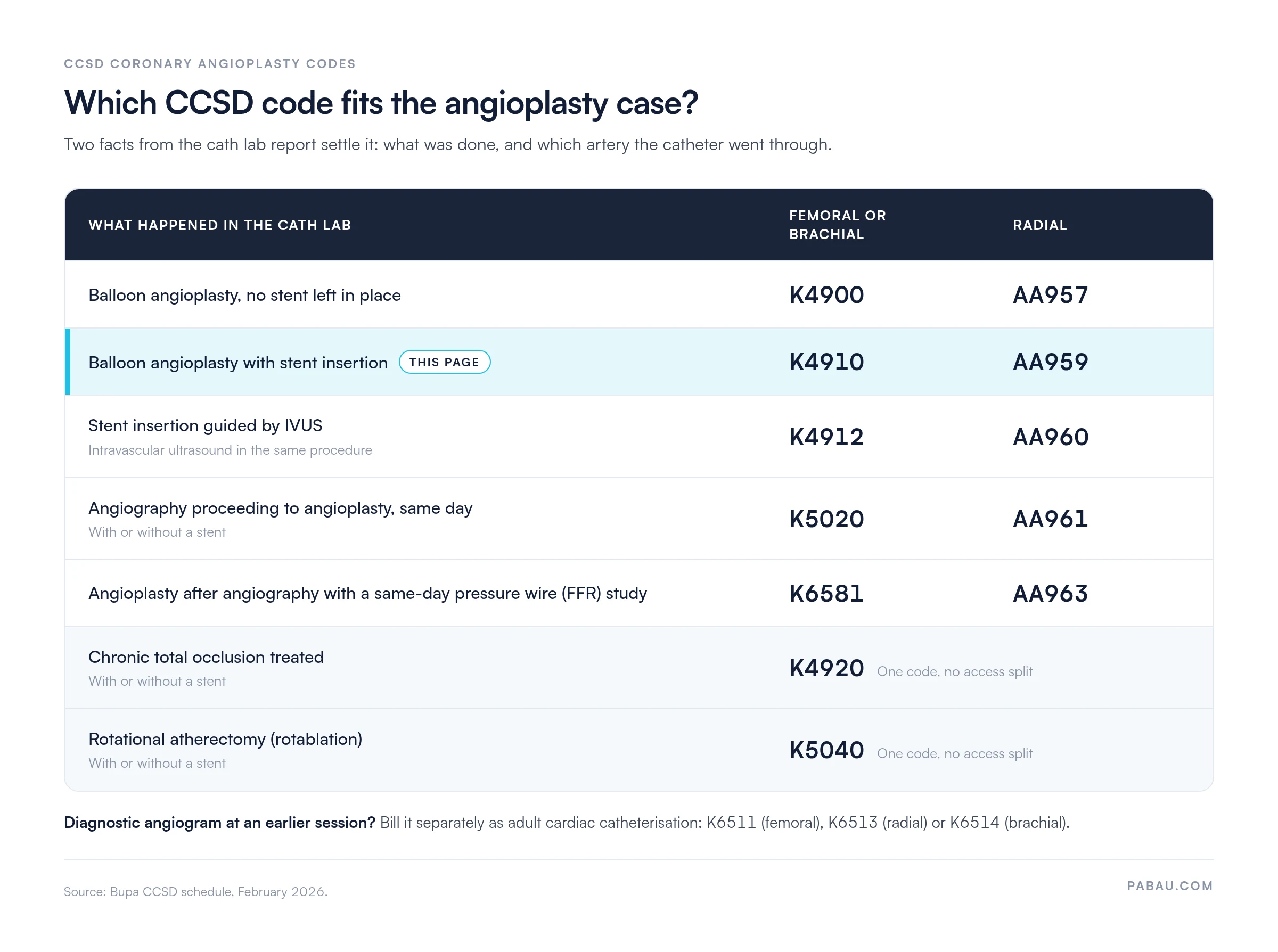
K4910 rarely stands alone in a private cardiology episode. Depending on what happened in the cath lab, an adjacent CCSD code either joins K4910 on the claim or replaces it. All codes below are taken from the February 2026 Bupa CCSD schedule.
Verify current code numbers and bundling rules against the live CCSD schedule before submission. Code numbers and their descriptors are subject to annual updates, and individual payer fee schedules may apply different unbundling policies. When a case fits none of these rows, our reference library helps you pick the right CCSD code.
Before you add an adult cardiac catheterisation code (K6511, K6513 or K6514) to a K4910 claim, check when the angiogram took place. The Bupa schedule lists combined codes, K5020 and AA961, for angiography proceeding to angioplasty on the same day. Coding that episode as two separate procedures is a common cause of partial payment or a claim query.
Most coding errors on PTCA claims come from the wrong stent status, access route, or level of complexity. The table below maps the key distinctions.
The single most common coding error is using K4910 when only balloon dilation was performed and no stent was left in place. Always confirm from the cath lab report whether a stent was deployed before selecting K4910.
Check the access route at the same time, because a radial case takes the AA-series code. The grid below puts both questions side by side.
OPCS-4 (the Office of Population Censuses and Surveys Classification of Interventions and Procedures, Version 4) is the parallel coding system used in NHS inpatient settings. Cardiologists who work across NHS and private practice should understand how K4910 maps to OPCS-4. So should practices that use OPCS-4 as a verification reference.
In OPCS-4, stented coronary angioplasty sits in the K75 category (percutaneous transluminal balloon angioplasty and insertion of stent into coronary artery). The K49 category covers balloon angioplasty of coronary artery without a stent, and it explicitly excludes stent insertion.
Do not let the shared digits mislead you: CCSD K4910 does not map to OPCS-4 K49.1. The NHS Classifications Browser is the definitive tool for confirming current OPCS-4 sub-codes.
Private UK insurers do not accept OPCS-4 codes. They use CCSD. Note one difference: OPCS-4 separates drug-eluting from bare metal stents, while CCSD does not. The NHS Classifications Browser is free to use and helps when you cross-check procedure descriptions before a coding decision.
Prior authorisation is required by all major UK private medical insurers for elective percutaneous coronary intervention. As a high-cost cardiac procedure, it is pre-authorised across every provider network.
Our Bupa CCSD billing guide covers the general pre-authorisation framework for Bupa-covered procedures in more detail.
Pre-authorisation rules change frequently. Always obtain written authorisation before performing elective PCI on a private patient, and retain the authorisation reference on the patient record. Emergency or urgent procedures performed without prior authorisation require retrospective notification to the insurer as soon as practicable. Timescales vary by payer.
A clean K4910 claim depends on a complete cath lab report. Private practice billing teams should check the following documentation is available before submitting.
Store procedure documentation and consent records in a system that links them to the matching claim. Payers can ask for supporting documents at any stage, and quick access shortens your reply to a query.
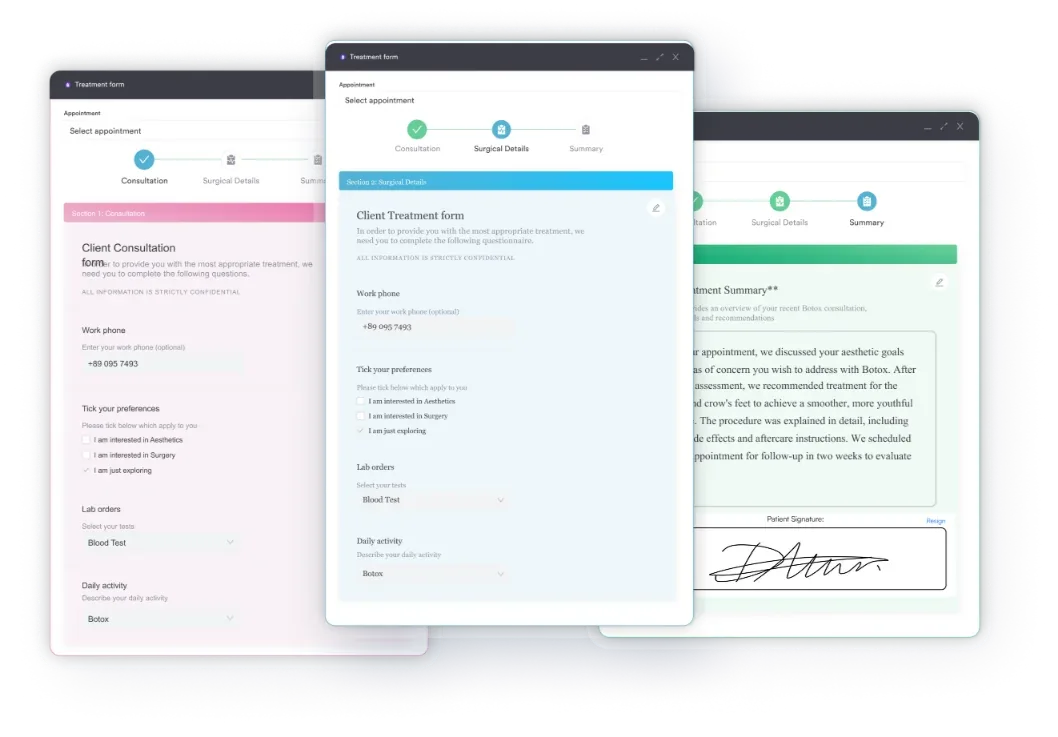
Coronary stent claim denials follow a predictable pattern. Most are preventable with the right administrative processes in place. Claims management software that tracks authorisation status and flags incomplete documentation before submission removes the most common denial triggers at source.
Multivessel coronary artery disease is common in the private cardiology patient population. When more than one vessel requires stenting, coding and billing become more complex, and payer rules diverge. Find out how each insurer treats multivessel PCI before the procedure, rather than when the claim comes back.
When two or more vessels are stented in the same session, some payers accept K4910 claimed once per treated vessel. Others pay a single K4910 fee, however many vessels are treated. This is one of the most variable areas in UK private cardiology billing.
Before submitting a multi-vessel claim, contact the insurer’s provider team to confirm their position. Where permitted, name each treated vessel in the cath lab report (e.g. LAD and RCA, or LCx and RCA). Document stent dimensions separately for each vessel.
In staged PCI, the interventional cardiologist treats one vessel at a first session and a second vessel later. This is more straightforward to bill. Each session generates its own K4910 claim, provided a fresh prior authorisation is obtained for each admission. The payer will treat each session as a separate episode.
Document clearly in the clinical notes that the second procedure is a planned staged intervention, naming the vessel(s) treated at each session. Payers may query a second K4910 submission if the documentation does not clearly distinguish it from the first episode.
When planning staged PCI for a private patient, tell the insurer at the first authorisation that a second, staged session is planned. Getting this on record before the second procedure removes the risk of a denial on grounds of duplication when the second K4910 claim arrives.
In many private cardiology practices, the authorisation number sits in an email and the cath lab report in the hospital system. The stent device record is often on paper. The claim goes out without one of them, and the insurer sends a query weeks later.
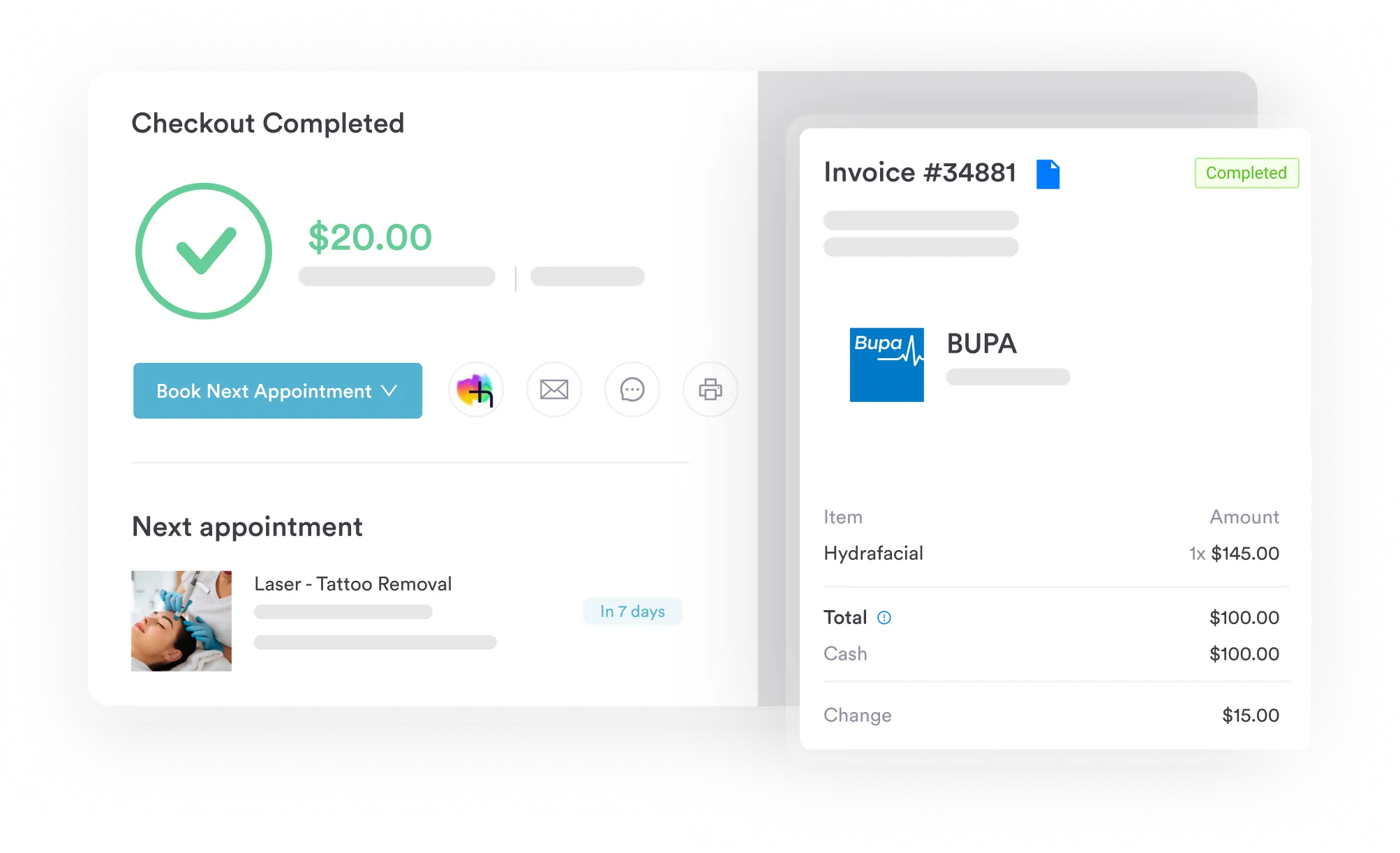
Pabau, the practice management and billing platform we build, keeps those pieces on one patient record. Insurance details and the authorisation reference sit on the client card. Signed consent and procedure documents attach to the episode. Claims go to Bupa, AXA Health, Vitality, Aviva and WPA through Healthcode.
Your billing team can check Bupa cover before the procedure and pull in paid Bupa invoices without matching them by hand. Claims management is included in every Pabau subscription.

Pabau helps UK private practices attach cath lab documentation, track prior authorisation status, and submit clean CCSD claims to Bupa, AXA Health, and Aviva.

Choosing K4910 comes down to two facts in the cath lab report. A stent was left in place, and the catheter went in through the femoral or brachial artery. Get either wrong and the claim fails, however good the clinical work was.
Most of the money on a stent claim is lost at the booking stage. Confirm the authorisation, the insurer’s stance on stent costs, and its multivessel rule while the case is still being booked. Each one takes minutes then and weeks once a query arrives.
Book a demo to see how Pabau keeps authorisation, cath lab documents and CCSD claims together for private cardiology practices.

Looking up a neighbouring code? CCSD codes gathers our CCSD procedure code guides in one library, so you can check descriptors before you submit.
Preparing the authorisation request? Medical prior authorization form gives you a ready-to-fill form covering patient and plan details, the requested procedure with its codes, and the clinical justification.
CCSD Code K4910 covers percutaneous transluminal angioplasty of coronary artery(ies) with stent insertion via femoral or brachial access. It is one combined code for balloon dilation of a narrowed coronary artery and stent deployment in the same session. It does not include diagnostic coronary angiography or balloon-only angioplasty without stent placement. Those require separate CCSD codes.
K4910 requires stent insertion. Balloon dilation without a stent is coded K4900 for femoral or brachial access, or AA957 for radial access. Stent deployment is the defining element that decides between them, so always confirm it from the cath lab report.
Yes. Both Bupa and AXA Health require prior authorisation before elective K4910 procedures are performed. Typical evidence requested includes a specialist referral, diagnostic angiography confirming significant stenosis, and the planned clinical approach. Performing the procedure without prior authorisation is the leading cause of K4910 claim denial and should be avoided for any elective intervention.
This depends on each payer’s rules. Some UK PMI insurers accept K4910 once per vessel treated in the same session. Others pay a single procedural fee regardless of vessel count. Confirm with each insurer’s provider team before submitting a same-session multivessel claim. Document each treated vessel separately in the cath lab report.
No. K4910 covers both drug-eluting stents and bare metal stents under the same procedural code. However, payers may apply different implant cost policies by stent type, particularly for DES, which carry a higher device cost. Check each insurer’s prosthesis rules to see whether the stent cost is paid within the K4910 fee or billed as a separate implant charge.
K4910 maps to OPCS-4 category K75, percutaneous transluminal balloon angioplasty and insertion of stent into coronary artery (K75.1-K75.4). It does not map to K49, which covers balloon angioplasty without a stent and excludes stent insertion. UK private insurers accept CCSD only, but the NHS Classifications Browser helps when cross-referencing between the two systems.