

HCPCS Code L0472: Hyperextension TLSO billing guide
HCPCS code L0472: Official descriptor and device definition HCPCS code L0472 des...

Last Updated: Nov 5, 2026
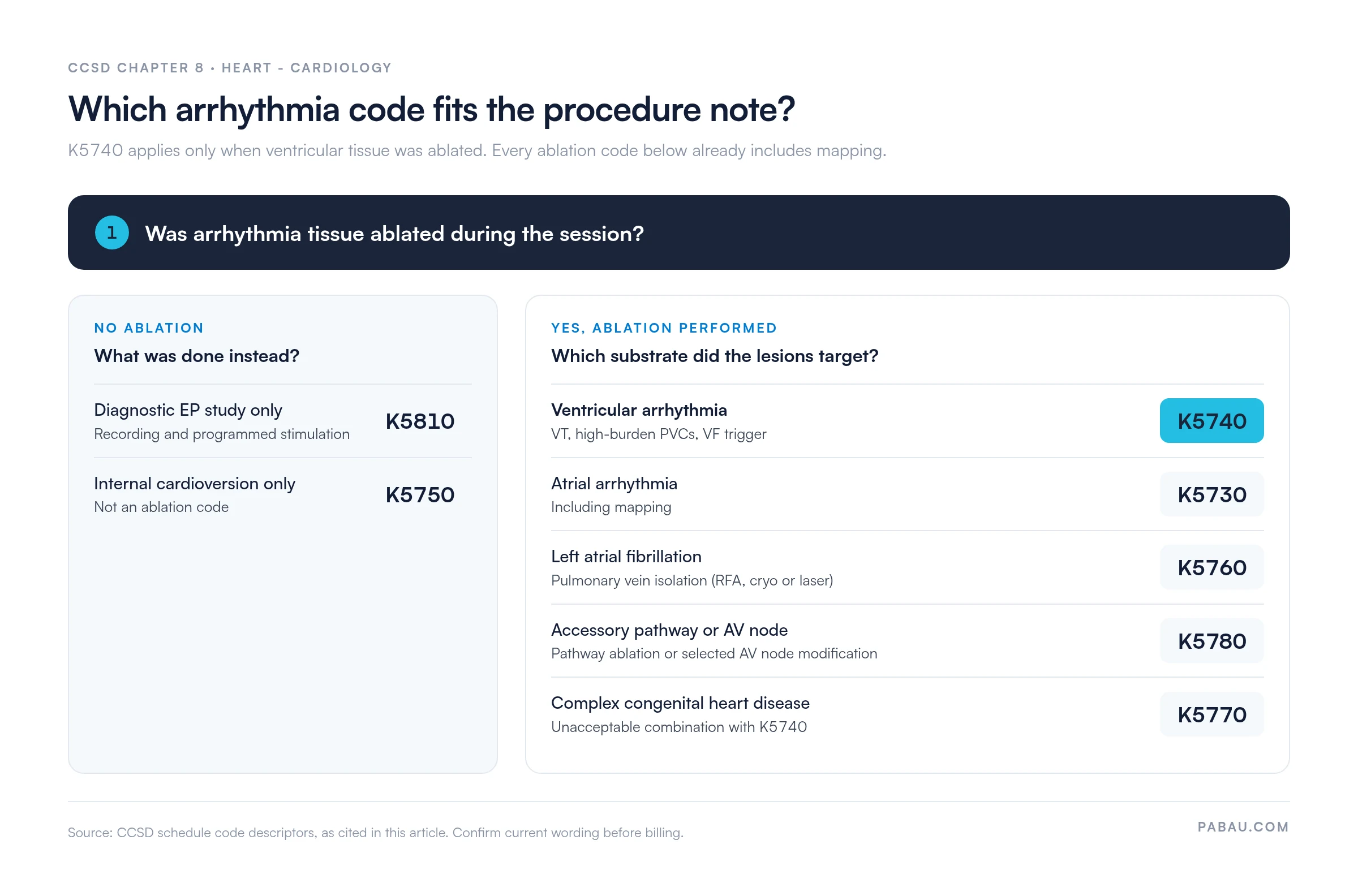
K5740 is the CCSD code for ablation of ventricular arrhythmia (including mapping). UK private consultants use it to bill a catheter ablation that targets ventricular tachycardia, high-burden ventricular ectopy or a ventricular fibrillation trigger.
Electroanatomical mapping is part of the code, so it is never billed as a separate line. Atrial and accessory-pathway ablations, internal cardioversion and diagnostic-only EP studies each have their own CCSD codes.
Let Pabau's smart automation suggest the right codes, reduce claim denials, and keep your practice compliant—effortlessly.
Automate repetitive tasks and focus on what matters most—your patients.
Reduce coding errors and ensure compliance with the latest regulations.
Clean claims, fewer denials, and faster reimbursements.
Powerful insights and reporting to help your practice thrive.
HIPAA compliant SOC 2 certified GDPR-compliant Trusted by 4,000+ clinics worldwide

CCSD Code K5740 covers ablation of ventricular arrhythmia including mapping, so electroanatomical mapping is bundled and never billed as a separate line.
Principal indications include sustained VT, VT storm, idiopathic VT, PVC-induced cardiomyopathy, and VF with an identifiable trigger.
Atrial, accessory-pathway and congenital arrhythmia ablations have their own K57xx codes, and a diagnostic-only EP study is billed as K5810.
Insurers expect pre-authorisation before the procedure, and missing it is a common cause of claim rejection.
Pabau, the practice management platform we build, stores each pre-authorisation code against the appointment so it reaches the CCSD-coded claim.
CCSD Code K5740 is the Clinical Coding and Schedule Development (CCSD) procedure code for ablation of ventricular arrhythmia (including mapping). It is used in UK private healthcare billing. The CCSD schedule is used by the CCSD Group insurers: Aviva, AXA Health, Bupa and VitalityHealth. Other insurers adopt it at their own discretion, and the NHS uses Healthcare Resource Groups (HRGs) instead.
K5740 sits in Chapter 8 (Heart – Cardiology) of the CCSD schedule. Its neighbours there cover atrial, accessory-pathway and congenital arrhythmia ablation, and the full set of CCSD codes for consultants runs across every specialty.
Therapeutic intent is what separates K5740 from diagnostic electrophysiology codes. The ablation catheter is deployed to eliminate or modify the arrhythmia substrate, and the descriptor explicitly includes the mapping that guides it. Those two elements define the billing scope.
A K5740 procedure follows a structured sequence performed in an EP lab under fluoroscopic guidance, typically with sedation or general anaesthesia. Understanding each phase clarifies why mapping is inseparable from ablation and therefore bundled within the single code.
Mapping directs where ablation energy is delivered, so in ventricular arrhythmia work it is part of the procedure itself. Ablating a ventricular substrate without it would be clinically substandard, which is why the CCSD descriptor packages both into K5740.
K5740 is appropriate when catheter ablation is the intended therapeutic intervention for a ventricular rhythm disorder. The British Heart Rhythm Society (BHRS) and the European Heart Rhythm Association (EHRA) publish consensus guidance on indications. The list below covers the principal clinical scenarios in which an electrophysiologist would submit this code.
K5740 is not the correct code for atrial fibrillation, atrial flutter or accessory-pathway arrhythmias, even when the ablation technique is similar. Atrial and accessory-pathway arrhythmias have their own codes in the K57xx block.
Accurate bundling decisions prevent overbilling queries and claim rejections. The table below sets out what is covered within K5740 and what may be billed separately or is not billable at all.
Verify bundling rules against the current CCSD technical guide edition. Bundling rules are updated between editions, and individual payer policies may apply additional restrictions.
K5740 belongs to a block of CCSD cardiology codes covering ablation procedures for different arrhythmia substrates. Choosing the wrong code within this block is a common cause of claim queries and downcoding. The table below lists the adjacent arrhythmia ablation codes. Verify current descriptors and fee levels against the Bupa code search or the relevant insurer’s fee finder before billing.
The critical distinction is between K5740 and the atrial and accessory-pathway ablation codes (for example K5730, K5760 and K5780). Submitting one of those for a ventricular ablation, or K5740 for an atrial one, creates a mismatch against the procedure note. That mismatch is a common audit trigger.
CCSD also lists K5770, for ablation in complex congenital heart disease, as an unacceptable combination with K5740. When the session ends without ablation, the study is billed as K5810 instead. The chart below walks through the choice in the order a coder reads the procedure note.
Always confirm a neighbouring code’s current fee level with each insurer before co-submitting. Fee schedules for the K57xx block vary across Bupa, AXA Health, Vitality, and WPA, and are updated annually. A code that is reimbursed at one rate by Bupa may attract a different fee from AXA Health.
Private insurers will query or reject a K5740 claim if the procedure note does not substantiate each billable element of the code descriptor. A complete EP lab report for a ventricular arrhythmia ablation must contain each of the following elements.
Missing any of these elements gives insurers grounds to query the claim. They may ask whether mapping was performed, whether the substrate was ventricular, or whether the endpoint was reached. A thorough EP lab report heads off most of those queries before submission.
UK private medical insurers expect pre-authorisation (pre-auth) before a catheter ablation goes ahead. Proceeding without it exposes the practice to full claim rejection, however well the procedure is documented. The Bupa CCSD code guide explains the general framework, and the table below covers the evidence each payer typically asks for with K5740.
Four pieces of clinical evidence consistently strengthen a pre-auth request:
Insurers do not guarantee approval even when every documentation criterion is met.
Most K5740 denials stem from one of five root causes, each with a clear corrective action.
Co-submission is one of the least-documented areas of K5740 billing. The guidance below reflects standard CCSD bundling principles and common payer practice. Co-billing rules differ between insurers and change between editions, so check the current CCSD technical guide and each payer schedule first.
Submit claims through Healthcode where possible. UK private insurers accept electronic claims through the platform, which validates the format before the claim reaches the payer. Practices with a steady flow of electrophysiology cases often compare UK medical billing software that links pre-auth records, procedure notes and invoices in one workflow.
Many cardiology billing teams keep pre-auth references in a spreadsheet, then re-key them onto the claim after the procedure. A missing or mistyped reference can sink an otherwise clean K5740 claim.
Pabau stores each insurer pre-authorisation as a case on the patient record. Attach the case when you book the ablation, and the authorisation code follows the appointment through to the claim. Its private practice claims management flags any claim still missing a code before it is sent.
Claims are raised from the patient’s invoice, checked for missing or invalid details, and sent through Healthcode to Bupa, AXA Health and Vitality. If a claim comes back rejected, Pabau shows the reason so your team can correct the field and resubmit.
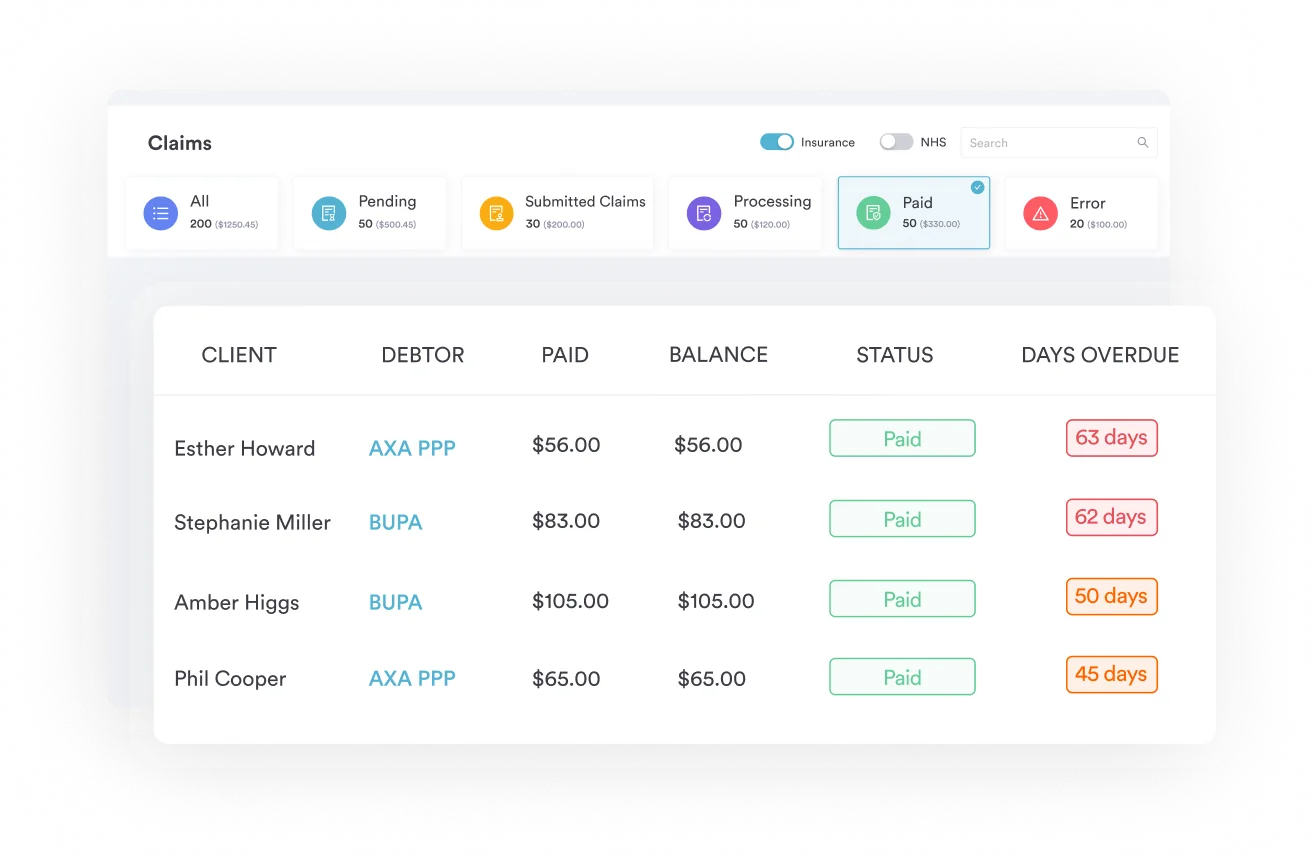

Pabau ties each pre-authorisation code to the ablation appointment and raises the CCSD-coded claim from the invoice. Claims are checked for missing details before they go to Bupa, AXA Health or Vitality through Healthcode.

A K5740 claim pays when three records agree. The authorisation covers the procedure, the note names a ventricular substrate, and the report shows that mapping guided the lesions. Your team already produces each of them, so the work lies in checking them before submission.
Move that check to the booking stage rather than the billing run. Confirm the pre-auth code when the ablation is scheduled, and send the EP lab report back if it does not name the mapping system. Leave any same-day device implant off the claim until the combination rules are confirmed.
Book a demo to see how Pabau carries the pre-auth code from the ablation booking to the K5740 claim.

Need guidance on Bupa’s CCSD procedure codes? Bupa CCSD codes guide covers the code schedule, fee chapters, and submission rules for UK private practice billing.
Billing an EP study that ended without ablation? CCSD Code K5810 explains the diagnostic intracardiac electrophysiological study code and its documentation.
Choosing billing software for a UK private practice? Best medical billing software in the UK compares the platforms that handle Healthcode claims.
CCSD Code K5740 is the UK private healthcare procedure code for ablation of ventricular arrhythmia (including mapping). It covers the complete ablation session: vascular access, electroanatomical mapping, delivery of ablation energy (radiofrequency or cryothermal), and acute endpoint testing. The anaesthetist bills the anaesthetic separately. A device implant in the same session is billed separately only where the CCSD combination rules and the insurer allow it.
Cardiac mapping is included in K5740. The code descriptor explicitly states “including mapping,” which means electroanatomical mapping performed during the same ablation session cannot be billed as a separate line item. Submitting a separate mapping code alongside K5740 is an unbundling error that private insurers will reject.
It depends on whether the diagnostic EP study was a distinct session or part of the same sitting as the ablation. A diagnostic EP study performed in a separate session before the ablation may be separately billable under K5810. When the study runs immediately before the ablation in the same visit, it is generally bundled into K5740. Rules differ, so verify with each payer before co-submitting.
The EP lab report must state the clinical indication and arrhythmia type, plus the mapping system used (e.g. CARTO or EnSite) and its findings. It also lists the energy modality and lesion sets. It then records the acute endpoint achieved, the anaesthetic method and anaesthetist name, and total fluoroscopy time. Missing any of these gives insurers grounds to query whether K5740 is justified.



