

CCSD code G5100: Bypass of duodenum billing guide
CCSD code G5100 bills a bypass that leaves the duodenum in place CCSD code G5100...

Last Updated: Oct 16, 2026
E1500 is the CCSD code for operation(s) on sphenoid sinus (including endoscopic) and bilateral. It covers sphenoidotomy, sphenoid sinus drainage and mucocele marsupialization, by an endoscopic transnasal or an open approach.
Because laterality is written into the descriptor, E1500 is billed once whether one or both sphenoid sinuses are treated. The code sits in Chapter 5 (Ear, nose and throat), in the Nasal sinuses section of the CCSD schedule.
Let Pabau's smart automation suggest the right codes, reduce claim denials, and keep your practice compliant—effortlessly.
Automate repetitive tasks and focus on what matters most—your patients.
Reduce coding errors and ensure compliance with the latest regulations.
Clean claims, fewer denials, and faster reimbursements.
Powerful insights and reporting to help your practice thrive.
HIPAA compliant SOC 2 certified GDPR-compliant Trusted by 4,000+ clinics worldwide

CCSD Code E1500 covers open and endoscopic operations on the sphenoid sinus, including sphenoidotomy, sphenoid sinus drainage and mucocele marsupialization.
The descriptor includes “and bilateral”, so E1500 is billed once, at one fee, whether the surgeon operates on one sphenoid sinus or both.
Supporting ICD-10 codes include J32.3 for chronic sphenoidal sinusitis, D14.0 for benign tumors, C31.3 for malignancy and D35.2 for pituitary access.
Most UK private insurers require pre-authorization before elective sphenoid sinus surgery, and a missing approval reference is a leading cause of E1500 denials.
Pabau, the practice management platform we build, keeps the operative note, consent, pre-authorization reference and CCSD code in one patient record.
CCSD Code E1500 is the Clinical Coding and Schedule Development code for operation(s) on the sphenoid sinus, including endoscopic approaches. Its full descriptor reads “Operation(s) on sphenoid sinus (including endoscopic) and bilateral”. It sits in Chapter 5 (Ear, nose and throat), under the Nasal sinuses section.
The CCSD schedule is maintained by the CCSD Group. Its members are Bupa, AXA Health, Aviva, VitalityHealth and the major UK private hospital groups. Each insurer then publishes its own fees against the shared codes. Our CCSD code guides cover other procedures in the schedule, one code per page.
The primary procedure captured by E1500 is sphenoidotomy. The surgeon opens the sphenoid sinus to allow drainage, biopsy or removal of diseased tissue. Transnasal endoscopic surgery, the most common modern technique, and open approaches both fall under this single code. The operative report still needs to state the approach, the side or sides treated, and the extent of surgery.
Other codes in the schedule span several operations in the same way. B3590 covers four duct procedures under one descriptor, so the report must name which one was performed.
The sphenoid sinus sits at the center of the skull base, directly behind the nasal cavity and in front of the pituitary fossa. It is flanked by the optic nerves and the carotid arteries on each side. This position makes sphenoid surgery one of the most technically demanding sinonasal procedures. It also explains the documentation scrutiny it attracts from UK private insurers.
Proximity to the skull base means sphenoid procedures may involve neuronavigation, intraoperative imaging or joint working with neurosurgery. Each adds detail that coders must capture in the operative note. That record supports medical necessity and, where relevant, any concurrent procedure claim.
Medical necessity documentation for CCSD Code E1500 must pair the procedure with a supporting ICD-10 diagnosis code that reflects the clinical indication. The table below lists the most common indications and their ICD-10 codes.
E1500 is billed once, whether the surgeon operates on one sphenoid sinus or both. Laterality is built into the CCSD descriptor, which reads “Operation(s) on sphenoid sinus (including endoscopic) and bilateral”.
CCSD has no bilateral modifier. Modifier 50 is a US CPT convention, and it has no place on a UK private medical insurance claim. Billing E1500 twice, once per side, duplicates a fee the insurer has already set to cover both sides.
The fee schedules confirm this. Freedom Health Insurance’s 2026 Chapter 5 schedule lists E1500 once, with a £250 specialist fee and a £213 anesthetist fee. The 2026 Guernsey tariff also lists E1500 once, at a single price.
Laterality still belongs in the operative note. State whether the right, left or both sphenoid sinuses were opened, because insurers check the note against the pre-authorization. A note that leaves the side unclear invites a medical review request.
The Nasal sinuses section of the CCSD schedule codes by procedure, not by sinus. Some sinuses have several codes, and some codes span more than one sinus. E1260, for example, covers image-guided endoscopic surgery on the frontal, sphenoid and/or ethmoid sinuses. The guide below shows which code the sphenoid work belongs to before E1500 goes on the claim.
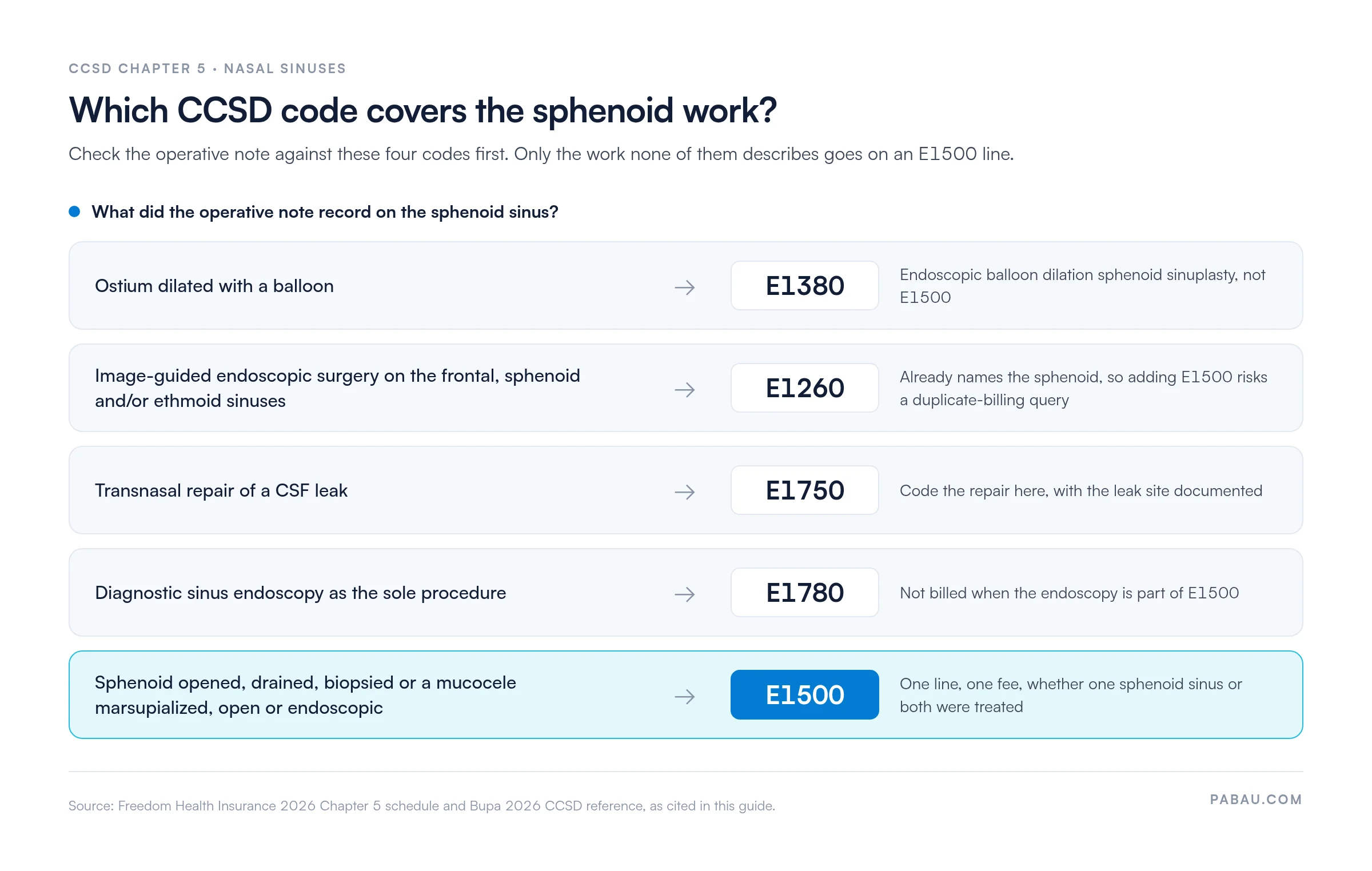
Descriptors above follow Freedom Health Insurance’s 2026 schedule and Bupa’s 2026 CCSD reference. Check the current CCSD schedule edition for exact wording before you code. CCSD numbering is separate from US CPT, where the nearest analogue for endoscopic sphenoidotomy is CPT 31287/31288. The two systems are not interchangeable on UK private insurance claims.
Freedom Health Insurance’s Chapter 5 notes say FESS includes removal of nasal polyps, antrostomy and turbinate reduction. Do not charge those as additional procedures alongside E1432 or E1260. Check each insurer’s chapter notes for its own bundling rules before you build a multi-sinus claim.
Elective sphenoid sinus surgery almost universally requires pre-authorization from UK private medical insurers before the procedure date. Submitting an E1500 claim without a valid pre-authorization reference number is the most common cause of outright rejection for this procedure. Review Pabau’s Bupa CCSD billing guidance for insurer-specific submission steps.
Pre-authorization requirements vary by insurer and policy year. The checklist below reflects general UK private medical insurance practice. Confirm current requirements directly with each payer before submitting.
Bupa, AXA Health, Aviva, VitalityHealth and WPA all publish insurer-specific guidance. Bupa’s procedure code search allows coders to verify E1500 recognition and any attached pre-auth conditions.
AXA Health maintains its specialist procedure code portal where fee chapters and authorization requirements are published. Aviva’s fee schedule and Vitality’s procedure fee finder, both on their provider websites, list each insurer’s reimbursement for E1500.
The operative note is the primary evidence supporting an E1500 claim. UK private payers routinely request operative reports when reviewing complex ENT surgical claims. A note that omits key elements is the fastest route to a documentation-based denial. Structured patient records with procedure-specific templates reduce the risk of omissions.
The following elements must be present in the operative report to support E1500:
An E1500 claim follows a similar path at most UK private insurers. The steps below run from booking to payment.
The anesthetist bills separately against the same code, using the anesthetist fee in the insurer’s schedule.
Each insurer sets its own E1500 fee, so check the schedule for the patient’s insurer before you quote any shortfall.
Freedom Health Insurance’s 2026 schedule rates E1500 as Intermediate complexity. It pays a £250 specialist fee and a £213 anesthetist fee. The 2026 Guernsey tariff places E1500 in price band 5, at £1,793.
Both schedules list the code once, which matches the single-line rule for bilateral surgery. Bupa, AXA Health, Aviva and VitalityHealth each publish their own fees through the provider tools covered above.
Most E1500 denials are preventable. The table below lists the most frequent denial triggers and the fix for each. A pre-submission check can flag a missing pre-authorization reference or an incomplete note before a claim leaves the practice.
Read the insurer’s stated reason before you change the claim. A missing pre-authorization reference or a wrong ICD-10 code can usually be corrected and resubmitted. A medical necessity or bundling denial needs the operative note, imaging report and treatment history sent with a short covering letter.
Keep a dated copy of every document you send. If the insurer upholds the denial, that record is what you take into its appeals process.
The most common multi-code scenario for E1500 is FESS, where the surgeon also treats the ethmoid, maxillary or frontal sinuses in one session. Each additional code must describe distinct, documented surgical work.
UK private insurers scrutinize pan-sinus claims for unbundling. E1432 already includes antrostomy, simple polypectomy and attention to the turbinates, so those are not billed again. When image guidance is used, E1260 names the sphenoid in its own descriptor. Adding E1500 for the same sphenoid work risks a duplicate-billing query.
An operative note that says “pan-sinus FESS including sphenoid” gives the payer grounds to bundle E1500 or pay a reduced rate. Write a separate paragraph for each sinus, covering the approach, the extent of surgery and any specimens. Confirm concurrent billing with the insurer’s pre-authorization team, because UK payers do not publish uniform bundling policies.
Transsphenoidal pituitary adenoma surgery involves ENT surgeons opening the sphenoid sinus to create a corridor through which the neurosurgeon reaches and removes the tumor. This joint pathway raises a question coders frequently ask: does E1500 apply to the ENT sphenoid-access component?
Under CCSD, each surgical team in a joint procedure generally bills for its own component. Where the ENT surgeon performs a sphenoidotomy as the access route, E1500 may fit that component. The pituitary resection is then coded separately under the relevant neurosurgery CCSD code.
Whether insurers accept this split is payer-specific, so confirm it before the procedure. Some treat sphenoid access as part of the global neurosurgical fee and will deny a concurrent E1500 claim.
The supporting ICD-10 code for pituitary adenoma cases is D35.2 (benign neoplasm of pituitary gland). If the pre-authorization covers both the ENT and neurosurgery components, keep that correspondence in the patient record. Document the ENT surgeon’s distinct contribution in a separate operative note section or a co-surgeon’s operative note.
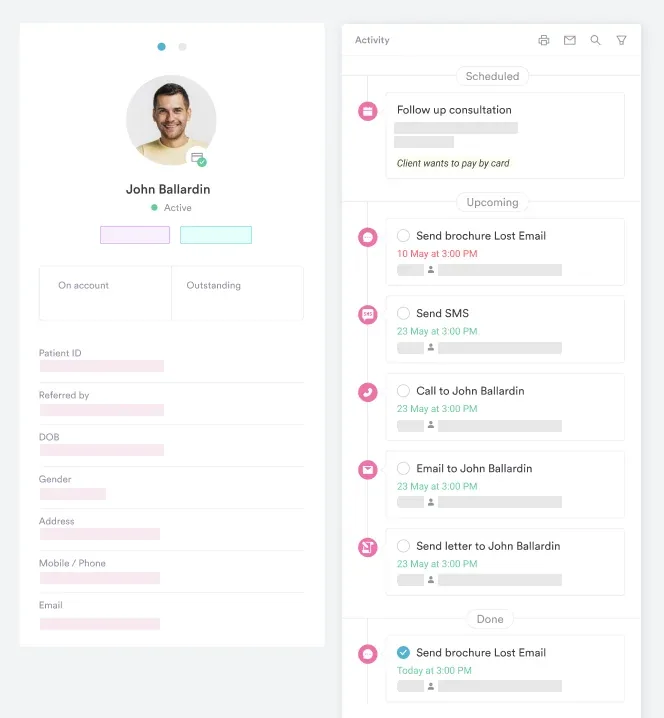
UK private ENT practices and specialist surgical teams use Pabau to manage CCSD billing from pre-authorization through to claim export. Its private practice claims software takes structured CCSD code entry, with diagnosis codes and insurer reference numbers attached before a claim is submitted.
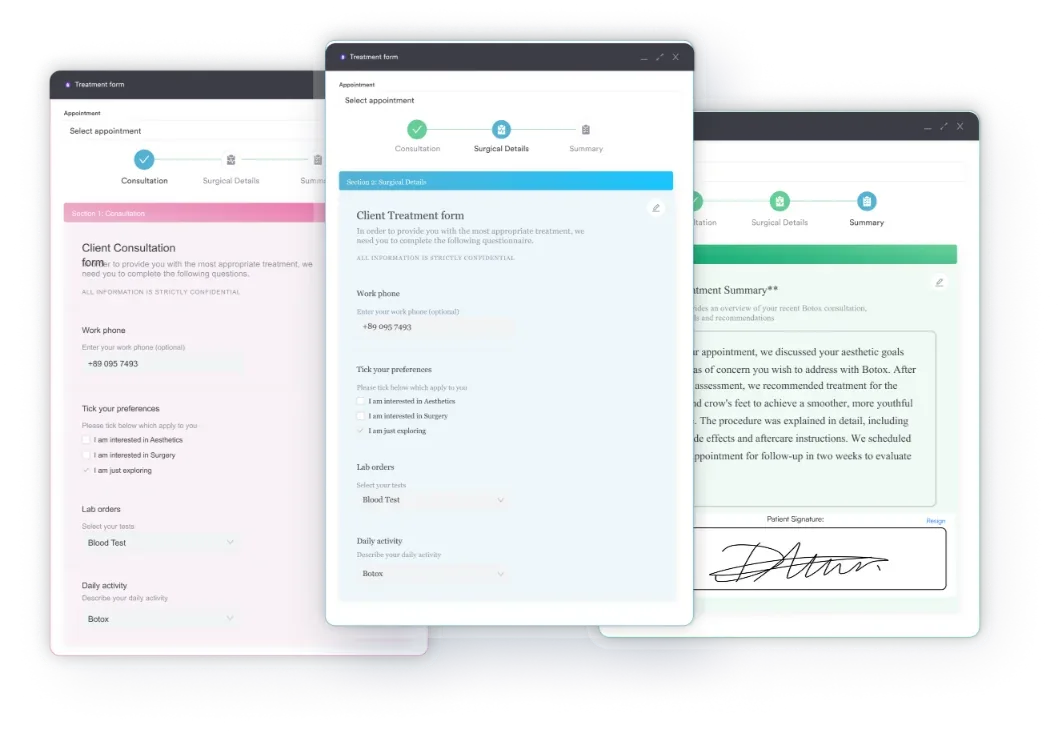
Surgeons can complete operative notes in digital clinical forms that prompt for laterality, approach, concurrent procedures and biopsy details. The coder then has what they need to apply E1500 correctly, captured at the point of care.
Consent forms, imaging referrals and pre-authorization letters sit against the same patient encounter. When a payer asks for evidence, the billing team has one place to look.
Every change to a record is logged in Pabau’s audit trail, which supports your UK GDPR obligations for billing data.

Pabau helps UK private ENT practices capture the documentation, pre-authorization references, and CCSD code details that insurers need, before a claim is submitted. See the billing workflow in action.

Coding E1500 correctly comes down to one question asked before the claim is built: does another code already describe this sphenoid work? Answer it from the operative note, and the bilateral question answers itself, because E1500 is billed once.
Treat the operative note as the claim. A note that names the side, the approach and each sinus separately survives review. A vague one invites a query, however correct the code.
Book a demo to see how Pabau ties the operative note, pre-authorization and E1500 claim together for your ENT practice.

Billing open frontal and ethmoid surgery instead? CCSD Code E1410: External frontoethmoidectomy billing guide explains how the open approach is coded separately from sphenoid work.
Working beyond the frontoethmoid recess? CCSD code E1480: Endoscopic frontal sinus exploration guide covers the frontal sinus code that often sits alongside multi-sinus claims.
Adding a bone flap to the frontal sinus? CCSD code E1450: Bone flap to frontal sinus billing guide sets out the documentation insurers expect for that procedure.
CCSD Code E1500 covers operations on the sphenoid sinus, by open or endoscopic approach, on one or both sides. It includes sphenoidotomy, sphenoid sinus drainage, mucocele marsupialization and integral biopsy. Diagnostic sinus endoscopy as a sole procedure is coded E1780, and balloon sphenoid sinuplasty is coded E1380. Ethmoid, frontal and maxillary procedures carry their own codes.
Yes, elective sphenoid sinus surgery almost universally requires pre-authorization from UK private medical insurers before the procedure date. Missing prior approval is the most common cause of outright claim rejection for E1500. Required documentation typically includes a supporting ICD-10 diagnosis, imaging (CT or MRI), evidence of failed conservative treatment, and the proposed CCSD code with laterality stated.
E1500 is billed once, whether surgery is on one side or both. Its descriptor reads “Operation(s) on sphenoid sinus (including endoscopic) and bilateral”, and insurers set one fee to match. CCSD has no bilateral modifier, since modifier 50 belongs to US CPT. Freedom Health Insurance’s 2026 schedule, for example, lists a single E1500 specialist fee of £250. The operative note should still state which side or sides were treated.
Yes, where distinct surgical work was performed in each sinus and the operative report describes each one separately. E1432 is the usual FESS ethmoid code, and it already includes antrostomy, simple polypectomy and attention to the turbinates. If image guidance was used, E1260 already names the sphenoid, so check before adding E1500. Confirm concurrent billing with each insurer’s pre-authorization team.
Only the ENT access component can be, and only where the insurer accepts split billing. When the ENT surgeon performs a sphenoidotomy as the access route, some insurers accept E1500 for that work, with the pituitary resection coded under neurosurgery. Others treat sphenoid access as part of the global neurosurgical fee. Confirm the convention before surgery and document the ENT contribution separately.
It depends on the insurer. Freedom Health Insurance’s 2026 schedule pays £250 to the specialist and £213 to the anesthetist, and rates E1500 as Intermediate complexity. The 2026 Guernsey tariff lists E1500 in price band 5, at £1,793. Check the patient’s insurer schedule before you quote any shortfall.



