CPT code 63081: Vertebral corpectomy, cervical spine
CPT code 63081: official descriptor and procedure overview CPT code 63081 descri...

Last Updated: Oct 6, 2026
Billable Code
B3590 is the CCSD code for operations on ducts of nipple.
Let Pabau's smart automation suggest the right codes, reduce claim denials, and keep your practice compliant—effortlessly.
Automate repetitive tasks and focus on what matters most—your patients.
Reduce coding errors and ensure compliance with the latest regulations.
Clean claims, fewer denials, and faster reimbursements.
Powerful insights and reporting to help your practice thrive.
HIPAA compliant SOC 2 certified GDPR-compliant Trusted by 4,000+ clinics worldwide

CCSD code B3590 covers surgical operations on the ducts of the nipple, including microdochectomy and total duct excision (Hadfield’s operation).
UK private medical insurers typically require pre-authorization before a B3590 procedure. Missing it is the leading denial trigger.
Every B3590 claim needs a detailed operative note naming the procedure, laterality, the duct or ducts involved, and specimen disposition.
Pabau, the practice management platform we build, helps private breast surgery practices capture CCSD codes and track pre-authorization before claims go out.
CCSD code B3590 sits within the breast chapter of the CCSD schedule, the code set that governs procedure billing across UK private healthcare. Its descriptor is “Operations on ducts of nipple.”
The code applies when a consultant breast surgeon performs any recognized surgical intervention on the lactiferous (mammary) duct system. That ranges from a targeted single-duct excision to a complete subareolar duct clearance.
It is billable on funded private medical insurance (PMI) claims and on self-pay invoices, provided the operative note supports the procedure described. If you already bill Bupa CCSD procedure codes, B3590 follows the same submission structure as the other breast codes in our CCSD code library.
B3590 does not represent a single defined operation. It is a category code covering several named procedures that share one anatomical target, the mammary duct. Unlike adjacent breast codes, B3590 concerns the ductal system of the nipple, not the surrounding breast parenchyma, nipple skin, or areola.
B3590 encompasses four main operative variants performed on the ducts of the nipple. Each involves a different extent of ductal excision and carries different documentation implications for billing.
Microdochectomy is the most frequently billed variant. It targets a single duct identified by perioperative dye injection or lacrimal probe cannulation. The surgeon excises that duct with its surrounding periductal tissue and sends the specimen for histopathology.
Total duct excision (the Hadfield operation) removes all of the subareolar ducts in one procedure. It is typically reserved for bilateral or multi-duct discharge, duct ectasia causing recurrent infection, or cases where a single-duct approach has not resolved symptoms.
Operations on the nipple ducts are performed once the cause of pathological nipple discharge has been localized. They usually follow conservative management that has not resolved it. In UK private practice, the referral typically comes from a GP or breast physician after imaging and cytology.
The main clinical indications documented to support a B3590 claim are:
Documentation must state the specific indication clearly. Vague entries such as “nipple discharge” without specifying whether it is unilateral, spontaneous, or associated with a lesion will draw a payer query. The ICD-10 diagnosis code submitted alongside B3590 should match the documented indication precisely.
Understanding the operative steps helps billing teams identify what the operative note must contain and whether companion codes for anesthesia or histopathology are justified.
B3590 rarely travels alone on a claim. The following companion codes are routinely submitted in the same episode, depending on the specific procedure performed and the clinical circumstances.
UK private insurers work from the WHO edition of ICD-10, so the codes above use its four-character form rather than US ICD-10-CM codes. Diagnosis code pairings are a frequent source of payer queries. The diagnosis code submitted must match the clinical indication documented in the operative note and any pre-operative imaging reports. Submitting D24 (benign neoplasm) when the operative note only documents discharge without confirmed papilloma will draw a query or denial.
Several breast codes can be confused with CCSD code B3590. The distinctions below reflect the anatomical focus and operative intent of each code, not simply the incision site.
The operative note is the deciding document. If the note describes excision of a single identified duct with a lacrimal probe, that is B3590. If it describes excision of a breast lump with no ductal involvement, a parenchymal excision code such as B2800 applies instead. Conflating the two is a frequent miscoding error on nipple-related breast claims.
Every B3590 claim sent to a UK private medical insurer needs supporting documentation. It must confirm the named procedure was performed and that the clinical record matches the code. Digital operative note templates reduce transcription errors and capture key fields before the claim is submitted.
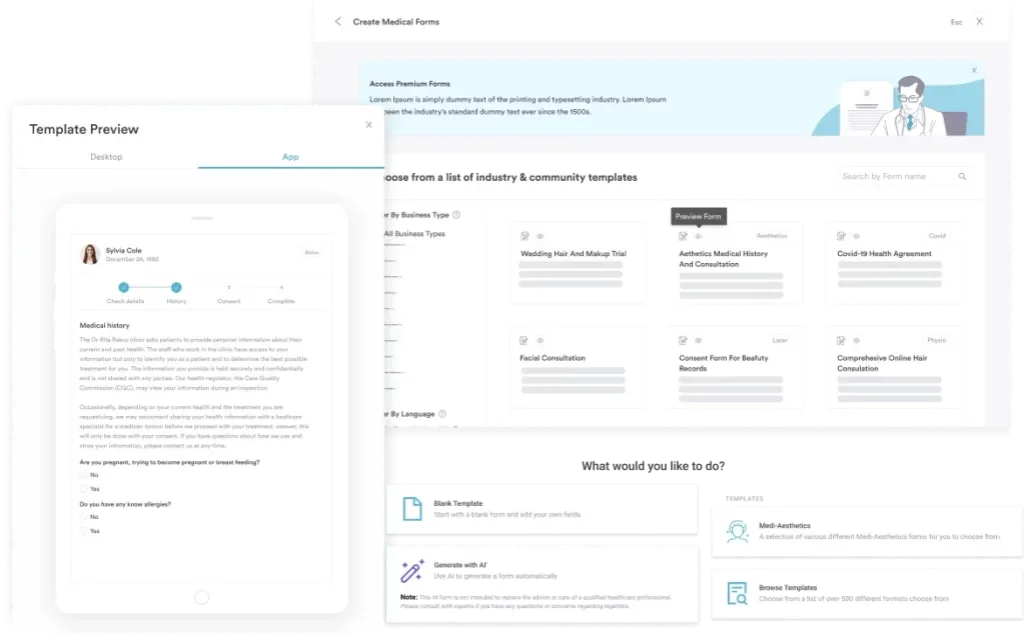
The operative note for B3590 must include all of the following:
Most major UK PMIs require pre-authorization before a B3590 procedure is performed. Skipping it is the most common reason nipple duct surgery claims go unpaid. A well-written operative note does not rescue a claim the insurer never approved.
Pre-authorization requirements vary by insurer, and the rules change. The table below summarizes general requirements, so verify with the relevant payer portal before booking.
The Bupa fee schedule and each payer’s own portal are the authoritative sources for current fee and authorization data. Registering on every portal early avoids delays when an authorization is needed urgently.
When submitting the authorization request, include the CCSD code B3590, the planned procedure name, the ICD-10 diagnosis code, laterality, and the referring clinician’s details. Some payers want the breast imaging report at the pre-authorization stage, not only with the final claim.
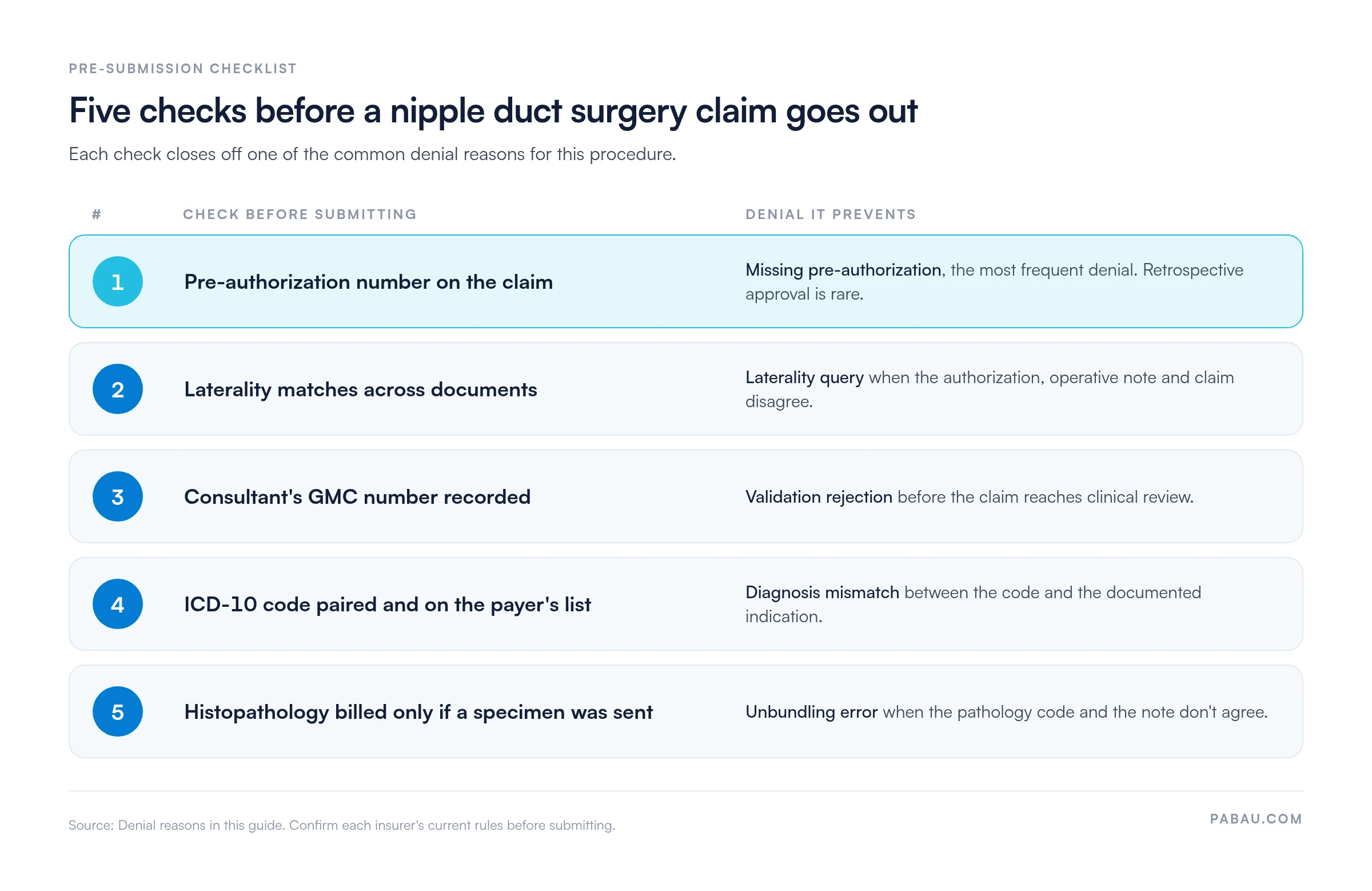
Most B3590 denials and payer queries are preventable. Automated claims management that checks documentation before submission catches most of these issues before the claim leaves the practice.
Each of these denials maps to one check that billing staff can run before the claim goes out.
When a claim is denied, the appeal should include:
Checking each claim at the point of care cuts the number of appeals a practice has to write in the first place.
Run the five checks above on every B3590 claim before it leaves the practice. Most avoidable denials are caught at this stage, before an insurer ever sees the claim.
In many private breast surgery practices, operative notes live in one system and pre-authorization numbers sit in email. Billing staff then re-key the claim by hand, which is where laterality and code mismatches creep in.
In Pabau, the operative note template can require the named procedure, laterality, ducts involved and specimen disposition before it is signed. The invoice is raised against the patient’s insurer from the same record, and the claim goes to Healthcode without re-keying.
Each claim is then tracked through clear stages, such as pending and submitted. A queried B3590 claim gets spotted early rather than at month end.

Pabau helps private breast surgery practices capture CCSD codes accurately and keep pre-authorization details with each claim. Operative notes carry the detail payers need, so fewer claims come back queried.

For B3590, billing starts before the patient reaches the operating room. Agree the pre-authorization number, laterality and ICD-10 code first, and the operative note only has to confirm them.
The trade-off is extra admin at booking in exchange for fewer queried claims after surgery. Build those checks into your note templates once, and every later claim inherits them.
Book a demo to see how Pabau links operative notes, pre-authorization and Healthcode claims for private breast surgery practices.

Need guidance on Bupa CCSD code submissions? Bupa CCSD procedure codes covers how Bupa structures its code schedule and what billing teams need to know when submitting claims.
Looking for the current Bupa fee schedule? Bupa procedure codes fee schedule breaks down procedure fee categories and submission requirements for UK private practice.
Billing a breast lump excision instead? CCSD code B2800 explains how to bill excision of a breast lump or fibroadenoma.
Coding a core biopsy before surgery? CCSD code B3212 walks through billing a percutaneous suction core biopsy for UK private insurers.
CCSD code B3590 covers surgical operations on the ducts of the nipple. These include microdochectomy (single duct excision), total duct excision (Hadfield’s operation), duct exploration, and duct cannulation. Consultant breast surgeons use it to bill UK private health insurers for procedures on the mammary duct system. Surgery on the surrounding breast tissue or nipple skin falls outside it.
Yes. The Hadfield operation (total duct excision or major duct excision) falls within the scope of CCSD code B3590. The operative note must name the procedure explicitly, confirm all major subareolar ducts were excised, and record the laterality. Some payers query whether the extent of surgery fits the documented indication. Make the clinical rationale clear in the pre-authorization request and the operative note.
Both are billed under B3590, but the operative note must clearly distinguish them. Microdochectomy targets a single identified duct (usually guided by lacrimal probe or dye), while total duct excision removes all major subareolar ducts en bloc. The distinction affects clinical justification for the payer. Microdochectomy suits localized single-duct discharge. Total duct excision is reserved for multi-duct or recurrent disease.
All major UK private medical insurers, including Bupa, AXA Health, Vitality and Aviva, require pre-authorization before a B3590 procedure. The request should include the CCSD code, the named procedure, the ICD-10 diagnosis code, laterality and referring clinician details. Some insurers also want the breast imaging report. Performing the procedure without a valid authorization number is the leading cause of non-payment for nipple duct surgery claims.
The most common denial reasons are missing pre-authorization, an incomplete operative note, and a missing or mismatched ICD-10 diagnosis code. A missing GMC number for the treating consultant also gets claims rejected. Laterality inconsistencies between the authorization and the submitted claim trigger denials regularly too. Most are preventable with a structured pre-submission checklist.
Three ICD-10 codes cover most cases. N64.5 (other signs and symptoms in breast) fits discharge-driven procedures, and D24 (benign neoplasm of breast) fits a confirmed intraductal papilloma. N60.4 (mammary duct ectasia) fits ectasia-driven procedures. UK insurers use the WHO edition of ICD-10, and accepted lists vary between PMIs, so check each payer’s list before submitting.