HCPCS code T2043: Hospice continuous home care billing guide
HCPCS code T2043 pays for hospice crisis care by the hour HCPCS code T2043 is th...

Last Updated: Oct 7, 2026
E1450 is the CCSD code for bone flap to frontal sinus (and bilateral), the open osteoplastic approach to one or both frontal sinuses.
E1450 sits in Chapter 5 (Ear, nose and throat), section 5.5.0 Nasal sinuses, under CCSD reference Fe.076. UK private medical insurers such as Bupa, AXA Health and Aviva pay against CCSD codes, so confirm the code with the insurer first.
Let Pabau's smart automation suggest the right codes, reduce claim denials, and keep your practice compliant—effortlessly.
Automate repetitive tasks and focus on what matters most—your patients.
Reduce coding errors and ensure compliance with the latest regulations.
Clean claims, fewer denials, and faster reimbursements.
Powerful insights and reporting to help your practice thrive.
HIPAA compliant SOC 2 certified GDPR-compliant Trusted by 4,000+ clinics worldwide

CCSD code E1450 describes a bone flap to the frontal sinus, the open osteoplastic approach, and one code covers one or both sides.
Confirm E1450 with the insurer before you bill, because each insurer decides which CCSD codes it pays.
Chronic frontal sinusitis (J32.1) is the usual paired ICD-10 diagnosis, followed by mucocele (J34.1) and frontal sinus fracture (S02.1).
The operative note has to show the bone flap itself, because endoscopic frontal sinus surgery is billed under other CCSD codes.
CCSD code E1450 covers a bone flap to the frontal sinus, on one side or both, in the procedure schedule UK private medical insurers use. The Clinical Coding & Schedule Development Group (CCSD) maintains that schedule for insurers such as Bupa, AXA Health and Aviva. Our overview of CCSD codes explains how the schedule is organized.
The code describes the osteoplastic flap approach. The surgeon raises a segment of frontal bone, treats the sinus through the opening, then puts the bone back. Endoscopic frontal sinus surgery is coded separately.
Claim tip: Before the code goes on a claim, check the CCSD schedule or ask the insurer which code it accepts.
The osteoplastic frontal sinus flap is the technique this code describes. An ENT surgeon makes a bicoronal or brow incision. A pedicled bone flap is then raised from the front wall of the frontal sinus to expose the cavity. The lining is then stripped and the cavity may be filled with the patient’s own fat, or the drainage pathway is rebuilt. The bone flap is returned and fixed at closure.
The operative note should record each of these steps.
If the note describes only an endoscopic Draf IIb or Draf III procedure, with no bone flap, E1450 does not apply.
Surgeons reserve the bone flap approach for cases where endoscopic access is not enough or has already failed. The most common indications are listed below.
Each indication maps to a different ICD-10 diagnosis code, shown in the pairing table below. Choose the most specific code the record supports.
UK private medical insurers expect an ICD-10 diagnosis code alongside the CCSD procedure code. The table lists the diagnoses most often paired with E1450 and when each one fits.
Code the condition that drove the decision to operate first. When the operation follows failed endoscopic surgery for chronic frontal sinusitis, J32.1 still fits unless the record names a different primary diagnosis.
The CCSD record for E1450 links it to four other frontal and sinus codes. E1432, the standard FESS code, sits in the same section and often comes before open surgery. Descriptors come from the CCSD schedule.
The bone flap is what defines E1450. If the surgeon reaches the frontal sinus endoscopically, without raising bone, E1450 is the wrong code whatever the diagnosis. The CCSD billing guide explains how the schedule is structured across insurers.
Two questions about the access route settle which of these six codes the operative note supports.
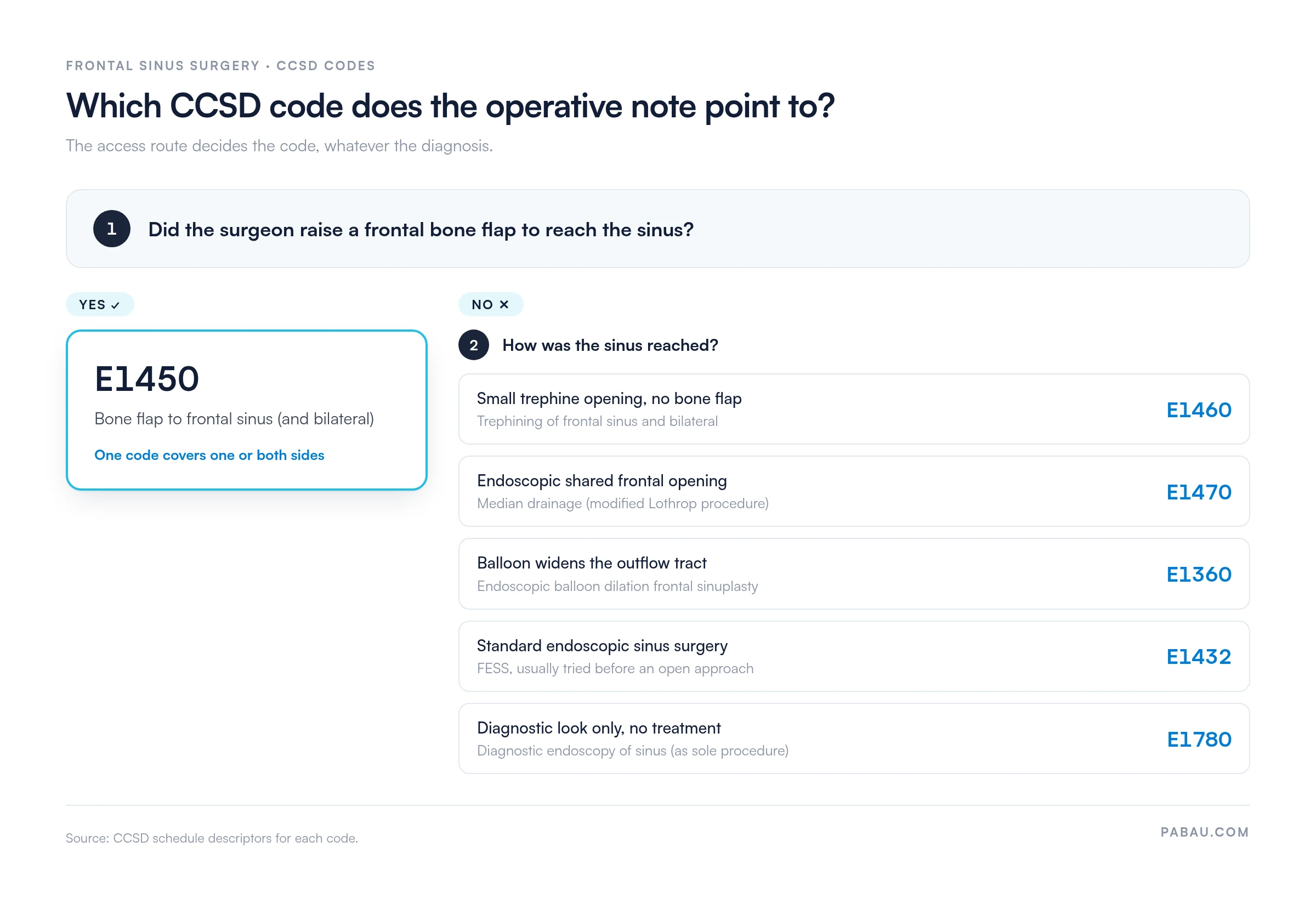
Each insurer decides which CCSD codes it pays, so confirm the code against the CCSD schedule or with the insurer first. Work through these checks before an E1450 claim leaves the practice.
UK private medical insurers usually expect pre-authorization before planned surgery. The patient normally contacts the insurer, which issues an authorization number tied to the procedure code. For an open frontal sinus procedure, expect the insurer to want the details below.
Pre-authorization does not guarantee payment. The claim still has to match the authorized code, the documented diagnosis and the operative note.
An insurer that queries a frontal sinus claim will start with the operative note. Make sure the note and the claim file include each of these items.
Supporting documents include the pre-operative CT report, earlier FESS operative notes for revision cases, and histopathology reports where a mucocele or tumor was removed.
Keeping digital clinical documentation timestamped against the patient file shortens the reply when an insurer asks for supporting records.
Most rejected frontal sinus claims trace back to a handful of causes. The table pairs each one with the fix.
Run a quick check on every frontal sinus claim before it goes out. Confirm the insurer accepts the code, match the authorization number, attach the operative note, and check the ICD-10 code against the primary diagnosis.
ENT billing teams often keep authorization numbers in one system, operative notes in another and insurer replies in an inbox. An outdated or unconfirmed code can then slip through, and the rejection is the first sign of trouble.
Pabau, the practice management platform we build, keeps the authorization number, operative note and ICD-10 pairing on one patient record. Its claims management software submits invoices to UK insurers through Healthcode, so each claim carries the evidence behind it.
The result is fewer rejected claims and less time spent answering insurer queries.
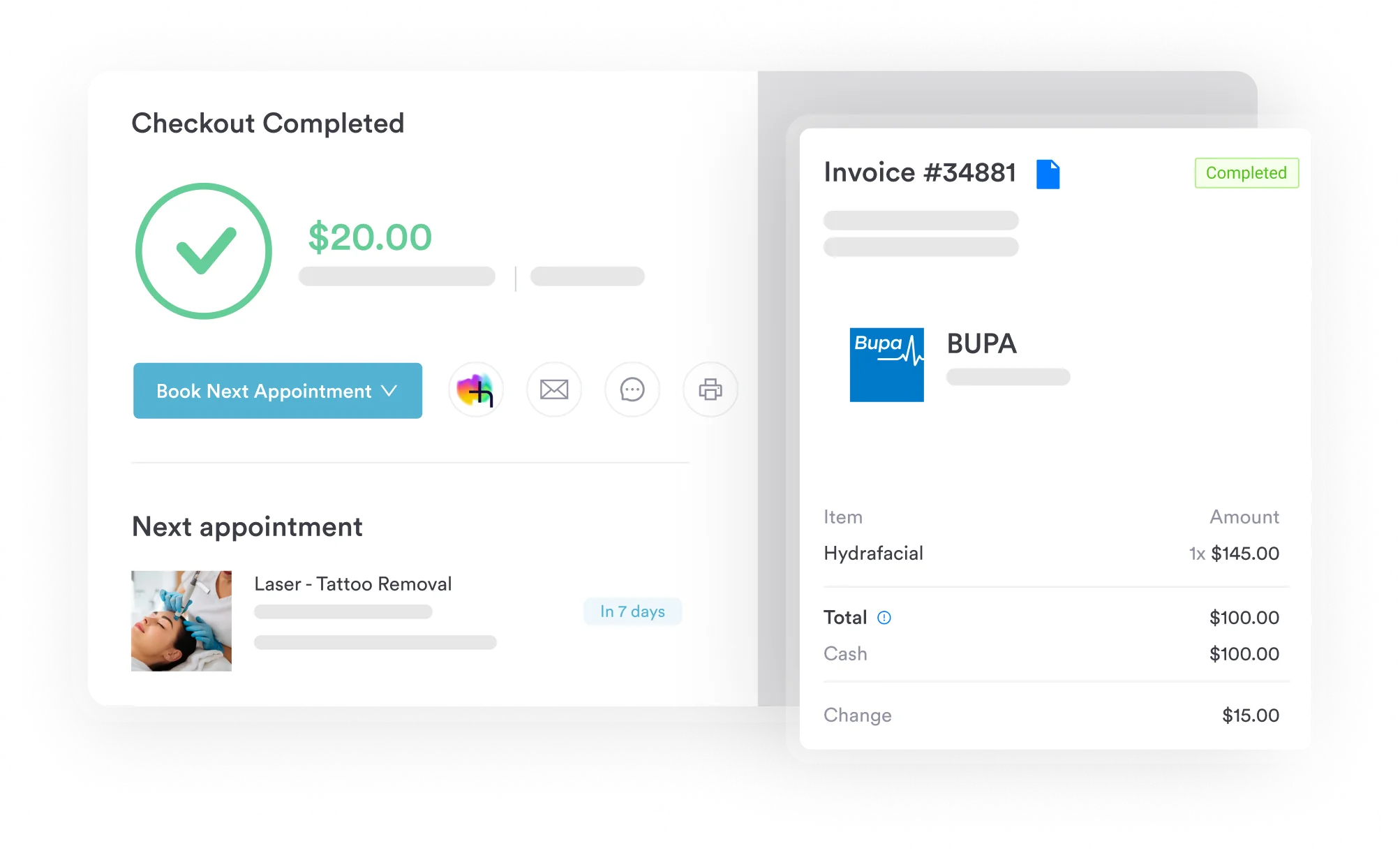

Pabau stores operative notes, authorization numbers and ICD-10 pairings on each patient record. Your ENT claims reach UK insurers with the right code and the evidence behind it.

E1450 describes a clearly defined open operation. Confirm it with CCSD or the insurer before it goes on a claim.
Once the code is confirmed, the rest of the claim is straightforward. The operative note proves the bone flap, the ICD-10 code explains why, and the authorization number ties both to the insurer’s approval.
Book a demo to see how Pabau keeps ENT claims, operative notes and insurer authorizations in one place.

Need a broader CCSD billing reference? CCSD billing guide for UK private healthcare covers code structure and insurer submission rules.
Looking up another CCSD code? CCSD codes explains how the schedule is organized and how UK insurers use it.
Want to reduce claim rejections across your practice? Medical billing compliance guide covers documentation standards, audit triggers and first-pass acceptance.
CCSD code E1450 covers a bone flap to the frontal sinus, on one side or both. It describes the open osteoplastic approach, so endoscopic frontal sinus procedures use other CCSD codes.
Yes. Each insurer decides which CCSD codes it pays, so check the CCSD schedule or ask the insurer before you submit a claim.
Yes. The descriptor reads “Bone flap to frontal sinus (and bilateral)”, so one code covers one or both sides. The operative note should still state which sides were treated.
J32.1 (chronic frontal sinusitis) is the most common pairing. J34.1 (cyst and mucocele of nose and nasal sinus) and D14.0 (benign neoplasm of the accessory sinuses) also fit. A frontal sinus fracture is coded S02.1.
The main UK private medical insurers use CCSD codes, including Bupa, AXA Health and Aviva. Each insurer sets its own fees and decides which codes it pays.
The most likely reasons are a missing authorization number or an operative note that skips the bone flap. A diagnosis code that does not match the record is another.