HCPCS Code G0163: Skilled nursing observation and assessment
What is HCPCS Code G0163? HCPCS Code G0163 is a deleted Level II code for skille...

Last Updated: Oct 15, 2026
C6930 is the CCSD code for injection into anterior chamber (including topical or local anaesthetic). It covers any injection delivered into the anterior segment of the eye, from the corneal limbus to the lens. The descriptor bundles the anaesthetic, so topical drops or a local block are never billed as a separate line.
The most common trigger is intracameral antibiotic prophylaxis at cataract surgery, usually cefuroxime. Whether C6930 is separately payable alongside a phacoemulsification code depends on the insurer, so check the current schedule before you submit.
Let Pabau's smart automation suggest the right codes, reduce claim denials, and keep your practice compliant—effortlessly.
Automate repetitive tasks and focus on what matters most—your patients.
Reduce coding errors and ensure compliance with the latest regulations.
Clean claims, fewer denials, and faster reimbursements.
Powerful insights and reporting to help your practice thrive.
HIPAA compliant SOC 2 certified GDPR-compliant Trusted by 4,000+ clinics worldwide

CCSD Code C6930 covers injection into the anterior chamber, and the anaesthetic is bundled into the fee rather than billed separately.
The most common clinical trigger is intracameral antibiotic prophylaxis, usually cefuroxime, given at cataract surgery.
Whether C6930 is separately payable alongside a phacoemulsification code varies by insurer, so verify the payer’s current schedule before submitting.
Practice management software like Pabau supports CCSD code lookup, insurer-specific rules, and audit-ready procedure notes for UK private practices.
The CCSD Group defines CCSD Code C6930 as: Injection into anterior chamber (including topical or local anaesthetic). CCSD stands for Clinical Coding and Schedule Development. This group maintains the procedure code schedule used by UK private medical insurers, and its members are Bupa, AXA Health, Aviva and Vitality.
The code covers any injection delivered into the anterior segment of the eye, from the corneal limbus to the lens. It applies wherever topical anaesthesia or a local anaesthetic block prepares the eye.
C6930 sits within the ophthalmology chapter of the CCSD schedule, alongside corneal, lens and vitreoretinal procedure codes. Private ophthalmology practices meet it regularly on cataract lists, in anterior segment trauma cases, and in intracameral therapeutic procedures.
The code applies regardless of which substance is injected, provided the injection site is the anterior chamber. It does not extend to injections into the vitreous, the subconjunctival space, or periocular tissues. Each of those sites carries its own CCSD code.
Understanding the clinical steps helps billing staff document what the operative note must capture. A consultant ophthalmologist performs the procedure in four broad stages.
The procedure note must record each of these stages explicitly. Vague entries such as “intracameral injection given” are a leading cause of claim rejection by Bupa and AXA Health.
Paracentesis appears in the wound entry stage as the way into the chamber, not as a second billable procedure. Where fluid comes out of the chamber rather than going in, the claim belongs to CCSD code C6920 instead.
The descriptor for CCSD Code C6930 states “including topical or local anaesthetic.” As a result, the procedure fee bundles the anaesthetic, so it must not appear as a separate line item.
Raising another anaesthetic code alongside C6930 counts as unbundling under the CCSD schedule. Most UK private medical insurers reject it outright. The bundling rule covers two anaesthetic types.
Insurer-specific exceptions may exist in each provider’s manual. Verify against the current schedule for each payer before assuming the bundling rule is absolute. Even so, the descriptor’s explicit inclusion wording makes separate billing hard to justify at audit.
Several distinct clinical scenarios generate a valid C6930 claim. The table below maps the most frequent indications to their supporting clinical authority and relevant ICD-10 context.
One principle runs across all these indications. The ICD-10 diagnosis code on the claim must support the clinical reason for the injection itself, as well as the main surgical procedure.
Whether C6930 can be billed alongside a cataract code depends on the insurer. This is the most common co-billing question for the code, and the place where unbundling most often goes wrong.
Under CCSD schedule principles, you should not separately bill a procedure that forms an integral and routine part of another listed procedure. Intracameral cefuroxime is now standard practice at phacoemulsification in the UK. NICE guideline NG77 on managing cataracts in adults supports it, and the Royal College of Ophthalmologists endorses it.
Some insurers therefore treat C6930 as included within the phacoemulsification code. That applies when the injection is an antibiotic given at the same operating session.
Other insurers permit a separate C6930 claim when the operative note identifies the injection as a distinct clinical act. The note has to name its own indication, substance, and technique. How the note is written decides the outcome as often as what was done in theatre.
A different secondary line applies when vitreous prolapses into the anterior chamber during the same cataract operation. The phaco code leads that claim and CCSD code C7910 follows it as the additional procedure.
Run a quarterly audit of all C6930 claims submitted alongside phacoemulsification codes. Flag any where the payment was reduced or the line was rejected. Cross-reference against each insurer’s provider manual to confirm whether their current schedule permits separate payment. This single check prevents the most common revenue leakage on cataract lists.
CCSD Code C6930 covers the act of injection into the anterior chamber. It does not automatically cover the cost of the drug or device used. Whether the substance requires a separate line item depends on the insurer and the type of agent.
Always verify per payer before adding a drug line. Submitting a drug charge that the insurer considers bundled within the procedure fee creates an overpayment risk at audit.
The most frequent coding error on ophthalmic injection claims is applying the wrong injection site code. Unlike the vitreous, the subconjunctival space, and the periocular tissues, the anterior chamber sits in its own place. Misassigning the site triggers instant rejection from most insurers.
Site is not the only restriction. CCSD also bars C6930 from sitting on the same claim as C6980, the code for removing a foreign body from the anterior chamber.
The CCSD procedure codes index lists the ophthalmology chapter in full, which is the quickest way to check a neighbouring code before you submit.
The operative note must name the injection site precisely. “Intracameral” or “into the anterior chamber” is the accepted language. Notes that describe the route as “intraocular” without naming the compartment are ambiguous and invite coding disputes.
Denied C6930 claims cluster around five root causes, each with a defined appeal pathway and most preventable with the right documentation at the time of the procedure.
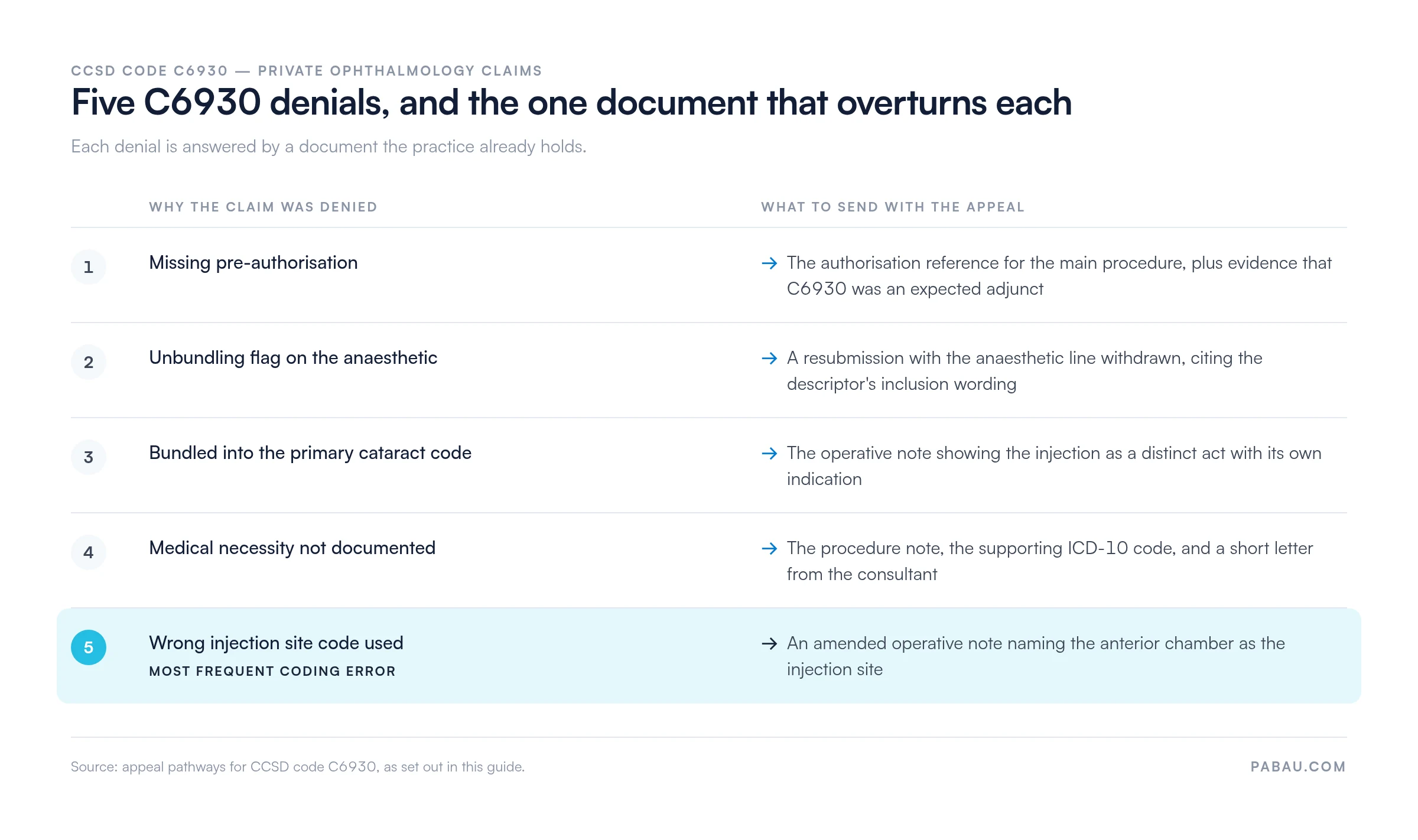
Appeals to UK insurers go through the insurer’s provider dispute portal, not the patient. Keep a copy of every operative note, consent form, and pre-authorisation reference on file.
Pre-authorisation requirements for C6930 differ widely between payers. The table below summarises the general position for four large UK private medical insurers, based on published provider guidance. Always verify against each insurer’s current provider manual before submitting, because these rules change.
Vitality also lists CCSD codes with their payment status in its fee-finder tool. Pre-authorisation requirements for adjunct codes like C6930 are worth confirming directly with the provider relations team. The same applies to Cigna UK and WPA for patients covered abroad.
A clean C6930 claim rests on the operative or procedure note. The note must contain six specific elements to withstand insurer scrutiny.
Capturing all six at the point of care beats rebuilding them from theatre lists afterwards. Notes rebuilt later are a red flag at insurer audit and can lead to full claim recovery demands.
Build a C6930 documentation checklist into your theatre note template: site, substance, volume, anaesthesia type, indication, operator, date, and laterality. Review it before the patient leaves the theatre suite. A two-minute check at that point prevents weeks of back-and-forth with insurer billing teams.
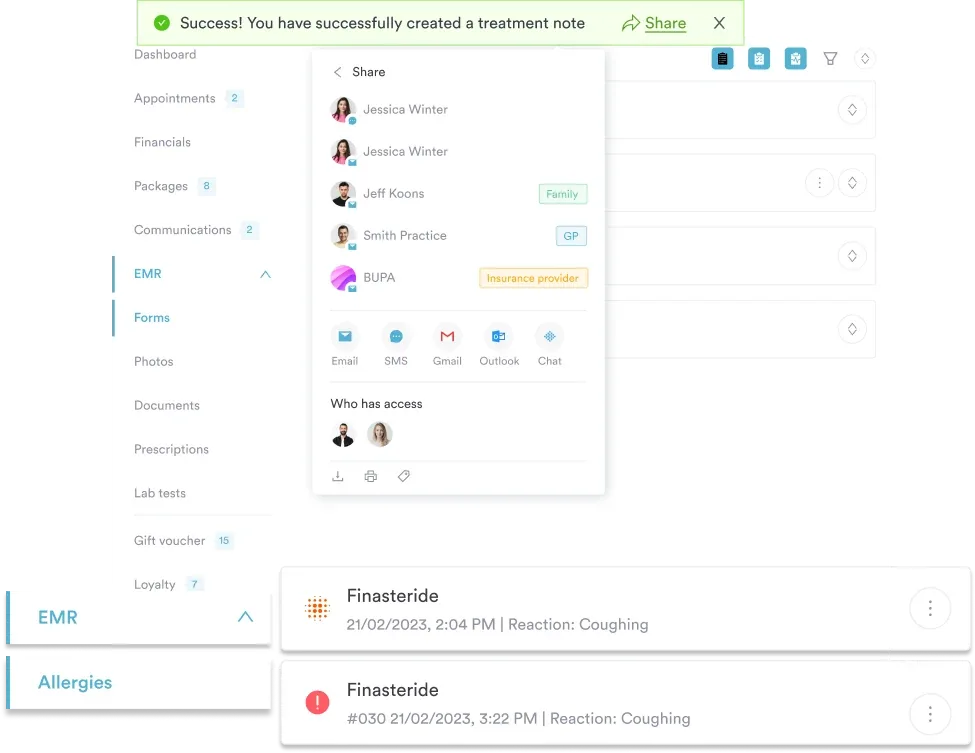
Most private ophthalmology practices keep the theatre note in one system and raise the invoice in another. The two systems reconcile only when a payer queries a line. Practice management software like Pabau lets UK practices look up CCSD codes and apply each insurer’s billing rules in the same place.
You can build procedure note templates to prompt for the six-element standard described above. Pabau’s audit-ready claims management then links the procedure record to the invoiced code.
That ties the clinical note, the code, and the payment together in one place. It matters most on high-volume cataract lists, where practices routinely append C6930 and insurer checks are common.
The Bupa CCSD procedure codes guide covers the wider CCSD billing framework, including the ophthalmology chapter codes that sit around C6930.


Pabau’s claims management tools help UK private practices look up CCSD codes, track insurer-specific rules, and keep procedure notes audit-ready. See how it works for ophthalmology practices.

CCSD Code C6930 has a tight descriptor, but insurer-by-insurer rules set its billing behaviour on bundling, pre-authorisation, and drug cost recovery. The anaesthetic is always bundled. Whether the code and the drug are separately payable alongside a cataract code is a payer-specific question, so verify it before submission.
The leverage therefore sits in theatre rather than in the appeal. A note that already names site, substance, volume, anaesthesia, indication, operator, and laterality turns most denials into a resend.
Book a demo to see how Pabau keeps CCSD codes, procedure notes, and insurer rules together for your ophthalmology lists.

Billing Bupa as a private consultant? Bupa CCSD codes and fee schedule guide covers the full CCSD code family for Bupa-insured patients, including ophthalmology chapter codes.
Managing multiple insurers across a private practice? Pabau’s claims management software centralises CCSD code billing, insurer rules, and payment tracking in one place.
Choosing billing software for a UK private practice? Best medical billing software in the UK compares the platforms that handle CCSD coding and insurer submissions.
CCSD Code C6930 covers injection into the anterior chamber of the eye, including topical or local anaesthetic. The code descriptor clearly bundles the anaesthetic, which practices must not bill separately.
It depends on the insurer. Some payers treat C6930 as bundled within the phacoemulsification code when the injection is routine antibiotic prophylaxis. Others permit a separate claim where the operative note documents the injection as a distinct clinical act. Verify against each insurer’s current provider manual before submitting.
No. The procedure code covers the act of injection; the drug is billed separately. Low-cost agents like cefuroxime are often absorbed within the procedure fee by payers, while higher-cost substances such as viscoelastics may require a separate consumable line. Check each insurer’s consumables policy.
No. Both are included within the C6930 descriptor. The descriptor reads “including topical or local anaesthetic,” meaning both types are bundled. Billing a separate anaesthetic code alongside C6930 constitutes unbundling regardless of which anaesthetic type was used.