

HCPCS code E0198: Water pressure pad billing guide
HCPCS code E0198 is a water pad for a standard mattress HCPCS code E0198 is the ...

Last Updated: Oct 13, 2026
A5210 is the CCSD code for an epidural injection via the lumbar approach, used on claims to UK private medical insurers. It covers injecting a corticosteroid and local anaesthetic into the lumbar epidural space.
A caudal epidural injection through the sacral hiatus is a separate code, A5211, and should not be billed as A5210.
Let Pabau's smart automation suggest the right codes, reduce claim denials, and keep your practice compliant—effortlessly.
Automate repetitive tasks and focus on what matters most—your patients.
Reduce coding errors and ensure compliance with the latest regulations.
Clean claims, fewer denials, and faster reimbursements.
Powerful insights and reporting to help your practice thrive.
HIPAA compliant SOC 2 certified GDPR-compliant Trusted by 4,000+ clinics worldwide

CCSD Code A5210 covers a lumbar epidural injection only, and a caudal epidural injection has its own separate code, A5211.
Most UK PMI payers, including Bupa, AXA Health and Aviva, require pre-authorisation before an A5210 claim will be reimbursed.
Missing pre-authorisation and an unsupported ICD-10 diagnosis code are the two most common A5210 denial triggers.
Pabau, the practice management platform we build, checks that authorisation codes are filled in before a claim is sent. It submits claims to UK insurers via Healthcode.
CCSD Code A5210 is the billable procedure code for a lumbar epidural injection within the CCSD Schedule of Procedures. That schedule is the coding framework UK private medical insurers use for claim adjudication. The official descriptor is: Epidural injection (lumbar).
The code sits in chapter 3 (Spine, spinal cord and peripheral nerves), section 3.3 Paraspinal Injections. Bupa’s 2026 CCSD reference rates it Minor 5 for complexity.
A5210 covers one approach only: the lumbar route into the epidural space. A caudal epidural injection through the sacral hiatus is a separate code, A5211, and should never be billed as A5210.
An epidural steroid injection (ESI) delivers corticosteroid medication directly into the epidural space surrounding the spinal cord and nerve roots. The goal is to reduce periradicular inflammation and provide pain relief lasting weeks to months, depending on the patient’s condition and response.
The proceduralist positions the patient prone, confirms the target lumbar level using fluoroscopy, and advances the needle to the epidural space using loss-of-resistance technique. Contrast medium confirms correct placement before the therapeutic injectate is delivered. The whole procedure typically takes 15 to 30 minutes.
Lumbar and caudal epidural injections carry two separate CCSD codes. A5210 is the lumbar code and A5211 is the caudal code, so the approach you document decides which code goes on the claim.
Coding a caudal injection as A5210 is a wrong-code error, and a thorough note cannot rescue it. The CCSD also lists A5211 as an unacceptable combination with A5210, so the two should not appear together on the same claim.
The complexity rating and listed fee match for the two codes, so a miscode does not change the figure on the invoice. It still puts the wrong procedure on the claim record. A payer query or audit that compares the code with the procedure note will catch it.
PMI payers expect the claim to be supported by a diagnosis that justifies epidural injection. The following conditions are the primary indications, each mapped to the ICD-10 code most commonly used on A5210 claims.
Verify ICD-10 codes against the current release before submission. Codes are subject to annual revision, and using a retired or unspecified code where a lateralised version exists is a common denial trigger.
A complete procedure record is the single most important factor in getting an A5210 claim accepted first time. PMI payers routinely request operative notes on epidural claims, and a thin or ambiguous note leads to requests for further information or outright rejection.
Use digital procedure documentation to record every required element in the procedure note at the point of care. The note is then ready when the payer asks for it.
The procedure note for an A5210 claim should include all of the following:
Check the pre-authorisation letter before writing the procedure note. Some PMI payers (Bupa in particular) issue authorisation references that must appear verbatim on both the invoice and the procedure note. Mismatches between the reference on the claim and the one on file with the insurer are a common cause of delay.
Most UK PMI payers require pre-authorisation for epidural injection before the procedure takes place. Submitting an A5210 claim without a valid pre-authorisation reference is the leading cause of outright denial, and retrospective authorisation is not routinely granted.
Payer policies change. Verify current requirements directly with each insurer before booking the procedure. The table below reflects typical requirements based on published Bupa procedure codes and publicly available PMI provider guidance.
A5210 covers the injection procedure itself. Additional services performed during the same episode may be separately billable depending on the payer’s bundling rules. Confirm with each insurer before including companion codes on the same claim.
Selecting the wrong spinal injection code is a common upcoding or downcoding error. A5210 covers lumbar epidural injection specifically. Adjacent codes in the CCSD code set cover different injection targets or techniques, and using one in place of another draws audits and denials. The approach written in the procedure note is what decides between them.
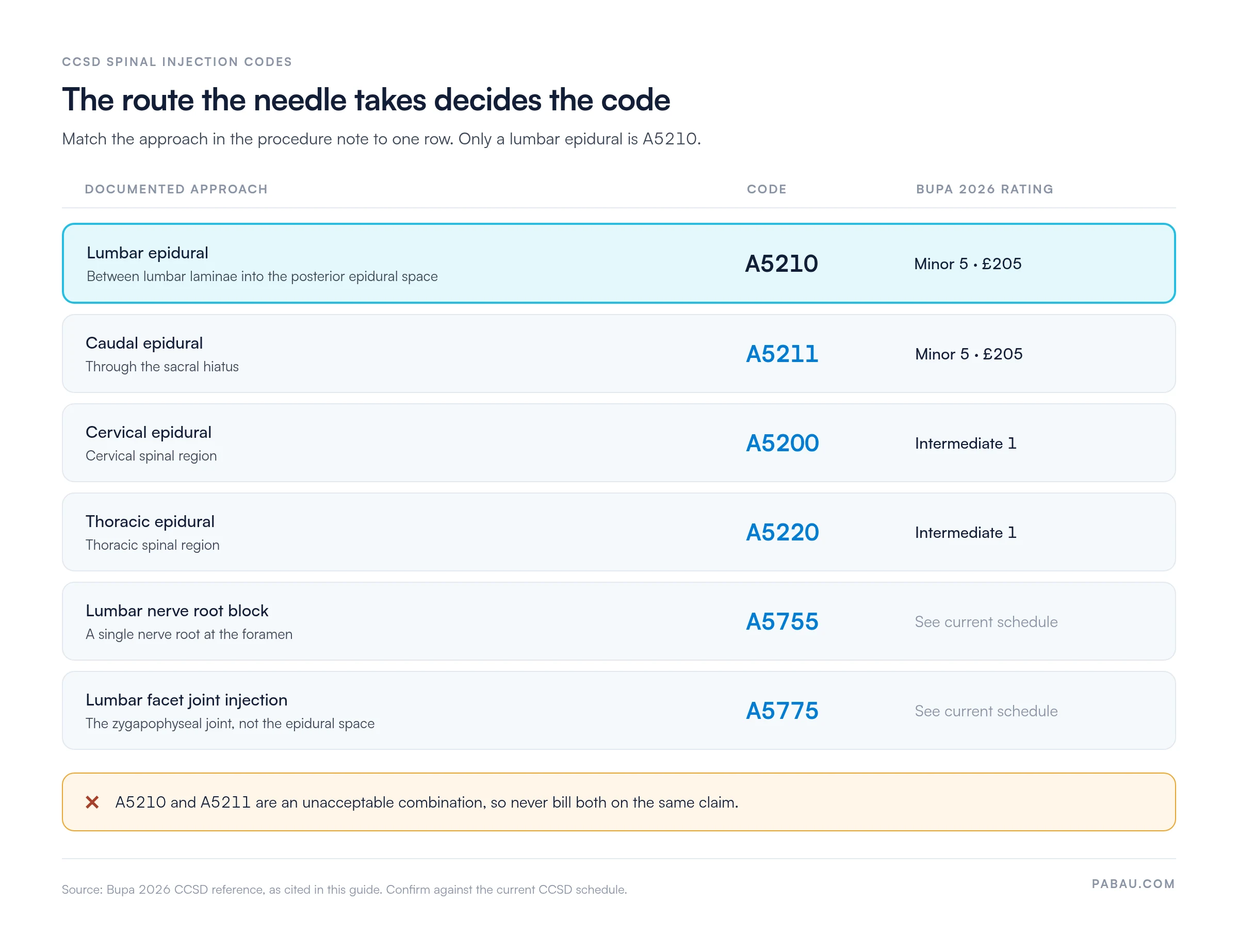
These codes and ratings come from Bupa’s 2026 CCSD reference. Confirm each one against the current published CCSD schedule before use, as descriptors and complexity ratings can change between editions.
Where contrast imaging of the epidural space is part of the procedure, check whether A5230 (epidurogram with or without epidural injection) is the better fit. Radiofrequency denervation of the facet joints is a separate procedure again, billed under A5730.
A5210 denials follow predictable patterns. Knowing the most common triggers allows billing teams to address them before submission rather than managing appeals after the fact.
Appeals are most successful when submitted within the payer’s stipulated window, typically 30 to 90 days of the denial notice. They also need to fix the specific problem the payer cited in the denial.
Private practices billing multiple PMI payers with CCSD codes carry a significant administrative burden. Tracking pre-authorisation references, structuring procedure notes, and managing appeal deadlines across Bupa, AXA Health, Aviva, and Cigna simultaneously is error-prone when done manually.
Pabau’s private practice claims management links each invoice to the patient’s insurer. Before the Send button is enabled, it checks that the membership number and authorisation code are filled in. That stops the most common A5210 denial trigger, a claim with no authorisation reference, before it reaches the insurer.
Claims then go to UK insurers through Healthcode, straight from the invoice. Procedure notes built with Pabau’s digital forms keep the approach, level, injectate and consent in one record before the invoice is raised.
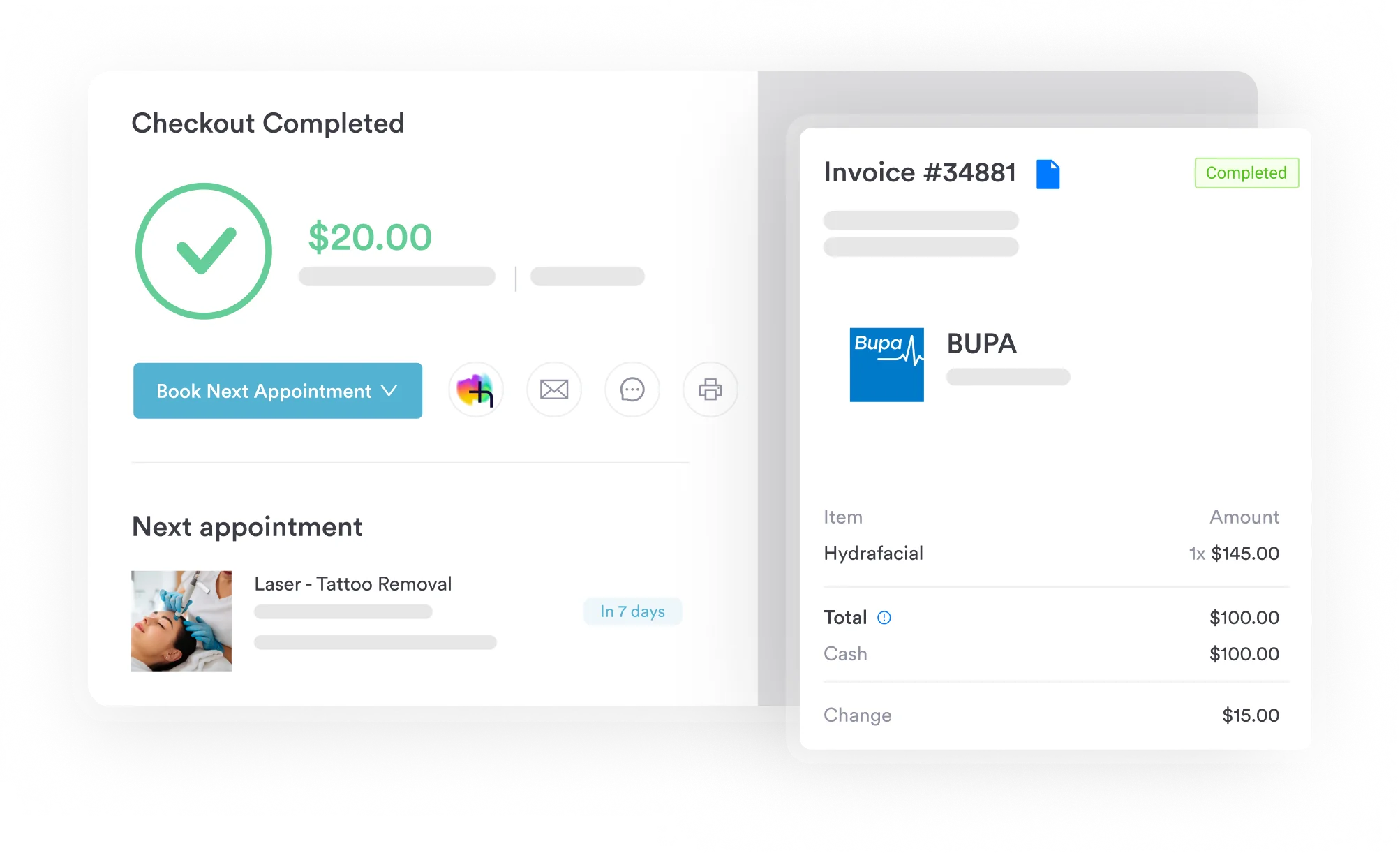
For practices performing high volumes of interventional pain procedures, the authorisation-code check and Healthcode submission take a manual step off every claim. A structured note also shows a missing injectate or consent entry before the claim leaves the practice.

Pabau checks that the authorisation code is filled in before an A5210 claim is sent. It then submits the claim to UK insurers via Healthcode.

Get the code right before anything else. A5210 fits a lumbar epidural only. A caudal injection goes on the claim as A5211, and a cervical or thoracic one as A5200 or A5220.
After that, most A5210 denials are settled before the patient reaches theatre. Secure the insurer’s authorisation, write the approach, level and injectate into the note, and check each payer’s fluoroscopy bundling rule. A practice that does this at booking spends its billing time on new claims rather than appeals.
Pabau checks that the authorisation code is on the claim before it goes out and submits it to UK insurers via Healthcode. Book a demo to see that check run on your own A5210 claims.

Need a complete guide to billing with Bupa? Bupa CCSD procedure codes covers Bupa’s specific CCSD code requirements, fee schedule structure, and documentation standards for private practice invoicing.
Managing insurance claims across multiple UK payers? Claims management software explains how Pabau checks authorisation codes and submits claims to UK insurers via Healthcode.
Billing an image-guided nerve block instead? CCSD code A7352 covers the code, documentation and insurer rules for image-guided named major nerve blocks.
Coding another chapter 3 spinal procedure? CCSD code A5530 explains how to bill a lumbar puncture with spinal manometry to UK insurers.
CCSD Code A5210 covers an epidural injection delivered via the lumbar approach, including the administration of a corticosteroid and local anaesthetic into the epidural space. It does not cover caudal epidurals, which have their own code, A5211, or cervical and thoracic epidurals, which are coded A5200 and A5220.
Image guidance (fluoroscopy) for an epidural injection is typically billed under a separate CCSD radiology code. Whether it is reimbursed separately or bundled into A5210 depends on the individual payer. Confirm unbundling rules with each insurer before including the guidance code on the same claim.
The most common denial triggers are missing pre-authorisation, an unsupported or unspecified ICD-10 diagnosis code, and an incomplete procedure note. Avoiding denials requires obtaining pre-auth before every procedure, using lateralised ICD-10 codes, and documenting the approach, injectate, guidance method, and consent in every procedure record.
A5210 is specific to the lumbar epidural approach. Caudal (A5211), cervical (A5200) and thoracic (A5220) epidurals each have their own code. So do lumbar nerve root blocks (A5755) and lumbar facet joint injections (A5775). Using A5210 for any of these is wrong-code selection, which triggers denial and audit risk.



