HCPCS Code G0163: Skilled nursing observation and assessment
What is HCPCS Code G0163? HCPCS Code G0163 is a deleted Level II code for skille...

Last Updated: Oct 15, 2026

CPT Code 64490 covers a single-level paravertebral facet joint injection in the cervical or thoracic spine, with image guidance built into the descriptor.
Fluoroscopy or CT is required and already bundled, so billing 77003 or 77012 alongside 64490 is an unbundling error that triggers denials.
Add-on codes 64491 and 64492 cover additional cervical or thoracic levels, while lumbar and sacral facet injections use CPT 64493 to 64495.
Practice management software like Pabau submits 64490-series claims through Claim.MD and flags denied claims for rework.
CPT Code 64490 reports one paravertebral facet joint injection in the cervical or thoracic spine, at the first level treated. Image guidance is written into the descriptor, so fluoroscopy or CT is part of the code rather than a separate charge.
The descriptor was revised in 2017, and the older wording still circulates in billing references. This guide works from the current AMA text. It then covers the 64490-64495 family, ICD-10 pairings, Medicare rates, and LCD frequency limits. Documentation, modifiers, and the errors behind most denials follow.
CPT Code 64490 is the primary billing code for a facet joint injection in the cervical or thoracic spine. The current descriptor in the American Medical Association’s CPT code set names the target, the agent, and the guidance in one line:
Injection(s), diagnostic or therapeutic agent, paravertebral facet (zygapophyseal) joint (or nerves innervating that joint) with image guidance (fluoroscopy or CT), cervical or thoracic; single level.
Two details in that wording do most of the billing work. The agent is described as diagnostic or therapeutic rather than as an anesthetic or a steroid, so a purely diagnostic block still belongs here. Image guidance sits inside the code, which means it is never reported separately.
The procedure targets the zygapophyseal (facet) joints of the cervical or thoracic spine. A physician advances a needle under real-time imaging to the target joint or the medial branch nerve supplying it, then delivers the injectate. The code covers the first joint or nerve injected per encounter.
CPT Code 64490 is the entry point for a six-code family covering facet joint and facet joint nerve injections across the spine. Region decides the series, and level decides the code inside it. The grid below puts the whole family on those two axes. The series replaced legacy codes 64470-64476, which the American Society of Anesthesiologists confirmed were retired in the AMA CPT restructuring.
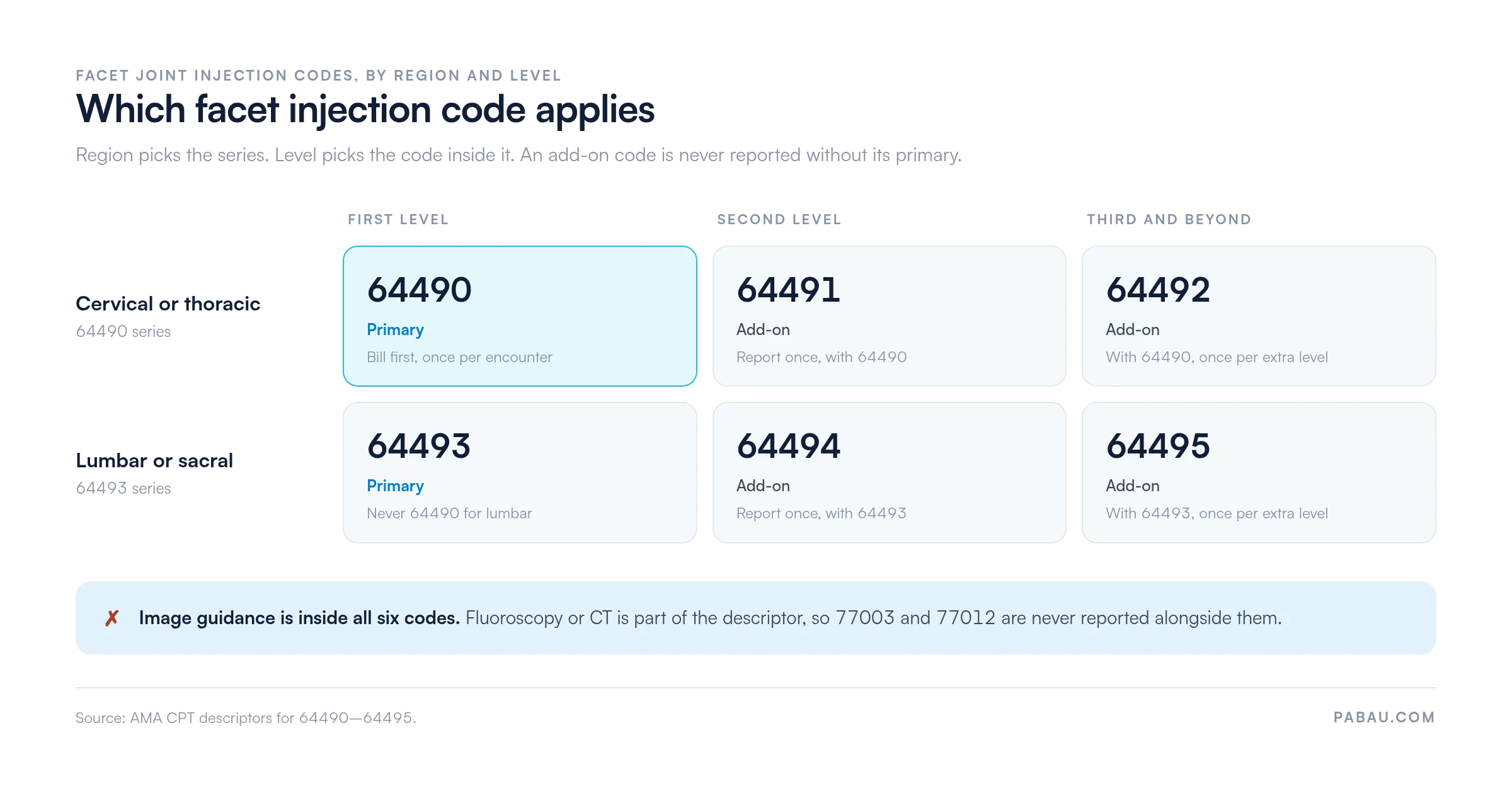
Critical add-on rule: 64491 and 64492 cannot be billed without 64490. They are add-on codes under AAPC’s CPT classification, so they report additional work beyond the primary service. Billing them standalone is an automatic claim error. Lumbar procedures need 64493 as the primary code, whatever the operative note calls the procedure.
The lumbar series is structured the same way. The add-on 64495 covers the third and any further level treated in the lumbar or sacral spine.
The CCSD schedule used by UK private insurers counts facet joints rather than spinal levels. A six-joint session under x-ray control is CCSD code A5770, so the two schedules do not map line for line.
Imaging guidance is not optional for CPT Code 64490. Fluoroscopic or CT guidance is inherent to the procedure under the AMA CPT descriptor, and that has four consequences at the claim level.
Imaging documentation is the weakest point in most interventional pain claims. One missing phrase in the procedure note turns a clean claim into a denial. The appeal then costs more staff time than the note would have.
Medical necessity for CPT Code 64490 has to be established through a supporting ICD-10-CM diagnosis code. Payers cross-reference the diagnosis against their LCD or coverage policy to decide whether the injection is appropriate. The codes below are among the most commonly accepted. Verify against the LCD for your own MAC jurisdiction before submitting.
Cervicalgia is the diagnosis most often paired with a cervical facet claim, and M54.2 is the code that carries it. Watch the myelopathy and radiculopathy split in the M47 codes, since the two halves of that family are easy to transpose.
The diagnosis code has to reflect what the record actually documents. No code guarantees coverage for CPT Code 64490 on its own, because payers still check the patient’s history, examination findings, and failed conservative treatment. Review the current guidelines through the CMS ICD-10 codes page for the applicable fiscal year.
Document conservative treatment failure explicitly before billing CPT Code 64490. Most MAC LCDs want evidence that physical therapy, chiropractic care, or analgesic medication was tried and gave inadequate relief. A single line noting failed conservative management for six weeks is not enough. Name the treatments, the durations, and the patient’s response to each.
Medicare covers CPT Code 64490 when the medical necessity criteria in the applicable Local Coverage Determination (LCD) are satisfied. Rates differ between facility settings, such as a hospital outpatient department or an ambulatory surgery center, and non-facility settings such as a physician office. Non-facility rates run higher because the practice carries the procedure room overhead itself.
On drug claims the up-front cost is acquisition rather than room overhead. Under HCPCS code J1450 the practice purchases the fluconazole itself, then bills Medicare for the drug and the infusion after administration.
Rate basis: the figures above are approximate national amounts for CY2026, before any locality adjustment. They sit on the CY2026 Medicare Physician Fee Schedule conversion factor of $33.4009, or $33.5675 for qualifying alternative payment model participants. Geographic practice cost indices move the final payment by locality. Pull the exact amount for your own locality from the CMS Physician Fee Schedule lookup. Do that before you quote a number to a patient or a payer.
Local Coverage Determinations govern which patients qualify for CPT Code 64490 under Medicare and many state Medicaid programs. Each MAC publishes its own LCD, and the coverage criteria, frequency limits, and documentation requirements differ across jurisdictions. Quoting one MAC’s frequency limit as universal is a common error that creates audit exposure.
The table below shows general frequency patterns across major MACs, based on publicly available LCD language. Always verify against the current LCD for your own MAC before you quote a limit to a patient or a prior authorization team.
Exceeding frequency limits without documented medical necessity triggers automatic claim edits. If a patient needs additional injections beyond the LCD limit, the record needs a clear clinical narrative explaining the exception.
Diagnostic blocks in the 64490 series are also the gateway to facet nerve ablation. Most MAC LCDs require two positive blocks before covering it, and each additional cervical or thoracic joint ablated is then CPT Code 64634.
Documentation failures are the second most common reason CPT Code 64490 claims are denied, after unbundling errors. LCD policies name the minimum documentation elements, and auditors check for each one. Writing the note properly the first time costs far less effort than answering an audit letter months later.
A superbill template built around the LCD for your jurisdiction keeps documentation consistent from one claim to the next. Required elements across most LCD policies include:
Modifier selection for CPT Code 64490 affects both claim processing and payment. Build a modifier review step into the pre-submission check for every interventional pain claim. The modifiers below are the ones that apply to 64490-series claims.
Bilateral billing caution: when injections are performed bilaterally at the same spinal level, some payers accept modifier -50 on a single line. Others want the code reported twice, with -LT and -RT on separate lines. Verify the payer’s bilateral policy before submission, because incorrect bilateral reporting is a common cause of partial payment and recoupment requests. A clearinghouse that validates payer rules before transmission catches this before the claim leaves the practice.
Most CPT Code 64490 claim failures cluster around five root causes. Each one has a fix at the workflow level, applied before the claim is submitted rather than after it is denied.
A quarterly review of 64490-series denials is worth the hour it takes, because the same reason codes keep coming back. Reading them against the standard denial codes shows whether the problem sits in the modifier, the region, or the documentation. Patterns show up faster when denials are grouped by code rather than by patient.
Prior authorization requirements for CPT Code 64490 vary substantially by payer and by plan. Original Medicare does not require prior authorization for facet joint injections, but Medicare Advantage plans frequently do. Commercial payers set their own policies, and requirements can differ between the same insurer’s PPO and HMO products.
Interventional pain practices bill CPT Code 64490 repeatedly across large patient panels. Each claim needs an imaging documentation check, level-by-level coding, a modifier decision, an LCD cross-reference, and authorization confirmation. Doing that by hand at volume is where the errors above come from.
Practice management software like Pabau offers single-system claims management, so clinical documentation, code entry, and claim submission sit in one workflow. For a 64490 claim, the procedure note confirming image guidance, the ICD-10 diagnosis, and the CPT code all live on the same record. Nobody retypes a code between the chart and the claim, so the transcription errors disappear.
Through the Claim.MD integration, 64490-series claims route electronically to Medicare and commercial payers. Adjudication data returns as ERA/835 files. The CARC and RARC codes on a denial land in the claims dashboard, not in a separate payer portal. Denied claims are flagged for rework, and the reason code tells the biller where to start.
Run a quarterly denial report filtered to CPT codes 64490, 64491, 64492, and 64493, then group the denials by reason code. CARC 4 means the procedure code is inconsistent with the modifier used, or a required modifier is missing. CARC 97 means the service is already included in another adjudicated service. Seeing either one repeatedly points straight at the modifier and unbundling errors above. Fifteen minutes across five denied claims usually shows whether the cause is documentation, code selection, or modifier use.

Pabau connects clinical documentation, CPT code entry, and claim submission in one platform. Interventional pain practices submit 64490-series claims through Claim.MD, check eligibility before the procedure, and see denied claims flagged for rework without leaving the system.

CPT Code 64490 rewards precision more than volume. Get the region, the level, and the imaging rule right and the claim usually pays on the first pass. Get any of the three wrong and the appeal costs more staff time than the injection earns.
The practices that stop repeating these denials fix the workflow rather than the individual claim. Build the note template around your own MAC’s LCD. Make the billing system refuse an add-on code without its primary. Check the spinal region before anyone selects the code. Book a demo to see how Pabau keeps 64490 documentation and claim submission on a single record.

Need to understand how clearinghouse validation works? How Claim.MD clearinghouse works explains the pre-submission edit process and how payer rules are applied before a claim reaches Medicare.
Managing ongoing denials across your pain management practice? Denial codes in medical billing covers the most common CARC and RARC codes, what each one means, and how to respond.
Want a complete overview of the billing submission process? What is medical billing walks through the claim lifecycle from charge capture through payment posting.
CPT Code 64490 reports a single-level paravertebral facet joint injection in the cervical or thoracic spine. The current AMA descriptor covers a diagnostic or therapeutic agent injected into the facet (zygapophyseal) joint, or the nerves innervating that joint. Fluoroscopic or CT image guidance is part of the code. It is reported once per encounter for the first level treated, and add-on codes 64491 and 64492 cover further levels.
Yes. Fluoroscopic or CT image guidance is a bundled component of CPT Code 64490 under the AMA CPT descriptor. Because it is already included, separately reporting 77003 or 77012 on the same claim triggers a CCI bundling denial. The procedure note must document that imaging was used and confirm real-time visualization of needle placement.
CPT 64491 covers the second level and CPT 64492 covers the third and additional levels of cervical or thoracic facet injection at the same encounter. Both must be reported with CPT 64490 as the primary code and cannot be billed independently. Each additional level injected has to be documented separately in the procedure note to support the add-on code.
Modifiers -LT and -RT identify injection laterality and are required by most payers. Modifier -50 may apply for bilateral injections at the same level, though some payers prefer two separate line items with -LT and -RT instead. Modifier -59 applies when a genuinely distinct service is performed on the same date that would otherwise be bundled. Verify the bilateral billing preference with each payer before submission.