ICD-10 code I50.20: Unspecified systolic heart failure
ICD-10 code I50.20 covers systolic heart failure with no stated acuity ICD-10 co...

Last Updated: Nov 12, 2026
Billable Code Specific Code
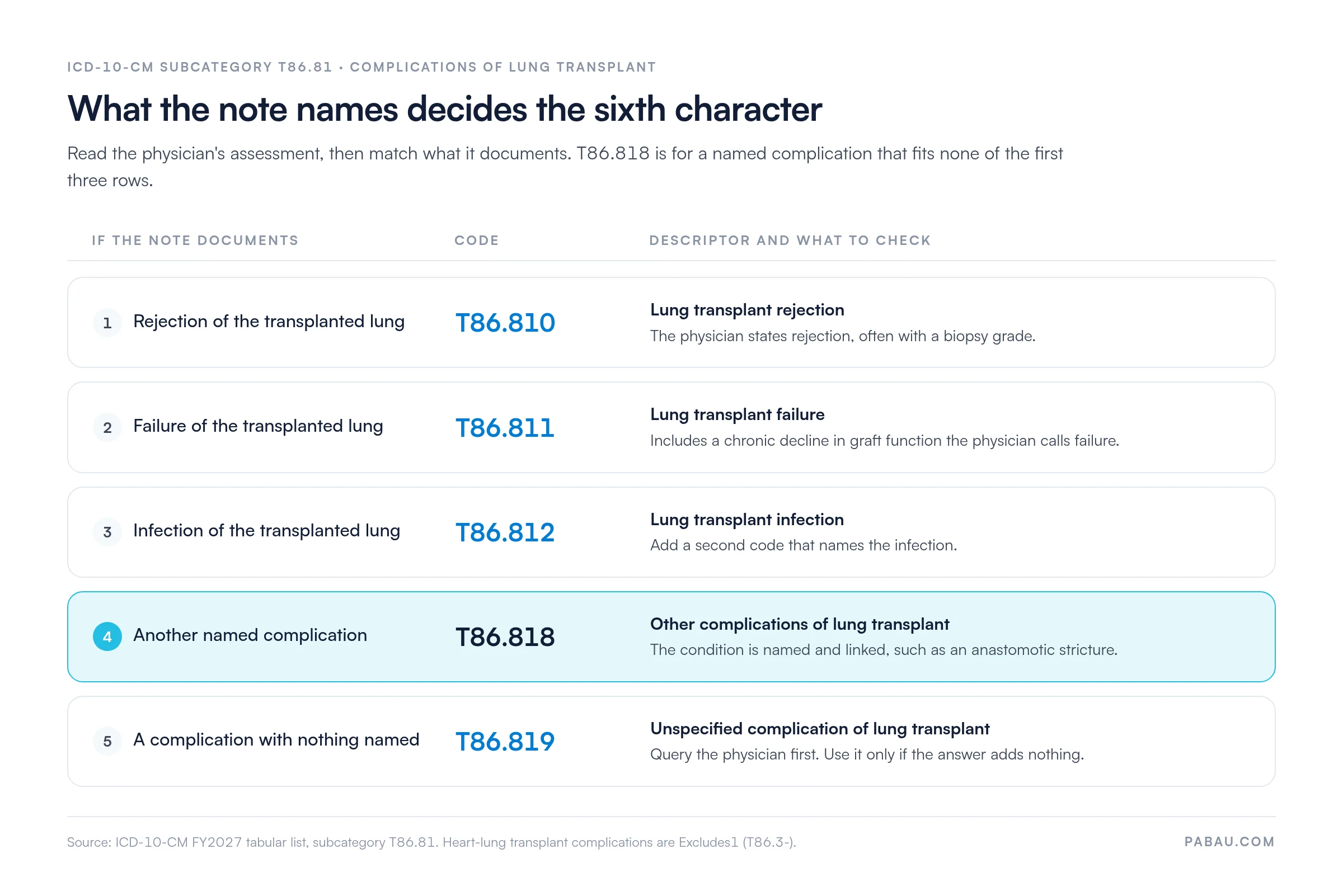
T86.818 is the billable ICD-10-CM code for other complications of lung transplant. It covers a complication the physician names and links to the graft when it isn't rejection (T86.810), failure (T86.811) or infection (T86.812).
A note that says only "transplant complication" supports unspecified T86.819 instead, so query the physician for the named condition before you submit. Report a second code that identifies the complication itself.
Let Pabau's smart automation suggest the right codes, reduce claim denials, and keep your practice compliant—effortlessly.
Automate repetitive tasks and focus on what matters most—your patients.
Reduce coding errors and ensure compliance with the latest regulations.
Clean claims, fewer denials, and faster reimbursements.
Powerful insights and reporting to help your practice thrive.
HIPAA compliant SOC 2 certified GDPR-compliant Trusted by 4,000+ clinics worldwide

T86.818 is a billable, six-character ICD-10-CM code for a named lung transplant complication that isn’t rejection, failure or infection.
Its siblings are T86.810 rejection, T86.811 failure, T86.812 infection and T86.819 unspecified, and there is no T86.813.
Z94.2 lung transplant status is not reported with T86.818, because the complication code already includes the transplant status.
Report T86.818 with a second code naming the complication, plus D47.Z1, D89.81- or C80.2 when the T86 category note applies.
A note that says only transplant complication supports T86.819, so query the physician for the named condition first.
ICD-10 code T86.818 is the billable code for other complications of lung transplant. You assign it when the physician names a complication, links it to the transplanted lung, and that complication is not rejection, failure or infection.
It sits in the residual “other” slot of subcategory T86.81. In a transplant pulmonology practice, four categories of conditions tend to land here:
The coding guidelines add one condition. A transplant complication code is assigned only when the complication affects the function of the transplanted organ. A problem that happens to occur in a transplant recipient, with no effect on the graft, is coded on its own.
T86.818 is a sixth-character code, a child of subcategory T86.81 (Complications of lung transplant). That subcategory sits in category T86, inside Chapter 19 (S00-T88). It has exactly five billable children, and there is no T86.813.
The choice that trips coders up is T86.819 against T86.818. “Unspecified” means the record doesn’t say what the complication is. “Other” means it does, but the named condition isn’t rejection, failure or infection.
The panel below walks the decision in order.
CLAD shows why the wording matters. The same chronic decline can be coded as lung transplant failure under T86.811, as rejection, or under T86.818. It depends on how the physician documents it. The coder follows the note and never picks the code from clinical inference.
Two sets of instructions govern T86.818 in the FY2027 tabular list. One sits on the subcategory, the other on the whole T86 category.
Subcategory T86.81 carries one Excludes1 note: complications of heart-lung transplant (T86.3-). A patient who received a combined heart-lung transplant is coded from T86.3-, never from T86.81. The two are never reported together for the same graft.
Category T86 tells you to use an additional code to identify other transplant complications. The tabular list names three:
The guidelines also call for two codes on every transplant complication. The T86 code comes first, then a secondary code that identifies the complication itself, such as the stricture or the drug’s adverse effect.
Z94.2 (Lung transplant status) is not a required companion to T86.818. The tabular list has no “use additional code Z94.2” note at T86.81 or T86.818. Category Z94 itself carries an Excludes1 sending complications of a transplanted organ to the Alphabetical Index.
Guideline I.C.21.c.3 settles it. A status code is not used with a diagnosis code that already includes the status information. Every T86.81 code already tells the payer the patient has a lung transplant.
Here’s an illustrative case. A patient comes in three months after a bilateral lung transplant with new wheeze and falling spirometry. Bronchoscopy shows narrowing at the right bronchial anastomosis.
The first draft of the assessment reads “post-transplant airway complication.” That supports only T86.819. The coder sends a one-line query asking what the complication is and whether it relates to the transplant.
The physician amends the note to “anastomotic stricture of the right main bronchus due to lung transplant, impairing graft function.” Now the claim carries T86.818 first, then a secondary code for the bronchial stricture. Z94.2 doesn’t go on it.
Each row assumes the physician has documented the condition as an other complication. If the note calls it rejection, failure or infection, a sibling code applies instead.
Keep a standing query template for transplant follow-ups. Ask three things: what the complication is, whether it relates to the transplanted lung, and whether it is rejection, failure, infection or another complication. One answer settles the sixth character.
Most T86.818 rework traces back to the note. The denial codes on the remittance usually point to one of these six patterns, so catch them before the claim leaves your system.
Commercial payers add their own layer. Check payer-specific policies and prior authorization rules before a planned admission. A denial management workflow that tags each denial to the step that failed shows you where to retrain.
T86.818 is valid for FY2027, which runs from October 1, 2026 through September 30, 2027. It has been part of ICD-10-CM since the October 1, 2015 transition and stayed valid through FY2025 and FY2026.
CMS publishes each year’s code files ahead of the October 1 start date. Confirm the current year in the CDC/NCHS ICD-10-CM browser tool or on the CMS ICD-10 codes page.
The General Equivalence Mappings treat 996.84 (Complications of transplanted lung) as the ICD-9-CM ancestor. The forward map sends 996.84 to several T86.81 codes, and T86.818 maps back to 996.84.
Treat the match as approximate. For revenue cycle trend work, pre-2015 claims can’t separate CLAD or strictures from other lung transplant complications.
In most transplant practices, the note lives in one system and the claim is built in another. The coder reads a PDF, keys the codes and waits weeks to learn a query was needed.
Pabau, the practice management and billing platform we build, keeps the clinical note and the claim on the same patient record. Your coder reads the assessment where it was written. Through our Claim.MD integration, US claims go out electronically after an eligibility check.
Remittances post back to the same record, so a denial lands next to the note that caused it. That shortens the loop between a vague assessment and the physician query that fixes it. See how our claims management software handles the full cycle.

Pabau keeps the physician’s assessment, the claim and the remittance on one patient record. Claims go to US payers through Claim.MD after an eligibility check, so coders query sooner and rework less.

T86.818 rewards one habit: code only what the physician named. When the note says stricture, CLAD or drug toxicity and links it to the graft, T86.818 plus the code for that condition holds up. When bronchiolitis obliterans syndrome is treated with extracorporeal photopheresis, each session is billed under CPT 36522. Medicare pays for it only within an approved clinical study.
When the note stays vague, send a query before you guess. A standing query in your transplant follow-up workflow reaches the physician while the visit is still fresh. Leave Z94.2 off the claim, since the T86.81 code already says the patient has a lung transplant.
Book a demo to see how Pabau keeps the note, the claim and the remittance together for transplant coding teams.

Need a broader grounding in claim submission? Clean claim submission guidelines covers the structural and coding requirements every claim must meet before payer adjudication.
Coding a chronic decline the physician calls failure? ICD-10 code T86.811 explains when lung transplant failure is the right sibling code.
Does the biopsy report a rejection grade? ICD-10 code T86.810 covers lung transplant rejection and the documentation it needs.
Seeing denials pile up across your coding team? Medical billing fundamentals walks through the billing cycle from charge capture to remittance posting.
Want to know how claims move through Claim.MD? How the Claim.MD clearinghouse works explains eligibility checks, claim submission and remittances in one place.
Z94.2 (Lung transplant status). Use it when a recipient is seen for a reason other than a graft complication. It isn’t reported with a T86.81 code, which already carries the transplant status.
No. T86.818 is complete at six characters and billable as written. Category T86 has no seventh-character extensions, so don’t add A, D or S.
Yes. When the complication is chiefly responsible for an inpatient admission, T86.818 goes first. The code that identifies the complication follows it.
J44.81 covers bronchiolitis obliterans and bronchiolitis obliterans syndrome. Its code-first note lists the lung transplant complication codes, so T86.818 leads when the physician documents BOS as another graft complication.
Keep it open and non-leading. Quote the documentation, then offer rejection, failure, infection, another complication, or unable to determine as options for the physician.