ICD-10 Code Y76.0: Diagnostic obstetric and gynecological devices
ICD-10 Code Y76.0: Definition and billable status ICD-10 Code Y76.0 is a valid, ...

Last Updated: Oct 23, 2026
Billable Code Specific Code
Z80.2 is the billable ICD-10-CM code for family history of malignant neoplasm of other respiratory and intrathoracic organs. It applies when a blood relative had a primary cancer of the nasal cavity, middle ear, sinuses, larynx, thymus, heart, mediastinum or pleura.
Coders trip over this code in two predictable ways. The first is confusing it with Z80.1 (trachea, bronchus and lung) or Z80.8 (other sites). The second is submitting it as a principal diagnosis when payers expect it as a secondary code. Claims also get denied when the physician note documents "cancer history" without saying whose it is. That blurs the line between Z80 family history and Z85 personal history.
Let Pabau's smart automation suggest the right codes, reduce claim denials, and keep your practice compliant—effortlessly.
Automate repetitive tasks and focus on what matters most—your patients.
Reduce coding errors and ensure compliance with the latest regulations.
Clean claims, fewer denials, and faster reimbursements.
Powerful insights and reporting to help your practice thrive.
HIPAA compliant SOC 2 certified GDPR-compliant Trusted by 4,000+ clinics worldwide

Z80.2 records a blood relative’s primary cancer of the nasal cavity, middle ear, sinuses, larynx, thymus, heart, mediastinum or pleura.
A relative’s cancer of the trachea, bronchus or lung is coded to Z80.1, not Z80.2, even though both codes cover respiratory organs.
Z80.2 is a billable FY2026 ICD-10-CM code, usually listed after the screening, exam or symptom code that explains the visit.
Z80 codes record a relative’s cancer, while the Z85.2- codes record the patient’s own prior respiratory or intrathoracic malignancy.
A relative’s pleural mesothelioma codes to Z80.8, not Z80.2, because mesothelioma falls outside the C37-C39 range.
ICD-10 Code Z80.2 is the billable ICD-10-CM code for family history of malignant neoplasm of other respiratory and intrathoracic organs. It applies when a blood relative had a primary cancer classifiable to C30-C32 or C37-C39.
In plain terms, that means cancer of the nasal cavity, middle ear, sinuses or larynx, or of the thymus, heart, mediastinum or pleura. The word “other” in the descriptor matters. Cancers of the trachea, bronchus and lung have their own code, Z80.1.
Z80.2 is valid for FY2026 claims, per the CDC/NCHS ICD-10-CM browser tool. It documents a risk factor, so it normally sits beside the code that explains why the patient came in.
The inclusion note ties Z80.2 to six neoplasm categories in Chapter 2. If a relative’s cancer would code to one of them, the patient’s family history codes to Z80.2.
The relative does not have to be a parent or sibling. A documented grandparent, aunt or uncle still supports the code, although naming the relationship strengthens medical necessity. If the note says only “family history of throat cancer”, query the physician, because throat can mean larynx or pharynx.
In the FY2026 tabular list, neither Z80.2 nor category Z80 carries an Excludes1, Excludes2, code first or code also note. The only instruction above them is the Z77-Z99 block note to code also any follow-up examination (Z08-Z09). Scope comes from the inclusion note, so these cases fall outside Z80.2:
One further check applies to the pleura. Category Z80 records a relative’s primary malignant neoplasm. A breast or lung cancer that spread to the pleura is coded to the primary site’s family history code, not to Z80.2.
Category Z80 splits family history of cancer by body system. Picking the wrong sibling is the most common Z80.2 error, and the table below lists every code in the category with its FY2026 descriptor. For a neighboring diagnosis outside category Z80, our ICD-10-CM guides for coders cover each code in the same format.
Z80.1 and Z80.2 split the respiratory tract in two. The lower airway and lung sit in Z80.1, and the upper airway, larynx and remaining chest organs sit in Z80.2. When a relative had cancers in both groups, assign both codes. The chart below routes each airway and chest site to its family history code.
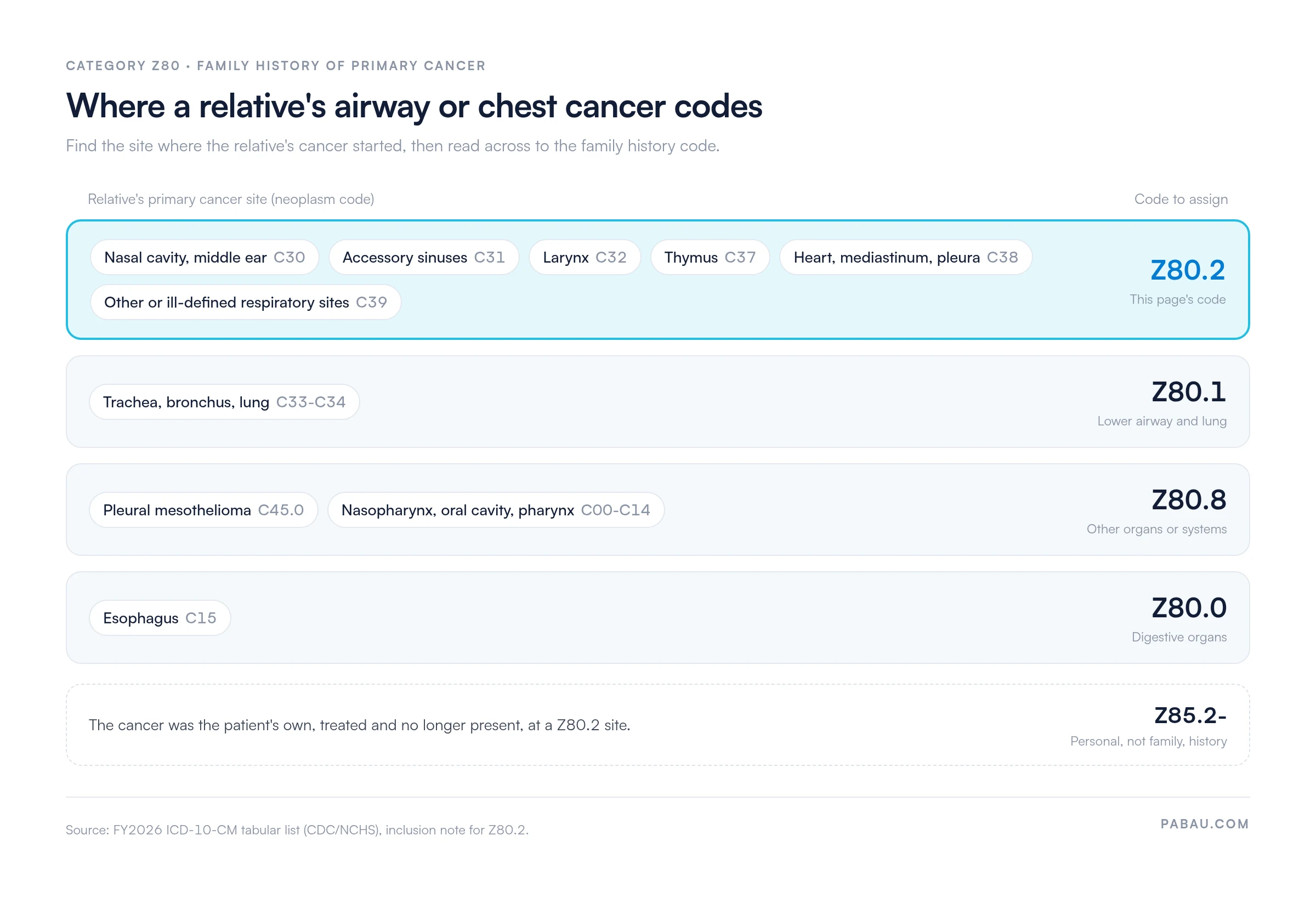
Check the tumor type before the site. Pleural mesothelioma codes to C45.0, not C38.4, so a relative’s mesothelioma belongs under Z80.8 rather than Z80.2.
Z80.2 applies when a blood relative had the cancer. The Z85.2- codes apply when the patient had a respiratory or intrathoracic cancer that was treated and is no longer present. The FY2026 ICD-10-CM Official Guidelines treat these as separate history types.
The short version for audits is Z80 for family and Z85 for self. When a patient and a relative both had cancer, both codes can appear on the same claim. If the note says only “history of laryngeal cancer”, query the physician before assigning either one.
A relative’s diagnosis never turns into a carrier code. Z14.8 covers confirmed carrier status for a heritable disease, so the record needs a genetic test result.
Z80.2 is a valid billable code, so it can go on an electronic claim under HIPAA’s code set standard. A clear picture of the medical billing workflow helps practices place Z codes correctly.
Family history codes explain why a service was needed. They rarely explain the visit by themselves, so payers expect the encounter reason first and Z80.2 as an additional code.
Check each payer’s policy before billing Z80.2 as the only diagnosis. Some payers accept it for a visit whose sole purpose is a family cancer risk review, but no blanket rule covers every payer.
The physician’s note must support Z80.2 before a coder assigns it. An intake form alone is not enough, so the family history needs to appear in, or be confirmed by, the provider’s encounter documentation. A well-built superbill carries these details through to the claim.
A compliant note for Z80.2 records:
When any of these is missing, send a provider query instead of choosing a code. A query takes minutes, while a wrong sibling code can cost a denial and a resubmission.
Z80.2 shows up most often in ENT, thoracic and primary care settings. These are the visits where a coder is most likely to see it:
Z80.2 rarely travels alone. The table below shows the codes most often paired with it and how to sequence each pairing.
The Z77.090 pairing is easy to miss. When a relative’s pleural cancer followed workplace asbestos exposure that reached the home, the patient’s own exposure is a separate risk factor. Coding both gives the payer the full reason for any imaging that follows.
Most Z80.2 denials come from five causes. Structured denial management helps billing teams spot which one keeps recurring.
A clean claim for an ENT visit looks like this: R49.0 first, Z80.2 second, and a note naming the relative who had laryngeal cancer. The clean claim checklist catches most of these errors before billing. Routing claims through a clearinghouse adds one more check against payer edits before submission.
Once a quarter, pull every claim that carries Z80.2 and read the documented site. Any lung, prostate, kidney, bladder, ovary or mesothelioma mention means the code needs correcting.
Family history usually arrives on an intake form, then gets retyped into the note and again onto the claim. Each handoff is a chance for “lung” to become “larynx” or for a relative’s cancer to become the patient’s own.
Pabau, the practice management software we build, keeps the medical history questionnaire, the treatment note and the claim in the same patient record. The physician confirms the family history in the note, and the coder assigns Z80.2 from that same record.
Pabau’s claims management software then sends the claim through Claim.MD, which checks it against payer edits before submission. Your billing team fixes a wrong sibling code on screen, not after a denial.


Pabau keeps the medical history form, the encounter note and the claim in one patient record. Claims pass through Claim.MD’s payer edits before submission, so a wrong Z80 code is caught early.

Z80.2 rewards one habit above the rest: confirm where the relative’s cancer started before you choose a code. A named site and tumor type make the choice between Z80.1, Z80.2 and Z80.8 straightforward.
The trade-off is a short delay. Querying the physician about a vague “respiratory” or “throat” cancer holds the claim briefly, but it spares you a denial, a correction and a resubmission.
Book a demo to see how Pabau keeps family history, documentation and claims in one record so Z80.2 claims go out right the first time.

Want to understand electronic remittance and ERA processing? Electronic remittance advice explains how 835 files and ERA workflows close the loop on submitted claims.
Looking for guidance on medical billing compliance for Z-code encounters? Medical billing compliance outlines the documentation and submission standards practices must meet to pass payer audits.
ICD-10 Code Z80.2 means family history of malignant neoplasm of other respiratory and intrathoracic organs. It is used when a blood relative had a primary cancer of the nasal cavity, middle ear, sinuses, larynx, thymus, heart, mediastinum or pleura.
Yes. Z80.2 is a valid, billable ICD-10-CM code for FY2026. It can go on HIPAA-covered electronic claims, usually as an additional code after the reason for the visit.
Z80.1 covers a relative’s cancer of the trachea, bronchus or lung. Z80.2 covers the other respiratory and intrathoracic sites, such as the larynx, sinuses, thymus and pleura. If a relative had cancer in both groups, assign both codes.
No. Z80.2 has no genitourinary scope. Use Z80.41-Z80.49 for genital organs, such as ovary or prostate, and Z80.51-Z80.59 for urinary organs, such as kidney or bladder.
Z80.2 records that a blood relative had a respiratory or intrathoracic cancer. The Z85.2- codes record the patient’s own prior cancer at those sites. Both can appear on one claim when the patient and a relative were each affected.
Pleural mesothelioma codes to C45.0, which sits outside the C37-C39 range that Z80.2 covers. A relative’s mesothelioma is therefore coded to Z80.8, family history of malignant neoplasm of other organs or systems.