ICD-10 Code Y74.2: General hospital and personal-use implant failure
ICD-10 code Y74.2: Definition, descriptor, and billable status ICD-10 code Y74.2...

Last Updated: Oct 29, 2026
Billable Code Specific Code
Z80.8 is the billable ICD-10-CM code for family history of malignant neoplasm of other organs or systems. It applies when a blood relative had cancer at a documented site outside Z80.0 through Z80.7, such as the thyroid, brain or bone.
Z80.8 sits in the Z80 category of Chapter 21 (Z00-Z99), which records factors influencing health status rather than active disease. It is generally a secondary or additional code, not first-listed. It supports medical necessity for cancer screening, genetic counseling and preventive visits.
Let Pabau's smart automation suggest the right codes, reduce claim denials, and keep your practice compliant—effortlessly.
Automate repetitive tasks and focus on what matters most—your patients.
Reduce coding errors and ensure compliance with the latest regulations.
Clean claims, fewer denials, and faster reimbursements.
Powerful insights and reporting to help your practice thrive.
HIPAA compliant SOC 2 certified GDPR-compliant Trusted by 4,000+ clinics worldwide

Z80.8 is a billable ICD-10-CM code for a blood relative’s cancer at an organ site not listed in Z80.0-Z80.7.
Z80.8 is generally a secondary or additional code, not the first-listed diagnosis on a claim.
Z80.9 is the fallback when the relative’s cancer site is unknown, while Z80.8 needs a specific, documented site.
Kidney and bladder cancer belong to Z80.5, leukemia to Z80.6, and lymphoma or myeloma to Z80.7, not to Z80.8.
Pabau, the practice management platform we build, runs eligibility checks and electronic claims for the preventive visits Z80.8 supports.
ICD-10 Code Z80.8 is the billable ICD-10-CM code for a blood relative’s cancer at a documented site outside Z80.0 through Z80.7.
Thyroid and brain cancer are typical examples. It is reported as a secondary code, usually to support a screening or genetic counseling visit. The table below lists the details to confirm before it goes on a claim.
Z80.8 captures family cancer histories that fall outside the eight sites individually classified in Z80.0 through Z80.7. It works as the catch-all subcategory for malignant neoplasms at other organ systems. These sites are precise enough to document but have no dedicated subcode.
The Z80.0-Z80.7 subcodes each claim a named anatomical region. Z80.8 covers every other documented malignant site.
Per the CMS ICD-10 coding guidelines, Z80 codes describe encounters where a relative’s cancer history shapes clinical management. The patient does not currently have that condition.
The Z80 category is a non-billable header, and so is Z80.4, which needs a fifth character. The reportable codes are Z80.0-Z80.3, Z80.41-Z80.49 and Z80.5-Z80.9. The table below maps the full Z80 subcode set, so coders can see at a glance when Z80.8 is the correct selection.
If the patient’s family member had colorectal cancer, use Z80.0 (digestive organs). Kidney and bladder cancer fall under Z80.5 (urinary tract). Thyroid cancer has no dedicated Z80.x subcode, so Z80.8 is the correct selection once the site is documented.
The Z80 category and its subcodes, including Z80.8, carry no formal Excludes1 or Excludes2 annotations in the CMS Tabular List. Three coding distinctions still work as de facto exclusions.
Z80.9 is the correct code when the cancer site in the family history is unspecified. The patient knows a relative had cancer but cannot identify the organ involved. Z80.8 applies when the site is a specific organ or system not covered by Z80.0 through Z80.7.
ICD-10-CM Official Guidelines instruct coders to use the most specific code available. If the chart documents a specific site, use Z80.8 or the matching named subcode rather than Z80.9. Choosing the unspecified code when a site is documented is a specificity error that may trigger an audit query. The decision path below runs from the type of condition to the documented site.
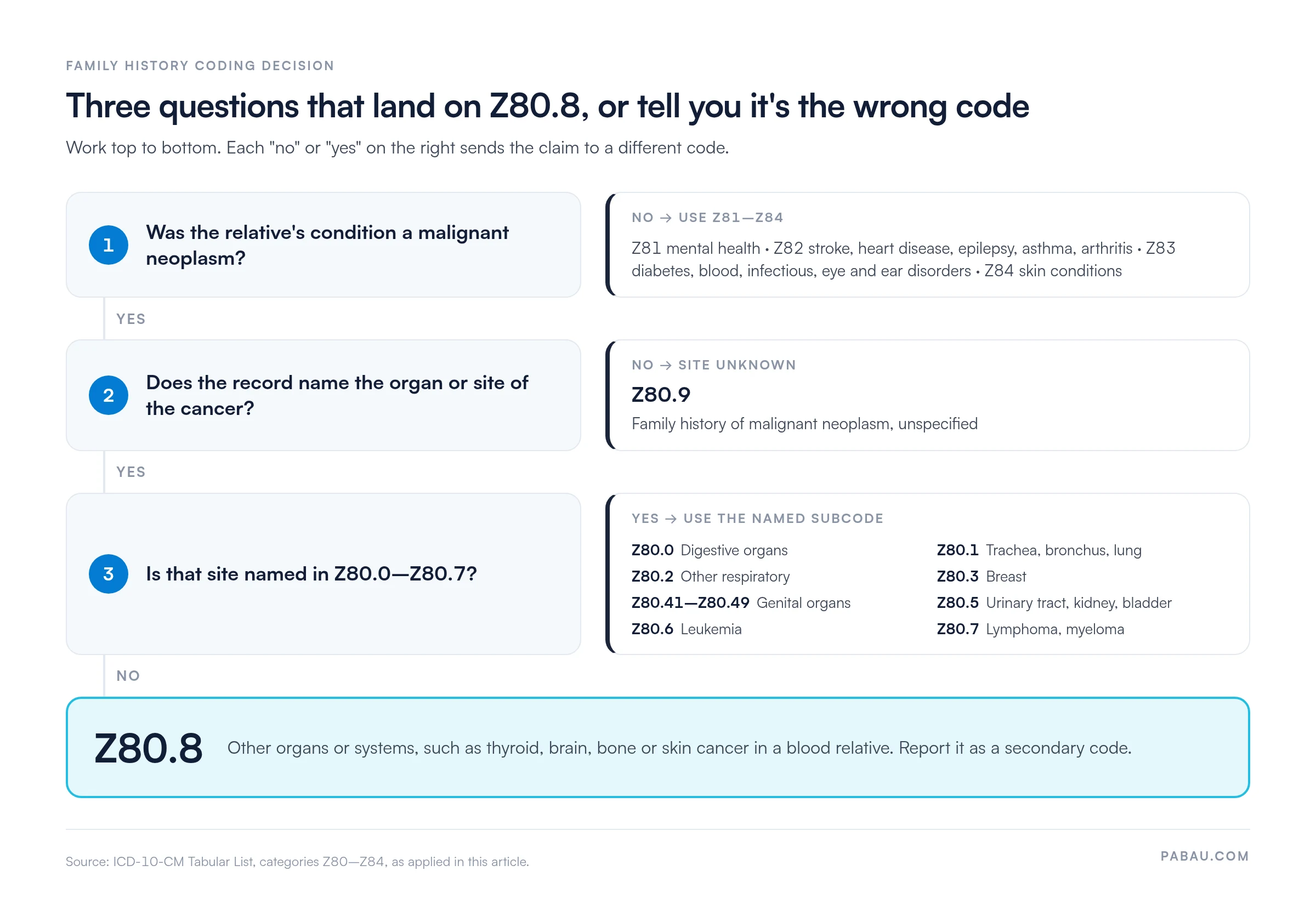
Z82 and Z83 cover non-malignant conditions in relatives, such as chronic diseases, disabilities and specific disorders. Z81 (mental and behavioral disorders) and Z84 (skin and other conditions) complete the set. The key question is whether the relative’s condition was a malignant neoplasm.
A patient whose mother had both Type 2 diabetes and thyroid cancer would correctly receive both Z83.3 and Z80.8. Each family condition is coded separately.
This distinction trips up coders more than any other in the Z80 category. Z80.8 documents that a blood relative had cancer. Z85 codes document that the patient previously had cancer.
Z80.8 and Z85.x can appear together on one claim. That happens when the patient had a prior malignancy and a relative had cancer at another site. Each condition is coded independently.
Payers and auditors expect the medical record to support Z80.8 on its own. A vague note of “family history of cancer,” with no relative or site named, is a frequent reason reviewers question the code.
Practices with medical billing compliance frameworks that include structured intake questionnaires tend to capture this information consistently. The relevant fields are built into the workflow, so the clinician doesn’t have to volunteer them at each visit.
Build a family history section into your preventive visit intake template that prompts for the relative’s relationship, specific organ site and approximate diagnosis year. This structure gives coders the documentation they need to select Z80.8 with confidence. It also protects the practice if a payer requests medical records to support the claim.
Z80.8 is generally a secondary or additional code, not first-listed. The ICD-10-CM Official Guidelines (Section I.C.21) list family history codes among the Z codes acceptable as secondary diagnoses. The reason for the visit drives the first-listed code.
Payers read the first-listed diagnosis as the reason for the encounter, a core rule of the medical billing process. A Z80.8 in first position suggests the patient came in solely because of a relative’s cancer history. That is rarely the whole picture, and it often triggers a medical necessity review.
Common primary codes that are paired correctly with Z80.8:
Z80.8’s most commercially important role is supporting medical necessity for screening services that payers might otherwise treat as elective or premature. Paired with a screening code, it tells the payer that elevated family risk, not age-based guidelines alone, motivates the service.
CPT 96041 replaced 96040 for genetic counseling on January 1, 2025. Some commercial payers still expect HCPCS S0265 for counseling under physician supervision, with Z80.8 explaining the hereditary risk.
Payer acceptance varies. Verify the applicable Local Coverage Determination (LCD) or National Coverage Determination (NCD) before relying on Z80.8 alone to establish medical necessity. Submitting a clean claim with the correct CPT-to-ICD-10 pairing is the clearest way to avoid a preventive service denial.
Medicare generally accepts Z80.8 as a supporting secondary diagnosis when it accompanies a covered preventive or screening service. Z80.8 is not an HCC-mapped code, so it does not trigger risk adjustment or raise a RAF score. Its reimbursement value lies in supporting medical necessity.
Commercial payers treat Z80.8 similarly, though specific LCD and NCD requirements vary. The safest approach is to confirm coverage for each CPT and Z80.8 pairing through the payer’s medical policy lookup before the service date. Practices using denial-reducing claims software can check eligibility and coverage before the claim goes out.
Most Z80.8 denials trace back to one of four root causes. Structured denial management workflows that catch these patterns before submission save the cost of working appeals later.
The AAPC ICD-10-CM code lookup and the CDC/NCHS ICD-10-CM web tool both let coders verify code descriptors and parent-category relationships before finalizing a claim. Cross-checking the code against the official tabular list takes less than a minute and catches most specificity errors.
For other diagnosis codes laid out the same way as this page, browse our diagnostic code library.
Run a quarterly Z-code audit on your family history claims. Pull every claim where a Z80.x code appeared as the first-listed diagnosis and flag it for sequencing correction. Also filter for any Z80.9 code where the medical record documents a site. Recode those to the matching Z80.0-Z80.8 subcode before the claim ages past the timely filing limit.
Many practices find a Z80.8 sequencing or eligibility problem only when the denial arrives. A biller then pulls the chart, recodes the claim and resubmits it, often weeks after the visit.
Pabau keeps the family history intake, the clinical note and the claim in one patient record. Eligibility checks run before the appointment. Claims go out electronically through Claim.MD, Pabau’s US clearinghouse partner, which connects to thousands of US payers.
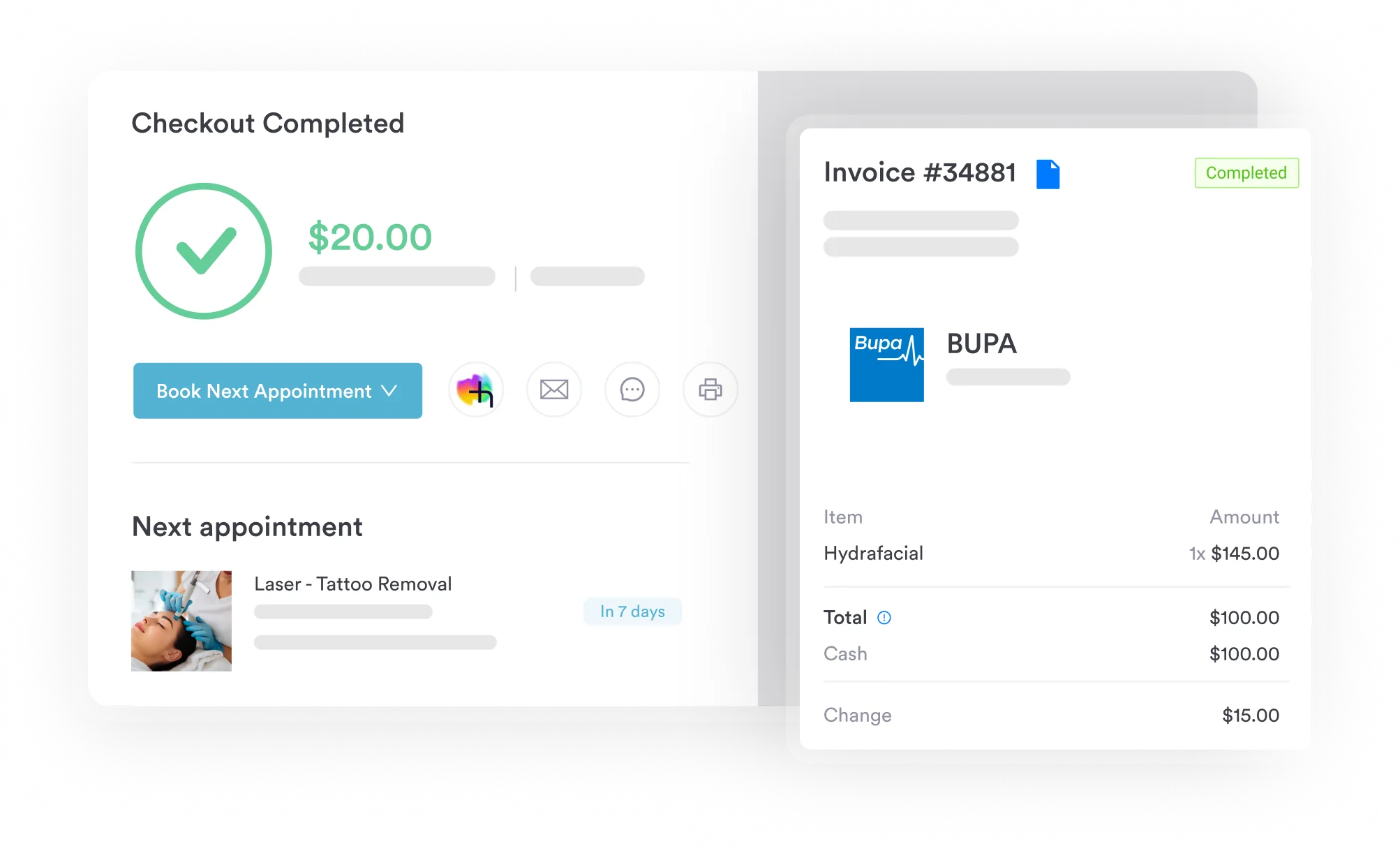
Remittances come back as electronic remittance advice (ERA), so your team can track which Z80.8 claims paid and which came back with edits. The result is fewer resubmissions and a faster path from screening visit to payment.

Pabau checks eligibility, sends claims electronically through Claim.MD to thousands of US payers, and tracks remittances. See how practices use it to keep family history codes off the denial list.

Z80.8 belongs on a claim when the chart holds three facts: a blood relative, a malignant cancer, and a named site that Z80.0-Z80.7 don’t cover. Without all three, another code is the right answer. That might be Z80.5 for a kidney, Z80.9 for an unknown site, or Z85 for the patient’s own cancer.
The fix that pays off most sits at intake rather than at billing. A family history form that asks for the relationship and the organ site gives coders a defensible Z80.8 every time. Sequencing it behind the reason for the visit then protects the screening it supports.
Book a demo to see how Pabau links family history intake, eligibility checks and electronic claims for preventive visits.

Need a framework for clean claim submission? Clean claim best practices covers the documentation and pairing rules that prevent edits at the clearinghouse level.
Dealing with repeated denials on Z-codes? Denial management in healthcare outlines the workflow changes that reduce denial rates across payer categories.
Want to understand how the billing cycle connects to code selection? Revenue cycle management explained maps the full process from documentation to payment posting.
ICD-10 Code Z80.8 is the billable diagnosis code for family history of malignant neoplasm of other organs or systems. It means a blood relative had cancer at a site not individually listed in Z80.0 through Z80.7. It belongs to the Z80 category and is generally a secondary or additional code, not first-listed.
Yes, Z80.8 is a billable ICD-10-CM code valid for claim submission in FY 2026 and FY 2027. The parent code Z80 is not billable, and neither is Z80.4, which needs a fifth character. The reportable codes are Z80.0-Z80.3, Z80.41-Z80.49 and Z80.5-Z80.9.
Z80.8 is used when the family member’s cancer site is documented and specific, such as thyroid, brain or bone. Z80.9 is the fallback when the site is unknown or unspecified. If the chart names an organ, Z80.8 or a more specific Z80.0-Z80.7 code is required. Defaulting to Z80.9 when a site is documented is a specificity error.
Use Z80.8 only when the family condition is a malignant neoplasm at a site not covered by Z80.0-Z80.7. Use Z82 for stroke, heart disease, epilepsy and asthma. Use Z83 for diabetes, infectious and blood disorders. Mental and behavioral disorders go under Z81.
Generally no. Under ICD-10-CM Official Guidelines Section I.C.21, family history codes are reported as secondary or additional codes, not first-listed. Listing Z80.8 first triggers a medical necessity edit from many payers. Pair it with a primary encounter code, such as a preventive visit, screening or E&M code, that represents the reason for the visit.
Medicare generally accepts Z80.8 as a supporting secondary diagnosis when it accompanies a covered preventive or screening CPT code. It is not an HCC-mapped code, so it does not affect risk adjustment. Coverage depends on the applicable NCD or LCD for each screening service, so verify the pairing before billing.