ICD-10 Code Y76.0: Diagnostic obstetric and gynecological devices
ICD-10 Code Y76.0: Definition and billable status ICD-10 Code Y76.0 is a valid, ...

Last Updated: Oct 23, 2026
Billable Code Specific Code
Z60.8 is the billable ICD-10-CM code for other problems related to social environment. It covers social problems that affect a patient's care but fit no named Z60 code, such as inadequate social support or lack of emotional support.
Assign it only after ruling out every named sibling, including Z60.2 (living alone), Z60.4 (social exclusion and rejection), and Z60.5 (perceived adverse discrimination and persecution). Most payers expect it as a secondary code alongside the condition being treated.
Let Pabau's smart automation suggest the right codes, reduce claim denials, and keep your practice compliant—effortlessly.
Automate repetitive tasks and focus on what matters most—your patients.
Reduce coding errors and ensure compliance with the latest regulations.
Clean claims, fewer denials, and faster reimbursements.
Powerful insights and reporting to help your practice thrive.
HIPAA compliant SOC 2 certified GDPR-compliant Trusted by 4,000+ clinics worldwide

Z60.8 is the NEC (not elsewhere classified) code in the Z60 category, so assign it only after ruling out every more specific Z60.x sibling.
The code is billable and valid for FY2025 and FY2026, with no descriptor or status changes from CMS.
Documentation must name the specific social environment problem and link it to the patient’s care plan, because coder inference isn’t enough.
Z60.8 is almost always an additional diagnosis, and standalone primary use is rare and payer-specific.
ICD-10 Code Z60.8 is a valid, billable ICD-10-CM diagnosis code for other problems related to social environment. It covers social problems that affect a patient’s care but fit no named Z60.x code, like inadequate social or emotional support.
The code sits in Chapter 21 (Factors influencing health status and contact with health services), within category Z60 (Problems related to social environment). It carries the NEC designation and has been active without change since at least FY2017. Per CMS’s ICD-10-CM resources, Z60.8 remains valid for FY2026 with no revision to its descriptor.
Z60.8 captures social environment problems that affect a patient’s health or treatment plan but fall outside the named Z60.x subcategories. The ICD-10-CM tabular lists two inclusion terms under it: inadequate social support and lack of emotional support.
Typical Z60.8 scenarios include a patient with no one to help during recovery, or one who has no emotional support while managing a new diagnosis. Persistent lack of support that doesn’t stem from living alone also belongs here, since living alone has its own code (Z60.2).
The code covers community-level barriers to care too, as long as they don’t amount to exclusion, discrimination, living alone, or acculturation difficulty. In every case, the provider must explicitly link the problem to the patient’s care.
What the code does not capture: social exclusion and rejection, including rejection by a peer, cultural, or religious group, belongs to Z60.4. Discrimination based on perceived race, ethnicity, or other characteristics belongs to Z60.5 (target of (perceived) adverse discrimination and persecution).
Adjustment difficulties following immigration belong to Z60.3 (acculturation difficulty). Search the CDC/NCHS ICD-10-CM search tool for “social support” or “social exclusion” before assigning Z60.8, and the Alphabetic Index will surface these distinctions.
Before assigning Z60.8, coders must rule out every named sibling. The NEC convention in ICD-10-CM means Z60.8 is a code of last resort within the Z60 block, not a default catch-all. The decision path below shows the order of that review, and the table after it maps each code’s scope.
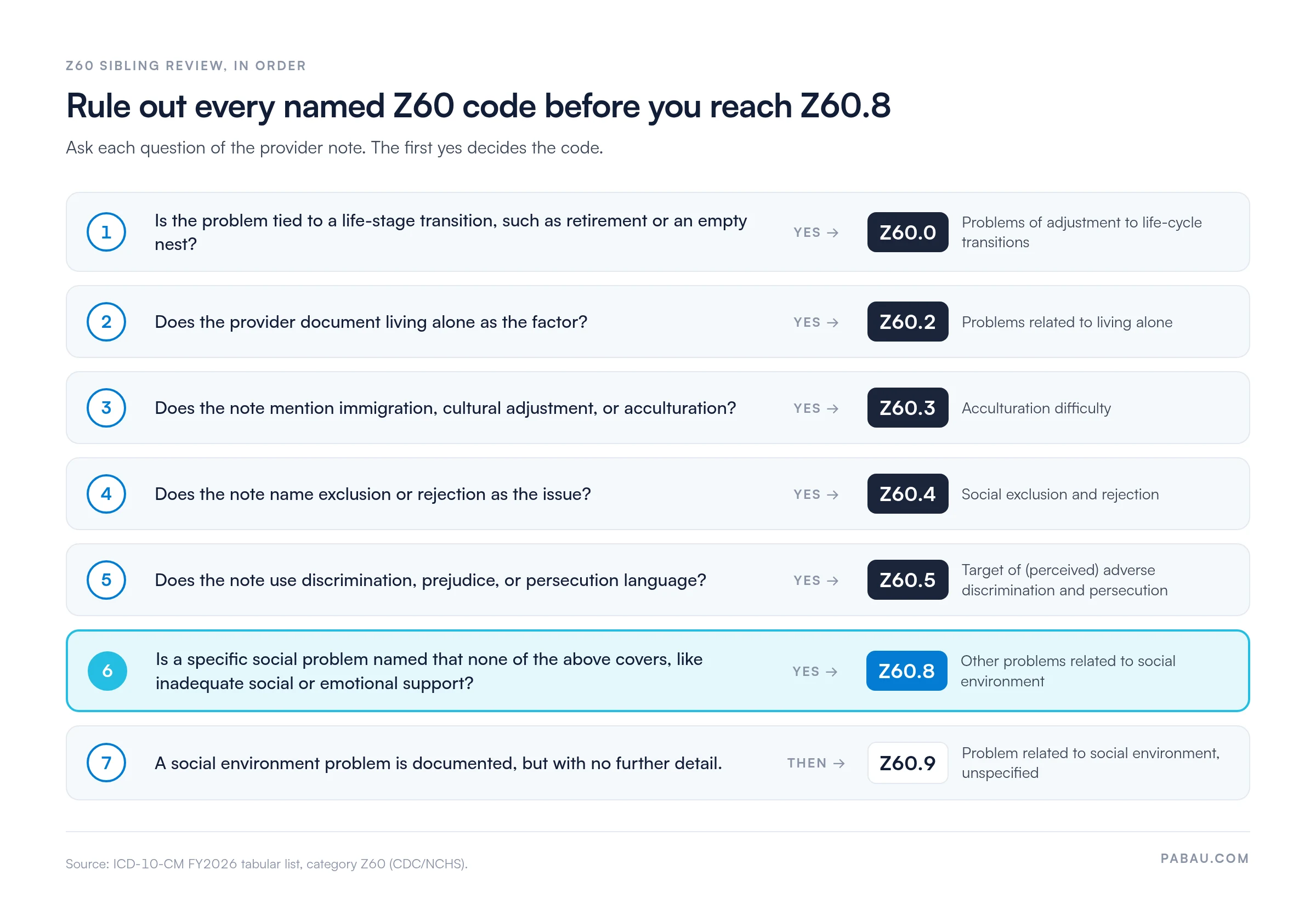
Common misassignment: Behavioral health tools that auto-suggest Z60.8 as the default “social problem” code often let coders skip the sibling review entirely. The AHA Coding Clinic has reinforced that coders may not assign a more specific code than the provider documentation supports. The inverse also applies. When the documentation is specific enough to support Z60.4 or Z60.5, Z60.8 is incorrect.
Z60.8 carries no standalone Excludes1 or Excludes2 note at the individual code level. Its exclusions are inherited from the Z60 category and from Chapter 21 conventions, so check both levels before dual-coding.
No 7th-character extension applies to Z60.8. The code is complete as a 4-character code.
Z60.8 is part of the broader ICD-10-CM framework for social determinants of health (SDoH), the non-clinical factors that influence patient health outcomes. CMS has actively promoted SDoH Z code capture since 2019. Medicaid managed care plans in multiple states now require or incentivize Z code documentation for quality measure reporting and risk adjustment.
Within the SDoH Z code set, Z60.8 addresses the social environment domain. That is distinct from food insecurity (Z59.4x), inadequate housing (Z59.1x), transportation insecurity (Z59.82), or low income (Z59.6). Payers and quality measure stewards separate these domains when building measure value sets.
Assigning Z59.4x when the note describes inadequate social support moves the record into the wrong SDoH category. That can change care coordination flags and value-based care scoring.
Federally Qualified Health Centers (FQHCs) face a specific reporting context. CMS has included SDoH Z codes in the FQHC SDOH quality measure value set, and Z60.8 appears in that value set for social environment reporting.
FQHCs using Accountable Health Communities (AHC) screening logic can map positive HRSN results on social support or community-level barriers to Z60.8. That mapping holds only when no more specific Z60.x sibling applies.
Audit your SDoH Z code distribution quarterly. If Z60.8 accounts for more than 70% of your Z60 block assignments, coders are likely defaulting to it rather than reviewing sibling codes. A coding audit targeting Z60.4 (social exclusion and rejection) and Z60.5 (perceived discrimination) shows how many of those encounters support a more specific code.
Z60.8 is almost always coded as an additional diagnosis. The Official Guidelines (Chapter 21) allow a Z code as the first-listed outpatient diagnosis when the encounter addresses the social factor directly. For Z60.8, that scenario is rare. A behavioral health provider could list it first when lack of social support is the whole reason for the visit. Most payers still expect a mental health or medical condition as the primary diagnosis.
The more common path starts with a behavioral health encounter for depression (F32.1). The provider notes that the patient’s lack of support at home is affecting treatment adherence. The coder assigns F32.1 as primary and adds Z60.8 to reflect the documented social circumstance.
Provider documentation must explicitly state the social environment problem, because the coder cannot infer Z60.8 from a screening score alone. A PHQ-9 score or a positive AHC HRSN flag isn’t enough on its own.
The provider has to interpret the finding and describe the social factor in clinical terms. Medical billing compliance requirements consistently hold that Z code assignment requires provider attestation, not coder interpretation of instrument results.
Three elements the documentation must contain to support Z60.8:
AI-assisted clinical documentation tools can capture social factors mentioned during the encounter. Provider attestation of any auto-generated note remains required under CMS guidelines before a Z code is assigned.
Z60.8 does not generate a standalone fee-for-service payment on its own. Its value on the claim lies in supporting risk adjustment, quality measure reporting, and care management flags.
Payer-specific acceptance varies significantly. Practices submitting Z60.8 through a clearinghouse should confirm payer policies before adding the code to every relevant encounter.
The CMS ICD code lists for Section 111 reporting list which diagnosis codes, including Z60.8, are valid in Medicare claims data submissions. Review this list annually, as code validity for specific claim contexts can change with the October 1 update cycle.
Denials on Z60.8 fall into five recurring categories, and most are fixed with a single documentation or code placement change. The catch is that the claim adjustment reason code (CARC) often points to a general edit rather than the Z60.8 issue. Checking each CARC against the common medical billing denial codes speeds up that root-cause review.
ICD-10 Code Z60.8 carried forward unchanged into FY2026 (effective October 1, 2025). Neither annual update revised the code’s descriptor, Includes notes, Excludes notes, or coding guidance. That is based on CMS’s published FY2026 MS-DRG v43.0 Definitions Manual and the NCHS ICD-10-CM update files.
Verify code validity annually at the AAPC Codify ICD-10-CM lookup or in the NCHS update files on the CMS website. This matters most when an encounter spans a fiscal year boundary, such as a late-September service billed in October.
Set a calendar reminder for September 15 each year to review the CMS ICD-10-CM addenda for the upcoming October 1 FY update. For Z60-range codes, check both the Tabular List addenda and the Alphabetic Index for changes to ‘social environment’ entries.
Most Z60.8 problems start before the claim exists. A provider mentions a patient’s lack of support in free text, and a coder has to decide later whether it supports a Z code.
Pabau, the practice management and billing platform we build, gives providers structured clinical note templates for recording social factors. The diagnosis codes sit on the same patient record the claim is built from, so coders aren’t reconstructing context from a screening score.
Claims then go out through our claims management software and its Claim.MD clearinghouse integration. Real-time eligibility checks and claim-level validation surface payer edits before submission, so a Z60.8 in the primary position gets caught early.

Pabau connects clinical documentation to claims submission. Providers document social factors in structured notes, and the claims workflow routes them to the right payer through built-in clearinghouse integration. That means fewer manual coding errors and less denial follow-up.

Treat Z60.8 as the last stop in the Z60 category. When a note describes inadequate social support or lack of emotional support and no sibling fits, it’s the right code. When the note names exclusion, discrimination, living alone, or acculturation, the sibling wins.
The fix sits in the workflow more than in coder knowledge. A provider template that asks for the specific social problem and its effect on care prevents most denials before a claim is built. The trade-off is a slightly longer note, which costs far less than an addendum request and a resubmission.
Book a demo to see how Pabau turns structured SDoH documentation into clean Z60.8 claims for behavioral health and primary care practices.

Is the patient’s missing support tied to a death in the family? ICD-10 Code Z63.4 explains when bereavement takes Z63.4 instead of a Z60 code, and when F43.81 applies.
Coding another social determinant alongside Z60.8? ICD-10 Code Z56.9 covers unspecified employment problems and why they are billed as a secondary code.
ICD-10 code Z60.8 is the not-elsewhere-classified (NEC) code for social environment problems that no named Z60.x sibling describes. Its inclusion terms are inadequate social support and lack of emotional support. It sits in ICD-10-CM Chapter 21 and is valid and billable for FY2025 and FY2026.
Yes, Z60.8 is a fully billable, 4-character ICD-10-CM code with no further specificity required. It has been valid without interruption for multiple fiscal years. It remains active for FY2025 and FY2026 with no changes to its descriptor.
Use Z60.8 only after ruling out every named sibling code. Those are Z60.0 (life-cycle transitions), Z60.2 (living alone), Z60.3 (acculturation difficulty), and Z60.4 (social exclusion and rejection). Z60.5 (target of (perceived) adverse discrimination and persecution) and Z60.9 (unspecified) complete the list. If the provider note describes a social environment problem that does not map to any of those, Z60.8 is correct. If the note is too vague to support any sibling but documents a social environment issue, Z60.9 applies instead.
Yes, but only in rare outpatient encounters. The visit must exist solely to address the social environment problem, with no underlying clinical condition being treated. Most payers expect Z60.8 in the secondary position with a primary medical or psychiatric diagnosis driving the encounter. Submitting Z60.8 as the sole or first-listed code on most claim types will generate a payer edit or denial.
The provider must name the specific social environment problem in the clinical note and explicitly state that it affects the patient’s health, treatment, or prognosis. A positive screening score alone isn’t enough, because the provider must interpret the finding and document its clinical relevance. Coder inference of social factors not stated in the note is not permitted under ICD-10-CM Official Guidelines.
No. Z60.8 carried forward unchanged into both FY2025 (effective October 1, 2024) and FY2026 (effective October 1, 2025). No revisions were made to the descriptor, Includes notes, Excludes notes, or coding guidance in either annual update. Coders should verify annually at the CMS ICD-10-CM update page to confirm no changes take effect after this article’s publication date.