

ICD-10 Code R63.4: Abnormal weight loss
ICD-10 Code R63.4: Definition, billability, and code structure ICD-10 code R63.4...

Last Updated: Nov 13, 2026
Billable Code Specific Code
W19.XXXA is the billable ICD-10-CM code for unspecified fall, initial encounter. Coders assign it only when no note in the record says how the fall happened.
It sits in Chapter 20 of ICD-10-CM (External Causes of Morbidity) and is never sequenced as the first-listed diagnosis. It is most often confused with W18.30XA, which covers fall on same level, unspecified.
Let Pabau's smart automation suggest the right codes, reduce claim denials, and keep your practice compliant—effortlessly.
Automate repetitive tasks and focus on what matters most—your patients.
Reduce coding errors and ensure compliance with the latest regulations.
Clean claims, fewer denials, and faster reimbursements.
Powerful insights and reporting to help your practice thrive.
HIPAA compliant SOC 2 certified GDPR-compliant Trusted by 4,000+ clinics worldwide

W19.XXXA is a billable ICD-10-CM external cause code for an unspecified fall at the initial encounter. It records how the injury happened, never the injury itself.
It is always sequenced after the injury diagnosis, such as a fracture, contusion or laceration, and never as the first-listed code.
Its 7th character matches the injury code for the encounter: A during active treatment, D (W19.XXXD) for routine healing and S (W19.XXXS) for sequela.
Any mechanism documented anywhere in the record, from a nursing note to the EMS report, calls for a more specific fall code than W19.
Pabau, the practice management platform we build, submits US claims through the Claim.MD clearinghouse and posts ERA remittances back to the patient record.
ICD-10 Code W19.XXXA is the billable ICD-10-CM code for an unspecified fall at the initial encounter, with the 7th character A marking active treatment.
CDC’s ICD-10-CM browser tool lists its official descriptor as “Unspecified fall, initial encounter,” under category W19 in Chapter 20. The code is valid in the FY 2027 code set, which took effect on October 1, 2026. Its neighbors in the W00-W19 block sit in our ICD-10-CM code library.
The 7th character on W19 tells the payer which phase of care the claim covers. Under CMS ICD-10-CM Official Guidelines Section I.C.20.a.2, the external cause code takes the same 7th character as the injury code for that encounter.
Character A applies while the patient receives active treatment, whether that is the first visit or the fifth. Using A on every visit, follow-ups included, is a frequent W19 coding error.
W19.XXXA codes the mechanism of injury only. It does not describe the resulting injury, and it cannot stand alone as a complete claim. The injury diagnosis (fracture, contusion, laceration, head injury) must always be sequenced before it.
Documentation trap: “Mechanical fall” is clinical shorthand, not an ICD-10-CM category. Many physicians write it as a catch-all, so treat it as a signal to query for more detail. If the clinician confirms no further detail exists, W19.XXXA is appropriate. If a nursing note or another entry adds detail, a more specific code may apply.
W19.XXXA is the last-resort fall code. Use it only when no mechanism can be identified anywhere in the medical record. Even a fall between levels that fits no named category has its own residual code, W17.89XA. A stumble after stepping on an object, with no fall at all, has its own code too, W18.41XA at the first visit.
W19 stays reserved for a fall with no documented mechanism. The decision runs in two steps, shown below: the mechanism first, then the 7th character.
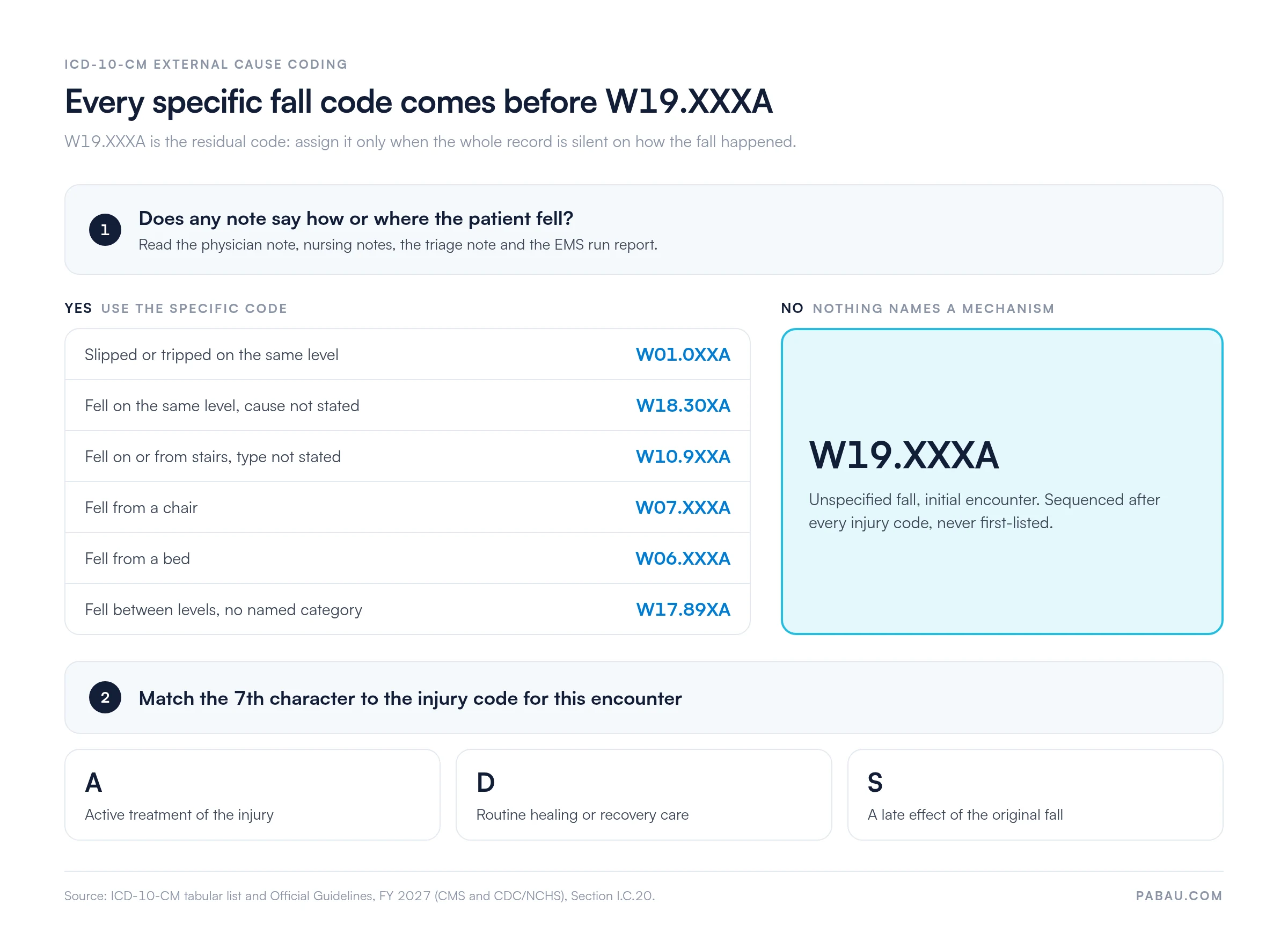
The table covers the most confused sibling codes, all with the A (initial encounter) suffix applied.
External cause codes are always secondary. The ICD-10-CM Official Guidelines for Chapter 20 state that they are never sequenced as the first-listed or principal diagnosis. W19.XXXA follows the injury or condition code on every claim type.
Outpatient claims follow the same logic. The condition treated, or the sign or symptom that prompted the visit, is first-listed, and W19.XXXA is secondary. Inpatient claims use the same principle: the injury that occasioned the admission is the principal diagnosis, and W19.XXXA is a secondary code.
Run a claim edit check for external cause code position before batch submission. External cause codes can never be first-listed, so a payer will reject W19.XXXA in position 1. If your system does not flag this automatically, add a manual audit step to your pre-billing workflow.
The physician’s note supports W19.XXXA through absence of specificity, not through the phrase “mechanical fall.” A coder cannot assign W19.XXXA if any part of the record documents a specific mechanism, including nursing notes, EMS run reports and the triage note. Submitting a clean claim with W19.XXXA means the entire record was reviewed and no more specific W-code applies.
There is no national requirement to report ICD-10-CM external cause codes. They become mandatory only where a state reporting mandate or a particular payer requires them, and the guidelines otherwise encourage voluntary reporting. When a W19.XXXA claim is denied, the cause is usually one of four fixable errors.
For recurring fall claim denials, a denial management process that tracks claim adjustment reason codes (CARCs) by external cause code is a practical start. A grounding in medical billing basics helps a newer team build a W19.XXXA prevention checklist.
Several clinical scenarios create sequencing complexity that straightforward fall coding does not address. Each requires a different approach to code order and code selection.
When a physician documents that syncope caused the fall, the claim carries the syncope code R55 as well as the injury codes.
The condition chiefly responsible for the encounter is listed first. W19.XXXA follows as the external cause of the injury, but only if the fall mechanism is otherwise unspecified. It never moves into position 1, whatever else is on the claim.
Falls in older adults bring up W19.XXXA often, because the mechanism frequently goes unwitnessed. The code itself does not change for geriatric patients, but supplemental codes often accompany it. Z91.81 (History of falling) may be added when the physician documents fall risk.
Place of occurrence codes can follow W19.XXXA to capture the setting. Use Y92.129 for an unspecified place in a nursing home, or Y92.009 for an unspecified home. These codes rarely change payment, but they feed population health reporting and fall prevention data.
When a single fall causes more than one injury, such as a hip fracture and a head contusion, every injury is coded and sequenced first. They are ordered by clinical severity or resource use. Only one W19.XXXA is added, after all injury codes, and it is never repeated for each injury from the same incident.
A fall during an inpatient admission is coded the same way. The injury code comes first, with W19.XXXA, or the more specific fall code where a mechanism is documented, as a secondary code. CMS quality programs track hospital-acquired falls separately, but the claim itself follows the standard sequencing rules.
For CDI teams: when the physician note gives no mechanism for an inpatient fall, check the wider chart. EMS records, nursing intake notes and logged family communications often hold the detail. Any mechanism detail found anywhere in the record should prompt a physician query before defaulting to W19.XXXA.
Many billing teams catch a misplaced external cause code only when the payer rejects the claim. A W19.XXXA in position 1, or an A on a follow-up visit, then costs a resubmission and days of delay.
Pabau keeps the clinical note and the claim in one patient record, so coders work from the documentation itself. A mechanism recorded in a nursing note is in front of them when they choose the fall code.
Pabau’s faster claims management then submits US claims through the Claim.MD clearinghouse, runs eligibility checks and posts ERA remittances back to the record.
The result is fewer rejected fall claims and less time spent reworking code order after the payer has already responded.

Pabau keeps fall injury documentation and the claim in one patient record. It submits US claims through the Claim.MD clearinghouse and posts remittances back to that record.

W19.XXXA is the fall code you reach for last. Before assigning it, read every note in the record for a mechanism, and match the 7th character to the injury code for that visit. Those two checks prevent the two errors behind most W19 rework: the code in position 1, and A on a follow-up.
The trade-off is time, since a full record review takes longer than accepting “mechanical fall” at face value. It still costs less than a resubmitted claim. Book a demo to see how Pabau puts the clinical note and the claim side by side for fall injury coding.

Submitting fall claims electronically for the first time? How the Claim.MD clearinghouse works explains real-time eligibility checks, 837P file submission, and ERA processing for US practices.
Looking for a plain-language overview of the billing process behind fall claims? What is revenue cycle management explains the end-to-end claim lifecycle from code entry to payment posting.
ICD-10 Code W19.XXXA is the billable external cause code for an unspecified fall at the initial encounter. It applies while the fall injury is in active treatment and the record documents no fall mechanism. It sits in Chapter 20 (External Causes of Morbidity) and is always sequenced after the injury diagnosis.
Yes, W19.XXXA is a billable ICD-10-CM code, but only as a secondary code. It cannot be the first-listed or principal diagnosis, and payers reject claims that list it in position 1.
W19.XXXA applies while the fall injury is in active treatment. W19.XXXD applies to encounters after active treatment, while the injury heals. Using W19.XXXA on a routine cast check or wound recheck, where W19.XXXD is correct, is a frequent coding error that can trigger payer audits.
Use W19.XXXA only when the entire medical record, including nursing notes and EMS documentation, says nothing about how the fall occurred. If any mechanism is documented, such as a trip, a slip, a fall from furniture or a fall on stairs, a more specific W-code applies. W19 is the last resort, not the default.
Assign W19.XXXA when the physician writes “mechanical fall” and no note in the chart records a mechanism. It goes after the injury code as the external cause. If the note names a cause, such as a step edge, a wet floor or a loose rug, a more specific fall code applies.
It depends on the payer. The ICD-10-CM guidelines allow an external cause code alongside a Z code, so a fall with no injury can still be recorded. Some payers accept that pairing, while others expect a documented injury diagnosis. Check your payer’s policy and AHA Coding Clinic guidance before submitting.



