ICD-10 Code S42.444P: Medial epicondyle fracture, right humerus
ICD-10 Code S42.444P: full descriptor and code validity ICD-10 Code S42.444P car...

Last Updated: Oct 13, 2026
Billable Code Specific Code
Y90.2 is the billable ICD-10-CM code for blood alcohol level of 40-59 mg/100 ml. It records a laboratory-measured blood alcohol concentration (BAC) of 0.040-0.059 g/dL and is always reported as a secondary code.
Y90.2 sits in category Y90 and supplements the principal diagnosis, never replacing it. Assignment turns on the lab value alone: a result of 39 mg/100 mL is Y90.1, and 60 is Y90.3.
Let Pabau's smart automation suggest the right codes, reduce claim denials, and keep your practice compliant—effortlessly.
Automate repetitive tasks and focus on what matters most—your patients.
Reduce coding errors and ensure compliance with the latest regulations.
Clean claims, fewer denials, and faster reimbursements.
Powerful insights and reporting to help your practice thrive.
HIPAA compliant SOC 2 certified GDPR-compliant Trusted by 4,000+ clinics worldwide

ICD-10 code Y90.2 documents a measured blood alcohol level of 40-59 mg/100 mL (0.040-0.059 g/dL) and is always a secondary code.
A quantitative laboratory BAC result between 40 and 59 mg/100 mL must appear in the medical record before you assign this code.
A result of 60 mg/100 mL moves the code up to Y90.3, and a result of 39 moves it down to Y90.1.
Y90.2 records a measured ethanol level rather than an alcohol use disorder, so it never replaces an F10 code.
Pabau, our practice management and billing platform, checks ICD-10 codes before claims go out, so Y90.2 sequencing errors surface early.
ICD-10 code Y90.2 records a laboratory-measured blood alcohol level of 40-59 mg/100 mL and is always reported as a secondary code. It belongs to Chapter 20 of ICD-10-CM (External Causes of Morbidity), Category Y90 (Evidence of alcohol involvement determined by blood alcohol level). The table below captures the core reference data at a glance.
ICD-10 code Y90.2 records one clinical fact: a laboratory-confirmed blood alcohol concentration (BAC) between 40 and 59 mg per 100 mL. Because the code captures a measurement, any condition, behavior or disorder behind it needs a code of its own.
The Y90.2 range sits below the most widely used legal driving threshold. In 49 states the per se driving limit is 0.08 g/dL; Utah’s is 0.05. A Y90.2 result of 0.040-0.059 g/dL is below the 0.08 limit, while a result of 50-59 mg/100 mL meets Utah’s limit. An ICD-10-CM code records the clinical measurement only. Whether a driver was over the limit is a legal question that stays off the claim.
Y90.2 typically appears on emergency department visits after trauma with a documented toxicology screen, and on inpatient admissions where alcohol involvement is recorded. It applies to any encounter where a measured BAC of 40-59 mg/100 mL appears in the record alongside a primary diagnosis.
The ICD-10-CM Tabular List places Y90.2 within the Y90 category (Evidence of alcohol involvement determined by blood alcohol level). There are no Excludes1 or Excludes2 notes specific to Y90.2 itself. The Y90 category does carry a “code first” note for any associated alcohol-related disorder (F10). The broader Chapter 20 guidelines also apply, so these codes supplement the primary diagnosis and never replace it.
Y90.2 is one of ten codes in the Y90 series, each covering a distinct BAC range. Picking a neighboring code by mistake is the main accuracy risk in this category. The table below shows the full series alongside the clinical context for each range.
The ten codes run in consecutive bands, so every measured result maps to exactly one code. A result of exactly 40 mg/100 mL is Y90.2, and so is a result of 59. At 60 the code becomes Y90.3, and at 39 it drops to Y90.1. When the record confirms alcohol but gives no measured level, the code is Y90.9 instead.
The chart below sets each band against the two per se driving limits, so you can see how narrow the Y90.2 window is.
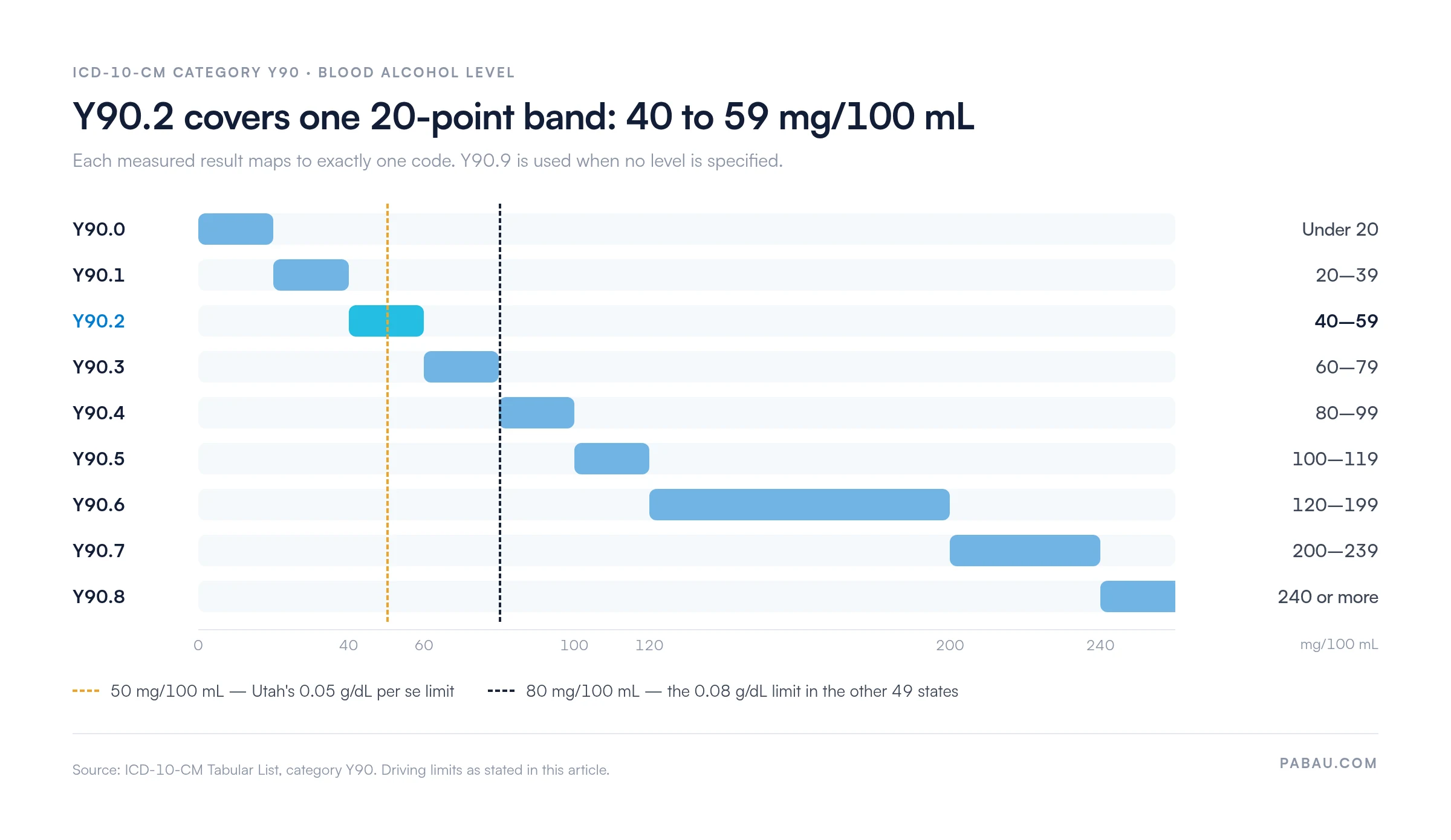
Y90.2 covers 40-59 mg/100 mL, and Y90.3 covers 60-79 mg/100 mL. The boundary is the number in the lab report. Assign Y90.2 when the result is 40 to 59, and Y90.3 when it is 60 to 79. There is no rounding or clinical judgment involved. The code follows the documented number exactly.
The most common assignment error occurs when a coder works from a handwritten note that says “BAC elevated, approximately 0.06” instead of the laboratory printout. A note stating “approximately 0.06 g/dL” could represent anywhere from 55 to 65 mg/100 mL. If the measured BAC is 60 or higher, Y90.3 applies, not Y90.2. Coders should always trace back to the quantitative lab result, not the provider’s narrative summary.
Before assigning any Y90 code, pull the laboratory report and read the exact result in mg/100 mL. Many US labs report ethanol in mg/dL, which is the same unit. If the provider’s note uses g/dL, multiply by 1,000 (e.g. 0.05 g/dL = 50 mg/100 mL = Y90.2). Never code from a narrative estimate.
Y90.2 and the F10.x codes are not interchangeable. They document different clinical facts and come from different chapters of ICD-10-CM.
Take a patient who presents to the ED after a fall, with a BAC of 52 mg/100 mL and a documented alcohol use disorder. The claim carries the primary injury code, an F10.x code for the disorder, and Y90.2 for the measured BAC. The F10 reference covers how to pick the disorder code that sits ahead of Y90.2.
Y90.2 is always a secondary code. Per ICD-10-CM Official Coding Guidelines, Chapter 20, external cause codes supplement the principal diagnosis and are never sequenced first. The coding sequence for an encounter involving Y90.2 follows these steps.
Pabau, the practice management and billing platform we build, checks codes against its built-in ICD-10 catalog before a claim goes to the Claim.MD clearinghouse. A Y90.2 sitting in the primary position gets flagged before submission.
Three documentation elements must be present in the medical record before a coder can assign Y90.2. Missing any one of them leaves the code unsupported and creates audit risk.
Pabau’s claims management software links encounter documentation to claim data. The BAC result and its external cause code travel through the workflow together, so nobody codes them later from incomplete notes.
The same evidence trail supports every other code on the claim. Our guide to clean claims covers the supporting documentation payers expect.
External cause codes, including Y90.2, are generally optional rather than required on outpatient claims under current CMS guidance. Several situations still make them worth reporting.
The CMS ICD-10 codes resource page provides current coding guidelines and annual update files. For Medicare claims, Chapter 25 of the CMS Medicare Claims Processing Manual covers the external cause code fields on the UB-04 institutional claim.
Denials on Y90.2 claims follow recognizable patterns. Most are preventable with pre-submission validation. The table below pairs each denial reason with its fix.
When a Y90.2 claim is denied, the resubmission process follows a standard external cause code appeal workflow.
For a reference on denial reason codes, see the denial codes in medical billing guide.
Many billing teams code Y90.2 after the encounter, working from a narrative note and a lab printout filed somewhere else. That is where range errors and sequencing errors creep in.
Pabau keeps the encounter documentation, the ICD-10 catalog, and the claim in one workflow. Codes are validated before the claim reaches the Claim.MD clearinghouse, so a Y90.2 in the primary position is caught early.
When a denial does come back, the clearinghouse integration supports denial management workflows. Electronic remittance retrieval and corrected claim resubmission run in one place, so billing teams can act on Y90.2 denials without tracking each step by hand.

Pabau checks ICD-10 code sequencing before claims go out, so coders catch a misplaced Y90.2 before the payer does.

Y90.2 is a narrow code with a hard ceiling at 59 mg/100 mL. Code it only from a quantitative lab result for the current encounter, and always behind a primary diagnosis. When a note gives the BAC in g/dL, convert it before you choose between Y90.1, Y90.2, and Y90.3.
Pulling the lab report adds a minute per chart. That minute prevents the range errors that turn into corrected claims and audit findings later.
Practices that link their clinical documentation directly to their billing workflow catch these errors at the source. Pabau’s medical billing workflow integrates ICD-10 code validation through the Claim.MD clearinghouse, from encounter documentation through to paid claim. Book a demo to see how Pabau keeps external cause codes like Y90.2 accurate for your billing team.

Need to understand how electronic claims reach payers? Medical claims clearinghouse overview explains how 837P transactions are processed and validated before reaching Medicare and commercial payers.
Coding alcohol dependence alongside the BAC? ICD-10 code F10.20 explains the uncomplicated alcohol dependence code that is sequenced ahead of Y90.2.
Looking for electronic remittance guidance after a denial? Electronic remittance advice (ERA) guide walks through reading 835 files and identifying CARC denial codes for corrected claim resubmission.
ICD-10 code Y90.2 is a supplementary code that documents a measured blood alcohol level of 40-59 mg/100 mL (0.040-0.059 g/dL). It belongs to Chapter 20 of ICD-10-CM. It is always assigned as an additional code alongside a primary diagnosis, never on its own.
No. Per ICD-10-CM Official Coding Guidelines, Chapter 20, external cause codes including Y90.2 are never sequenced as the principal diagnosis. A claim with Y90.2 in the primary position will typically reject. Assign the underlying condition (injury, poisoning, or related diagnosis) as PDX first.
Y90.2 covers a BAC of 40-59 mg/100 mL, and Y90.3 covers 60-79 mg/100 mL. The code depends entirely on the laboratory result. A result of 59 is Y90.2, and a result of 60 is Y90.3. Always code from the quantitative lab report, not the provider’s narrative estimate.
Y90.2 records a measured BAC level from a laboratory result (Chapter 20, external causes). F10.x codes classify diagnosed alcohol use disorder based on clinical criteria (Chapter 5, mental disorders). Both can appear on the same claim when documentation supports them, with the F10 code sequenced first.
A quantitative laboratory BAC result between 40 and 59 mg/100 mL must appear in the medical record for the current encounter. Clinical signs of intoxication alone do not satisfy the requirement. Neither do breath test results without blood laboratory confirmation, or BAC results from a prior visit.
Assign Y90.2 as a secondary code when the record for the current encounter includes a laboratory-confirmed BAC between 40 and 59 mg/100 mL. The alcohol involvement should be clinically relevant to the encounter, such as a fall or trauma case with a documented toxicology screen.
Not in most states. A Y90.2 result of 0.040-0.059 g/dL is below the 0.08 g/dL per se limit that 49 states use. Utah’s limit is 0.05, so a result of 50-59 mg/100 mL meets it there. The code records the measurement, not a legal finding.