Pabau Engage inbox

Pabau Engage is here: every patient conversation in one inbox.

Learn more
ICD-10-CM Code

ICD code Y76.0 – Diagnostic obstetric and gynecological devices

Billable Code Specific Code


Code Definition

Y76.0 is the billable ICD-10-CM code for diagnostic and monitoring obstetric and gynecological devices associated with adverse incidents. It covers devices used to examine or monitor the patient, such as colposcopes, fetal monitors and diagnostic ultrasound probes.

Y76.0 sits in the Y70-Y82 external cause block, so it never stands alone on a claim. It follows a primary diagnosis that names the injury or complication the device caused.

Chapter
V00-Y99 External causes of morbidity
Category
Y76 Obstetric and gynecological devices associated with adverse incidents
Group
Y76.0 Diagnostic and monitoring obstetric and gynecological devices associated with adverse incidents
Billable
Yes
Code also known as
ob/gyn diagnostic device adverse event, gynecological device incident, obstetric device malfunction, diagnostic device complication
Save time. Improve accuracy. Get paid faster.
Automate coding with Pabau

Let Pabau's smart automation suggest the right codes, reduce claim denials, and keep your practice compliant—effortlessly.

  • AI-powered code suggestions
  • Real-time compliance checks
  • Faster claims, fewer denials
Why practices choose Pabau
Save hours every week

Automate repetitive tasks and focus on what matters most—your patients.

Improve accuracy

Reduce coding errors and ensure compliance with the latest regulations.

Get paid faster

Clean claims, fewer denials, and faster reimbursements.

Grow with confidence

Powerful insights and reporting to help your practice thrive.

HIPAA compliant SOC 2 certified GDPR-compliant Trusted by 4,000+ clinics worldwide

Key takeaways

Key takeaways

Y76.0 covers adverse incidents involving diagnostic and monitoring obstetric and gynecological devices, such as colposcopes and fetal monitors.

Y76.0 is an external cause code, so it never appears as the first-listed diagnosis on a claim.

The injury or complication code goes first, and Y76.0 follows it as a secondary code.

A hysteroscope used only to look is Y76.0, while the same scope used for ablation is Y76.3.

Coding Y76.0 does not file an FDA MAUDE report, which is a separate obligation for user facilities.

ICD-10 Code Y76.0: Definition and billable status

ICD-10 Code Y76.0 is a valid, billable ICD-10-CM code for the 2026 and 2027 coding years. Its official descriptor is “Diagnostic and monitoring obstetric and gynecological devices associated with adverse incidents.”

The code sits in category Y76, Obstetric and gynecological devices associated with adverse incidents. That category belongs to the Y70-Y82 block for medical devices associated with adverse incidents in diagnostic and therapeutic use.

Confirm these attributes before you submit a claim that carries Y76.0.

AttributeValue
CodeY76.0
Official descriptorDiagnostic and monitoring obstetric and gynecological devices associated with adverse incidents
Code systemICD-10-CM (US Clinical Modification)
Billable statusYes, billable and valid for submission (2026 and 2027)
Parent categoryY76: Obstetric and gynecological devices associated with adverse incidents
BlockY70-Y82: Medical devices associated with adverse incidents in diagnostic and therapeutic use
Code typeExternal cause of morbidity, never first-listed
Maintaining bodiesNCHS (National Center for Health Statistics) and CMS (Centers for Medicare and Medicaid Services)

Billable status is set per coding year, so check it against the tabular list for the date of service. The status above reflects the NCHS tabular list for 2026 and 2027.

What Y76.0 covers: Inclusions and exclusions

Y76.0 covers devices used to examine, visualize or monitor an obstetric or gynecological patient. A device used to deliver treatment belongs in a different Y76 subcode. The whole Y76 series splits along that diagnostic-versus-therapeutic line.

Devices typically included under Y76.0

  • Colposcopes (optical instruments used to examine the cervix and vaginal walls)
  • Fetal monitors (electronic fetal monitoring devices used during labor assessment)
  • Diagnostic ultrasound transducers used in OB/GYN examination (transvaginal or transabdominal probes applied diagnostically)
  • Hysteroscopes used purely for diagnostic inspection of the uterine cavity
  • Specula and cervical dilators used solely in the context of a diagnostic examination

What Y76.0 does not cover

  • Therapeutic or nonsurgical devices, such as intrauterine devices and pessaries used for prolapse, fall under Y76.1
  • Prosthetic and implant devices, such as vaginal mesh and obstetric reconstructive implants, fall under Y76.2
  • Surgical instruments used in OB/GYN procedures, such as laparoscopes and hysteroscopes used for ablation or resection, fall under Y76.3
  • Miscellaneous OB/GYN devices not elsewhere classified fall under Y76.8
  • Diagnostic devices outside OB/GYN belong in other Y70-Y82 categories by specialty

Ask what the device was doing in the encounter. If it gathered information and delivered no treatment, and it is an obstetric or gynecological device, Y76.0 is the correct subcode.

How Y76.0 differs from the other Y76 subcodes

Each Y76.x subcode maps to one device function: diagnostic, therapeutic, prosthetic, surgical or miscellaneous. Once you know the five functions, most encounters resolve without a trip back to the tabular list.

SubcodeDevice typeExamplesMost common confusion
Y76.0DiagnosticColposcope, fetal monitor, diagnostic ultrasound probeConfused with Y76.3 when a scope used to look is also used to treat, such as a hysteroscope
Y76.1Therapeutic/nonsurgicalIntrauterine device (IUD), vaginal pessaryConfused with Y76.0 when the therapeutic device has a monitoring function
Y76.2Prosthetic/implantVaginal mesh, obstetric reconstructive implantLess commonly confused; implant incidents are usually documented clearly
Y76.3Surgical instrumentLaparoscope (surgical use), hysteroscope (ablation/resection use), obstetric forcepsHysteroscopes are the main ambiguity: diagnostic use = Y76.0; surgical use = Y76.3
Y76.8Miscellaneous/NECOB/GYN devices not elsewhere classifiedDefault fallback, correct only when no other Y76.x subcode fits

With hysteroscopes, the subcode depends on what the scope did in this encounter. A hysteroscope used only to visualize the uterine cavity maps to Y76.0. The same scope used for endometrial ablation maps to Y76.3, so the operative note has to state the intent. Incidents with OB/GYN devices that fit no named subcode go to Y76.8.

When and how to use ICD-10 Code Y76.0 as an external cause code

Y76.0 is an external cause of morbidity code. It explains the circumstances of an adverse event, while the resulting condition gets its own code. Under the ICD-10-CM Official Guidelines for Coding and Reporting, external cause codes are never sequenced as the first-listed or principal diagnosis.

Sequencing rules step by step

  1. Assign the primary diagnosis first. Code the injury or complication that the device incident caused. Depending on the clinical situation, this is a procedural complication code such as N99.71, an injury code, or an infection code.
  2. Add Y76.0 as an additional code. With the primary diagnosis in position one, list Y76.0 as a secondary external cause code to identify the device class involved.
  3. Consider additional external cause codes. Some payers also want place of occurrence (Y92.x) and patient activity codes, though these are not universally mandated. Check the payer’s guidelines before adding them.
  4. Never send Y76.0 as the only code on a claim. A claim carrying Y76.0 without a supporting primary diagnosis will be denied. No clinical scenario makes Y76.0 correct on its own.

The ICD-10-CM guidelines set no national requirement to report external cause codes. A state reporting mandate or a payer policy can make them required, so check both before you leave Y76.0 off a claim.

When you do report it, the order holds for every payer, specialty and care setting. The diagnosis code goes first and Y76.0 comes second or later, as the diagram below shows.
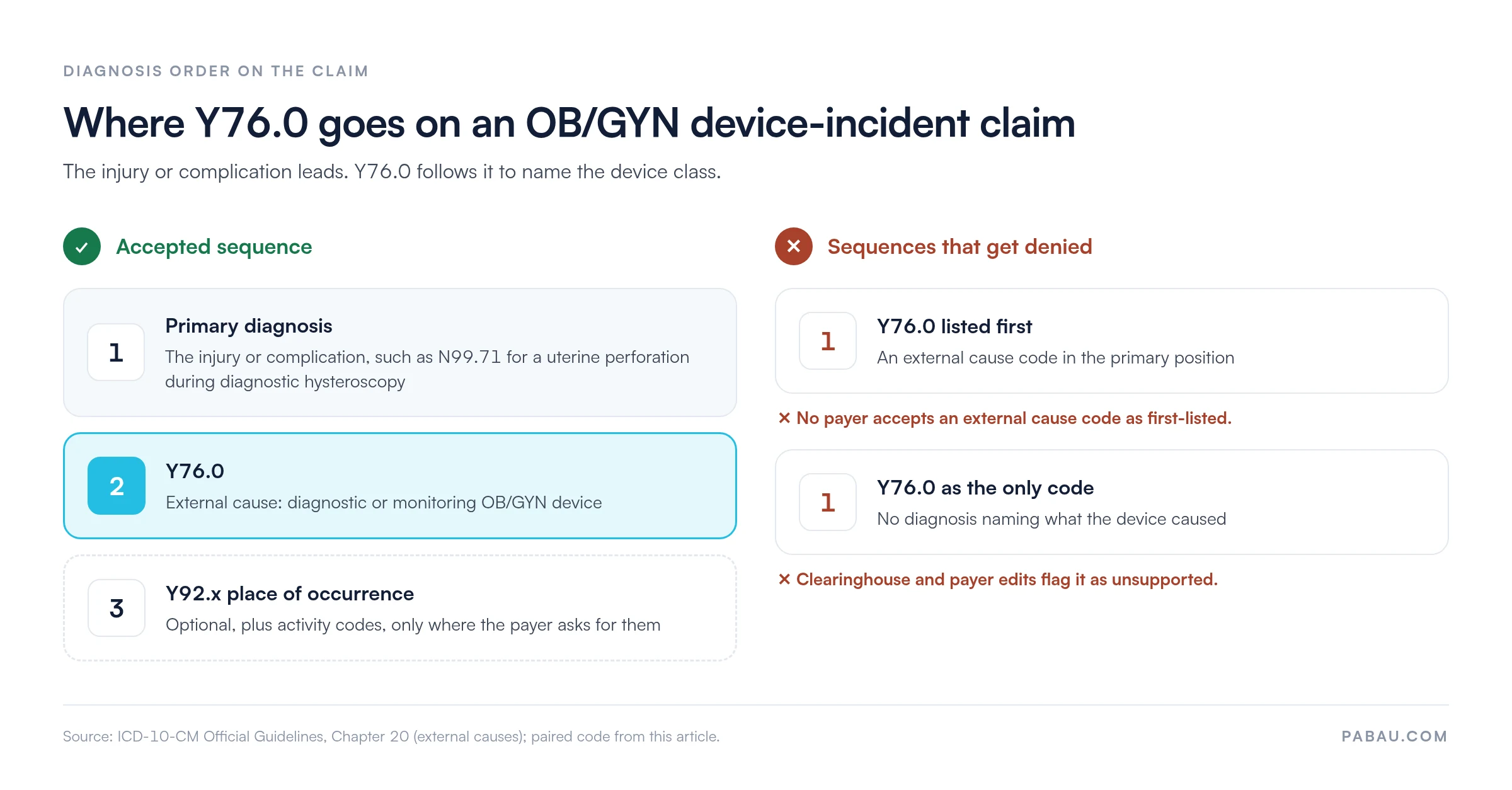
Diagram of diagnosis order for ICD-10 code Y76.0
Both denied patterns fail for the same reason: no code on the claim names the injury the device caused. Sequence per the ICD-10-CM Official Guidelines, Chapter 20.

Clinical scenarios where Y76.0 applies

Each scenario turns on one question. What was the device doing when the harm happened? The procedure note answers it, and the answer decides between Y76.0 and a sibling code.

  • Uterine perforation during diagnostic hysteroscopy: List N99.71 first, then Y76.0, because the scope was only visualizing the uterine cavity.
  • The same perforation during a hysteroscopic polypectomy: N99.71 still leads. The scope was removing tissue, so Y76.3 replaces Y76.0.
  • IUD complication found on a transvaginal ultrasound: The probe found the problem but did not cause it. Code the IUD complication from subcategory T83.3 and add Y76.1.
  • Fetal monitor fault with no harm to the patient: Y76.0 needs a resulting condition to follow. A fault that injured no one goes into an incident report, and no diagnosis code is assigned.

The procedure code on the same claim often hints at the device class. A colposcopy billed under 57452 or a transvaginal scan billed under 76830 points to a diagnostic device, but the note still has to confirm it.

Documentation requirements for Y76.0 claims

The medical record must tie the specific diagnostic device to the adverse incident. Without that connection, Y76.0 lacks clinical support, and the claim is open to audit and denial. Structured note templates help OB/GYN practices capture the same elements every time.

Required documentation elements

  • Physician narrative linking device to incident: The clinician’s note must name the specific device and explicitly connect its use to the adverse event. Vague language such as “device issue” is not enough.
  • Device identification: Name, model, and (where applicable) lot or serial number of the diagnostic device involved.
  • Procedure performed: The clinical procedure or examination during which the incident occurred, including the date.
  • Nature of the adverse incident: Whether the event involved device malfunction, breakage, misuse, or a complication arising from device use.
  • Resulting condition: The injury, complication, or unintended outcome that forms the basis of the primary diagnosis code. Y76.0 supplements this code.
  • FDA MAUDE cross-reference (where applicable): If a mandatory MAUDE report was or will be filed, note the report number or filing intent in the record. It shows regulatory awareness and supports the clinical narrative.

Most payers expect these same elements. Some commercial insurers add requirements, such as a signed incident disclosure or a root-cause note. CMS publishes no Local Coverage Determination (LCD) specific to Y76.0. Medicare claims follow the general external cause rules in Chapter 20 of the ICD-10-CM Official Guidelines.

Payer requirements and common claim denial reasons for Y76.0

No CMS National Coverage Determination (NCD) or LCD makes Y76.0 a prior authorization trigger on its own. The primary diagnosis code may carry authorization rules, depending on the payer. Check the primary code for those rules, because Y76.0 adds no requirement of its own.

Top denial reasons for Y76.0 claims

Denials on Y76.0 claims usually trace back to one of the six errors below. The reason on the remittance comes from the standard medical billing denial codes, and it points you to the pattern. Denial management for an external cause code follows the usual steps: correct the sequence, attach the documentation and resubmit.

  • Y76.0 submitted as first-listed code. No payer accepts an external cause code in the primary position. Resequence with the primary diagnosis first and Y76.0 as a secondary code.
  • Wrong Y76.x subcode selected. A therapeutic device incident coded as Y76.0 (diagnostic) rather than Y76.1 (therapeutic) causes a coding mismatch. The device type in the record must match the subcode billed.
  • Missing device identification in documentation. If the record names no specific device, the clinical linkage required to support Y76.0 does not exist. Amend the record before appeal.
  • No causal narrative between device and adverse event. The coder cannot create a link the physician did not document. Query the treating clinician before coding if the connection is not explicit.
  • Expired or invalid code year. A code that was not valid on the date of service can trigger a rejection. Check it against the coding year of the date of service, not the submission date.
  • Claim carries Y76.0 without any other diagnosis code. Some clearinghouses and payer edits flag single-code claims when that code is an external cause type. Always pair Y76.0 with its required primary diagnosis.

How claims management software prevents Y76.0 denials

Most Y76.0 denials start with a manual step. A coder reads the visit note days later and keys the diagnosis codes by hand, sometimes in the wrong order.

Pabau, the practice management platform we build, keeps the clinical note, the patient record and the claim in one system. Its claims management software opens each claim pre-filled from the invoice, so the injury code and Y76.0 travel together.

Claim validation scrubs every claim for missing or invalid details before it leaves Pabau, so each fix takes seconds. US claims then route through Claim.MD to thousands of payers, with insurance eligibility checked before the visit.
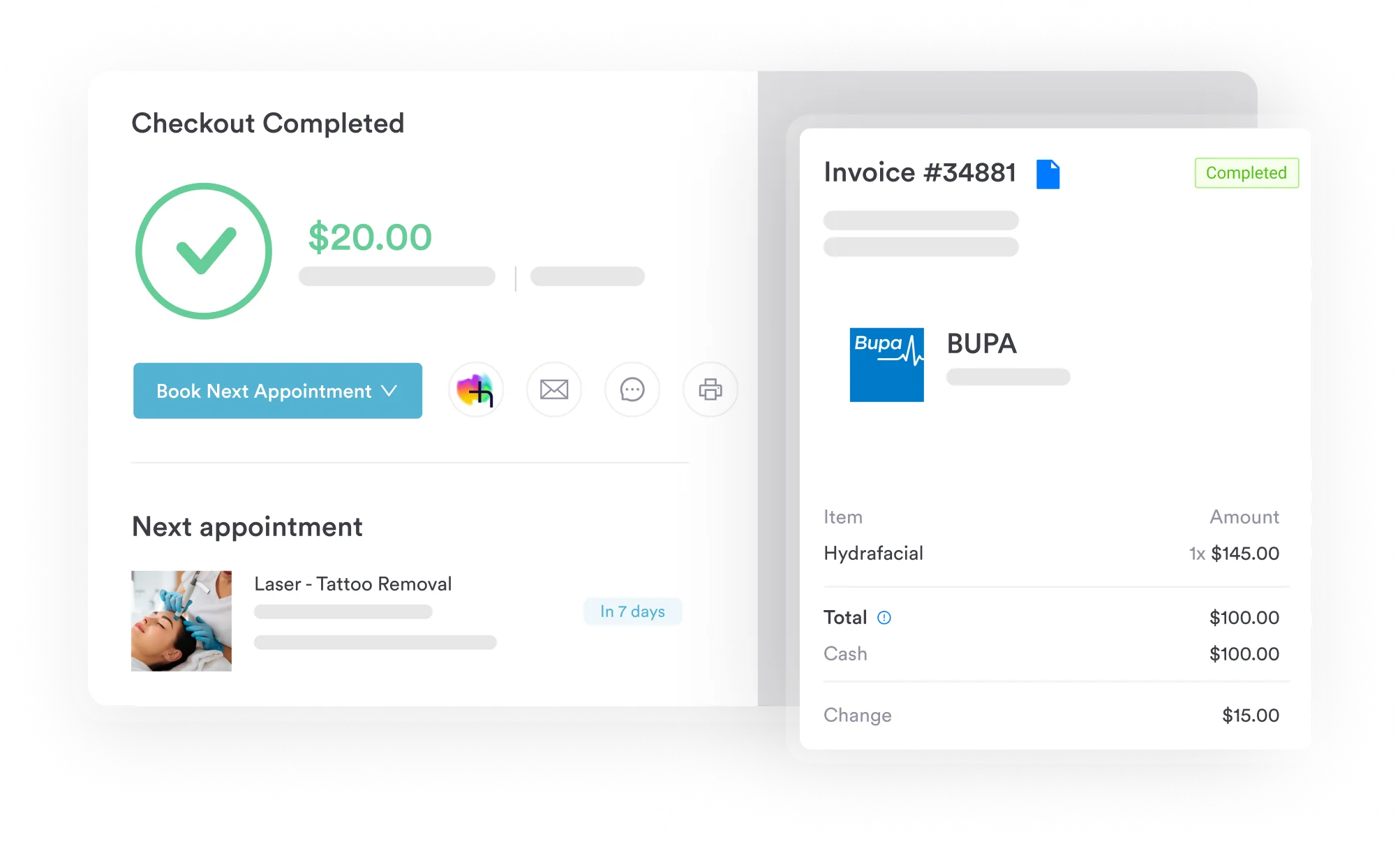
Pabau checkout screen next to a completed invoice billed to an insurer
Pabau’s insurance invoicing ties each completed invoice to the patient’s insurer, so a Y76.0 claim bills from the same record as the colposcopy or scan.

Get OB/GYN device-incident claims right the first time

Pabau keeps OB/GYN notes, invoices and claims in one record, validates each claim before submission and sends it through Claim.MD. See how it supports accurate coding from note to claim.

Pabau claims management dashboard

Conclusion

Build every Y76.0 claim from the clinician’s note. When the clinician names the device and ties it to the injury, the subcode and the claim order follow from the chart.

The trade-off is a query on every vague note, such as “probe issue” or “monitor problem.” It delays the claim by a day, but it costs less than a denial and an appeal.

Book a demo to see how Pabau keeps OB/GYN notes and claims in one record, so Y76.0 leaves the practice in the right position.

Continue your research

Continue your research

Need to understand how claims reach payers after coding? Medical claims clearinghouse guide covers how clearinghouses validate, route and confirm electronic claims.

Looking up the injury code that goes before Y76.0? ICD-10-CM code index lists the diagnosis codes in our code library by chapter.

Want fewer claims coming back at all? What a clean claim is lists the checks a claim needs to pass on first submission.

Training a new coder on external cause codes? Medical coding cheat sheet puts the core coding conventions on one printable page.

Want to see where coding fits in the billing cycle? Revenue cycle management overview explains how coding, submission and payment fit together.

Frequently asked questions

What does ICD-10 Code Y76.0 mean?

ICD-10 Code Y76.0 is the external cause code for adverse incidents involving diagnostic and monitoring obstetric and gynecological devices. Examples include colposcopes, fetal monitors and diagnostic ultrasound probes.

Is Y76.0 a billable ICD-10-CM code?

Yes. Y76.0 is billable and valid for the 2026 and 2027 coding years. It always follows the code for the resulting injury or complication.

Can Y76.0 be the primary diagnosis?

No. The ICD-10-CM Official Guidelines never allow an external cause code in the first-listed position. List the injury or complication first, then add Y76.0.

What is the difference between Y76.0 and Y76.3?

Y76.0 covers devices used to examine or monitor, while Y76.3 covers surgical instruments. A hysteroscope used only to look is Y76.0, and the same scope used for ablation is Y76.3.

Does coding Y76.0 report the incident to the FDA?

No. The code records the incident on the claim only. User facilities have a separate duty to report device-related deaths and serious injuries under FDA Medical Device Reporting rules.
Avatar photo
Anja Dodevska
Content Writer

Anja Dodevska writes about healthcare, dermatology, and the day-to-day realities of running a medical practice for Pabau. She enjoys breaking down complex topics into clear, accessible content and has a soft spot for the often-overlooked aspects of clinic life. When she's not writing, she's exploring cafes, walking her dog, or spending time with friends and family.
×