ICD-10 Code T63.591D: Toxic effect of other venomous fish
ICD-10 Code T63.591D: Quick reference ICD-10 Code T63.591D reports the toxic eff...

Last Updated: Oct 23, 2026
Billable Code Specific Code
W61.43XA is the billable ICD-10-CM code for pecked by turkey, initial encounter.
Coders report it at the visit where a turkey’s beak injury gets active treatment, such as cleaning a puncture wound. It always follows the injury code as the external cause. A wing or body blow from the same bird is W61.42XA, so the chart must say “pecked.”
Let Pabau's smart automation suggest the right codes, reduce claim denials, and keep your practice compliant—effortlessly.
Automate repetitive tasks and focus on what matters most—your patients.
Reduce coding errors and ensure compliance with the latest regulations.
Clean claims, fewer denials, and faster reimbursements.
Powerful insights and reporting to help your practice thrive.
HIPAA compliant SOC 2 certified GDPR-compliant Trusted by 4,000+ clinics worldwide

W61.43XA codes being pecked by a turkey at the visit where active treatment is given. It explains how the injury happened, so it is never the first-listed diagnosis.
The turkey subcategory W61.4 has three codes: W61.42 struck, W61.43 pecked and W61.49 other contact. ICD-10-CM has no “bitten by turkey” code.
A peck usually leaves a puncture or small laceration. The injury code that leads the claim is most often an open wound code by body site.
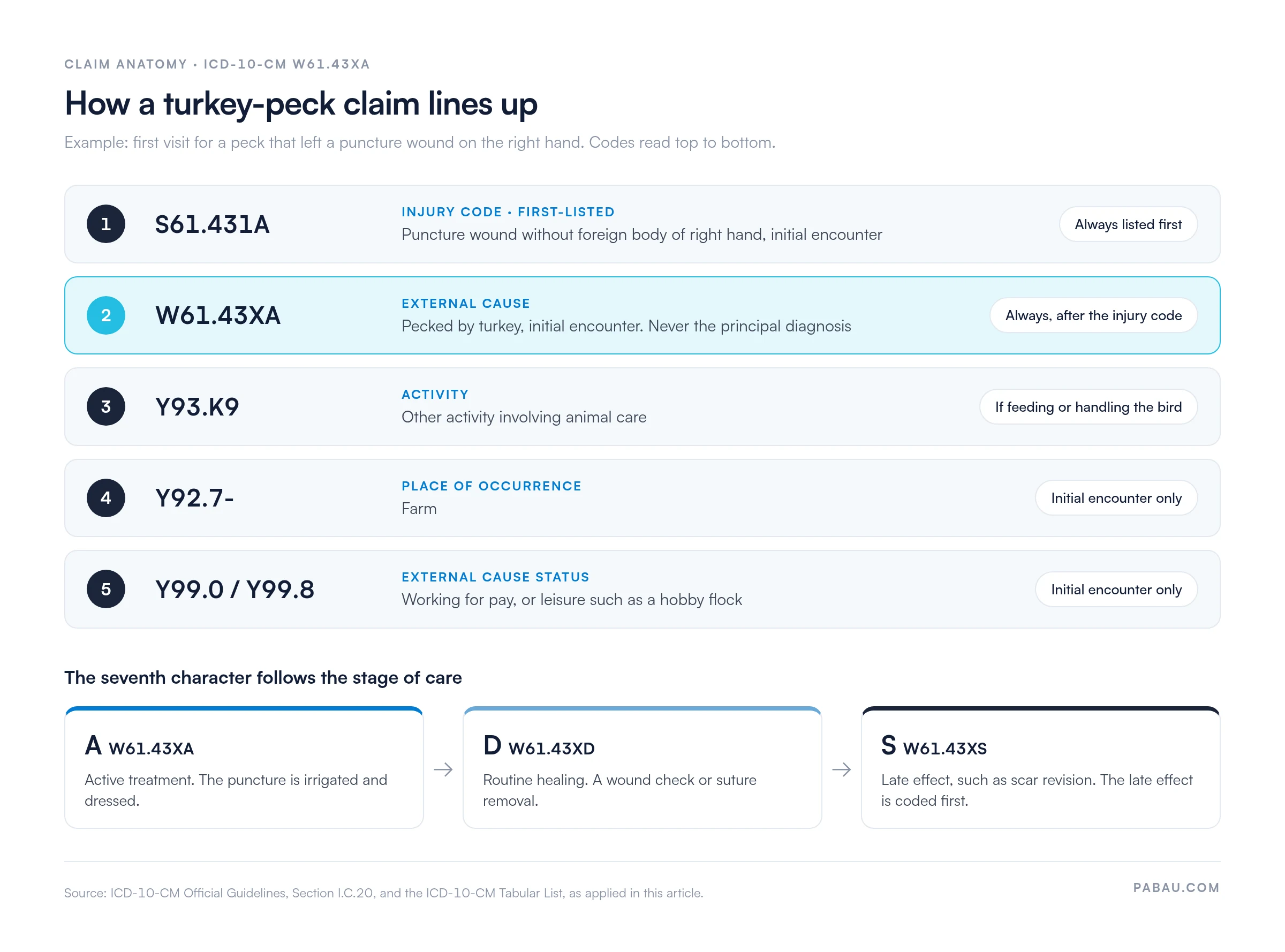
The 7th character A covers active treatment. Use W61.43XD for routine healing visits and W61.43XS for late effects such as a scar.
Pabau, the practice software we build, keeps the wound code, W61.43XA and any Y-codes on one claim. The payer receives the full code set together.
ICD-10 code W61.43XA is the billable ICD-10-CM code for pecked by turkey, initial encounter. It records that a turkey’s beak caused the injury. A separate injury code describes the wound itself and is listed first.
The code belongs to Chapter 20 of ICD-10-CM, External causes of morbidity (V00–Y99), in the W50–W64 block for exposure to animate mechanical forces. Under the CMS ICD-10-CM coding guidelines, an external cause code never serves as the principal diagnosis.
W61 is a three-character category. The subcategory digits 4 and 3 add the bird and the mechanism, which gives W61.43. A placeholder X fills the sixth position, and the seventh character A completes the code at seven characters.
Dropping the placeholder turns the code into W61.43A, which has only six characters and is invalid. Most clearinghouse edits reject it before the payer ever sees the claim.
Count the characters before you submit. W61.43XA has exactly seven. A shorter string means the placeholder X is missing.
Category W61 splits into subcategories by bird, and each subcategory splits by mechanism. The turkey subcategory W61.4 holds exactly three codes.
ICD-10-CM has no “bitten by turkey” code. Parrots, macaws, geese and ducks do have bite codes, which is why coders sometimes expect one here. An injury from a turkey’s beak is coded as a peck. A wing or body blow belongs under W61.42XA instead.
The seventh character tells the payer which stage of care the visit covers. The CDC/NCHS ICD-10-CM browser tool lists three valid values for W61.43: A, D and S.
A frequent error is carrying W61.43XA onto a follow-up visit. Once care moves to monitoring or a dressing change, switch to W61.43XD. On a sequela claim, the late effect is coded first and W61.43XS follows it.
W61.43XA documents the beak as the cause of injury. Turkeys peck at hands while being fed, at legs during handling, and occasionally at the face when a person bends down to the bird. These visits most often involve puncture wounds, small lacerations or abrasions.
The Tabular List carries no Excludes1 or Excludes2 note specific to W61.43. The chapter-wide rule still applies: an external cause code is never the principal diagnosis. If the note doesn’t say how the turkey caused the injury, query the provider before falling back on W61.49XA.
The W61 category holds closely related codes that differ by bird and by mechanism. The table below lists the codes most often picked in place of W61.43XA.
The injury code and the W61.4- code should tell the same story, because an auditor reads both. A peck tends to break the skin, so it usually pairs with an open wound code. A strike tends to leave a bruise or an abrasion.
Section I.C.20 of the ICD-10-CM Official Guidelines for Coding and Reporting governs external cause codes. The steps below apply it to a turkey-peck visit.
Ask providers to write the verb. ‘Pecked on the right hand by a domestic turkey’ supports W61.43XA on its own. ‘Turkey injury’ or ‘bird attack’ sends a query back and holds the claim.
Put together, those steps produce the claim below for a first visit with a pecked right hand.
A peck visit often involves more than wound care, because broken skin raises infection and tetanus questions. Each service or complication the provider documents needs its own code.
Code an infection only when the provider documents it. Concern about a possible infection does not support an L03.- code on its own.
The clinical note must support W61.43XA at audit. Per CDC/NCHS ICD-10-CM guidelines, documentation for an external cause code has to establish the mechanism and the setting of the injury.
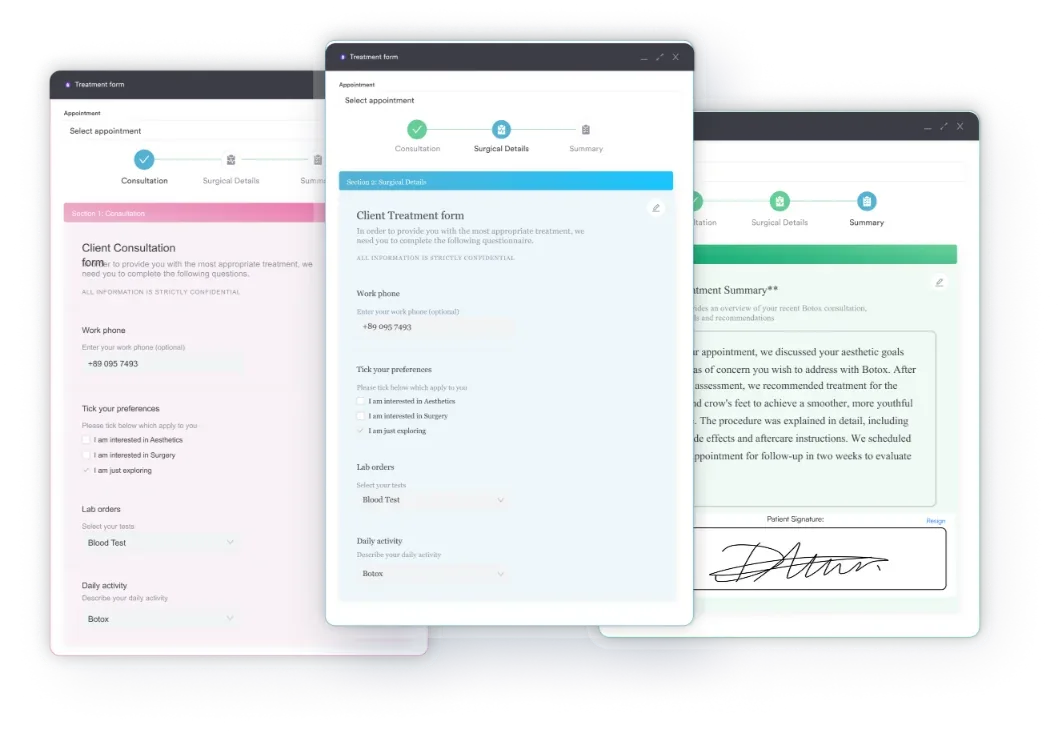
Capturing these details at the point of care avoids a provider query days later. A structured intake form with a mechanism-of-injury field does that job. Good medical billing compliance starts with that kind of note.
External cause codes in the W61 family generate a predictable set of denials. Each one can be caught before submission.
A denial management workflow that flags W-series codes for a pre-submission check catches most of these errors. A billers’ denial code guide explains how the codes in an 835 remittance file point to the root cause of each rejection.
ICD-9-CM had no code for turkey injuries or for pecking. The nearest legacy code is E906.8, “Other specified injury caused by animal,” and that mapping is approximate only. E906.3 is sometimes cited, but it means “Bite of other animal except arthropod,” which describes a bite rather than a peck.
Use the crosswalk only for legacy reconciliation or historical data analysis. Current claims always carry the ICD-10-CM code. The AAPC ICD-10-CM code reference is a useful cross-check for any mapping you rely on.
Without a check before submission, a dropped placeholder or a wound code in the wrong slot only surfaces when the denial arrives. The claim then needs a correction, a resubmission and another wait for payment.
Pabau’s claims software for coders holds the wound code, W61.43XA and any Y-codes on one claim while the encounter is still open. Claims then go out as electronic CMS-1500 claims through the Claim.MD clearinghouse integration, and remittance advice comes back into billing.
Intake forms and claims share one patient record, so the mechanism the provider writes is the one the coder reads. That keeps peck and strike codes from getting crossed.

Pabau keeps the injury code, the external cause code and any Y-codes on one claim, then submits it electronically through Claim.MD. See how it works for your practice.

W61.43XA rests on one word in the chart. “Pecked” points to this code, while “struck” points to W61.42XA, and a turkey bite code does not exist.
The rest is sequencing. The wound code leads, W61.43XA follows, and the seventh character moves from A to D once active treatment ends.
Practices that record species, mechanism and wound site at intake rarely see these claims come back. The clean claim guide covers what payers check on every submission. To see how Pabau handles external cause coding from intake to payment, book a demo.

Need to understand how external cause codes flow through billing? Revenue cycle management fundamentals explains how diagnosis codes connect to payment collection end to end.
Want a clearer picture of claim submission? Medical claims clearinghouse guide covers how claims move from the practice to the payer and where errors are caught.
Looking for the bigger billing picture? What is medical billing walks through where coding fits between the visit and the payment.
ICD-10 code W61.43XA is the billable ICD-10-CM external cause code for pecked by turkey, initial encounter. It applies at the visit where the patient receives active treatment. It is always reported after the injury code, never as the principal diagnosis.
Yes, W61.43XA is a billable and specific ICD-10-CM code. The X fills the sixth position so the seventh character A can follow, which makes the code complete. It still must follow an injury code on the claim.
W61.43XA is pecked by turkey, and W61.42XA is struck by turkey. A peck is contact from the beak, while a strike is a blow from the wing or body. The clinical note decides which code applies.
No. Subcategory W61.4 has only three codes: W61.42 struck, W61.43 pecked and W61.49 other contact with turkey. An injury from a turkey’s beak is coded as a peck with W61.43-.
Use W61.43XA while the patient receives active treatment for the peck injury. Switch to W61.43XD for routine follow-up visits during healing, such as a wound check. Use W61.43XS for late effects after healing.
The first-listed code is the injury itself, chosen from the S00–T88 range by wound type and body site. A peck usually breaks the skin. S61.431A, a puncture wound without foreign body of the right hand, is a typical example.
W61.43XA has one placeholder X, in the sixth position. W61 is three characters, the subcategory digits 4 and 3 bring it to five, and the seventh character A completes it. Leaving out the X produces an invalid code.