

ICD-10 code S61.201A: Open wound of left index finger without nail damage
ICD-10 code S61.201A covers a left index finger wound of unstated type ICD-10 co...

Last Updated: Oct 16, 2026
Billable Code Specific Code
W61.42XA is the billable ICD-10-CM code for struck by turkey, initial encounter.
Coders use it when a patient receives active treatment for an injury from a turkey’s wing or body. It is reported after the injury code as the external cause, never as the first-listed diagnosis. A peck from the same bird is coded W61.43XA instead, so the note must name the mechanism as well as the species.
Let Pabau's smart automation suggest the right codes, reduce claim denials, and keep your practice compliant—effortlessly.
Automate repetitive tasks and focus on what matters most—your patients.
Reduce coding errors and ensure compliance with the latest regulations.
Clean claims, fewer denials, and faster reimbursements.
Powerful insights and reporting to help your practice thrive.
HIPAA compliant SOC 2 certified GDPR-compliant Trusted by 4,000+ clinics worldwide

W61.42XA codes being struck by a turkey at the visit where active treatment is given. It names the cause of the injury, so it never stands as the first-listed diagnosis.
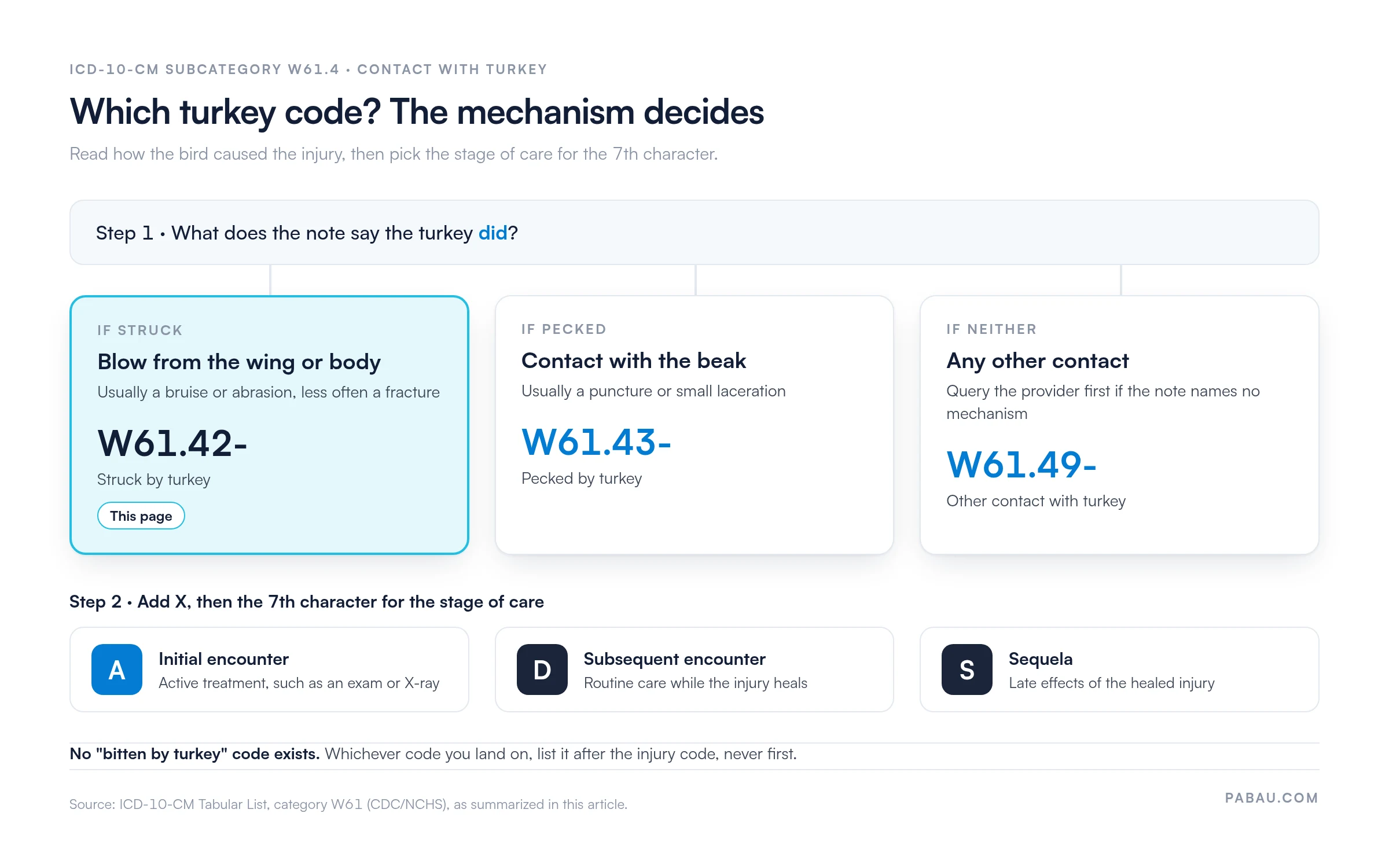
The turkey subcategory sorts by mechanism: W61.42 for a strike, W61.43 for a peck and W61.49 for any other contact. There is no “bitten by turkey” code.
The 7th character A marks active treatment. Switch to D for routine care while the injury heals, and to S for late effects.
Most denials trace back to sequencing or specificity: W61.42XA listed first, no injury code on the claim, or a peck documented but a strike coded.
In Pabau, the practice software we build, the injury code, W61.42XA and the companion Y-codes sit on one claim. The full code set reaches the payer at once.
W61.42XA is a valid, billable ICD-10-CM code for being struck by a turkey, initial encounter. It reports how an injury happened, so it travels with a separate code for the injury itself. It sits in Chapter 20 of ICD-10-CM, External causes of morbidity (V00 to Y99).
Under the CMS ICD-10-CM coding guidelines, an external cause code is never the principal or first-listed diagnosis. There is no national mandate to report these codes. They are required where a state reporting rule or a payer policy asks for them, and many practices report them anyway for complete injury data.
Each character of W61.42XA carries a specific meaning. Reading the code this way helps coders land on the right sibling when the bird or the mechanism changes.
W61.42 has only five characters, so the placeholder X is needed before the 7th character. Without it, the code is invalid for submission. Coders who transcribe from a superbill or a manual lookup often drop it.
Category W61 covers contact with birds, both domestic and wild, and splits into subcategories by species. W61.4 is the turkey subcategory, and its codes are sorted by mechanism. Knowing the layout stops coders from settling on the residual code when the note already names the mechanism.
The turkey subcategory has no “bitten” code, and there is no W61.41. The parrot and macaw subcategories do have one (W61.01 and W61.11), which is why coders sometimes expect it here. A turkey injury from the beak is coded as a peck, W61.43XA.
The 7th character tells the payer which stage of care the visit belongs to. A wrong qualifier is one of the most frequent reasons external cause codes are rejected. The CDC/NCHS ICD-10-CM browser tool lists three valid 7th characters for W61.42: A, D and S.
A common error is keeping W61.42XA on follow-up visits where no new active treatment occurs. Once care moves to monitoring, a wound check or a dressing change, switch to W61.42XD.
The turkey codes cover a narrower set of events than many coders assume. Knowing the boundaries prevents two errors. One is under-coding with W61.49XA when a strike is documented. The other is using W61.42XA for a peck that belongs under W61.43XA.
If the note does not say how the turkey caused the injury, query the provider before you fall back on W61.49XA. W61.42XA never appears as the first-listed diagnosis on any claim.
The W61 category holds closely related codes that differ by bird and by mechanism. Picking the wrong sibling is a common specificity error. The table below covers the codes most often mistaken for W61.42XA.
The strike versus peck split matters for the claim and for the chart. A strike is a blow from the bird’s wing or body and tends to leave a bruise, an abrasion or, less often, a fracture. A peck is beak contact and tends to leave a puncture or small laceration. The injury code and the W61.4- code should tell the same story, because an auditor reads both. The diagram below maps each mechanism to its code and 7th character.
Section I.C.20 of the ICD-10-CM Official Guidelines for Coding and Reporting governs external cause codes. The steps below apply it to a turkey-strike visit. The AAPC ICD-10-CM code reference is a useful cross-check before submission.
Name the bird and the mechanism in the clinical note. ‘Struck on the left forearm by the wing of a domestic turkey’ gives the coder enough to select W61.42XA with confidence. ‘Bird contact’ or ‘attacked by turkey’ sends a query back to the provider and holds the claim.
A complete code set for a turkey-strike visit starts with the injury code and W61.42XA. Activity, place and status codes follow where a payer or state rule asks for them. An infection or other complication needs its own code as well.
A zoonotic infection needs its own code only when the provider confirms it and documents it. General concern about animal contact does not support an A28.- code. For electronic submission, Pabau’s Claim.MD clearinghouse integration sends complete ICD-10-CM code sets to thousands of US payers.
The clinical note must give the coder enough to select W61.42XA and to defend it in a payer audit. A vague note pushes the coder toward W61.49XA (other contact with turkey), which is less specific and invites a query.
Practices that use a structured template for animal-contact injuries capture all six elements every time. An animal injury intake form records the species, mechanism and body site before the coder opens the record. That removes the provider query that can hold a claim for days. The clean claim guide covers what payers expect across ICD-10-CM encounters.
Denials on W61.42XA claims usually trace back to one of six errors, and each one can be caught before submission. The denial management guide covers CARC reason codes and how to appeal efficiently.
Without a system check, a coder learns about a missing injury code or a wrong 7th character only when the denial arrives. The claim then needs a correction, a resubmission and another wait for payment.
Pabau holds the injury code, W61.42XA and the companion Y-codes on one claim. Its claims management software lets your team review the full code set while the encounter is still open. Coders can fix sequencing before the claim leaves the practice.
Intake forms and claims sit in the same record, so the mechanism the provider documents is the one the coder sees. That keeps strike and peck codes from getting crossed.

Pabau keeps ICD-10-CM external cause codes next to the injury code in the patient record. Every claim leaves with the complete code set payers expect.

W61.42XA is precise, but only when the chart backs it up. The code turns on two facts, the bird and the mechanism. A note that says “struck by a turkey” supports it, while one that says “pecked” belongs under W61.43XA.
Sequencing is the other half. The injury code goes first, W61.42XA follows, and the 7th character moves from A to D once active treatment ends.
Practices that capture species and mechanism at intake avoid the six denial triggers above. The medical billing guide shows where coding fits in the revenue cycle. To see how Pabau handles external cause coding from intake to submission, book a demo.

Need to understand how denial codes work after a W61.42XA rejection? Denial codes in medical billing explains CARC and RARC reason codes and the steps to resolve them.
Want a clearer picture of the claim submission process end to end? Medical claims clearinghouse guide covers how claims move from the practice to the payer and where errors are caught.
Looking for guidance on ICD-10-CM documentation best practices? Medical billing compliance outlines the documentation standards payers audit against.
ICD-10 Code W61.42XA is the billable ICD-10-CM external cause code for being struck by a turkey, initial encounter. It applies at the visit where active treatment is given. It sits in Chapter 20 (External causes of morbidity) and is always reported after the injury code, never as the primary diagnosis.
Yes, W61.42XA is a billable ICD-10-CM code. The X fills the 6th position so the 7th character A can be added, which makes the code complete for claim submission. It still cannot be the first-listed or principal diagnosis, so it must follow an injury code.
The X is a placeholder and the A means initial encounter, the stage when the patient receives active treatment. Once active treatment ends and the patient is in routine healing care, the 7th character changes to D (subsequent encounter). If late effects develop after healing, it becomes S (sequela).
W61.42XA is struck by turkey, and W61.43XA is pecked by turkey. A strike is a blow from the bird’s wing or body, while a peck is contact with the beak. The clinical note decides which one applies, so it should name the mechanism in plain words.
The usual causes are W61.42XA submitted as the primary diagnosis, or XA billed on a follow-up visit that needs XD. A missing injury code also triggers denials. So does a mechanism mismatch, such as a documented peck coded as a strike. Each one is fixed with a corrected claim.
W61.42XA belongs to category W61 (contact with birds, domestic and wild), inside the W50 to W64 block for exposure to animate mechanical forces. That block sits in Chapter 20, External causes of morbidity (V00 to Y99). These codes describe how an injury happened and always supplement an injury code.



