ICD-10 code S52.125Q: Nondisplaced radial head fracture with malunion
ICD-10 code S52.125Q: Full descriptor and official definition ICD-10 code S52.12...

Last Updated: Nov 2, 2026
Billable Code Specific Code
W50.3XXD is the billable ICD-10-CM code for accidental bite by another person, subsequent encounter. It records an unintentional human bite at a follow-up visit, once active treatment of the bite wound is complete.
The code is valid for FY 2027 and always follows the bite injury code, such as an open bite of the hand. An intentional bite is coded Y04.1, assault by human bite, instead.
Let Pabau's smart automation suggest the right codes, reduce claim denials, and keep your practice compliant—effortlessly.
Automate repetitive tasks and focus on what matters most—your patients.
Reduce coding errors and ensure compliance with the latest regulations.
Clean claims, fewer denials, and faster reimbursements.
Powerful insights and reporting to help your practice thrive.
HIPAA compliant SOC 2 certified GDPR-compliant Trusted by 4,000+ clinics worldwide

W50.3XXD is the billable ICD-10-CM code for an accidental human bite at a subsequent encounter, and it is valid for FY 2027 claims.
The 7th character D means active treatment of the bite wound is complete and the visit is routine healing-phase care, such as a wound check.
W50.3XXD is never first-listed, so the bite injury code leads, such as S61.451D for an open bite of the right hand.
An intentional bite is coded Y04.1, assault by human bite, and the W50 Excludes1 note bars reporting it alongside W50.3XXD.
Pabau, our practice management platform, turns follow-up invoices into electronic CMS-1500 claims through its Claim.MD integration and tracks each one to payment or denial.
ICD-10 Code W50.3XXD records an accidental bite by another person at a follow-up visit, after active treatment of the bite wound has ended.
It sits in category W50, which covers injuries another person causes without intent to harm. The code is valid for FY 2027 claims and needs no further characters.
W50.3XXD is a seven-character code, and each segment carries a specific meaning. Reading it character by character prevents the most common sequencing and 7th-character mistakes.
The placeholder X characters in positions 5 and 6 are mandatory. ICD-10-CM uses X as a placeholder whenever a code needs a 7th character but has fewer than six characters before it. W50.3D without the XX placeholders is an invalid code, and the clearinghouse will reject it.
The 7th character D means the patient has completed active treatment for the bite and is now receiving routine care while it heals. It does not mean the bite was minor or has fully healed.
Section I.C.19.a of the ICD-10-CM guidelines defines D as care during the healing or recovery phase. For a human bite, that usually means a wound check, a dressing change, suture removal or a review of a completed antibiotic course. The phase of care decides the character, not the provider, so a primary care wound check after an emergency department visit still takes D.
W50.3XXA covers each encounter where the bite is under active treatment. W50.3XXD covers follow-up care once that treatment is complete. W50.3XXS covers a late effect of the bite, such as a scar or a stiff finger, after the wound itself has healed. The diagram below maps common bite visits to each character.
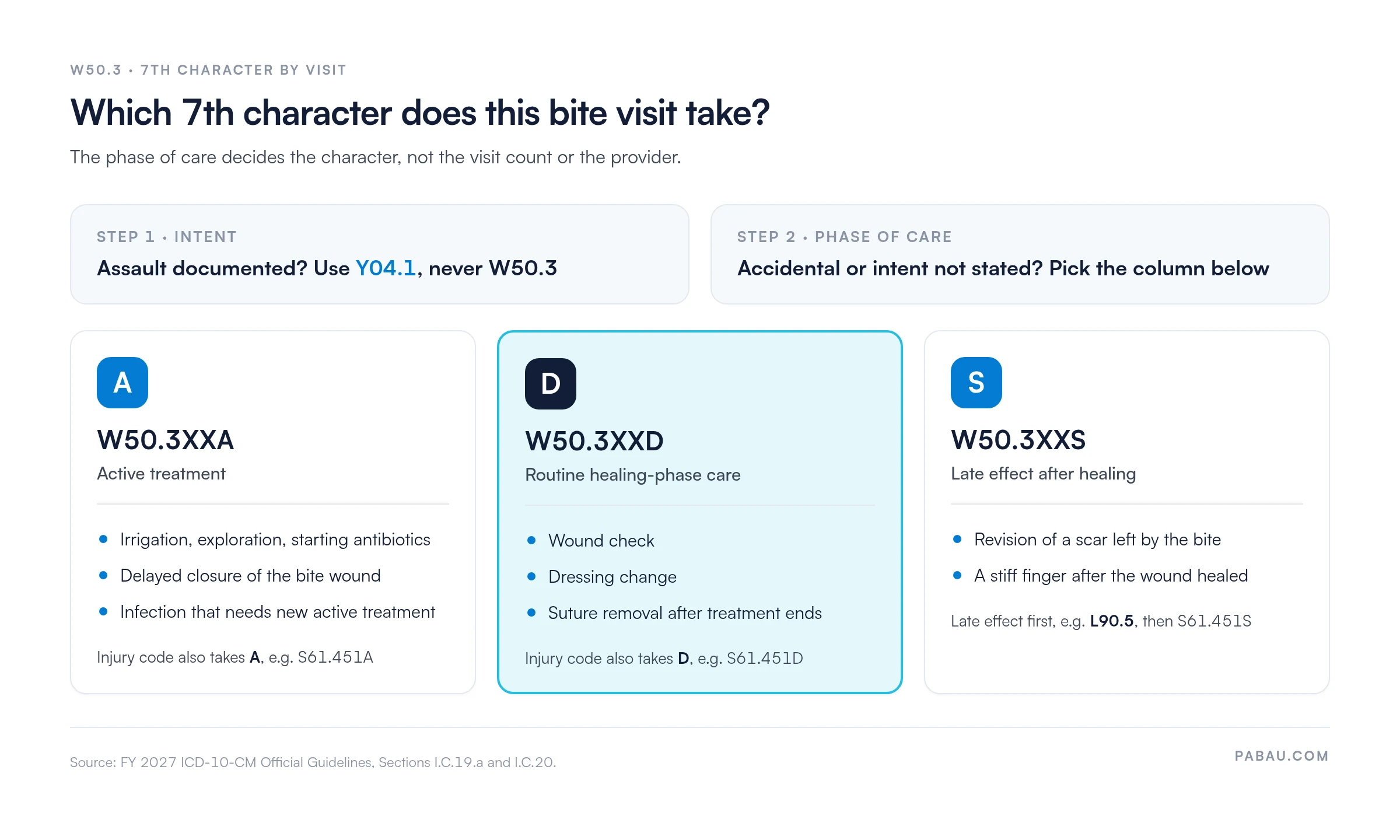
The most common error is reading “initial” as “first appointment.” The guideline ties it to the phase of treatment, not the visit count. Two providers can both report an A encounter in the first days after a bite. Each one simply has to deliver active treatment.
Sequela coding with W50.3XXS needs the late-effect condition sequenced first, such as L90.5 for a scar. The injury code then follows with an S character, such as S61.451S for an open bite of the right hand. W50.3XXS closes the set as the external cause.
Human bites carry a high infection risk because the human mouth holds a dense mix of bacteria. Bites to the hand worry clinicians most, since tendons and joints sit close to the skin. That is why so many bite patients return within days, and why W50.3XXD is a common code on those return visits.
A typical follow-up checks the wound for redness, swelling or discharge, confirms the antibiotic course was finished and changes the dressing. Wound checks, dressing changes and suture removal after treatment is complete all take D.
Some practices close a bite wound late, once the infection risk has passed. Delayed closure is a procedure, so that visit still counts as active treatment. Code it W50.3XXA, with the A character on the injury code too, such as S61.451A.
The same logic applies when a bite becomes infected after treatment ended. If the infection needs new active treatment, such as incision and drainage or IV antibiotics, the codes move back to the A character. Section I.C.19.a assigns A to each encounter with active treatment, not only the first one. Return to D once the visits are routine healing-phase care again.
A cut over the knuckles from contact with another person’s teeth is often called a fight bite. That history raises questions about who did what and why. Query the provider on mechanism and intent before you settle on W50.3 rather than assuming the bite was accidental.
Correct use of ICD-10 Code W50.3XXD depends on three facts: a human bite, an accidental mechanism and a healing-phase visit. These scenarios show the common right and wrong applications.
A child was bitten on the right hand by a sibling during rough play, and the record documents it as accidental. Urgent care irrigated the open bite and started antibiotics three days ago. Today’s pediatric visit checks a healing wound with no sign of infection. Correct codes: S61.451D (open bite of right hand, subsequent encounter) + W50.3XXD.
A care worker is bitten on the forearm by a confused resident, and the record states the bite was unintentional. She is seen the same day, and the open bite is cleaned and dressed. That is active treatment, so W50.3XXD is wrong. The correct pair is S51.851A or S51.852A, open bite of the right or left forearm, with W50.3XXA.
Eight months after an accidental hand bite healed, a patient returns for revision of a tight scar. The visit treats a late effect, not the bite in its healing phase. Code L90.5 first, then S61.451S and W50.3XXS.
A patient returns for a wound check on a bite inflicted during an assault. W50.3XXD does not apply, because the W50 category covers accidental injuries only. The ICD-10-CM external cause index sends a bite “with intent to injure or kill” to Y04.1, assault by human bite. Here that means Y04.1XXD alongside the bite injury code.
Unknown intent: When the record does not state intent, Section I.C.20.h tells you to code it as accidental. A documented assault always overrides that default. You can check each descriptor in the CDC/NCHS ICD-10-CM browser tool.
W50.3XXD is an external cause code, so it cannot be the first-listed or only diagnosis on a claim. The Chapter 20 guideline says external cause codes are never sequenced first. The bite injury code leads, and W50.3XXD explains how it happened.
Practices using claims management software can see the full diagnosis order on the claim before it goes out. That makes a missing injury code or a mismatched 7th character easier to spot before it turns into a denial.
The sequencing workflow for a W50.3XXD claim:
Choose between open and superficial bite codes from the wound description. “Bite of hand NOS” indexes to the open bite code S61.45-, and an Excludes1 note keeps superficial bite codes off the same claim. A bite to the left hand takes S61.452D at the same follow-up visit. The cellulitis pairings fit a healing-phase visit, and an infection that needs new active treatment moves the set to A.
The W50 category carries an Excludes1 note for assault by bodily force (Y04) and for being struck by objects (W20-W22). An Excludes1 note means the two can never be reported together. If documentation supports an intentional bite, W50 codes drop out entirely.
W50 carries no “code first” note of its own. The sequencing rules below come from the FY 2027 ICD-10-CM Official Guidelines for Coding and Reporting.
Documentation must establish three facts before W50.3XXD can be reported. Another person bit the patient, the bite was accidental, and the visit is healing-phase care. A primary injury code must also support the external cause code.
Practices that submit claims through Pabau’s Claim.MD clearinghouse integration can run a real-time eligibility check before the follow-up visit. For a clean claim submission, the record should include each element below.
There is no national requirement to report external cause codes. Some state reporting mandates and individual payers do require them, so check plan policy before you submit without them.
Most W50.3XXD claim problems trace back to five errors. Each one has a straightforward fix.
Strong denial management workflows flag these patterns before they become write-offs. Tracking denial reasons at the code level shows whether a practice has a systemic 7th-character problem or an isolated documentation issue. To read the payer’s side, match the remittance reason against the denial codes in medical billing.
Audit W50.3XXD denials by sorting remittance advice by denial reason code. If most share the same CARC, the cause is systemic and calls for coder education. If the reasons vary, review documentation at the individual visit level.
Several codes are routinely confused with ICD-10 Code W50.3XXD. Some share the W50 category, and others cover intentional or animal bites.
For the full tabular hierarchy, use the CDC/NCHS ICD-10-CM browser tool. The FY 2027 ICD-10-CM Official Guidelines for Coding and Reporting cover the external cause sequencing rules quoted on this page.
Follow-up claims for bite wounds often get rekeyed into a separate clearinghouse portal after the visit. Someone checks the diagnosis order and the 7th characters by hand, and a denial surfaces weeks later in a remittance file.
Pabau’s Claim.MD integration keeps that work inside the practice software. The invoice for the wound check becomes an electronic CMS-1500 claim, and a real-time eligibility check (270/271) confirms coverage before the patient arrives. Claim status and ERA remittances then come back into Pabau.
The biller sees an accepted, paid or denied claim next to the visit it came from. A wrong character or a missing injury code can be corrected and resubmitted the same day.

Pabau’s Claim.MD integration turns follow-up visit invoices into electronic CMS-1500 claims. Claim status and ERA remittances come back into Pabau, so denials get fixed fast.

W50.3XXD earns its place on a claim only when three facts line up. A person bit the patient, nobody meant it, and the bite is past active treatment. If any of the three is unclear in the note, query the provider before you code.
The trade-off is speed against rework. A quick A-or-D guess saves a minute at coding and costs a resubmission later. Practices that match the injury code, the external cause and the 7th character on every bite claim get paid on the first pass. Book a demo to see how Pabau turns follow-up visits into clean electronic claims.

Need guidance on handling claim rejections systematically? Medical billing fundamentals covers the end-to-end claim lifecycle, from code selection through remittance posting.
Want to understand how clearinghouses process ICD-10 external cause codes? Medical claims clearinghouse guide explains how 837P transactions carry diagnosis codes to payers and where external cause codes sit in the EDI structure.
Looking for remittance advice reason code definitions? Electronic remittance advice (ERA) explained maps the 835 transaction fields that carry CARC denial reasons back to specific coding errors.
ICD-10 Code W50.3XXD is the billable ICD-10-CM external cause code for an accidental bite by another person at a subsequent encounter. The patient is receiving follow-up care after active treatment of the bite has ended. The code records the mechanism and the phase of care, and a bite injury code is always listed before it.
Yes, W50.3XXD is a valid, billable ICD-10-CM code for FY 2027. It cannot be the only diagnosis on a claim, though. As an external cause code, it follows a bite injury code, such as S61.451D for an open bite of the right hand.
W50.3XXA applies to each visit where the bite is under active treatment, such as irrigation, exploration or starting antibiotics. W50.3XXD applies once that treatment is complete and the patient returns for a wound check or dressing change. The phase of treatment decides the character, not the visit count.
W50.3 has three valid 7th characters. A is the initial encounter, D the subsequent encounter and S the sequela. Each one needs the XX placeholders in positions 5 and 6, giving W50.3XXA, W50.3XXD and W50.3XXS.
Yes. The ICD-10-CM guidelines say external cause codes are never sequenced first, so a bite injury code must lead the claim. Examples include S61.451D for an open bite of the right hand and S01.551D for an open bite of the lip. Both codes carry the same D character.
Use S61.451D or S61.452D for an open bite of the right or left hand at a follow-up visit. A bite that did not break the skin takes a superficial bite code from S60.57- instead. If the wound is infected, also code the infection, such as L03.113 for cellulitis of the right upper limb.
No. W50.3XXD covers accidental bites only. An intentional bite is coded Y04.1, assault by human bite, which is Y04.1XXD at a follow-up visit. The W50 Excludes1 note for assault by bodily force (Y04) means the two codes never appear on the same claim.