ICD-10 Code Y76.0: Diagnostic obstetric and gynecological devices
ICD-10 Code Y76.0: Definition and billable status ICD-10 Code Y76.0 is a valid, ...

Last Updated: Oct 23, 2026
Billable Code Specific Code
W01.119D is the billable ICD-10-CM code for fall on same level from slipping, tripping and stumbling with subsequent striking against unspecified sharp object, subsequent encounter.
It sits in the W01.11 subcategory, which covers same-level falls that strike a sharp object, and applies when the record doesn't name that object. As an external cause code, it always follows the injury code it supports. W01.119A covers the initial encounter, and W01.10XD covers an object the record doesn't describe at all.
Let Pabau's smart automation suggest the right codes, reduce claim denials, and keep your practice compliant—effortlessly.
Automate repetitive tasks and focus on what matters most—your patients.
Reduce coding errors and ensure compliance with the latest regulations.
Clean claims, fewer denials, and faster reimbursements.
Powerful insights and reporting to help your practice thrive.
HIPAA compliant SOC 2 certified GDPR-compliant Trusted by 4,000+ clinics worldwide

ICD-10 Code W01.119D is a billable external cause code, not a principal diagnosis, so always sequence the injury code first.
The 7th character D means active treatment has ended and the patient is in routine follow-up care for the injury.
W01.119 covers an unspecified sharp object. An object the record doesn’t describe at all codes to W01.10XD, and mixing the two up is a common error.
Pabau’s claims management software flags external cause code pairing errors before a claim reaches the payer.
ICD-10 Code W01.119D is a valid, billable ICD-10-CM diagnosis code for the fiscal year in effect. Its full official descriptor is Fall on same level from slipping, tripping and stumbling with subsequent striking against unspecified sharp object, subsequent encounter.
Three details decide whether it is the right code:
Every character in W01.119D carries a specific clinical meaning, and misreading any segment leads to the wrong code. The table below breaks each component down, following the structure the ICD-10-CM code set uses across all external cause categories.
The critical distinction at the W01.11 level is that the whole subcategory covers sharp objects. When the documentation doesn’t say which sharp object the patient struck, coders assign W01.119.
A named object that isn’t sharp, such as furniture, moves the code to W01.19-. When the record doesn’t describe the object at all, W01.10XD applies.
A subsequent encounter, coded with 7th character D, means active treatment is complete. The patient is now receiving routine care while the injury heals.
Under ICD-10-CM Official Guidelines Section I.C.19.a, the choice between A, D, and S depends on the phase of care, not the visit count. A patient can attend a third appointment and still warrant 7th character A if active treatment is ongoing.
A note that says only “follow-up visit” doesn’t tell the coder whether active treatment has ended. Before assigning D, the record needs to state that healing is progressing routinely and no new interventions are planned. Without that language, query the provider, and treat A as the safer assignment until the answer comes back.
The W01.11 and W01.10 subcategories sit close together in the tabular list, and coders confuse them more often than almost any other W01 pair. The table below covers the codes most often mixed up with ICD-10 Code W01.119D.
The most common miscoding pair: coders assign W01.10XD (unspecified object) when W01.119D (unspecified sharp object) is correct. Both descriptors use the word “unspecified,” but at different levels of specificity. When the note says only that the patient “struck an object,” W01.10XD fits. When it says “hit a sharp edge” or “caught a sharp corner” without naming the object, W01.119D applies.
If the note names glass, the code moves to W01.110D. The guide below maps each kind of object wording to its code, then to its 7th character.
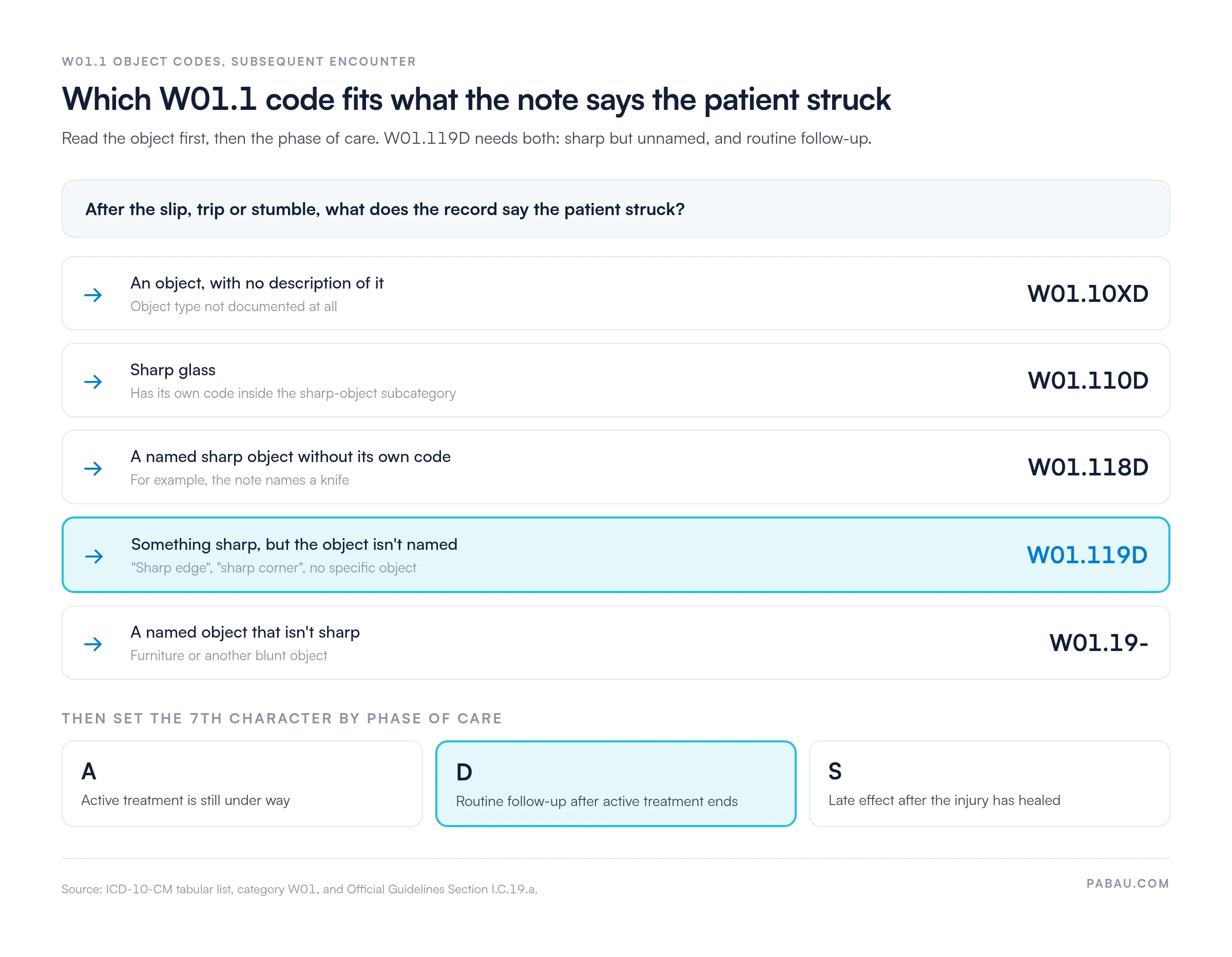
The W01 category includes falls on the same level caused by slipping, tripping, and stumbling. It excludes falls on ice or snow (W00) and falls caused by a collision with another person (W03). Falls from one level to another code to W10-W17 instead. Coders should confirm the mechanism of fall before assigning any W01 code.
To assign ICD-10 Code W01.119D accurately, the clinical record needs to capture four elements:
When any of these elements is absent from the documentation, coders should query the provider rather than assume. A query answered in the record protects the practice in an audit and heads off a denial for an incomplete external cause code.
ICD-10 Code W01.119D is never the principal diagnosis. Under ICD-10-CM Official Guidelines Section I.C.20, external cause codes are supplementary and are sequenced after the code for the injury itself.
Knowing which injury code pairs with it matters as much as the external cause code. Coders working with medical billing workflows should build this pairing into claim templates for fall-related encounters.
A patient slipped on a wet floor and cut their right palm on something sharp that the note doesn’t identify. The ED treated the laceration. That ED visit was the initial encounter. The patient now attends a wound check at a primary care practice, which is a subsequent encounter. The correct sequencing is:
If the record doesn’t specify the hand or the wound type, S61.409D is the unspecified option. A provider query usually earns a more specific code. The injury code drives payment. The external cause code adds context for epidemiology, public health reporting, and payer audit defense.
Some payers require the external cause code, and others accept it as supplemental data. Either way, never flip the order.
Medicare doesn’t require external cause codes for payment on most claims, and the Centers for Medicare and Medicaid Services (CMS) treat them as supplemental data.
Some state programs do require them, and many commercial payers use them to flag claims for medical necessity review or liability investigation. Check the specific payer’s policy before assuming the code is optional.
Common denial triggers on ICD-10 Code W01.119D claims include:
Before submitting a claim with W01.119D, confirm the injury code on the same claim carries the same 7th character. A principal diagnosis coded as S61.411A (initial encounter) paired with W01.119D (subsequent encounter) is likely to trigger a clearinghouse edit. Align the encounter type across all codes on the claim.
For prior authorization on ongoing physical therapy or wound care, document the phase of healing in every progress note. Payers auditing subsequent encounter claims look for evidence that acute care has ended.
Phrases like “wound healing as expected, no signs of infection, sutures removed” satisfy that requirement, while “patient returns for follow-up” alone does not.
Submitting a clean claim for W01.119D encounters takes three checks. Include the paired injury code, match the encounter type across all codes, and confirm the payer’s external cause code policy. Build them into the pre-submission workflow, so errors are caught before the claim goes out rather than on the remittance.
ICD-10 Code W01.119D sits in a part of the tabular list where one character changes the code. Four errors come up again and again in denials and audit queries on W01.119 claims.
Coders sometimes default to the initial encounter suffix on every claim for a fall injury, whatever the visit type.
W01.119A is correct only when the provider is delivering active treatment: reducing a fracture, debriding a wound, or initiating management. Once the patient shifts to routine wound checks, cast monitoring, or physical therapy for the same injury, D is correct. Applying A to a physical therapy visit generates a code-visit mismatch that payers flag on audit.
W01.10XD covers a fall where the patient struck an object the record doesn’t describe. W01.119D covers the same fall when the object is described as sharp but not named.
The documentation trigger is language describing sharpness, such as “metal edge,” “broken surface,” or “sharp corner.” When these descriptors appear without a named object, W01.119D is correct. Catching this mix-up before submission saves a rework cycle in your denial management process.
Submitting W01.119D without a principal diagnosis injury code causes an immediate edit at the clearinghouse level. External cause codes cannot stand alone. The injury code always comes first, and for a fall injury it usually comes from the injury chapter (S00-T88), never from another external cause category.
Sequela (7th character S) applies when the patient presents with a late effect that developed after the original injury has healed. A patient attending physical therapy six weeks after the fall for a healing laceration takes the D character. A patient who returns 18 months later with chronic nerve pain from that laceration takes the S character.
Assigning D to a sequela understates the clinical picture. It can also trigger a medical necessity query, because the ongoing care looks inconsistent with “routine” healing.
In many practices, the coder pairs the injury code and the external cause code by hand and checks the 7th characters by eye. A mismatch then only surfaces when the denial arrives, weeks after the follow-up visit.
Pabau, the practice management platform we build, includes claims software for billing teams that flags sequencing errors before submission. Its Claim.MD clearinghouse integration validates claims against 4,000-plus US payers in real time. Payer-specific edit messages point to code-pairing conflicts before the claim reaches adjudication.
Your team fixes an S61.411A and W01.119D mismatch while the claim is still a draft, so fewer fall-injury claims come back for rework.

Pabau’s Claim.MD integration validates ICD-10 code pairs against 4,000-plus US payers before submission. Catch sequencing errors and encounter-type mismatches before they become denials.

Code W01.119D only when the note supports all three parts: a slip, trip or stumble, a sharp but unnamed object, and routine follow-up care. If any part is missing, query the provider before the claim goes out. A one-line query costs far less than a denial.
The trade-off worth remembering is specificity. W01.119D is right only when the record can’t name the sharp object. Once a note says glass or a knife, the more specific code wins, and payers expect it.
Our guide to revenue cycle management shows where this validation fits in the wider billing process. Book a demo to see how Pabau keeps your fall-injury claims clean from the first submission.

Need to understand how clearinghouse edits catch code pairing errors? Claim.MD clearinghouse overview explains how real-time validation works across US payer networks.
Seeing denials on fall-related external cause codes? Denial codes in medical billing breaks down the most common remittance adjustment reason codes and how to respond.
Want to verify electronic remittance advice for W01.119D claims? Electronic remittance advice covers ERA reading, 835 transaction sets, and matching EOBs to posted payments.
ICD-10 Code W01.119D is the billable ICD-10-CM external cause code for a same-level slip, trip, or stumble onto an unspecified sharp object. It applies at a subsequent encounter. It is classified under Chapter 20 (External Causes of Morbidity) and must always be sequenced after the injury code for the harm the fall caused.
W01.119A applies during the initial or active treatment phase, when the provider is delivering interventions such as wound repair, fracture management, or initial dressing. W01.119D applies once the acute phase is over and the patient is in routine follow-up or healing care for the same injury. The distinction is based on care phase, not visit number.
Use D when the original injury is still healing and the patient is receiving routine or follow-up care directly related to it. Use S only when the original injury has fully healed. The patient then presents with a direct late effect of the fall, such as chronic pain, scarring, or functional limitation. Applying S to an actively healing wound is a coding error.
Yes, W01.119D is a valid, billable ICD-10-CM code. It cannot, however, be submitted as a standalone principal diagnosis. It must be paired with an injury code from the S00-T88 range sequenced first, with W01.119D following as the supplementary external cause code.
Medicare treats external cause codes including W01.119D as supplemental and does not require them for payment on most claims. Some state programs and commercial payers require or strongly recommend external cause codes for fall injuries. They use them to establish liability and medical necessity for ongoing care. Always check the specific payer’s policy before treating the code as optional.
No. Under ICD-10-CM Official Guidelines Section I.C.20, external cause codes in the V00-Y99 range are never the principal or first-listed diagnosis. Submitting W01.119D as the primary code will generate a clearinghouse edit or payer denial. Always sequence the injury code from the S00-T88 range first.