ICD-10 Code R63.4: Abnormal weight loss
ICD-10 code R63.4: Definition, billability and code structure ICD-10 code R63.4 ...

Last Updated: Nov 13, 2026
Billable Code Specific Code
W18.41XA is the billable ICD-10-CM code for slipping, tripping and stumbling without falling due to stepping on object, initial encounter. It records how an injury happened when a patient steps on something, such as a toy or a loose stone, and stumbles but stays upright.
As an external cause code from Chapter 20 (V00-Y99), it never goes first on a claim. The injury code is listed first, and W18.41XA explains the mechanism. If the patient fell, the code is W18.31XA instead, and a slip on ice or snow belongs in W00.
Let Pabau's smart automation suggest the right codes, reduce claim denials, and keep your practice compliant—effortlessly.
Automate repetitive tasks and focus on what matters most—your patients.
Reduce coding errors and ensure compliance with the latest regulations.
Clean claims, fewer denials, and faster reimbursements.
Powerful insights and reporting to help your practice thrive.
HIPAA compliant SOC 2 certified GDPR-compliant Trusted by 4,000+ clinics worldwide

W18.41XA is the billable ICD-10-CM code for slipping, tripping or stumbling without falling after stepping on an object, at the initial encounter.
It is an external cause code, so the injury code it explains always goes ahead of it on the claim.
The 7th character follows the phase of care: A for active treatment, D for routine healing and S for sequela.
If the patient fell after stepping on the object, the mechanism is W18.31XA, and a slip on ice or snow belongs in W00.
The note needs what the patient stepped on, proof they stayed upright and the treatment given at this visit.
ICD-10 code W18.41XA records slipping, tripping or stumbling without falling after stepping on an object, at the initial encounter. A patient treads on a child’s toy, a loose stone or a piece of debris and loses their footing. They catch themselves and stay upright, but the stumble still causes an injury.
The injury gets its own code, and W18.41XA explains how it happened. The code sits in Chapter 20 of the CDC/NCHS ICD-10-CM classification, External causes of morbidity (V00-Y99). Its XA ending adds the placeholder X and the 7th character A, which marks active treatment.
The 7th character tells the payer which phase of care the visit covers. Category W18 takes three values, and W18.41 needs the placeholder X before each one.
Initial encounter does not mean the first visit. A specialist who first sees the patient during active treatment still reports the A character. Choose the external cause character the same way as the injury code’s, from what this visit does.
Yes, W18.41XA is a billable, valid ICD-10-CM code in the current release, which the CMS ICD-10 code files publish each fiscal year. The shorter W18.41 is not billable, because it still needs the X placeholder and a 7th character.
Billable does not mean it can stand alone. Section I.C.20 of the ICD-10-CM Official Guidelines says an external cause code can never be a principal or first-listed diagnosis. W18.41XA always rides along with the code for the condition it explains.
Every claim that carries W18.41XA follows the same order.
Example: a patient steps on a toy at home while walking and rolls their right ankle. The claim reads S93.401A (Sprain of unspecified ligament of right ankle, initial encounter), then W18.41XA. It ends with Y92.009 (home), Y93.01 (walking) and Y99.8 (other external cause status). That order is what a clean claim looks like for this mechanism.
From there, the claim travels like any other injury claim. The clearinghouse checks the format first. The payer’s edits then check code validity and order, and a claim with an external cause code in the first slot fails at that point.
Stepping on an object without falling tends to twist the foot and ankle. The knee and lower back take the strain as the patient recovers their balance. These pairings all come from that motion, and every descriptor below matches the CDC tabular list.
Swap the laterality digit when the left side is injured. Watch for one trap with nails. When a nail goes into the foot, code the wound as a puncture, such as S91.331A. The mechanism is then W45.0XXA (Nail entering through skin). Add W18.41XA as well only when a stumble on the object caused a separate injury.
The codes around W18.41XA split on two questions. Did the patient fall, and what made them lose their footing? Answer both from the note before you choose, in that order, as the chart lays out.
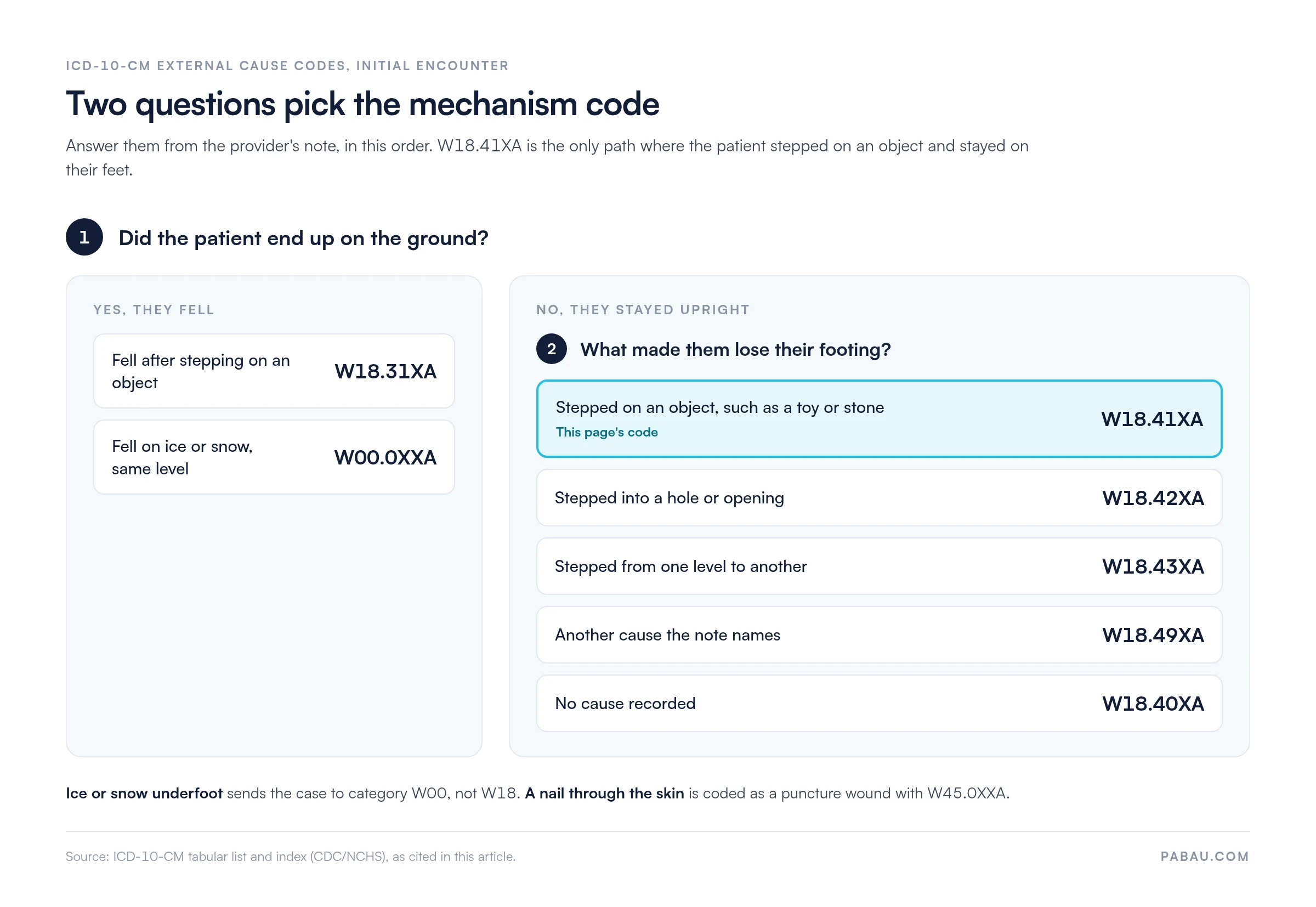
W18.31XA is fall on same level due to stepping on an object, initial encounter. It describes the same trigger, but the patient ends up on the ground. A fall with no documented mechanism at all takes the residual W19.XXXA code instead. The tabular list makes the split explicit, since W18.41 carries an Excludes1 note pointing to W18.31 for a fall.
W18.42XA covers slipping, tripping and stumbling without falling due to stepping into a hole or opening. The foot goes into something, such as a pothole or an uncovered drain, instead of landing on top of something.
W18.43XA covers stepping from one level to another without falling. Think of a patient who misjudges a curb or a single step and stumbles. No object was involved, so W18.41XA does not apply.
W18.49XA is other slipping, tripping and stumbling without falling. Use it when the note names a cause that none of the other W18.4 codes describe. When the note gives no cause at all, the code is W18.40XA, slipping, tripping and stumbling without falling, unspecified.
No W18 code describes ice. The ICD-10-CM index sends slipping on ice or snow to category W00, Fall due to ice and snow. For a same-level fall on an icy path, the code is W00.0XXA, fall on same level due to ice and snow, initial encounter.
The notes sit at three levels of the tabular list, and each one steers a different case away from this code. Category W18 itself carries no Excludes note.
An Excludes1 note means the two codes never go on the same record for the same event. W01 carries one that points back here, so W01 codes and W18.4- codes cannot pair. A single stumble either ended in a fall or it did not, so only one of the two can describe it.
The note has to show the mechanism, not just the injury. Coders and auditors look for these points when they check a claim against the record. They also form the base of medical billing for any injury visit.
Chapter 20 pairs the mechanism code with three supporting codes. Y92 records the place, Y93 the activity and Y99 the patient’s status. The guidelines limit each of them to the initial encounter.
Report each one once, on the initial encounter. A follow-up visit coded W18.41XD carries no Y92, Y93 or Y99 code. These codes add detail to W18.41XA and never replace it.
Most problems with this code come from sequencing or from a note that tells a different story. For the wider process, see our guides to denial management and denial codes in medical billing.
Checking a W18.41XA line takes seconds, and reworking a rejected claim takes far longer. Go through these points before you release it.
The Chapter 20 guidelines set no national requirement to report external cause codes. They apply only where a state mandate or a payer policy asks for them. Even so, the guidelines encourage providers to report them voluntarily, because they explain how injuries happen.
Report W18.41XA whenever the note supports it, unless you know a payer has no use for it. That habit is part of medical billing compliance for injury visits.
A W18.41XA claim usually breaks at a handoff. The provider writes the mechanism in the note, and a biller keys the codes into another system. The detail about the stumble gets lost between the two.
Pabau, the practice management platform we build, keeps the visit note, the diagnosis codes and the invoice on one patient record. Coders pick W18.41XA from the built-in ICD-10-CM library while reading the note that supports it.
US practices send claims through the Claim.MD clearinghouse from inside Pabau’s claims management software. The CMS-1500 claim is pre-filled from the record. Required fields, such as member IDs, must be complete before the claim can be sent.
Eligibility checks run before the visit, and ERA remittances post back to the patient record. When a payer adjusts a line, the reason code sits next to the visit it belongs to.
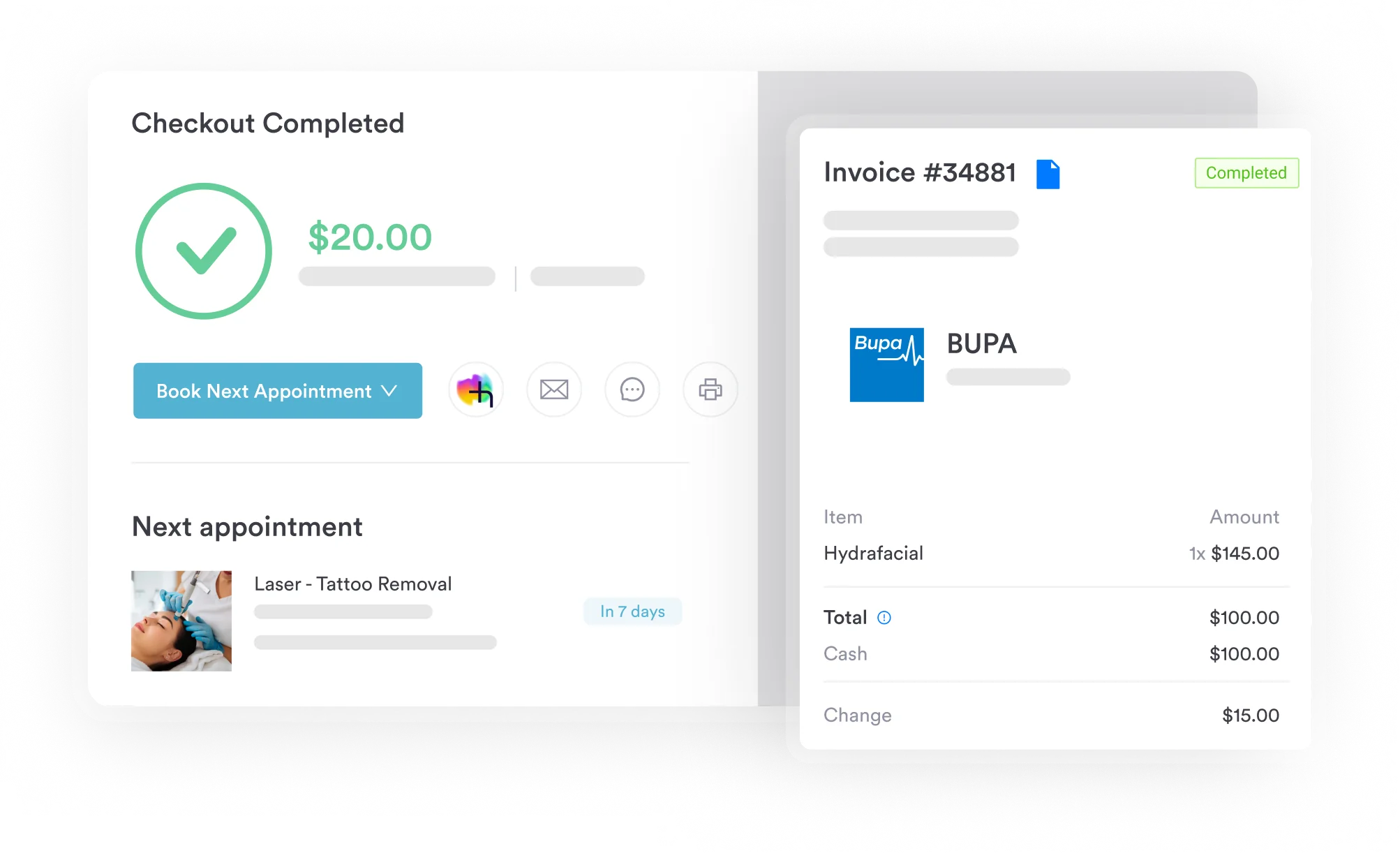

Pabau keeps the note, the ICD-10-CM codes and the claim on one patient record. US practices submit through Claim.MD, with required fields checked before the claim goes out.

W18.41XA rests on two facts in the note. The patient stepped on something, and the patient stayed upright. If either fact is missing, a different code fits, however tidy the claim looks.
So read the mechanism before you pick the code. A fall moves you to W18.31XA, ice moves you to W00 and a nail through the skin adds W45.0XXA. Then match the 7th character to today’s visit, not the first one.
That check takes a few seconds per chart, which costs far less than a corrected claim. Book a demo to see how Pabau keeps the note, the codes and the Claim.MD claim on one record.

Need to understand how clearinghouse claim submission works? Claim.MD clearinghouse guide explains how EDI claim routing, payer enrollment, and real-time eligibility checks reduce submission errors.
Seeing high denial rates across injury-related claims? Revenue cycle management fundamentals covers the end-to-end process from encounter to paid claim, including where external cause codes fit.
Comparing billing platforms for a US practice? Best medical billing software for US practices reviews platforms with ICD-10-CM validation built in.
No object in the note, but another named cause? ICD-10 code W18.49XA covers other stumbles without a fall, with its own sequencing and documentation rules.
W18.41XA cannot stand alone, so it needs a condition to explain. If the provider examined the patient and found no injury, Z04.3 (Encounter for examination and observation following other accident) goes first, with W18.41XA after it.
Not directly. External cause codes do not set the payment for a visit, and they carry no CMS-HCC risk weight. Payers use them to spot cases where another party, such as an employer or property owner, may owe the bill.
W18.41XA describes one event, not a pattern. For ongoing unsteadiness, the provider documents a condition such as R26.81 (Unsteadiness on feet). Z91.81 (History of falling) applies once the patient has fallen before.
Use the Y92.5- trade and service area codes. Y92.512 covers a supermarket, store or market, and Y92.511 covers a restaurant or cafe. These cases often turn into liability claims, so the place code matters.
No, W18.41 covers any object the patient stepped on, and the note names it. The exceptions are injuries the object caused directly. Sharp glass that cuts the foot goes to W25, and a nail through the skin goes to W45.0XXA.