

ICD-10 code S61.201A: Open wound of left index finger without nail damage
ICD-10 code S61.201A covers a left index finger wound of unstated type ICD-10 co...

Last Updated: Oct 16, 2026
Billable Code Specific Code
V97.32XA is the billable ICD-10-CM code for a person on the ground injured by an aircraft's rotating propeller, initial encounter. It records how the injury happened, so it is always reported after the injury code and never as the principal diagnosis.
The placeholder X fills the sixth character so the 7th character A sits in position seven. Use V97.32XA during active treatment, V97.32XD for routine care while the injury heals, and V97.32XS for sequelae.
Let Pabau's smart automation suggest the right codes, reduce claim denials, and keep your practice compliant—effortlessly.
Automate repetitive tasks and focus on what matters most—your patients.
Reduce coding errors and ensure compliance with the latest regulations.
Clean claims, fewer denials, and faster reimbursements.
Powerful insights and reporting to help your practice thrive.
HIPAA compliant SOC 2 certified GDPR-compliant Trusted by 4,000+ clinics worldwide

V97.32XA is the ICD-10-CM external cause code for a person on the ground injured by a rotating aircraft propeller, initial encounter.
It is never the principal diagnosis. Report the injury code first, then V97.32XA to explain how the injury happened.
The placeholder X fills the sixth character, so the string V97.32A without it is not a valid code.
Use V97.32XD for routine visits during healing and V97.32XS when treating a late effect of the propeller injury.
No code in V95-V97 names drones or unmanned aircraft, so a drone injury needs an External Cause Index lookup.
ICD-10 Code V97.32XA describes a person on the ground injured by an aircraft’s rotating propeller in an air transport accident, initial encounter. It is a valid, billable ICD-10-CM code for FY2027, which runs from October 1, 2026 to September 30, 2027.
V97.32XA applies when someone who is not aboard the aircraft is struck by its turning propeller. Typical patients are ramp agents, refuelers, aircraft marshals, maintenance crew, and bystanders on an airstrip.
The code records the mechanism only. The injury itself, such as a laceration, fracture, or traumatic amputation, takes its own code from Chapter 19.
These situations belong to other codes:
Two questions settle the code: where the patient was when the aircraft injured them, and what struck them.
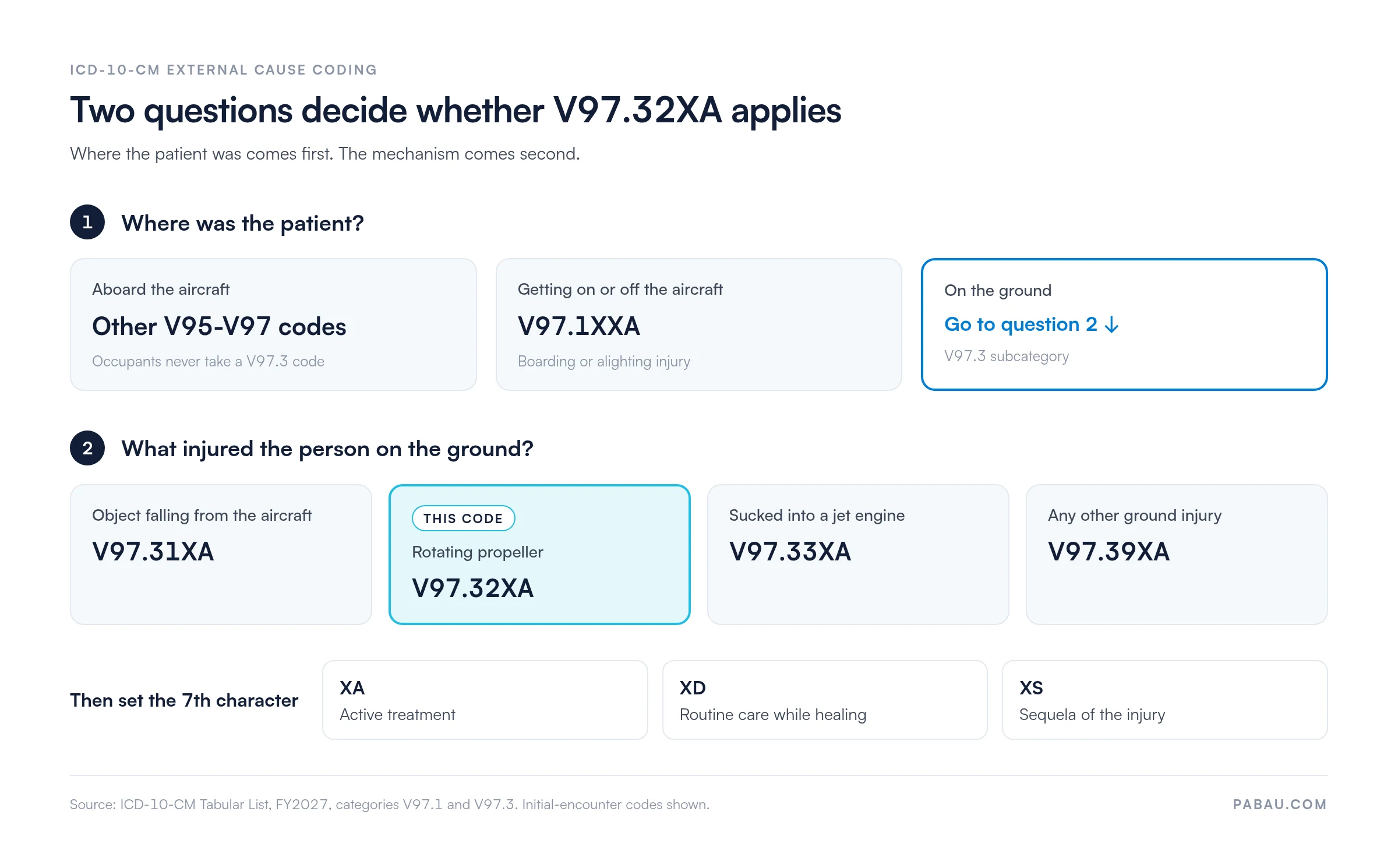
Each character in V97.32XA has a fixed meaning under ICD-10-CM conventions. Reading the code left to right tells you the accident type, the victim, the mechanism, and the encounter.
The X carries no clinical meaning. V97.32 has only five characters, so the X fills the sixth position before the 7th character is added. Without it, the string reads V97.32A, which is not a valid code and gets rejected.
The 7th character on V97.32 tracks the patient’s treatment phase for the propeller injury. It should match the 7th character on the injury code it explains.
The treatment phase sets the switch from A to D, so a long course of active care keeps the A character. For a sequela visit, code the late effect first. The injury code with S and V97.32XS follow it.
Per the CMS ICD-10-CM Official Guidelines for Coding and Reporting, external cause codes are never the principal or first-listed diagnosis. A propeller-strike encounter follows four steps.
Worked example: A 41-year-old ramp agent walks into the rotating propeller of a taxiing turboprop and sustains a laceration of the left forearm. The coder reports S51.812A (laceration without foreign body of left forearm, initial encounter) first.
V97.32XA follows as the external cause. Y92.520 (airport as the place of occurrence) and Y99.0 (civilian activity done for income or pay) complete the set.
The V97.3 subcategory splits ground injuries by mechanism, so the documented mechanism decides the code. The table uses the official descriptors.
If the note says only that the patient was struck by an aircraft, query the provider for the mechanism. That answer decides between V97.31XA, V97.32XA, and V97.39XA.
ICD-10-CM has no code that names drones or unmanned aircraft anywhere in V95-V97, and FY2027 added none. Do not assign V97.32XA because a drone has spinning rotors.
Look up the documented mechanism in the External Cause Index and follow its entry. V97.89XA is one candidate the Index may lead to, but confirm it there before you report it.
The provider’s note has to support each part of the code before the coder assigns it. Check the record for these five elements.
The CDC/NCHS ICD-10-CM official web tool carries the full Tabular List and External Cause Index. When the documentation is ambiguous, query the provider rather than defaulting to a less specific code.
There is no national requirement to report external cause codes. The official guidelines make them mandatory only under a state reporting mandate or a payer’s own rule. They still encourage voluntary reporting.
Propeller strikes on airport ramps are usually workplace injuries. Workers’ compensation is then typically the primary payer, so confirm the carrier and claim number before you bill a health plan.
A health plan may send an accident questionnaire when the codes point to a possible liable third party. Answering it quickly keeps the claim from sitting in a pended status. Run insurance eligibility verification at follow-up visits too, since coverage can change during a long recovery.
Most rejections on this code trace back to format, sequencing, or payer errors that are fixable before submission. The table applies denial management best practices to V97.32XA.
A clean claim review before submission catches the format and sequencing errors in this table. Spot-check exported claims, because some billing exports strip the X placeholder. If a claim still comes back, its denial reason code narrows down which of these errors to fix first.
Confirm where the patient was before you code. A person on the ground hit by a propeller is V97.32XA. Someone aboard the aircraft or boarding it belongs to a different V95-V97 code.
A propeller-strike claim carries several codes from the provider’s note: the injury code, V97.32XA, and the Y92, Y93, and Y99 codes. Retyping them into a separate billing system is where a dropped X or a misordered code slips in.
Pabau, the practice management platform we build, carries the codes already on the patient’s record into the claim. US practices then submit and track those claims through Claim.MD without leaving Pabau.
Your billing team follows each claim’s status with claims management in Pabau, next to the patient’s appointments and records. A pended accident or workers’ compensation claim gets chased sooner.

Pabau carries the codes on the patient record into each claim, then submits and tracks it through Claim.MD. Your team follows every V97.32XA claim from one dashboard.

V97.32XA is narrow by design. It records one mechanism, a person on the ground struck by a turning aircraft propeller. Code the injury first, keep the X, and match the 7th character to the treatment phase.
When the record describes a drone or a different mechanism, let the External Cause Index decide instead of stretching this code. To see how Pabau moves those codes from the note to a tracked claim, book a demo.

Need to understand how denial codes work? Denial codes in medical billing explains the most common CARC reason codes and how to act on them when a claim comes back.
Coding the work status for a ramp injury? ICD-10 code Y99.8 covers the external cause status codes and when Y99.0 applies instead.
Want to see how electronic remittance works? Electronic remittance advice (ERA) covers how 835 ERAs communicate denial reasons and adjustment codes back to the practice after claim adjudication.
Coding a patient who was aboard the aircraft? ICD-10 code V95.21XA covers an occupant injured in a private fixed-wing aircraft crash, the other side of the V95-V97 split.
V97.32XA means a person on the ground was injured by an aircraft’s rotating propeller in an air transport accident, at the initial encounter. It is a Chapter 20 external cause code, reported after the injury code and never as the principal diagnosis.
The X is a placeholder that fills the sixth character, and A marks the initial encounter while the patient receives active treatment. Use V97.32XD for routine care during healing and V97.32XS for sequelae.
No. ICD-10-CM has no code that names drones or unmanned aircraft anywhere in V95-V97, including FY2027. Look up the documented mechanism in the External Cause Index. V97.89XA is one possible result, but confirm it in the Index first.
Yes. V97.32XA explains how the injury happened, so it cannot stand alone on a claim. Report the Chapter 19 injury code first, such as a laceration or amputation code, then V97.32XA.
The usual causes are a missing placeholder X, V97.32XA listed as the principal diagnosis, and XA used on a routine healing visit. Billing a health plan for a work injury that workers’ compensation should cover is another.
There is no national requirement to report external cause codes. They are required only under a state mandate or a payer’s own rule, though the official guidelines encourage voluntary reporting.



