ICD-10 Code V91.84XS: Other burn due to burning watercraft
ICD-10 Code V91.84XS: overview and key facts ICD-10 Code V91.84XS identifies the...

Last Updated: Oct 30, 2026
Billable Code Specific Code
V96.04XD is the billable ICD-10-CM code for balloon fire injuring occupant, subsequent encounter.
This code sits in V96, the ICD-10-CM category for accidents to nonpowered aircraft that injure an occupant. It reports visits after active treatment ends, such as wound checks or rehabilitation. It is never used alone or listed first. It always follows a code for the injury itself, such as a burn, smoke inhalation, or a fracture.
Let Pabau's smart automation suggest the right codes, reduce claim denials, and keep your practice compliant—effortlessly.
Automate repetitive tasks and focus on what matters most—your patients.
Reduce coding errors and ensure compliance with the latest regulations.
Clean claims, fewer denials, and faster reimbursements.
Powerful insights and reporting to help your practice thrive.
HIPAA compliant SOC 2 certified GDPR-compliant Trusted by 4,000+ clinics worldwide

V96.04XD reports a balloon fire injuring an occupant at a subsequent encounter, never the initial treatment visit.
As an external cause code, V96.04XD is never the principal or first-listed diagnosis on a claim.
The nature-of-injury code is sequenced first, and after a balloon fire that is usually a burn or smoke inhalation code.
Code burns to the highest degree first, and add a T31 code when the record states the total body surface burned.
ICD-10 Code V96.04XD is the billable external cause code for a balloon fire injuring an occupant, subsequent encounter.
The descriptor comes from the ICD-10-CM Tabular List. The National Center for Health Statistics (NCHS) and the Centers for Medicare and Medicaid Services (CMS) maintain it.
V96.04XD describes the event, not the injury. It tells the payer that a balloon occupant was hurt when the balloon caught fire, and that this visit falls after active treatment.
Each character in the code carries its own meaning:
ICD-10-CM coding conventions require the placeholder “X” in the sixth position. It fills the slot whenever a code needs a 7th character but has fewer than six characters before it. Omitting the X produces an invalid code that payers reject.
Per the ICD-10-CM Official Guidelines for Coding and Reporting, the placeholder X is mandatory. The CMS ICD-10 code files list V96.04XD in its full seven-character form.
Among the ICD-10-CM diagnostic codes, V96.04XD belongs to the external causes of morbidity chapter. Understanding the hierarchy helps coders select the right level of specificity and avoid defaulting to unspecified codes when more precise options exist.
This hierarchy matters for medical billing workflows because the external cause code should be as specific as the documentation allows. Subcategory V96.0 splits balloon accidents into crash, forced landing, collision, fire, explosion, and other.
Defaulting to V96.00XD (unspecified balloon accident injuring occupant, subsequent encounter) when the note names a fire is poor coding practice and can draw audit attention. The CDC/NCHS ICD-10-CM browser is the authoritative lookup tool for verifying hierarchy and official descriptors.
The 7th character “D” designates a subsequent encounter, meaning the patient is receiving routine care after the active treatment phase of the injury is complete. Mixing up A and D is a common error.
A common documentation failure: The clinician notes “follow-up for burns from a balloon fire” but the coder submits V96.04XA (initial encounter). The 7th character must match what the notes describe, not what was assumed.
Section I.C.19.a of the ICD-10-CM Official Guidelines for Coding and Reporting defines the 7th characters. “D” applies once active treatment is complete and the patient receives routine care during healing or recovery. Under the aftercare rule in Section I.C.21.c.7, injury aftercare Z codes are not used for these visits. The acute injury code takes the “D” character instead.
Check the note’s clinical language before assigning the 7th character. If the provider documents ‘wound check,’ ‘healing burn reviewed,’ ‘suture removal,’ or ‘physical therapy follow-up,’ the encounter is subsequent (D). Active treatment language, such as ‘debridement performed,’ ‘skin graft today,’ or ‘fracture reduced,’ signals initial (A).
V96.04XD is a valid, billable ICD-10-CM code. However, “billable” for an external cause code has a specific meaning that differs from standard diagnosis codes.
External cause codes in the V00-Y99 chapter are never sequenced as the principal or first-listed diagnosis. Per ICD-10-CM Official Guidelines Section I.C.20, they are always secondary codes. They explain the mechanism or cause of an injury that a primary diagnosis code already describes.
Submitting V96.04XD alone on a claim, or placing it in the primary diagnosis field, will draw a denial from many payers.
Every claim using V96.04XD must include at least one primary diagnosis code describing the injury the occupant sustained in the balloon fire. The injury code is sequenced first, and V96.04XD follows as the external cause.
For subsequent encounters, the companion injury code also takes a 7th character of “D”. Burns and smoke inhalation are the injuries a fire causes directly, though an escape or rough landing can add a fracture:
Two burn rules shape these claims. When more than one burn is present, sequence first the code for the highest degree of burn (Section I.C.19.d). Category T31 reports the share of body surface burned and takes no 7th character.
Ensuring the companion code’s 7th character also reflects a subsequent encounter is a common oversight. A claim with T22.211A (initial encounter burn) plus V96.04XD (subsequent encounter) mixes encounter types on one visit, which invites payer queries.
Pabau, the practice management platform we build, checks each claim for missing or invalid details before it leaves the practice. Its integration with the Claim.MD clearinghouse then submits the claim as an electronic CMS-1500. Checking that encounter characters match across codes stays with your coders.
Several codes in the V96 category, and the adjacent V95 category for powered aircraft, are easy to confuse with V96.04XD. The table below highlights the key differences.
A note can describe a fire and an explosion in the same event. Code to the event the provider documents as the cause of injury. When the record says only “balloon accident,” query the provider before defaulting to V96.00XD.
The hang-glider codes need care too. Subcategory V96.1 mirrors the V96.0 structure, so V96.14XD sits one subcategory away from V96.04XD. Use the AAPC ICD-10-CM code lookup to verify hierarchy before selecting between V96 subcategories.
Supporting documentation for V96.04XD must establish three facts clearly. The encounter is post-acute, a balloon fire caused the injury, and a companion code describes the injury itself. Missing any one of these is a sufficient basis for a payer to deny or downcode the claim.
Required documentation elements:
Good documentation practice for medical billing compliance means the coder should not have to infer the mechanism or encounter type from context alone. When documentation is ambiguous between initial and subsequent, query the provider before coding rather than defaulting to one or the other.
V96.04XD draws a predictable set of claim edits and denials.
Systematic denial management in healthcare workflows catch these patterns after the fact. A better approach is a pre-submission check of external cause code placement and 7th character consistency before the claim leaves the practice.
Medicare does not require external cause codes for reimbursement purposes. However, when external cause codes are submitted, they must follow official ICD-10-CM coding conventions. HIPAA (Health Insurance Portability and Accountability Act) code set rules make those conventions binding. Medicare Advantage plans, Medicaid managed care organizations, and commercial insurers vary in how strictly they enforce external cause code submission.
Specific considerations by payer type:
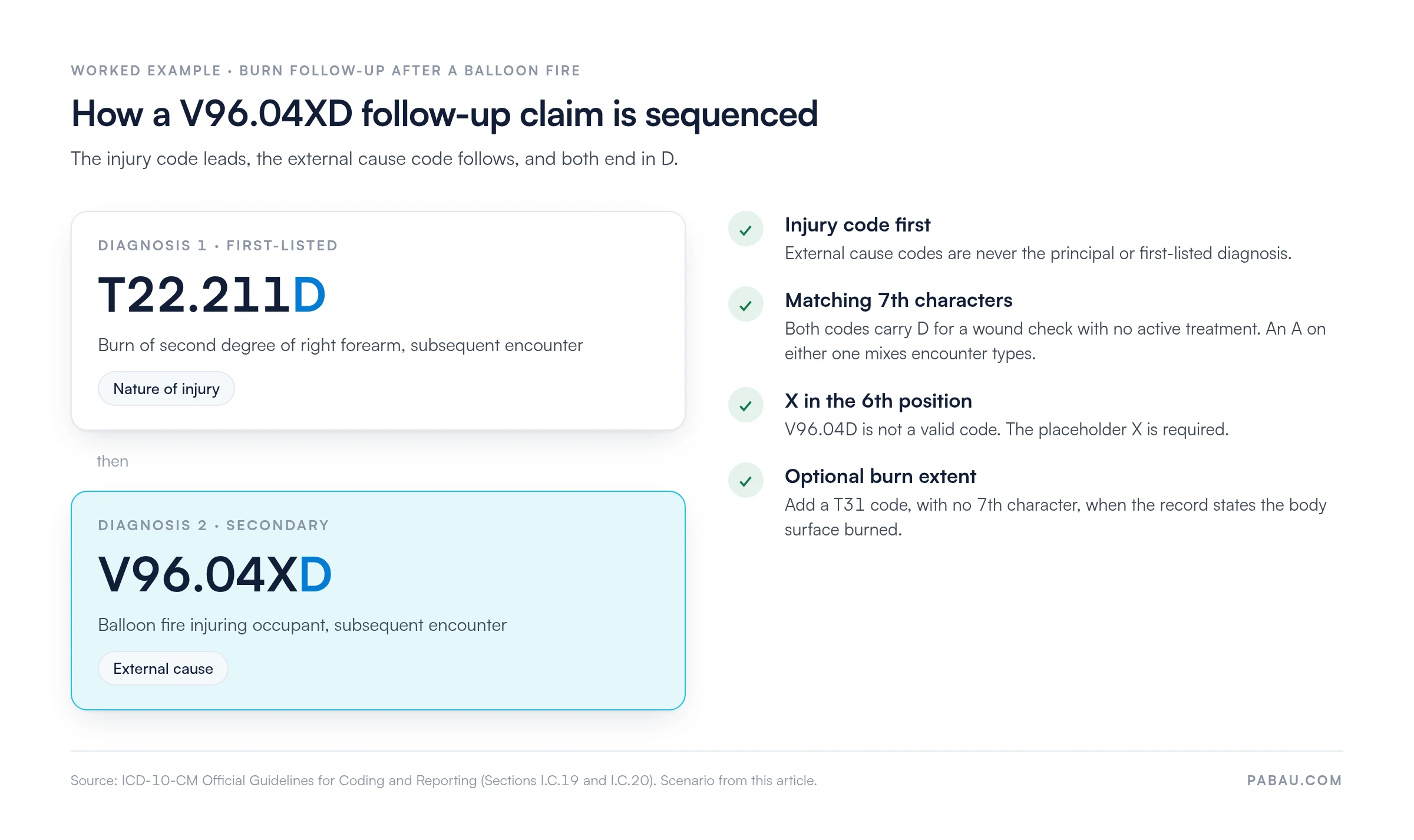
The following worked example shows correct code sequencing for a typical subsequent encounter involving V96.04XD.
Clinical scenario: A 41-year-old patient presents for a follow-up visit three weeks after a second-degree burn of the right forearm. The burn happened when the hot air balloon the patient was riding in caught fire. The wound is healing well, and no new treatment is performed today.
Final claim sequencing: T22.211D, V96.04XD. This pairing is consistent, correctly sequenced, and supported by the clinical note. ICD-10-CM is the US clinical modification of the WHO’s ICD-10 classification, which sets the chapter structure behind these codes.
For electronic claim submission workflows, the clean claim submission process should include a pre-submission check confirming external cause codes are in secondary positions before transmitting.
Run a pre-submission check on any claim containing V-category external cause codes. Confirm the first diagnosis field contains a nature-of-injury code and the external cause code sits in a secondary position. Then check that both codes carry the same 7th character. This catches most V96.04XD denials before they leave the practice.
Follow-up care after a balloon fire usually means several claims for the same injury, often weeks apart. Re-keying each one into a separate clearinghouse portal leaves room for missing fields and mismatched details.
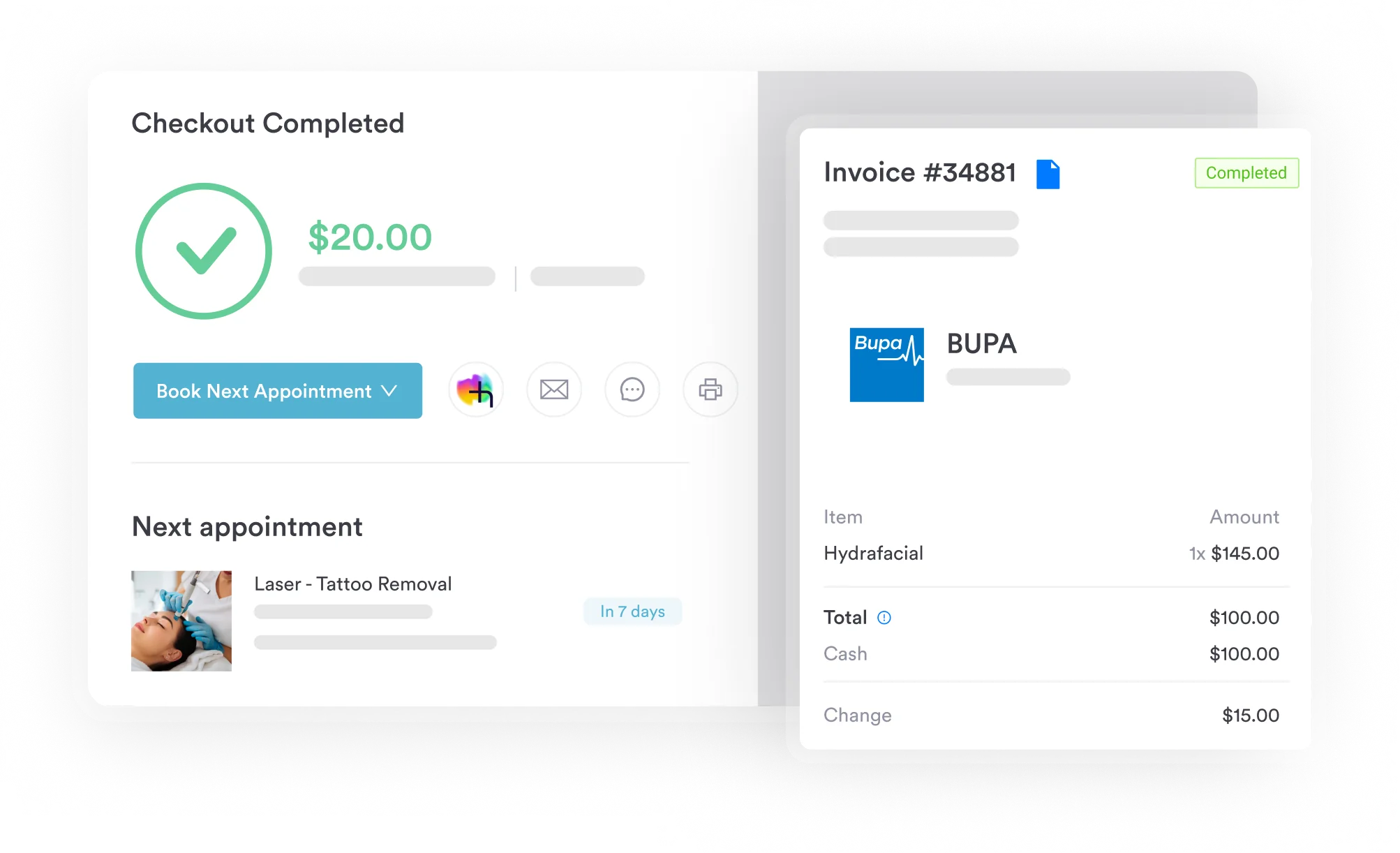
Pabau’s claims management software builds each claim from the invoice you already raise. Its claim validation scrubs the claim for missing or invalid details before it leaves Pabau. US claims go out as electronic CMS-1500s through Claim.MD, and statuses and ERA remittances come back into Pabau.
If a payer rejects a claim, Pabau flags it as Needs action and links straight to the field to correct. Your coders keep ownership of code choice, sequencing, and encounter characters, while Pabau handles the submission work around them.

Pabau’s claim validation catches missing or invalid details before you submit, so injury follow-up claims go out complete. Claims reach Claim.MD as CMS-1500s, and every status update comes back into Pabau.

V96.04XD is a straightforward code once its rules are clear. It is always secondary, always paired with a nature-of-injury code, and always carries a 7th character that matches the documentation.
The harder calls come earlier, when you confirm the event was a fire rather than an explosion or crash. Confirm too that the patient was aboard the balloon. Get both facts into the note at the first visit, and each follow-up claim can rely on them.
Book a demo to see how Pabau’s claim validation and Claim.MD submission keep injury follow-up claims moving.

Need to understand how clearinghouse edits catch coding errors? Claim.MD clearinghouse overview explains how Claim.MD’s electronic claim validation catches missing or invalid details before submission.
Dealing with repeated external cause code denials? Denial codes in medical billing lists common denial codes and what each one means.
Want to see where coding fits in the payment cycle? Revenue cycle management overview covers how claims move from documentation through coding to payment, and where compliance checks sit.
ICD-10 Code V96.04XD is the external cause code for a balloon fire injuring an occupant, subsequent encounter. It applies when the patient receives routine follow-up care after active treatment for the injury has ended. It sits in the V96 nonpowered aircraft category and is always sequenced after a nature-of-injury code.
Use V96.04XA while the patient receives active treatment for injuries from the balloon fire, such as emergency care, debridement, or grafting. Use V96.04XD for follow-up visits, wound checks, physical therapy, and routine monitoring after active treatment ends. The 7th character must match what the provider documents.
Yes. V96.04XD is an external cause code and cannot stand alone on a claim. It must follow a code for the injury itself, such as a burn code, a smoke inhalation code, or a fracture code. The injury code is sequenced first, and V96.04XD explains how the injury happened.
No. External cause codes in the V00-Y99 chapter are never sequenced as the principal or first-listed diagnosis. Placing V96.04XD in the primary diagnosis field will result in a claim denial from most payers. It must appear in a secondary position, after the nature-of-injury code that describes the injury.
Select the nature-of-injury code first, such as a burn code, with the correct 7th character for the encounter. Then add V96.04XA (initial encounter), V96.04XD (subsequent encounter), or V96.04XS (sequela) as the external cause code. Match its 7th character to the encounter type on the injury code.
V96.04XD reports a fire aboard a balloon, while V96.14XD reports a fire aboard a hang glider. Both are subsequent encounter codes in the V96 nonpowered aircraft category. Code to the aircraft type the provider documents.
Documentation must confirm the encounter is post-acute follow-up and name a balloon fire as the cause of the original injury. It should show the patient was aboard the balloon and describe the specific injury being monitored. Notes that read like an initial assessment create a documentation-to-code mismatch that supports payer denial on audit.