ICD-10 code S31.30XD – Open wound of scrotum and testes
ICD-10 code S31.30XD covers a scrotal or testicular wound at follow-up ICD-10 co...

Last Updated: Nov 2, 2026
Billable Code Specific Code
V90.37XA is the billable ICD-10-CM code for drowning and submersion due to falling or jumping from crushed water-skis, initial encounter.
It sits in Chapter 20 of the ICD-10-CM tabular list as an external cause code. That means it describes how the injury happened rather than the injury itself. Two sequencing errors cause common claim problems. The code gets listed as the principal diagnosis instead of an additional code, or it is submitted without the companion injury code.
Let Pabau's smart automation suggest the right codes, reduce claim denials, and keep your practice compliant—effortlessly.
Automate repetitive tasks and focus on what matters most—your patients.
Reduce coding errors and ensure compliance with the latest regulations.
Clean claims, fewer denials, and faster reimbursements.
Powerful insights and reporting to help your practice thrive.
HIPAA compliant SOC 2 certified GDPR-compliant Trusted by 4,000+ clinics worldwide

ICD-10 Code V90.37XA is a billable external cause code for drowning or submersion after falling or jumping from crushed water-skis. It is valid for the current fiscal year (verify annually against the NCHS tabular list).
It is always an additional code, never the principal or first-listed diagnosis. The companion injury code, such as T75.1XX-, goes first.
The 7th character A marks the initial encounter, D a subsequent encounter and S a sequela. Picking the wrong one is a common denial trigger.
Pabau’s claim validation scrubs claims for missing or invalid details before they leave Pabau.
ICD-10 Code V90.37XA is defined as drowning and submersion due to falling or jumping from crushed water-skis, initial encounter.
The “crushed” qualifier is specific. The water-skis were structurally damaged before the patient entered the water, for example after a vessel struck them. The person then fell or jumped and drowned or went under.
This specificity matters for coding. A patient who simply falls off intact water-skis does not meet the descriptor for V90.37XA. Documentation must establish that the equipment was crushed or damaged, not merely that the patient lost balance. Coders who miss that distinction risk assigning a code the record does not support, which invites a payer query.
V90.37XA descends from Chapter 20 of the ICD-10-CM tabular list, which covers external causes of morbidity. Knowing the parent-child chain helps coders reach the right code when they can’t recall the full string. The same chain runs through every water transport code, so the ICD-10-CM library for coders is a quick way to check a sibling code.
The tabular list requires coders to reach the seventh-character level before the code is complete. V90.37 alone, without the XA suffix, is not a valid submission code. Verify the full string against the CDC/NCHS ICD-10-CM web tool whenever you doubt the current fiscal year’s code set.
The 7th character in V90.37XA is A, which marks the initial encounter. The breakdown below shows how each character narrows the code, from the watercraft category down to this single encounter.
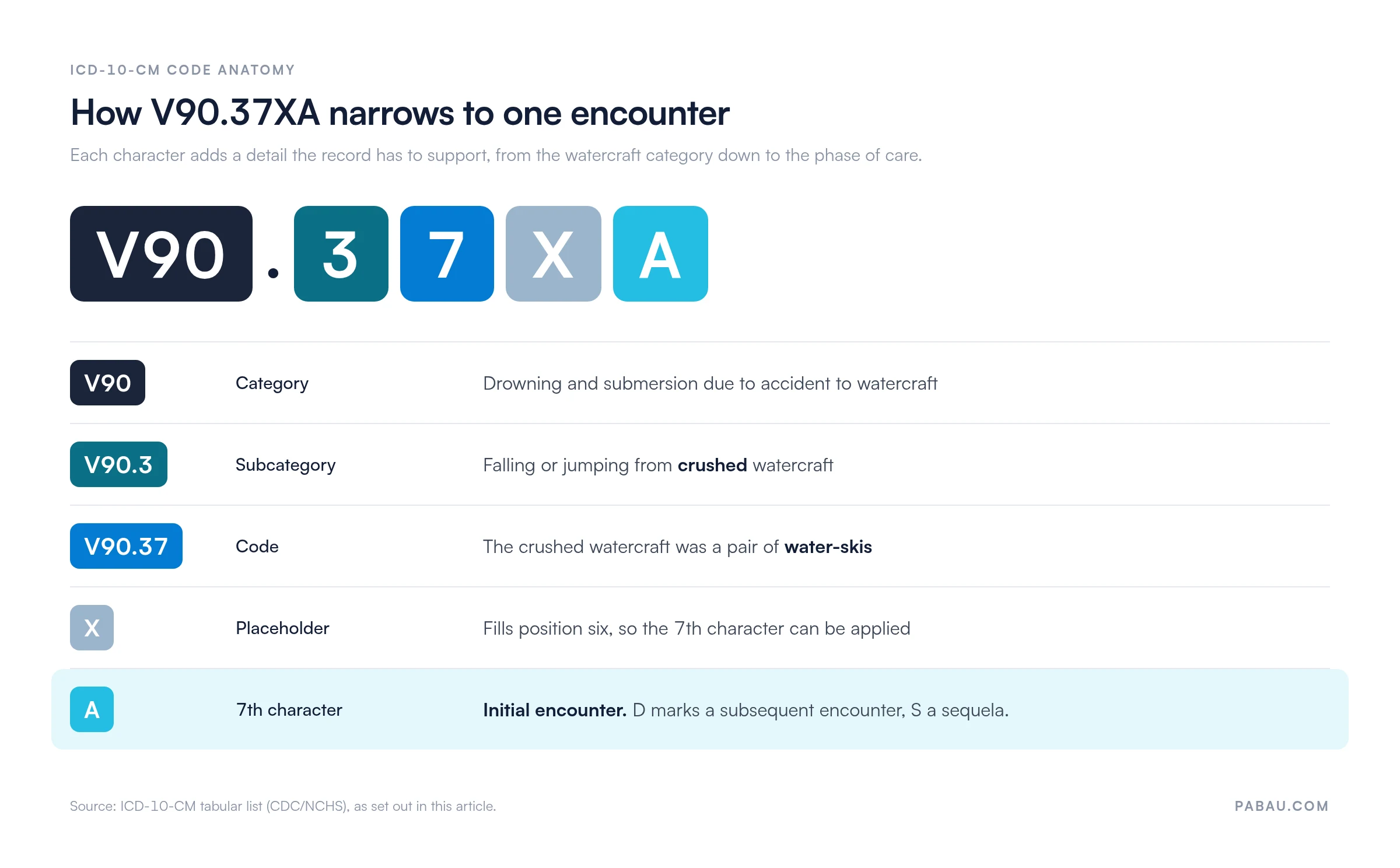
Because the base code V90.37 has only five characters, ICD-10-CM requires a placeholder “X” in the sixth position. Submitting V90.37A without it is a structural coding error that clearinghouses typically reject outright. The table below sets out all three 7th-character options.
Emergency department coders almost always apply the “A” suffix. Inpatient rehabilitation or follow-up coders handling later complications from the near-drowning event switch to “D” or “S”, depending on clinical context. Applying “A” on a third-visit pulmonary follow-up is one of the more common 7th-character errors on these cases.
V90.37XA covers cases where a person was on water-skis that were crushed or structurally compromised. The person then fell or jumped into the water and drowned or was submerged. The code does not capture the resulting injury on its own. It describes the external cause only.
What falls outside the code: Military operations involving watercraft drowning fall under Y36 and Y37 codes, not V90. V91.07XA, burn due to water-skis on fire, covers a thermal outcome rather than drowning. Coders sometimes reach for V90.37XA when the notes mention water-skis and any adverse outcome, but the descriptor must match precisely.
Use additional code: Per ICD-10-CM tabular instructions, coders assign the principal injury code first. For drowning-related effects, T75.1XX- (effects of drowning and nonfatal submersion) is the most commonly paired companion code. Add other injury codes if the fall caused further harm, such as rib fractures, head trauma or soft-tissue injuries from the damaged skis.
Several codes share watercraft-drowning mechanisms or water-ski contexts with V90.37XA. The table below covers four commonly confused alternatives and what sets each one apart.
The V90 vs. V91 split is a frequent point of confusion. V90.37 and V91.07 both involve water-skis, and the outcome determines the category. Drowning or submersion routes to V90, while burns route to V91. When the record documents both a thermal component and submersion from the same event, code both and let the primary injury drive the principal diagnosis.
Four documentation elements must appear in the medical record before V90.37XA can be assigned with confidence. Missing any one of them leaves the code open to a query or payer denial. The same principle holds across every external cause category: the record must support the specific code, not just a nearby one.
When the provider’s note says “fell from water-skis” without saying the skis were damaged, the coder should query the provider before assigning V90.37XA. Assigning a more specific code than the documentation supports is a compliance risk under CMS ICD-10-CM coding guidelines.
V90.37XA is an external cause code. Per ICD-10-CM Official Guidelines Section I.C.20, external cause codes are never listed as the principal or first-listed diagnosis. They always follow the injury code that describes what happened to the patient. Listing V90.37XA first will trigger a sequencing edit from most payers.
Correct sequencing follows four steps:
Practices new to insurance claims can start with medical billing fundamentals before working through code-specific sequencing rules like these.
Five denial patterns appear consistently on claims carrying ICD-10 Code V90.37XA. Each has a straightforward correction once the root cause is identified. A structured denial management workflow catches most of these before they become write-offs.
The placeholder X omission deserves its own mention, because coders reviewing claim lines by eye rarely spot it. Many encoders and EHRs catch it automatically, but manual claim entry systems may not. Verify the full seven-character string before submission: V-9-0-.-3-7-X-A. Knowing what makes a clean claim helps billing teams stop structural errors before claims leave the practice.
ICD-10 Code V90.37XA appears mainly in two clinical settings. Emergency departments handle acute near-drowning presentations, and inpatient teams manage pulmonary and neurological complications from submersion. Trauma registry coordinators also assign it for injury surveillance, where it records the mechanism independently of billing.
In the ED, the code typically follows T75.1XX- as the principal diagnosis. It may sit alongside acute respiratory distress syndrome (J80) or acute respiratory failure (J96.0-) codes when the submersion caused lung injury. For inpatient admissions after a near-drowning, the external cause code carries forward wherever the payer requires external cause reporting.
Outpatient coders should watch for a change in encounter type. When a patient attends a follow-up clinic for pulmonary rehabilitation after a near-drowning event, the encounter becomes subsequent. V90.37XD is appropriate there, not V90.37XA. The injury is the same, and only the phase of care has changed.
On a manual workflow, V90.37XA errors surface late. The external cause code gets listed first, the companion T75.1XX- code goes missing, or V90.37A goes out without its placeholder. The practice finds out when the denial arrives.
Pabau, the practice management platform we build, keeps visit notes, invoices and insurance claims in one system. Its claims software for coders runs claim validation that scrubs claims for missing or invalid details before they leave Pabau.
Claims then go to the payer electronically through Pabau’s Claim.MD clearinghouse integration, so nobody re-types codes into a separate portal. Your billing team fixes a V90.37XA claim once, before submission, instead of reworking it after a denial.

Pabau’s claim validation scrubs claims for missing or invalid details before they leave Pabau. Your billing team fixes a V90.37XA claim once, before the payer sees it.

V90.37XA rewards precision over speed. If the note doesn’t say the skis were crushed, query the provider before you code. A broader V90 code the record supports beats a specific one it can’t defend.
Once the documentation holds up, the remaining risk sits in sequencing and the 7th character. Put the injury code first and match A, D or S to the phase of care. That keeps the claim clear of the denial patterns above.
Book a demo to see how Pabau scrubs your external cause code claims for missing or invalid details before they reach the payer.

Need to understand how clearinghouse validation works? Pabau’s Claim.MD clearinghouse integration guide explains how pre-submission edits catch code-level errors before they reach the payer.
Working through a high denial rate on external cause codes? Denial codes in medical billing maps common CARC denial reason codes to actionable corrections for billing teams.
Want the full picture on electronic remittance? Electronic remittance advice (ERA) covers how 835 files report denial reasons back from payers so your team can action them quickly.
ICD-10 Code V90.37XA is the billable diagnosis code for drowning and submersion due to falling or jumping from crushed water-skis, initial encounter. It is an external cause code in Chapter 20 of the ICD-10-CM tabular list. It describes the mechanism of injury rather than the injury itself. It is always coded alongside the principal injury code, never as a standalone or first-listed diagnosis.
Yes, V90.37XA is a billable ICD-10-CM code, valid for the current fiscal year. It is only billable as an additional code alongside a principal injury diagnosis. Submitting it as the sole diagnosis or as the first-listed code will get the claim denied. Verify its status annually against the NCHS tabular list, since the code set updates each fiscal year.
The 7th character A designates initial encounter, meaning the patient is receiving active treatment for the condition. The X before it is a required placeholder. V90.37 has only five characters, so a dummy X fills position six and lets the 7th character apply. Clearinghouses typically reject V90.37A, submitted without the placeholder, as a structural error.
V90.37XA covers drowning or submersion after falling or jumping from crushed water-skis. V91.07XA covers a burn sustained when water-skis are on fire. Both involve water-skis, but the clinical outcome decides the category. Submersion routes to V90, and thermal injury routes to V91. When the record documents a burn and submersion from the same event, code both and let the principal injury drive the first-listed diagnosis.
Yes. V90.37XA describes only the external cause mechanism. ICD-10-CM instructions require an additional code for the injury itself, most commonly T75.1XX- for effects of drowning and nonfatal submersion. Assign codes for concurrent traumatic injuries, such as fractures or head trauma, when they are documented. Submitting V90.37XA without an accompanying injury code is a common denial trigger.
The three encounter variants are V90.37XA (initial encounter, active treatment), V90.37XD (subsequent encounter, routine follow-up care) and V90.37XS (sequela, late effects of the original event). Switch from XA to XD when the patient moves from active treatment to routine monitoring or rehabilitation. Apply XS when coding a complication that is a direct late effect of the original submersion, such as anoxic brain injury.