ICD-10 code Y83.0: Surgical operation with whole organ transplant
ICD-10 code Y83.0 names the transplant as the cause, not the problem ICD-10 code...

Last Updated: Nov 19, 2026
Billable Code Specific Code
W16.112D is the billable ICD-10-CM code for fall into natural body of water striking water surface causing other injury, subsequent encounter. It applies after a fall into a lake, river or the sea where hitting the surface caused an injury other than drowning. Typical injuries are a fracture, concussion or laceration.
The D marks routine follow-up while the injury heals, such as a fracture check or a cast change. W16.112D always sits behind the injury code, never first. A patient who struck the bottom needs W16.12- instead, and drowning moves the code to W16.111-.
Let Pabau's smart automation suggest the right codes, reduce claim denials, and keep your practice compliant—effortlessly.
Automate repetitive tasks and focus on what matters most—your patients.
Reduce coding errors and ensure compliance with the latest regulations.
Clean claims, fewer denials, and faster reimbursements.
Powerful insights and reporting to help your practice thrive.
HIPAA compliant SOC 2 certified GDPR-compliant Trusted by 4,000+ clinics worldwide

W16.112D is a billable external cause code for a fall into natural water that struck the surface and caused an injury other than drowning.
The 7th character D marks routine care during healing, after active treatment of the injury has ended.
It never goes first on the claim. The injury code, such as a fracture or concussion, leads with its own subsequent-encounter character.
Drowning, hitting the bottom, hitting the side and jumping in on purpose each have their own code, so check the note before you pick.
Place and activity codes (Y92, Y93) belong on the initial encounter, so leave them off unless a payer asks for them.
ICD-10 code W16.112D reports a fall into a natural body of water that struck the water surface and caused an injury other than drowning. The D tells the payer this is a subsequent encounter. The CDC’s ICD-10-CM browser tool lists the full title as “Fall into natural body of water striking water surface causing other injury, subsequent encounter.”
Picture a patient who slipped off a pier into the sea and cracked a rib on impact. They were treated in the emergency department and are now back for a fracture check. That follow-up visit is where W16.112D belongs.
Older write-ups of this code describe drowning or striking the bottom. Both are wrong, and both point to different codes. The rest of this guide shows how to read the code, how to sequence it, and what gets these claims denied.
Read the code left to right and it tells the whole story of the fall. The 5th and 6th characters are where most mistakes start, so check them against the note every time.
W16.112D is billable as it stands. Drop the 7th character and W16.112 is rejected, because every code in category W16 needs one.
Where the code sits matters because the notes at category level apply to every code below it. Here is the path from chapter to billable code.
Category W16 carries an Excludes1 note, so none of these are ever coded together with it:
There is one Excludes2 note. Striking or hitting a diving board (W21.4) can be coded alongside W16 when both happened.
W16 has dozens of near-identical codes. Four questions separate them: what kind of water, whether the patient fell or jumped, what they struck, and whether they drowned. This table lines up the subsequent-encounter versions coders confuse most often.
Don’t reach for W74 as a fallback. W74 covers unspecified drowning and submersion, and W16’s Excludes1 note keeps W65-W74 for cases with no fall involved. If the note says the patient fell into a lake, stay in W16.1- and let the documented impact and outcome pick the code. When the note confirms a fall into water but never names the water type, the follow-up code for an injury other than drowning is W16.42XD.
Read the verb in the note before anything else. A patient who fell from a jetty is W16.1-, but one who jumped or dove into the same lake is W16.6-. If the note only says ‘went into the water’, query the provider before you assign either.
Under the official guidelines in CMS’s ICD-10-CM files, D is for encounters after active treatment has ended. The patient is now getting routine care during the healing or recovery phase. Cast changes, a repeat x-ray, medication adjustments and follow-up visits all qualify.
The switch from A to D follows the patient’s treatment, whatever the calendar says. A patient seen at urgent care two days after the ED, still being worked up, is still an initial encounter. A different provider doesn’t change that.
Two more rules catch people out. Don’t use aftercare Z codes for injury follow-up, because the guidelines want the injury code with its subsequent-encounter character instead. And when a fracture shows delayed healing, use G on the fracture code. W16.112D stays as it is, because W16 only has A, D and S.
External cause codes can never be the principal or first-listed diagnosis. They explain how the injury happened, so they ride behind the code for the injury itself. Here is how a typical follow-up claim is built.
Take a second patient as a worked example. They fell from a riverbank, hit the water hard and had a concussion with no loss of consciousness. At the two-week follow-up, the claim reads S06.0X0D first, then W16.112D. Nothing else from the W, Y92 or Y93 families is needed.
ICD-10-CM doesn’t make external cause codes mandatory. Reporting them is recommended where they apply, and some states and payers require them. When you do report a place code, pick the Y92 code that matches the documented location.
Y92.828 is often used as a catch-all, but it means “other wilderness area” within the Y92.82- wilderness group. A fall at a beach belongs in the Y92.83- recreation area group, as Y92.832. For activity, Y93.01 covers walking and hiking, and Y93.11 covers swimming.
If the record is vague, the code is a guess. Check for each of these before you assign W16.112D, and query the provider when one is missing. The chart below shows where each answer sends the code.
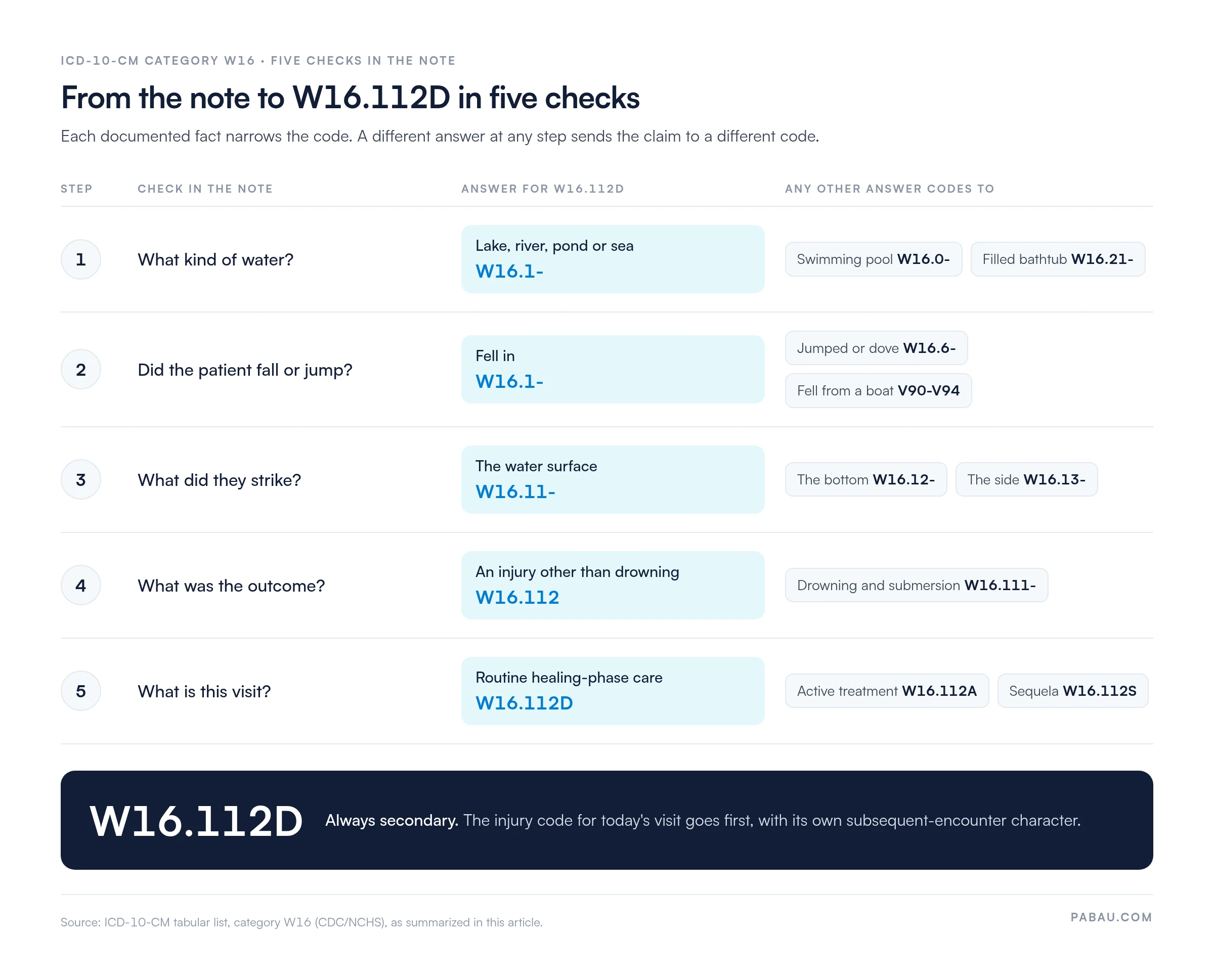
A medical billing workflow that checks these points when the note is signed saves you a query weeks later, when the claim comes back.
Five minutes on this list costs less than reworking a denial. It also gives your team a fixed standard to train new coders against.
Most denials on W16 claims trace back to the same handful of errors. Each one is fixable at the coding stage.
A steady denial management process shows which of these keeps coming back, so you fix the cause once. The reason code on each remittance is the place to start, and our list of claim denial codes explains what each one means.
Pull every W16 claim from the last 90 days that was denied or pended. For each one, check that an injury code led the claim and the water type matched the note. Then check the 7th character against the visit. The same error usually shows up across several claims, so one process change fixes most of them.
There is no national requirement to report external cause codes on outpatient claims. Some state Medicaid programs require them, though, and some commercial payers want them on accident-related claims.
A W code tells the payer an accident happened. That can prompt coordination of benefits questions, or a check on whether another policy should pay first. Payment may wait until the patient or the practice answers. Ask each payer about its rules for accident claims, and note the answer where your billing team can see it.
In many practices, follow-up claims are keyed into a clearinghouse portal by hand. Eligibility gets checked by phone, and remittances arrive as files nobody has time to read. A denied W16 claim can sit for weeks before anyone notices.
Pabau, the practice management platform we build, sends electronic claims through Claim.MD as CMS-1500 and 837P submissions. It runs eligibility checks before the visit and brings ERA remittances back into the system. Our claims management software also tracks denials, so you see which claims came back and why.
The result is a shorter path from the follow-up visit to payment. Your team spends its time fixing the few claims that need it, not chasing all of them.

Pabau submits claims through Claim.MD, checks eligibility before the visit and tracks denials and remittances, so your team sees which claims need attention.

W16.112D is a narrow code, and that is its value. It says the patient fell into natural water, hit the surface, and came away with an injury other than drowning. It also says this visit is routine healing-phase care.
Get the injury code in front of it and match the 7th characters, and the claim usually goes through. When it doesn’t, the cause is almost always in the note, so fix the documentation habit rather than the single claim. Book a demo to see how Pabau tracks your claims from submission to remittance.

Need to understand how claims reach payers? Medical claims clearinghouse workflows explains how clearinghouses validate, translate, and route claims before payer adjudication.
Looking for denial code reference material? Denial codes in medical billing covers the CARC and RARC reason codes that appear on remittance advice for rejected claims.
Exploring remittance advice workflows? Electronic remittance advice (ERA) processing details how 835 ERA files communicate payer denial decisions and balance adjustments back to the practice.
Use W16.111- when a fall into natural water struck the surface and caused drowning and submersion. Code the effects first, such as T75.1- for nonfatal submersion, then the W16 code with the same encounter character.
Usually not directly. Payers price the claim on the injury code and the service billed. A W code does tell the payer an accident happened, which can trigger coordination of benefits questions.
For as long as the patient gets routine healing-phase care for that injury. Once the injury has healed and a complication remains, code the complication first and switch to W16.112S.
Not W16. Falls into water from a watercraft go to V90-V94, and hitting the bottom when falling from a watercraft is V94.0. Both sit under W16’s Excludes1 note.
They record how injuries happen. Public health agencies and injury researchers use the data to track causes such as falls into water and to plan prevention work.