ICD-10 Code Z86.73: Personal history of TIA
ICD-10 Code Z86.73: Definition, descriptor, and code hierarchy ICD-10 Code Z86.7...

Last Updated: Nov 20, 2026
Billable Code Specific Code
W16.42XD is the billable ICD-10-CM code for fall into unspecified water causing other injury, subsequent encounter. It applies when a patient fell into water, the record does not name the type, and the injury was something other than drowning.
The D marks routine care while the injury heals, such as a wound check or a fracture review. W16.42XD always follows the injury code. Drowning moves the code to W16.41XD, and a jump or dive moves it to W16.92XD.
Let Pabau's smart automation suggest the right codes, reduce claim denials, and keep your practice compliant—effortlessly.
Automate repetitive tasks and focus on what matters most—your patients.
Reduce coding errors and ensure compliance with the latest regulations.
Clean claims, fewer denials, and faster reimbursements.
Powerful insights and reporting to help your practice thrive.
HIPAA compliant SOC 2 certified GDPR-compliant Trusted by 4,000+ clinics worldwide

W16.42XD is a billable external cause code for a fall into unspecified water that caused an injury other than drowning, at a subsequent encounter.
It is the index default for a fall into water when the note names no water type, so a vague note lands here.
A jump or dive moves the code to W16.92XD, drowning moves it to W16.41XD, and a named fountain or reservoir moves it to W16.3-.
The injury code goes first with D, W16.42XD follows it, and Y92, Y93 and Y99 stay on the initial claim.
Practice software such as Pabau sends follow-up claims through Claim.MD and tracks the denials that come back, so coding errors surface early.
ICD-10 code W16.42XD is the external cause code for a fall into unspecified water causing an injury other than drowning, at a subsequent encounter. The FY2027 ICD-10-CM tabular list from CDC’s National Center for Health Statistics places it under W16.4, Fall into unspecified water. It is billable, and it is always reported after the injury code.
Three facts have to line up before W16.42XD is the right code. The patient fell into water rather than jumping or diving. The note doesn’t say what kind of water it was. And the injury was something other than drowning or submersion, such as a fracture, sprain, laceration or concussion.
The D tells the payer this visit is routine care while the injury heals. A wound check, a cast review or a physical therapy reassessment fits. If active treatment is still going on, the visit takes W16.42XA instead.
Every character narrows the event down. Read left to right, the code moves from the chapter to this one encounter.
The X is required. W16.42 has five characters, and the 7th character has to sit in position 7, so the X fills position 6. A claim carrying W16.42D fails as an invalid code.
Notes at category level apply to every code below them. Here is the path from chapter to billable code.
Category W16 carries an Excludes1 note, so none of these are ever coded together with it:
There is one Excludes2 note. Striking or hitting a diving board (W21.4) can be coded alongside a W16 code when both happened. Subcategory W16.4 carries no inclusion terms or notes of its own.
W16.42- is where the Alphabetic Index of External Causes sends a fall into water with no further detail. Under “Fall, into, water”, the default entry is W16.42-, and “causing drowning” changes it to W16.41-.
Detail in the note moves the code elsewhere. A natural body of water goes to W16.1-, whose inclusion terms are lake, open sea, river and stream. A follow-up visit after a fall into a river that struck the water surface, for example, is W16.112D.
Other water goes to W16.3-, which includes a fountain or a reservoir. A swimming pool goes to W16.0-, and a filled bathtub to W16.21-.
The index also points “Fall, into, pond” to the same “Fall, into, water” entry. So a note that only says the patient fell into a pond codes to W16.42- unless it records more.
The official guidelines reserve unspecified codes for records that lack the detail for a more specific code. If the patient can say where they fell, ask the provider to document it and code the specific water type.
W16.4 splits on one question: Did the fall cause drowning and submersion? W16.41XD is the subsequent-encounter code when it did. W16.42XD covers every other injury from the same kind of fall.
Neither code records what the patient struck. The surface, bottom, wall and side splits exist only where the water type is known, such as W16.33- for a wall in other water. With the water unspecified, the impact point has no code of its own.
If the note mentions submersion as well as an injury, query the provider about whether W16.41- applies before you assign W16.42XD.
Four questions separate the W16 codes. What kind of water was it, did the patient fall or jump, what did they strike, and did they drown? This table lines up the subsequent-encounter codes most often confused with W16.42XD.
“Other water” and “unspecified water” sound alike but code to different subcategories. Other water (W16.3-) means the note names a type with no code of its own, such as a fountain or a reservoir. Unspecified water (W16.4-) means the note names no type at all.
Read the verb before the noun. A note that says the patient fell into the water supports W16.42-. A jump or a dive into unspecified water moves the code to W16.92-. If the note only says the patient went into the water, query the provider before you assign either.
The official guidelines use D for encounters after active treatment is complete, while the patient receives routine care during healing or recovery. The external cause code’s 7th character should match the injury code’s for the same encounter.
The 7th character tracks the stage of treatment. A specialist seeing the patient for the first time still uses D if active treatment has ended. Injury follow-up also takes the injury code with D, never an aftercare Z code.
External cause codes can never be the principal or first-listed diagnosis. On a follow-up claim, the order is short:
The guidelines assign a place of occurrence code generally once, at the initial encounter, and the activity and status codes only once. They belong on the W16.42XA claim, not the W16.42XD claim.
A place code can also contradict W16.42-. Y92.016 means a swimming pool in a single-family private house or garden. If the record supports it, the water type was known, and the fall codes to W16.0- instead.
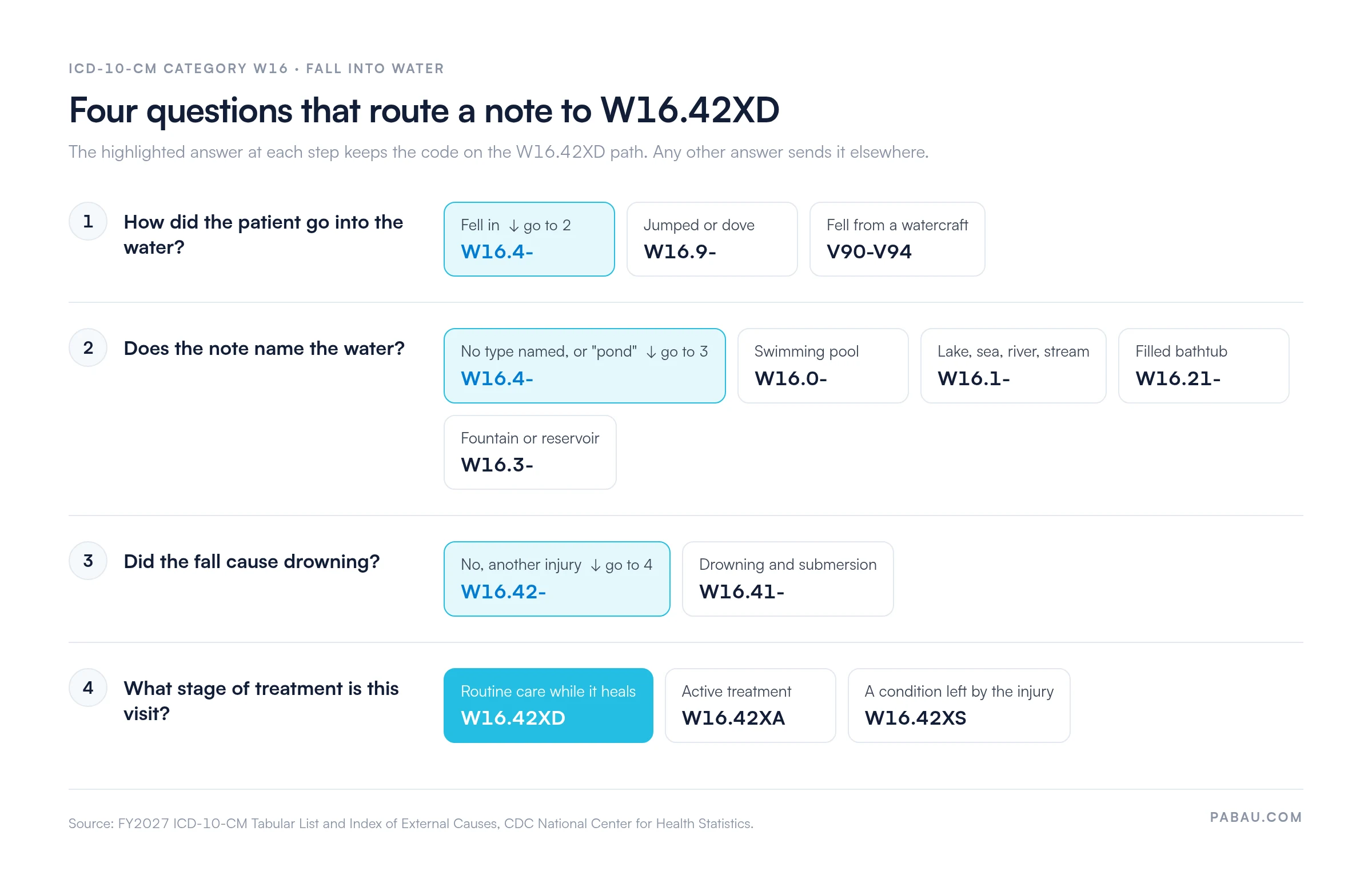
If the record is vague, the code is a guess. Check each of these before you assign W16.42XD, and query the provider when one is missing. The flow below shows where each answer sends the code.
A medical billing workflow that checks these points when the note is signed saves a query weeks later, when the claim comes back.
Each of these errors can be caught at the coding stage, before the claim reaches the payer.
A steady denial management process shows which of these keeps coming back, so you fix the cause once. Our list of claim denial codes explains the reason code on each remittance.
Pull every W16.42 claim from the last 90 days. For each one, check whether the note named the water type or described a jump. Those claims should have carried a more specific code. If several did, add a water-type prompt to your injury note template.
There is no national requirement to report external cause codes. The guidelines make them optional unless a state reporting mandate or a particular payer requires them, and they encourage voluntary reporting.
A W code tells the payer an accident happened. That can prompt coordination of benefits questions, or a check on whether another policy should pay first. Ask each payer about its rules for accident claims, and record the answer where your billing team can see it.
In many practices, the coder reads the visit note days later and picks the external cause code from memory. A vague note gets W16.42XD by default, and nobody checks whether the patient said where they fell. The follow-up claim then goes out by hand through a clearinghouse portal.
Pabau, the practice management platform we build, keeps the visit note and the claim in the same patient record. Its claims software for practices sends electronic claims through the Claim.MD clearinghouse as CMS-1500 and 837P submissions. It runs eligibility checks before the visit, brings remittances back into the system and tracks denials.
The result is a shorter path from the follow-up visit to payment. Your team spends its time on the few claims that need a query, instead of chasing all of them.
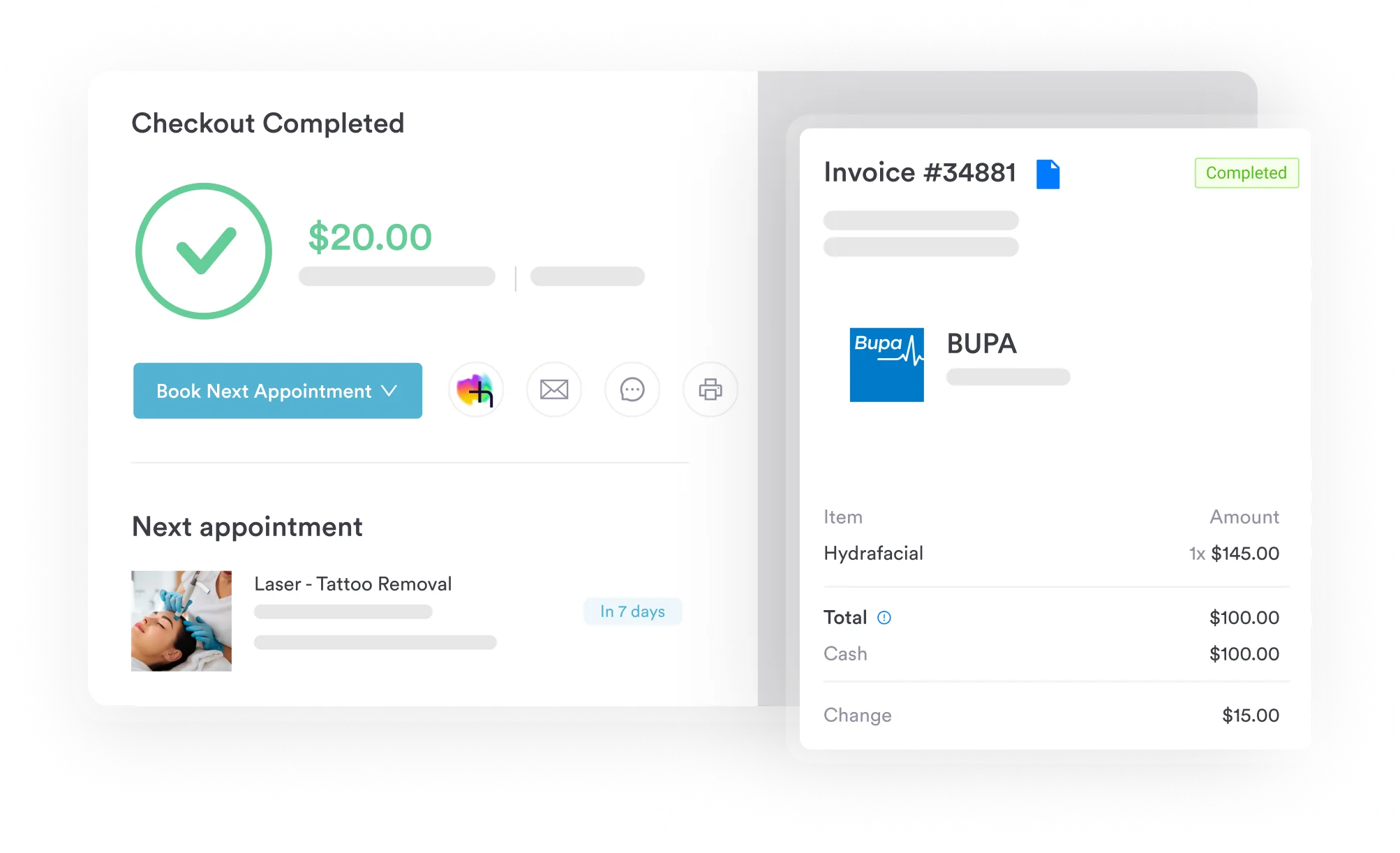

Pabau submits claims through Claim.MD, checks eligibility before the visit and tracks denials and remittances, so your team sees which follow-up claims need attention.

W16.42XD is the code a fall into water gets when the record names nothing else. It is correct when the note lacks the water type, and it is a missed detail when the patient could have told you.
Put the injury code in front of it, match the 7th characters, and leave the place and activity codes on the initial claim. When the note names the water or a dive, follow it to the specific code. Book a demo to see how Pabau tracks your injury follow-up claims from submission to remittance.

Need a clearinghouse that validates external cause codes before submission? Claim.MD clearinghouse overview explains how Pabau’s US clearinghouse partner processes 837P claims with real-time code edits.
Getting denials on injury claims and need a systematic response process? Denial codes in medical billing covers the most common CARC denial reasons and how to appeal them effectively.
Want to understand the full revenue cycle behind injury follow-up billing? Revenue cycle management overview walks through each stage from intake through payment posting.
Coding a fall where the note names a lake or a river? ICD-10 code W16.112D covers the follow-up visit after a fall into a natural body of water that struck the surface.
ICD-10 code W16.42XD means fall into unspecified water causing other injury, subsequent encounter. It records how an injury happened when the patient fell into water of an undocumented type and the injury was not drowning. The D marks routine care during healing.
Yes, W16.42XD is a billable ICD-10-CM code. It can never be the principal or first-listed diagnosis, so it always follows the injury code it explains.
W16.41XD is for a fall into unspecified water that caused drowning and submersion. W16.42XD is for the same fall when it caused any other injury, such as a fracture or a laceration. Both are subsequent-encounter codes.
No. Other water is subcategory W16.3-, used when the note names a type with no code of its own. A fountain or a reservoir are examples. W16.42XD is for unspecified water, where the note names no type. A fall into other water striking a wall is W16.332D.
Use W16.92XD when the patient jumped or dove into unspecified water and the injury was not drowning. W16.42XD is only for a fall. Query the provider if the note doesn’t say which happened.
No, not on the subsequent encounter. The official guidelines report place of occurrence, activity and external cause status codes at the initial encounter for treatment. They belong on the W16.42XA claim.
W16.42XS applies when the patient is treated for a condition caused directly by the original injury. Stiffness after a healed fracture is one example. Code the sequela condition first, then the injury code with S, then W16.42XS.