ICD-10 Code V91.84XS: Other burn due to burning watercraft
ICD-10 Code V91.84XS: overview and key facts ICD-10 Code V91.84XS identifies the...

Last Updated: Oct 30, 2026
Billable Code Specific Code
V91.35XA is the billable ICD-10-CM code for hit or struck by falling object due to accident to canoe or kayak, initial encounter.
It sits in category V91, Other injury due to accident to watercraft, and describes how the injury happened rather than the injury itself. It is always sequenced after the injury code for the nature of the injury, from the S00-T88 chapter. The 7th character A applies for as long as the patient receives active treatment.
Let Pabau's smart automation suggest the right codes, reduce claim denials, and keep your practice compliant—effortlessly.
Automate repetitive tasks and focus on what matters most—your patients.
Reduce coding errors and ensure compliance with the latest regulations.
Clean claims, fewer denials, and faster reimbursements.
Powerful insights and reporting to help your practice thrive.
HIPAA compliant SOC 2 certified GDPR-compliant Trusted by 4,000+ clinics worldwide

V91.35XA is a billable ICD-10-CM external cause code for a patient struck by a falling object after a canoe or kayak accident.
It can never be the principal or first-listed diagnosis. The injury code from S00-T88, such as a contusion, fracture or laceration, is listed first.
Use it only when the vessel itself had an accident, such as overturning or a collision. Injuries on board without an accident to the vessel belong in category V93.
The XA suffix covers every encounter during active treatment. XD covers routine care in the healing phase, and XS covers sequelae.
Pabau, our practice management and billing software, checks eligibility in real time through Claim.MD and tracks each claim’s status.
ICD-10 Code V91.35XA reports that a patient was hit or struck by a falling object after an accident to a canoe or kayak. The table below covers the reference fields to confirm before you submit a claim that includes it.
Each part of the descriptor narrows the code to one mechanism, one vessel type and one phase of care. Reading it piece by piece prevents the most common misapplications.
In practice, V91.35XA fits a paddler struck by stowed gear when a kayak capsizes. It also fits a branch that falls after a canoe hits an overhanging tree. It does not describe a drowning, a burn or a fall from the boat.
Other unpowered watercraft take the fifth character 8 instead, as in V91.38XS, the sequela code for that vessel group. The decision path below runs the three checks in the order a coder should apply them.
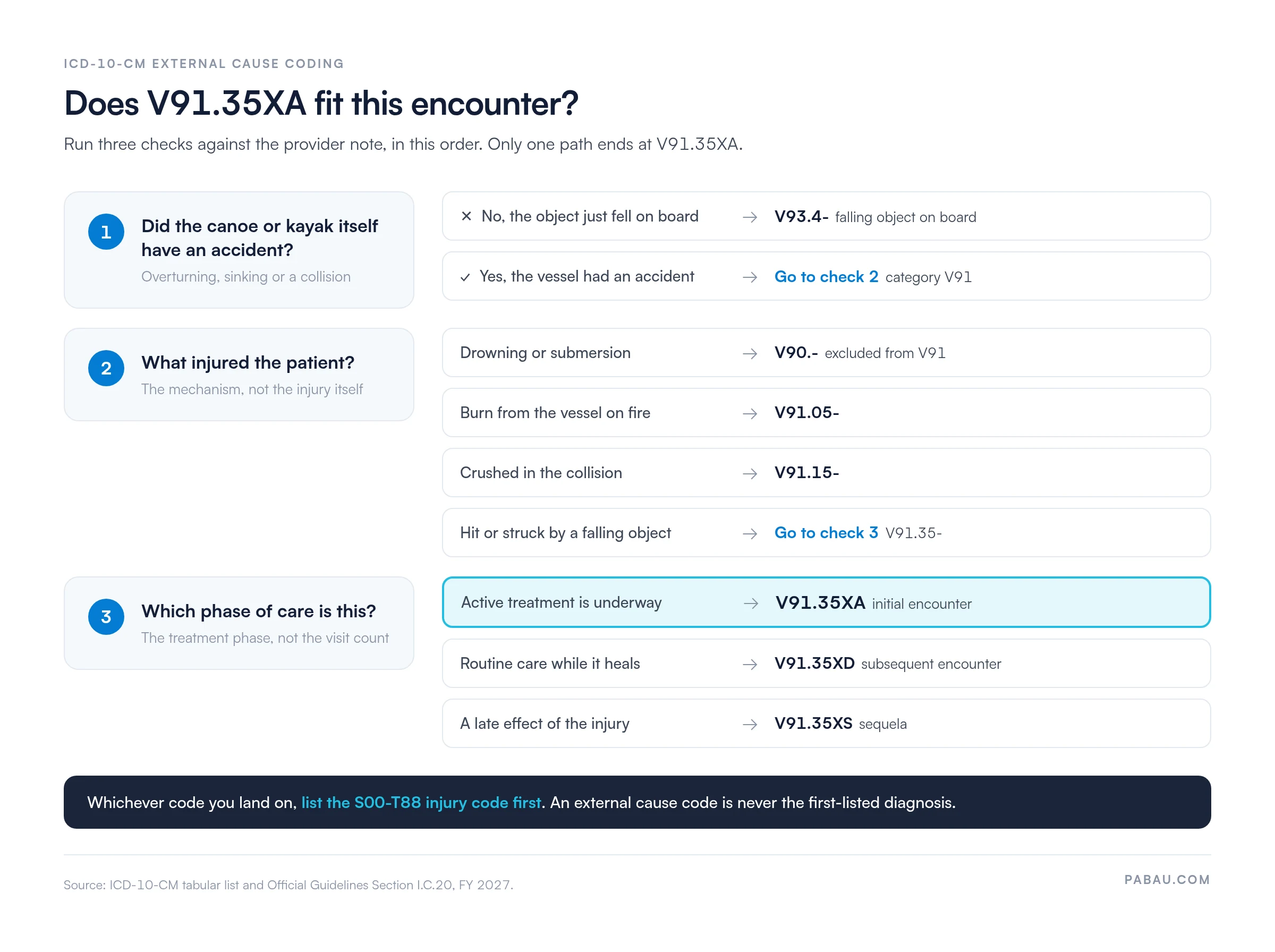
The 7th character is a frequent source of claim errors on V91-series codes. Under the CMS ICD-10-CM coding guidelines, each extension reflects the phase of treatment rather than the number of visits.
The practical rule: If the provider is still actively treating the injury, use XA. The move to XD happens when the note documents that active treatment is complete.
The tabular list sets clear boundaries for V91.35XA through notes at the category and subcategory level. Coding outside them creates mismatches that payers can flag on audit.
What category V91 includes: Any injury except drowning and submersion that results from an accident to watercraft. Subcategory V91.3 narrows that to injuries from being hit or struck by a falling object.
What it excludes, and the codes to use instead:
V91.35XA is an external cause code under ICD-10-CM Official Guidelines Section I.C.20. External cause codes explain how an injury happened, and they are never sequenced first on a claim. Understanding medical billing fundamentals helps coders place this code correctly within a multi-code encounter.
Take a kayaker whose boat capsizes against a dock. A cooler strapped to the deck falls and cuts the scalp. Build the code set for that encounter in this order:
The guidelines report the activity, place and status codes once, at the initial encounter only. V91.35XA itself can follow the injury code on every encounter for that injury, with the 7th character updated as care progresses.
V91.35XA can never be a principal or first-listed diagnosis. Section I.C.20 requires it to accompany a code from another chapter that identifies the nature of the injury.
Code the S or T injury first, then add V91.35XA. Before you pick the V91.3 subcategory, confirm the note describes an accident to the canoe or kayak itself. If the object simply fell on board, category V93 applies instead.
Watercraft codes change meaning with a single character. The table below lists the codes coders most often confuse with V91.35XA, with the official descriptor for each.
Cross-reference with the AAPC Codify ICD-10-CM lookup or the CDC/NCHS ICD-10-CM web tool. Confirm the vessel type and the injury mechanism before you finalize the code. Pabau’s library of diagnostic codes covers many of the neighboring watercraft codes as well.
The claim only holds if the provider note supports each element of the code. Strong medical billing compliance begins at documentation, not at code entry.
The provider note must contain:
Query the treating provider when the note does not say what happened to the vessel or what struck the patient.
Prior authorization depends on the procedure codes and the first-listed injury code, not on V91.35XA. No payer authorizes care on the strength of an external cause code alone.
The ICD-10-CM guidelines set no national requirement to report external cause codes. Reporting becomes mandatory where a state injury reporting mandate or a payer policy demands it. Check each payer’s rules before you decide whether to include the Y92, Y93 and Y99 codes.
Liability coordination: V91-series codes can prompt a payer to look for third-party liability, such as a rental outfitter or tour operator. Payers may send the patient an accident questionnaire, and a complete note shortens that process.
Submitting claims through Pabau’s Claim.MD clearinghouse integration checks the patient’s eligibility in real time. Coverage problems then surface before the claim leaves the practice.
Effective denial management on watercraft injury claims starts with the errors payers and clearinghouse edits catch. The patterns below cover the most common rejections on V91.35XA claims.
Reviewing denials against the clean claim process shows which code-set combinations to audit before they build a receivables backlog. Pabau’s claims management software tracks each claim from submission to payment or denial.
Run a monthly denial report filtered to the V90-V94 block. If D-extension denials cluster, a coder is probably counting visits instead of reading the treatment phase. A short team refresher on 7th-character logic usually fixes the pattern faster than working each denial alone.
Many practices still key injury claims by hand from the provider note. Each V91.35XA claim then depends on a coder catching the sequencing, the vessel type and the 7th character unaided.
Pabau turns the invoice from the visit into an electronic CMS-1500 claim through Claim.MD. It checks the patient’s eligibility before treatment and tracks each claim through acceptance, payment or denial.
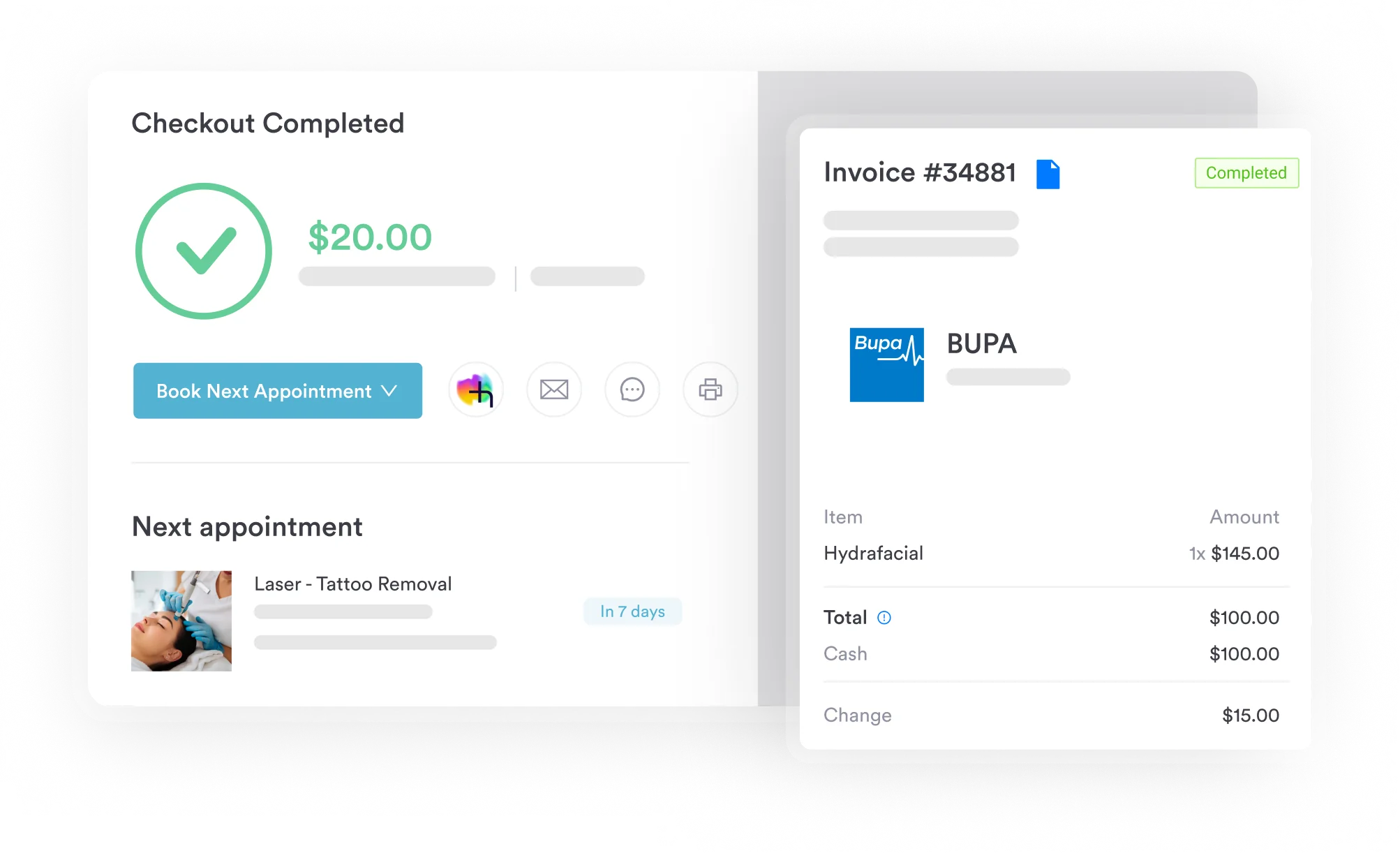
Remittance advice comes back into Pabau and ties each payment to its claim. Your team sees a rejected watercraft injury claim in the same system where the note lives, so the fix starts sooner.

Pabau’s Claim.MD integration turns visit invoices into electronic claims, checks eligibility in real time and tracks each claim’s status. Your team catches rejected injury claims sooner.

V91.35XA earns its place on a claim only when the note proves three facts. The canoe or kayak had an accident, a falling object struck the patient, and active treatment is still underway. If any one of those is missing, the right code is a different one.
Pair it with the specific S or T injury code, and report the activity and place codes once. Query the provider when the vessel or mechanism is vague. Those habits feed straight into revenue cycle management, because every clean first submission is one less resubmission to chase.
Book a demo to see how Pabau tracks every injury claim from eligibility check to payment.

Need to understand how external cause codes fit into the billing process? Medical billing fundamentals explains how diagnosis codes, procedure codes, and external cause codes work together on a clean claim.
Struggling with injury claim denials? Denial codes in medical billing covers the most common CARC reason codes and resolution steps for injury-related encounters.
Want to check eligibility before submission? How Claim.MD works as a clearinghouse walks through how Pabau routes claims and checks eligibility in real time.
ICD-10 Code V91.35XA is the billable external cause code for a patient hit by a falling object after a canoe or kayak accident. It covers the initial encounter. It describes how the injury happened and is sequenced after the injury code for the nature of the injury.
Yes, V91.35XA is a billable ICD-10-CM code valid for fiscal year 2027. It cannot be the principal diagnosis, so it always follows an injury code from the S00-T88 chapter.
V91.35XA applies while the patient receives active treatment for the injury, such as laceration repair or fracture management. V91.35XD applies to routine care in the healing or recovery phase after active treatment ends. The treatment phase decides the extension, not the visit count.
List the injury code first, such as S01.01XA for a scalp laceration. Then add V91.35XA as the external cause. At the initial encounter, add Y93.16 for canoeing or kayaking, a Y92 place code and a Y99 status code where the record supports them.
No. ICD-10-CM Official Guidelines Section I.C.20 states that external cause codes can never be the principal or first-listed diagnosis. V91.35XA always follows the code for the injury itself.
The common triggers are V91.35XA listed as the principal diagnosis and a D extension used during active treatment. Others are V91.3 chosen when the vessel had no accident, repeated Y-codes on later visits and a missing or unspecified injury code.