

ICD-10 Code S42.444P: Medial epicondyle fracture, right humerus
ICD-10 Code S42.444P: full descriptor and code validity ICD-10 Code S42.444P car...

Last Updated: Oct 13, 2026
Billable Code Specific Code
V90.22XS is the billable ICD-10-CM code for drowning and submersion due to falling or jumping from burning fishing boat, sequela.
The "S" seventh character marks a late-effect visit. By then the drowning has resolved and the patient returns with a residual condition. Two mistakes drive most denials on this code. Coders apply it during active treatment, or submit it without a paired primary diagnosis. The placeholder "X" at position 6 is mandatory, and dropping it makes the code invalid.
Let Pabau's smart automation suggest the right codes, reduce claim denials, and keep your practice compliant—effortlessly.
Automate repetitive tasks and focus on what matters most—your patients.
Reduce coding errors and ensure compliance with the latest regulations.
Clean claims, fewer denials, and faster reimbursements.
Powerful insights and reporting to help your practice thrive.
HIPAA compliant SOC 2 certified GDPR-compliant Trusted by 4,000+ clinics worldwide

V90.22XS covers drowning from a burning fishing boat coded at a sequela encounter, not during active treatment.
The placeholder X at character position 6 is mandatory. Omit it and the code is invalid, so the claim is rejected automatically.
V90.22XS is an external cause code and cannot be submitted as the sole or primary diagnosis on any claim.
Pabau’s claims management software supports accurate code pairing and submission through its Claim.MD clearinghouse integration.
ICD-10 Code V90.22XS is a billable, valid ICD-10-CM code for fiscal year 2026. Its full official descriptor is: Drowning and submersion due to falling or jumping from burning fishing boat, sequela.
The code sits within category V90, drowning and submersion due to accident to watercraft. That category falls under ICD-10-CM Chapter 20, external causes of morbidity (V00-Y99), per the CDC/NCHS ICD-10-CM web tool.
Two elements make this code unique within the V90 category. First, the mechanism is specific. The watercraft was on fire when the patient fell or jumped. That separates it from codes covering capsizing, sinking, or swamping.
Second, the encounter type is sequela. The coder applies this code only after the acute drowning episode has fully resolved. The patient must be returning for care of a documented residual condition it left behind.
Each character in V90.22XS carries a distinct clinical meaning. Coders who understand the structure catch format errors before submission rather than during denial review. The CMS ICD-10-CM official tabular list defines the hierarchy below.
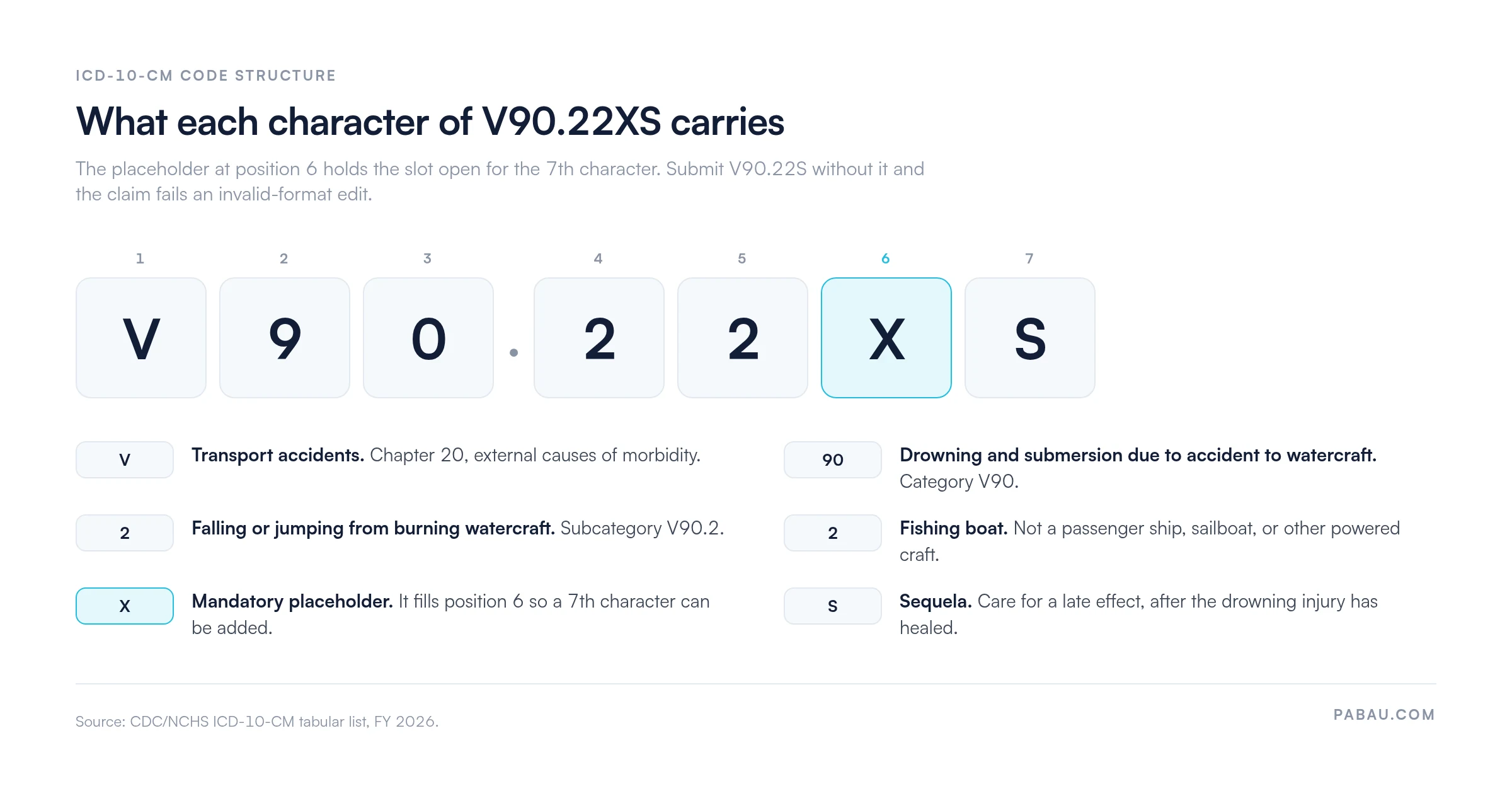
The placeholder X is governed by ICD-10-CM Official Guidelines Section I.A.4. It holds the sixth character position open so the code can carry a meaningful 7th character. Submitting V90.22S (six characters, no placeholder) generates an invalid-format edit at any clearinghouse or payer system. Record the full seven-character string every time, in the note and on the claim.
All three codes share the same injury mechanism. The only variable is when, within the treatment timeline, the encounter occurs. Selecting the wrong 7th character is one of the most common compliance errors on external cause codes. It also carries audit risk, because it misstates whether the patient is still in active treatment.
One documentation test settles the choice. The physician note must state that the drowning episode has resolved, and that the current condition follows directly from it.
A note describing pulmonary edema from a drowning last week supports V90.22XD. A note describing cognitive deficits from anoxic brain injury eight months ago, with the original injury documented as healed, supports V90.22XS.
Per the ICD-10-CM Official Guidelines Section I.B.10, a sequela code belongs on the encounter for the late effect rather than on the injury.
Sequela coding for drowning injuries turns up most often in rehabilitation, neurology, and pulmonology. Patients return months or years after the acute event with documented late effects.
Each scenario below requires the physician note to connect the residual condition to the original drowning by name, not merely by implied temporal proximity.
Three elements in the documentation support V90.22XS. The note must identify the original drowning event as the cause. It must state that the original injury has healed or resolved. It must also link that event to the residual condition being treated at this visit.
V90.22XS is an external cause code under ICD-10-CM Chapter 20. Per ICD-10-CM Official Guidelines Section I.C.20.a, external cause codes are supplementary and are never reported as the primary or sole diagnosis on a claim.
Every claim using V90.22XS requires at least one principal diagnosis code from another chapter describing the actual condition being treated. The same holds for every other Chapter 20 code. A sequela visit after a fall on icy steps, coded W00.1XXS, still needs its primary diagnosis first.
Practice management software like Pabau pairs the codes as the claim is built, so a Chapter 20 code never leaves on its own. Its claims management software flags the missing principal diagnosis before submission.
Sequencing rule: the condition code (G93.1, J84.10, etc.) is listed first as the reason for the visit. V90.22XS follows as an additional code providing the external cause context.
Payers differ on whether they require external cause codes, but the code pair produces cleaner data and is strongly encouraged under ICD-10-CM guidelines. A clean claim carries both codes whenever the documentation supports the pairing.
Run a quick pre-submission check: does the claim have at least one code from Chapters 1-19 or 21 before V90.22XS appears? If V90.22XS is the only diagnosis on the claim, the clearinghouse will reject it. Build a two-code minimum rule into your coding workflow for all Chapter 20 external cause codes.
The V90 category has 30+ sibling codes, several differing only by vessel type or mechanism. Selecting the wrong sub-code is a common specificity error. The AAPC ICD-10-CM code lookup provides a complete V90 hierarchy for cross-reference.
The most common specificity error is reaching for V90.02XS when the vessel was on fire. V90.0 codes cover a watercraft that overturned, and V90.1 covers one that sank. Neither involves a fire, and neither requires the patient to fall or jump. The note should say “burning” or “fire on vessel” to support V90.22XS.
The mechanism changes again if a blast on board the fishing boat caused the injury rather than drowning. That late-effect encounter codes to V93.52XS, which sits in the V93 category for accidents on board a watercraft.
Medicare does not require external cause codes for claim processing, but many state Medicaid programs and commercial payers do. Submitting V90.22XS alongside a properly sequenced primary diagnosis code improves data completeness and reduces audit risk, whatever the payer policy says.
Pabau’s Claim.MD clearinghouse integration reaches thousands of US payers, and it screens ICD-10-CM codes against payer edits before the claim leaves the practice. Format and sequencing problems surface at that point rather than in a remittance advice weeks later.
Payer-specific considerations coders should verify before submission:
Five error types account for the majority of claim rejections and audit findings on V90.22XS claims. Each has a distinct root cause and a corresponding fix. Reading the denial codes that come back with those rejections shortens the correction cycle.
All five are caught by a pre-submission check, which costs far less staff time than working the denial afterwards.
Flag every V90.22XS claim for a dual-code check before submission. First, confirm the placeholder X sits at character 6. Second, confirm a non-Chapter 20 diagnosis code appears in position 1. Build these two checks into your billing system’s pre-submission validation rule set.
A missing placeholder or an unpaired external cause code usually surfaces when the remittance arrives. By then the claim is weeks old, and someone has to rebuild the documentation trail before resubmitting.
Pabau keeps the clinical note and the coded claim in the same patient record. The physician’s statement that the drowning has resolved sits beside the sequela code it supports. A coder or an auditor can follow that link without chasing paper.
Claims are then screened against payer edits through the Claim.MD clearinghouse integration. Format errors and missing principal diagnoses are caught before submission, so the denial never reaches the aging report.

Pabau’s integrated claims management submits ICD-10 codes through the Claim.MD clearinghouse, catching format errors and missing code pairs before they reach the payer. See how it fits your documentation workflow.

V90.22XS breaks on two structural rules far more often than on a clinical judgment call. The placeholder X must occupy position 6, and a primary condition code must always precede it on the claim.
The clinical trigger is the harder judgment. Sequela coding applies only once the physician has documented that the drowning injury resolved, and that this visit treats a late effect of it. Where that statement is missing, query for it rather than coding around it.
Build both checks into the pre-submission step and the code stops generating rework. Book a demo to see how Pabau validates code pairs before a claim reaches the payer.

Managing external cause code denials? Denial management in healthcare provides a structured framework for reducing repeat rejections on supplementary codes.
Looking for a compliance-ready claims submission workflow? Medical billing compliance outlines documentation standards and audit trail practices that support external cause code defensibility.
Decoding the reason code on a rejected claim? Electronic remittance advice explains how payers report a denial and what each adjustment code means.
Need the paperwork behind the claim? Superbill sets out what a practice captures at the encounter, so the diagnosis and procedure codes line up.
ICD-10 Code V90.22XS is the billable ICD-10-CM code for drowning after falling or jumping from a burning fishing boat, at a sequela encounter. The “S” 7th character indicates the patient is presenting with a late effect of the original drowning injury, after the acute episode has resolved.
Yes. V90.22XS is a billable, valid ICD-10-CM code for fiscal year 2026. However, it cannot be submitted as the sole or primary diagnosis on a claim. It must always be paired with a principal diagnosis code from another ICD-10-CM chapter describing the residual condition being treated.
All three codes describe drowning from falling or jumping from a burning fishing boat. The 7th character distinguishes when the encounter occurs. V90.22XA is the initial encounter during active treatment. V90.22XD is a subsequent encounter while the injury is still healing. V90.22XS is a sequela encounter, used only after the original injury has fully resolved and the visit is for a documented late effect.
The X at position 6 is a mandatory dummy placeholder. ICD-10-CM convention requires it whenever a code needs a 7th character but has no meaningful 6th character. Omitting it produces a six-character code (V90.22S) that is structurally invalid and will be rejected by any clearinghouse or payer system. Per ICD-10-CM Official Guidelines Section I.A.4, the placeholder X must appear in every code that requires it.
No. V90.22XS is a Chapter 20 external cause code and is explicitly classified as a supplementary code under ICD-10-CM Official Guidelines Section I.C.20.a. A claim submitted with V90.22XS as the only diagnosis will be rejected. The principal diagnosis code describing the condition being treated (anoxic brain injury, pulmonary sequelae, etc.) must appear first.
Five denial triggers account for most rejections. The first is a missing placeholder X, which produces an invalid code format. The second is using the S encounter type while active treatment is still ongoing. The third is submitting the external cause code without a paired primary diagnosis. The fourth is selecting the wrong vessel sub-code, such as an overturning code on a burning-vessel case. The fifth is documentation that never links the drowning event to the residual condition.




