ICD-10 Code S42.444P: Medial epicondyle fracture, right humerus
ICD-10 Code S42.444P: full descriptor and code validity ICD-10 Code S42.444P car...

Last Updated: Oct 13, 2026
Billable Code Specific Code
V93.00XD is the billable ICD-10-CM code for burn due to localized fire on board merchant vessel, subsequent encounter. It sits in Chapter 20 (External Causes of Morbidity) and never leads a claim as the principal diagnosis.
A burn code from the T20-T32 range goes first, then V93.00XD explains the cause. The 7th character carries the rest of the meaning. "D" covers follow-up care once active treatment has finished, and "A" belongs to the initial encounter.
Let Pabau's smart automation suggest the right codes, reduce claim denials, and keep your practice compliant—effortlessly.
Automate repetitive tasks and focus on what matters most—your patients.
Reduce coding errors and ensure compliance with the latest regulations.
Clean claims, fewer denials, and faster reimbursements.
Powerful insights and reporting to help your practice thrive.
HIPAA compliant SOC 2 certified GDPR-compliant Trusted by 4,000+ clinics worldwide

V93.00XD is a billable ICD-10-CM external cause code, valid for FY 2025 and 2026.
The 7th character ‘D’ signals a subsequent encounter, where active treatment is complete and healing continues.
Never sequence V93.00XD as the principal diagnosis. A burn injury code from the T20-T32 range comes first.
Three facts decide the code: the vessel is a merchant ship, the burn came from a localized fire, and the visit is follow-up care.
Pabau’s claims management software flags sequencing errors and tracks external cause codes before submission.
ICD-10 Code V93.00XD is the billable external cause code for a burn from a localized fire on board a merchant vessel. The D character marks a follow-up visit. The code explains how the burn happened, so it is always sequenced after a T20-T32 burn code and never first.
Use the reference table below to confirm the code’s properties before you submit. Check them against the current fiscal year’s tabular list, because verifying against a superseded edition is the most common error here.
The code documents a thermal burn caused by a localized fire aboard a merchant vessel during a subsequent care encounter. Three elements must all be present to use it correctly.
As an external cause code, V93.00XD explains how the injury happened. It says nothing about burn severity, body surface area, or depth. First, second, or third degree comes from the accompanying T20-T32 code, which must always lead the claim.
The 7th character is the single most consequential digit in a V93 code. Choosing the wrong one misstates the encounter and puts the reimbursement at risk.
The ICD-10-CM Official Guidelines published by CMS and NCHS define a subsequent encounter as any visit after active treatment has concluded. That includes routine cast or splint changes, medication adjustments, and follow-up evaluations.
Active treatment is not limited to inpatient care. A patient discharged from a burn center may still have an open wound under specialist management. That patient remains in the initial phase until the management ends. Reading the character off the discharge date rather than the treatment status is where coders go wrong.
Several neighboring codes are easy to confuse. Use the comparison table to confirm the right code before submitting.
The V91 versus V93 distinction is the most commonly misapplied. V91 applies when the watercraft itself suffers a catastrophic event, such as fire, flooding, sinking, or collision. V93 applies to injuries on board a vessel that may still be operational. Verify vessel type from the patient’s incident report or maritime employer documentation before coding.
V91 splits by vessel as well. A fishing boat that burns and becomes the casualty takes V91.02XD on the subsequent encounter.
Mechanism separates these codes as sharply as vessel type does. A burn from a blast, rather than a sustained fire, belongs with the V93 explosion codes instead. The sequela of an explosion aboard a fishing boat, for example, is V93.52XS.
Four questions separate V93.00XD from every code around it, and they have to be answered in order. The chart below runs through them.
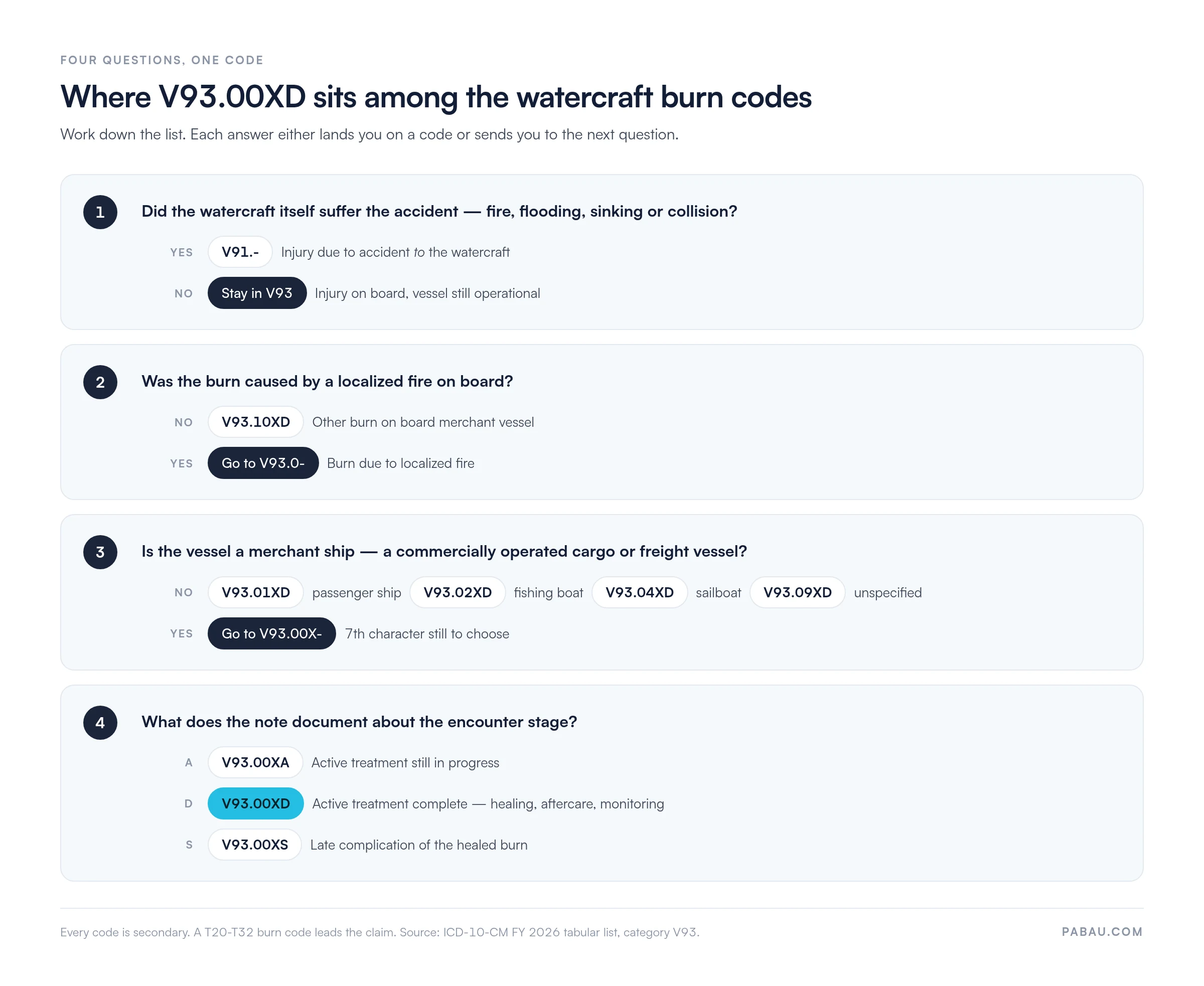
The V93 category carries several official notations that directly affect code selection. Ignoring them is a reliable path to a denial or an audit flag.
These notes come directly from the CMS ICD-10-CM tabular list. An Excludes1 note is a hard prohibition, so both codes cannot appear on the same claim. An Excludes2 note is informational, and it identifies a related but distinct condition that may legitimately co-exist.
ICD-10-CM Official Guidelines Section I.C.20 governs external cause codes. Follow these steps in order for every claim involving ICD-10 Code V93.00XD.
Audit your documentation before the first follow-up visit. If the chart note does not name the vessel as a merchant ship, the coder has no basis for V93.00XD. The note must also identify the injury as a burn from a localized fire. A maritime incident intake note completed at the initial encounter hands every later coder the vessel type and the mechanism in writing.
External cause codes require source documentation that the visit note alone rarely provides. Billing teams should request and retain these records for any V93.00XD claim.
Payers conducting post-payment audits on external cause codes routinely request the underlying incident documentation. Meeting medical billing compliance requirements means retaining this documentation with the claim file, not solely in the clinical record.
External cause codes generate a disproportionate share of claim edits. These are the denial patterns coders see most often on V93.00XD claims, along with the fix for each.
Knowing the common denial codes a payer returns helps a billing team fix a V93.00XD claim on the first appeal rather than the third. Each of the five patterns above maps to a specific remittance code, so the rework is usually mechanical once the reason is read correctly.
Merchant vessel burn injuries raise payer questions that a plain code lookup does not answer. Three payer contexts create distinct billing scenarios.
Medicare does not require external cause codes for claim processing, but it does accept them, and CMS encourages their use for public health reporting. Submitting V93.00XD alongside the principal T20-T32 code typically causes no edit, and omitting it has no impact on payment.
Medicaid policies vary by state. Confirm with the specific state plan before relying on external cause codes for a coverage determination.
Merchant vessel crew members injured during employment may have claims routed through Jones Act maritime workers’ compensation rather than standard health insurance.
Workers’ compensation payers often require external cause codes to establish the occupational nature of the injury. That makes V93.00XD more significant here than in a standard health plan.
The Jones Act creates legal rights and remedies that sit outside ICD-10 coding scope. Confirm with the employer’s maritime insurer which code set and claim format apply, and keep coding guidance separate from legal advice on maritime liability.
Where the burn resulted from a third-party incident, such as equipment failure or another crew member’s negligence, the claim may route to a liability insurer. Liability carriers typically require detailed external cause coding to establish the mechanism and location of injury.
V93.00XD plus the accompanying T20-T32 burn code provides that narrative in coded form. Retaining the maritime incident report with the claim file is standard practice in these cases.
A sequencing error on an external cause code usually surfaces after the payer has already rejected the claim. By then a coder has to reopen the chart, find the T20-T32 code that should have led, and resubmit. The visit was coded correctly in clinical terms, and the money still arrives weeks late.
Practice management software like Pabau closes that loop before the claim leaves. Pabau is built for cleaner claims management. A Chapter 20 code sitting in the first position is flagged at submission, not at the payer. Claims also route through the Claim.MD clearinghouse, which validates code combinations before they reach a payer.
The documentation side matters just as much on a V93.00XD claim. The incident report, the vessel classification evidence, and the follow-up note all sit on the patient record. An audit request is then answered from one place instead of three.
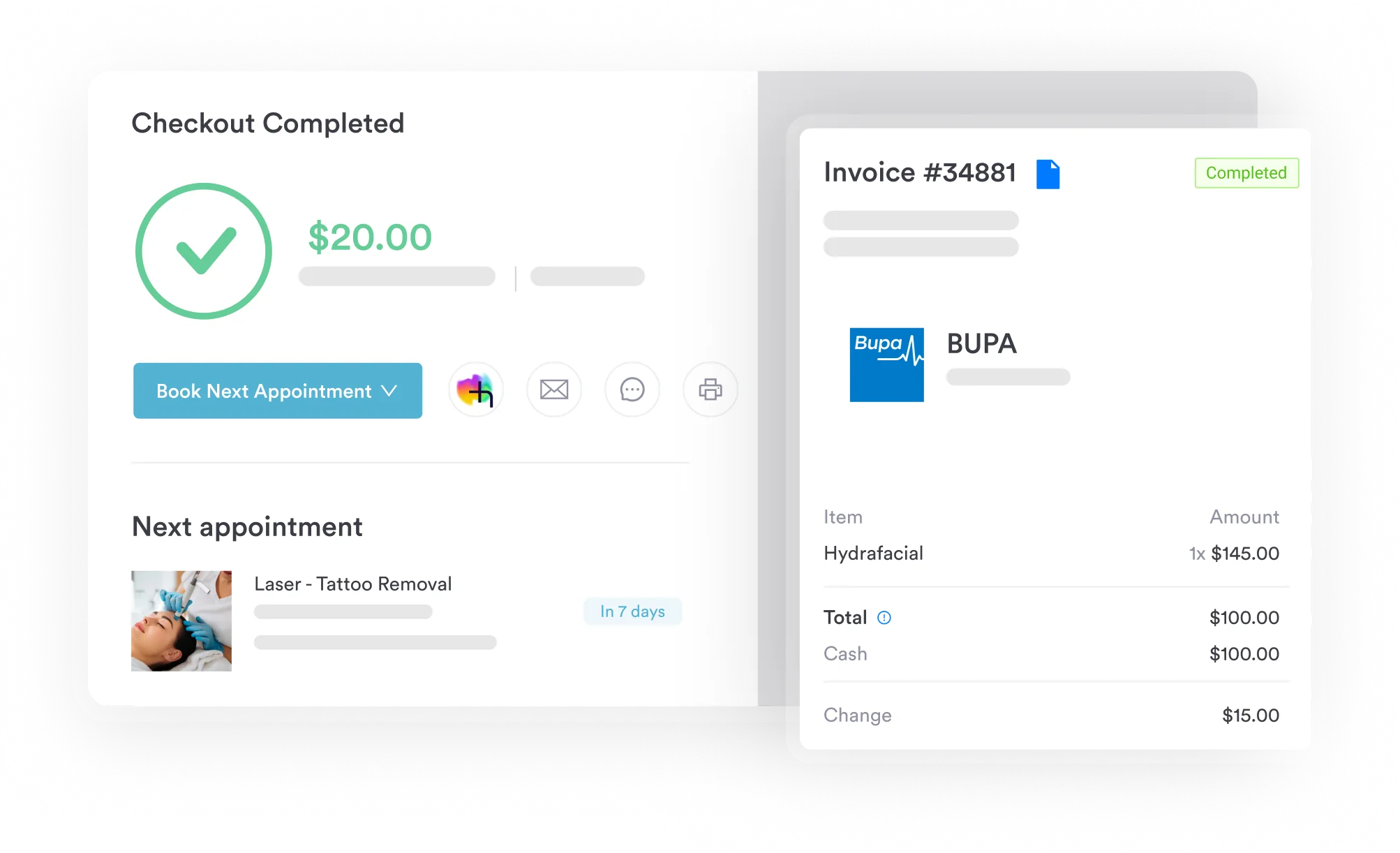

Pabau’s claims management software flags external cause codes sitting in the first position. It keeps supporting documentation on the patient record and validates claims through Claim.MD before submission.

V93.00XD is a narrow code, and that narrowness is what makes it fragile. Three documented facts hold it up: a merchant vessel, a localized fire, and a visit that happens after active treatment ends. Lose any one of them in the chart and the code becomes unsupportable at audit, however well the claim was coded at the time.
So the work belongs at the initial encounter, not the follow-up. Capture the vessel classification and the burn mechanism while the incident report is still in reach, and every subsequent visit inherits a defensible code. The trade-off is a few minutes of intake work against a denial that surfaces months later.
Pabau keeps that evidence and the claim in the same system, so a coder is never reconstructing an incident from memory. Book a demo to see how Pabau handles external cause code sequencing and the documentation behind it.

Need guidance on managing denials across external cause code families? Denial management in healthcare covers the workflows that reduce rework on complex code submissions.
Looking for a structured approach to clean claim submission? Clean claim requirements outlines the elements every claim needs before it reaches a payer.
Want to understand how clearinghouse validation works? Electronic remittance advice explains how ERAs confirm payment outcomes and flag adjustment codes after submission.
Working through the wider billing process? What is medical billing walks through the full path from encounter to payment.
ICD-10 Code V93.00XD is a billable external cause code for a burn due to localized fire on board a merchant vessel. The D character marks a subsequent encounter, meaning active wound treatment is complete. It belongs to Chapter 20 and must always be coded alongside a principal T20-T32 burn diagnosis.
Yes. V93.00XD is billable as of ICD-10-CM FY 2025 and FY 2026. It is specific enough to appear on a medical claim. It must still be submitted as a secondary code, alongside a principal burn diagnosis from the T20-T32 range.
V93.00XA applies when active burn treatment is still in progress, such as the initial ED visit, burn center admission, or first surgical debridement. V93.00XD applies once active treatment is complete and the patient is in a follow-up, healing, or aftercare phase. Using XA for a routine wound check visit is a top denial trigger.
No. External cause codes from Chapter 20 can never be sequenced as the principal diagnosis under CMS ICD-10-CM Official Guidelines Section I.C.20. A burn injury code from the T20-T32 range must always lead the claim. V93.00XD is a supplementary code that explains how the burn occurred.
The accompanying principal code comes from the T20-T32 burn range in ICD-10-CM Chapter 19. It specifies the burn site and the depth, whether first, second, or third degree. Sites run T20 for head and neck, T21 trunk, T22 shoulder and upper limb, and T23 wrist and hand. T24 covers the lower limb, T25 ankle and foot, and T30-T31 the extent of body surface. The 7th character on the T-code must also match the encounter stage, so D for subsequent.
Use the D subsequent encounter character once the patient’s active burn treatment is complete, including wound debridement, skin grafting, and burn center management. Follow-up visits for dressing changes, scar assessment, suture removal, and routine wound monitoring all qualify as subsequent encounters. If any active surgical or specialist wound management is ongoing, the encounter is still initial (A).