ICD-10 code V43.42XS: Car boarding injury, sequela
ICD-10 code V43.42XS covers the late effects of a car boarding injury ICD-10 cod...

Last Updated: Oct 7, 2026
Billable Code Specific Code
S00.222D is the billable ICD-10-CM code for blister (nonthermal) of left eyelid and periocular area, subsequent encounter. It covers a fluid-filled blister on the left eyelid or nearby skin, caused by friction, pressure, or minor trauma. The D means active treatment is over and the patient is back for routine healing-phase care.
Side and cause decide the code. A right-sided blister is S00.221D, a heat burn of the left eyelid is T26.02XD, and a bruised left eyelid is S00.12XD.
Let Pabau's smart automation suggest the right codes, reduce claim denials, and keep your practice compliant—effortlessly.
Automate repetitive tasks and focus on what matters most—your patients.
Reduce coding errors and ensure compliance with the latest regulations.
Clean claims, fewer denials, and faster reimbursements.
Powerful insights and reporting to help your practice thrive.
HIPAA compliant SOC 2 certified GDPR-compliant Trusted by 4,000+ clinics worldwide

S00.222D codes a nonthermal blister of the left eyelid or periocular area at a subsequent encounter, when the patient is back for routine healing-phase care.
Use S00.221D for the right side, S00.229D when no side is documented, and S00.222A while the blister is still under active treatment.
A blister caused by heat is a burn (T26.02X-), one caused by a chemical is a corrosion (T26.52X-), and a bruised left eyelid is S00.12X-.
Before the claim is built, the note should name the left side, a nonthermal cause, and a follow-up visit in the healing phase.
ICD-10 code S00.222D is the billable ICD-10-CM code for blister (nonthermal) of left eyelid and periocular area, subsequent encounter. It applies when a blister on the left eyelid or the skin around the left eye was caused by friction, pressure, or minor trauma. The patient has finished active treatment and is back for routine care while it heals.
The code sits in the injury chapter, under superficial injuries of the head. It is listed as billable in the FY2026 ICD-10-CM tabular list, so it can go on a claim as written.
The D in S00.222D marks a subsequent encounter. Per the ICD-10-CM Official Guidelines, Section I.C.19.a, D applies after the patient has completed active treatment. It covers routine care for the injury during the healing or recovery phase.
The 7th character follows the phase of care, not the number of visits or the clinician. A patient seen by a new physician who is still actively treating the blister keeps the A character. A patient back at the original practice for a healing check moves to D.
Do not swap the injury code for an aftercare Z code at these visits. The guidelines direct you to report the injury code itself with the D character for healing-phase care.
A nonthermal blister is a fluid-filled pocket that forms when the outer layers of skin separate after friction, pressure, or minor trauma. On the eyelid and periocular area it can follow rubbing from goggles, a tight mask strap, or a glancing injury. The periocular area takes in the skin of both lids and the tissue surrounding the eye socket.
The word nonthermal does the classifying work. ICD-10-CM keeps heat and chemical blisters out of this subcategory and codes them as burns or corrosions instead. Blisters that come from a disease, such as shingles or an allergic reaction, are coded to that condition, not to an injury code.
Typical follow-up findings for S00.222D include:
Each level of the code narrows the diagnosis until the 7th character finishes it. Only the full seven-character code is billable.
Most coding errors on this code come from three choices made out of order. Settle the cause of the blister first, then the side, then the phase of care, as the diagram below lays out.
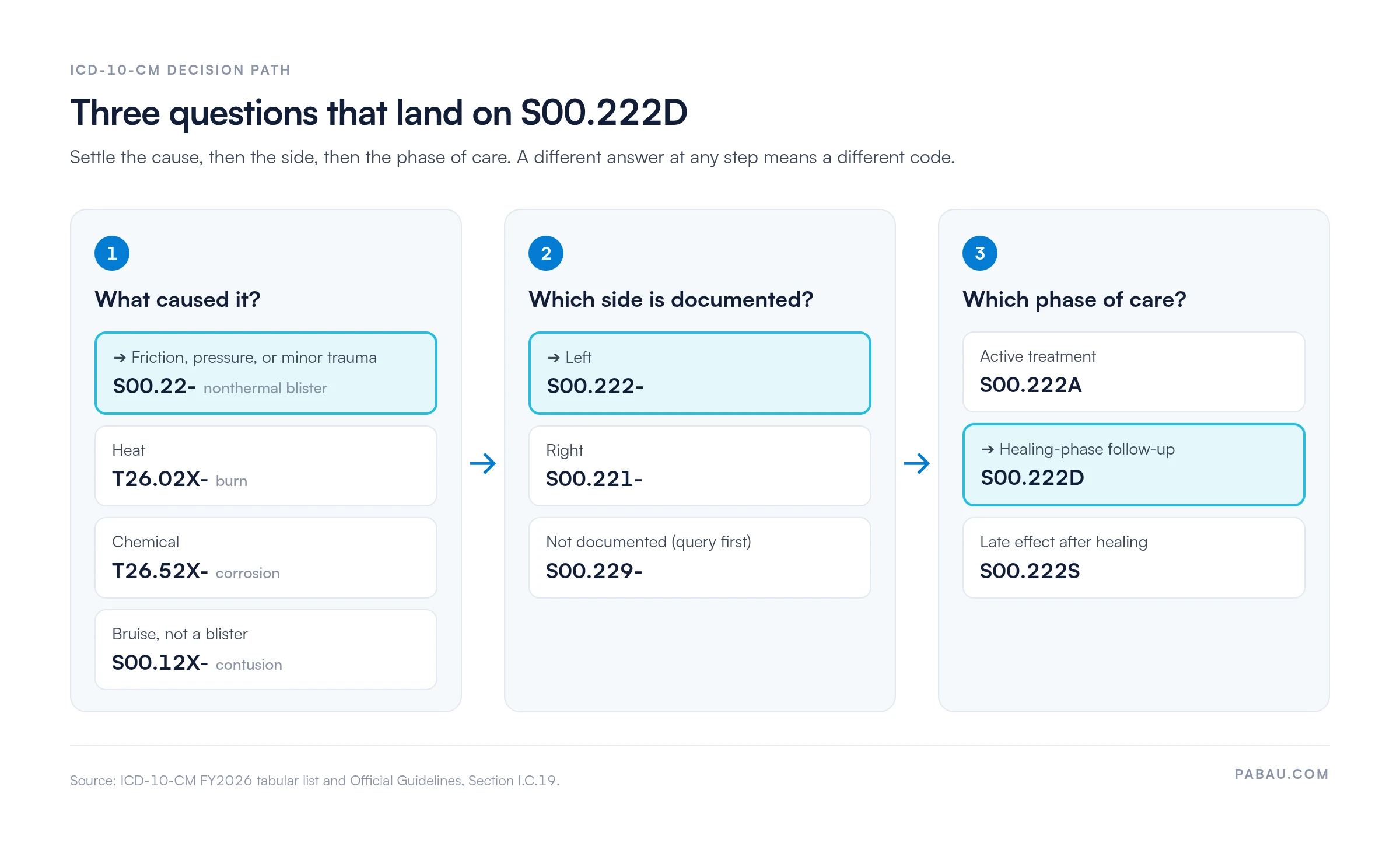
The table below lists the siblings in S00.22- and the codes this one is most often confused with.
When the note says only “eyelid blister”, query the provider for the side before you settle on S00.229D. A specific code supported by the record is always preferred over an unspecified one.
The tabular list carries notes at several levels above S00.222D. Each one changes what you can report alongside it.
Category S00 excludes injury of eye and orbit (S05.-) and open wound of head (S01.-). If the skin over the left eyelid is broken into an open wound, code the wound from S01.1- instead.
Subcategory S00.2 has an Excludes2 note for superficial injury of conjunctiva and cornea (S05.0-). Both can be reported together when the patient has a left eyelid blister and a separate injury to the surface of the eye.
Section I.C.19.b of the guidelines says superficial injuries are not coded when they accompany a more severe injury of the same site. If a deeper injury of the left eyelid is documented, that code takes the place of S00.222D.
Per the CMS ICD-10-CM Official Guidelines, the record must support each element of the code. Before submitting a clean claim, confirm these points in the note:
Look for the visit where active treatment ended before you assign S00.222D. If the left eyelid blister is still being drained or dressed for the first time, the visit is S00.222A. Once the patient returns only for a healing check, D is the right 7th character.
External cause codes from Chapter 20 explain how the injury happened. The CDC/NCHS ICD-10-CM tool lists them alongside the injury chapter. Per Section I.C.20, an external cause code may be reported at each encounter while the injury is being treated, with the matching 7th character.
That means a D visit may carry the cause code with its own D character. The place, activity, and status codes stay off it, so a status code such as Y99.8 belongs on the initial claim only. No national rule requires external cause codes, so check your payer and state reporting rules.
S00.222D does not trigger prior authorization by itself. Authorization rules attach to the service billed with the diagnosis. Payers do expect the note to support the subsequent-encounter designation and the left side.
Denials on this code usually trace back to the 7th character, the side, or a truncated code. Effective denial management workflows treat each one as its own root cause.
A denied S00.222D claim comes back with an adjustment reason code on the remittance. Check it against our list of medical billing denial codes to see which row of the table applies.
Medicare and Medicaid follow the ICD-10-CM Official Guidelines for 7th character selection. Commercial payers generally mirror them, though local coverage policies can add documentation requirements. The AAPC ICD-10-CM code range lookup is a quick way to check neighboring codes before you resubmit.
Picking the right 7th character and side is the coder’s job. What happens to the claim afterward often sits in a separate portal, and the remittance arrives somewhere else again. Someone then rekeys the outcome into the patient record days later.
Pabau, the practice management and billing platform we build, keeps that chain in one record. It submits electronic claims through the Claim.MD clearinghouse and checks eligibility with 270/271 transactions before the visit.
It tracks each claim’s status and posts electronic remittance advice back to the patient record. Validation of required claim fields stops an incomplete claim before it goes out.
Your billing team then works from one record instead of three, which is the job of claims management software. When an S00.222D claim comes back, you see it next to the note that produced it. You can correct the code and resubmit in the same sitting.

Pabau submits claims through Claim.MD, checks eligibility before the visit, tracks claim status, and posts remittance back to the patient record.

S00.222D carries three decisions in one code: a nonthermal blister, the left side, and a healing-phase visit. Get any one wrong and a different code applies, from S00.221D to S00.222A to T26.02XD. The note has to support all three before the claim is built.
The cheapest fix is at the point of documentation. A minute spent confirming the cause and the phase of care costs far less than a rejected claim and a second wait for payment.
Want the note, the claim, and the remittance in one place? Book a demo and we’ll walk your billing team through it.

Need help reducing billing errors across injury codes? Medical billing compliance covers the documentation and claim-submission standards that prevent preventable denials.
Want to understand how clearinghouses validate claims? Medical claims clearinghouse explains how electronic claim routing and validation work before adjudication.
Looking for a billing fundamentals refresher? Revenue cycle management breaks down the end-to-end process from patient encounter to payment posting.
S00.222D is the billable ICD-10-CM code for blister (nonthermal) of left eyelid and periocular area, subsequent encounter. It is used when a friction, pressure, or trauma blister on the left eyelid is seen again during routine healing-phase care.
Yes. S00.222D is a specific, billable code. The headers above it, S00.2, S00.22, and S00.222, are not billable because they lack the 7th character that encounter-type reporting requires.
Only the side differs. S00.221D codes a nonthermal blister of the right eyelid and periocular area at a subsequent encounter, and S00.222D codes the same blister on the left. The 6th character carries laterality: 1 for right, 2 for left, 9 for unspecified.
No. A black eye is a contusion, which ICD-10-CM codes in the S00.1- family. A bruised left eyelid at a follow-up visit is S00.12XD, while S00.222D is reserved for a nonthermal blister.
Code it as a burn, not with S00.222D. A thermal burn of the left eyelid and periocular area is T26.02X-, and a chemical injury is the corrosion code T26.52X-. The nonthermal label in S00.22- exists to separate these cases.
Use D once active treatment is complete and the patient returns for routine care during healing. Wound checks, dressing changes, and follow-up visits fit here. A patient still receiving active treatment, even from a new clinician, keeps the A character.