ICD-10 code V43.42XS: Car boarding injury, sequela
ICD-10 code V43.42XS covers the late effects of a car boarding injury ICD-10 cod...

Last Updated: Oct 7, 2026
Billable Code Specific Code
S00.04XD is the billable ICD-10-CM code for external constriction of part of scalp, subsequent encounter. It applies when a patient returns for routine care while the scalp heals, after a band, ring, or hair tourniquet was removed.
The visit where the item is removed takes S00.04XA, so coding a follow-up with A is a common denial trigger. The X in position 6 is a required placeholder that lets the 7th character D sit in position 7.
Let Pabau's smart automation suggest the right codes, reduce claim denials, and keep your practice compliant—effortlessly.
Automate repetitive tasks and focus on what matters most—your patients.
Reduce coding errors and ensure compliance with the latest regulations.
Clean claims, fewer denials, and faster reimbursements.
Powerful insights and reporting to help your practice thrive.
HIPAA compliant SOC 2 certified GDPR-compliant Trusted by 4,000+ clinics worldwide

S00.04XD covers a follow-up visit for external constriction of part of the scalp, such as a tight band, ring, or hair tourniquet.
The 7th character D marks routine care during healing, while A covers active treatment and S covers a late effect.
The X in position 6 is a mandatory placeholder that lets the 7th character sit in position 7.
A scalp abrasion follow-up is coded S00.01XD, so confirm the injury type before you pick a code from S00.0-.
A W49.0- external cause code can name the constricting item, such as W49.01XD when hair caused the constriction.
ICD-10 Code S00.04XD is a valid, billable ICD-10-CM code for external constriction of part of the scalp at a subsequent encounter. The official descriptor is “External constriction of part of scalp, subsequent encounter,” and the code is valid in the current ICD-10-CM revision.
The code sits in chapter 19 (Injury, poisoning and certain other consequences of external causes), within category S00 for superficial injuries of the head. Other chapter 19 injury codes are covered in our ICD-10-CM code guides.
External constriction means an item has wrapped around or pressed into part of the scalp tightly enough to compress the tissue underneath. Typical causes are a tight hair elastic, a band or ring, string or thread, and strands of hair wound into a hair tourniquet.
The D character applies once the item has been removed and the patient returns while the scalp heals.
Scalp abrasions are coded elsewhere. The CMS ICD-10-CM tabular list splits scalp injuries by type at the 5th character, and an abrasion is S00.01- (S00.01XD at a follow-up visit). “Superficial injury of scalp” is the title of the non-billable category S00.0, not the meaning of this code.
Billability is still subject to payer policy and documentation support. The code is valid on professional claims when paired with an appropriate E&M or procedure code. The medical record must also show a follow-up visit for a previously treated scalp constriction.
Every character in S00.04XD carries a specific meaning within the ICD-10-CM classification system. Reading the structure prevents the three most common assignment errors: the wrong injury type, a missing placeholder X, and the wrong 7th character.
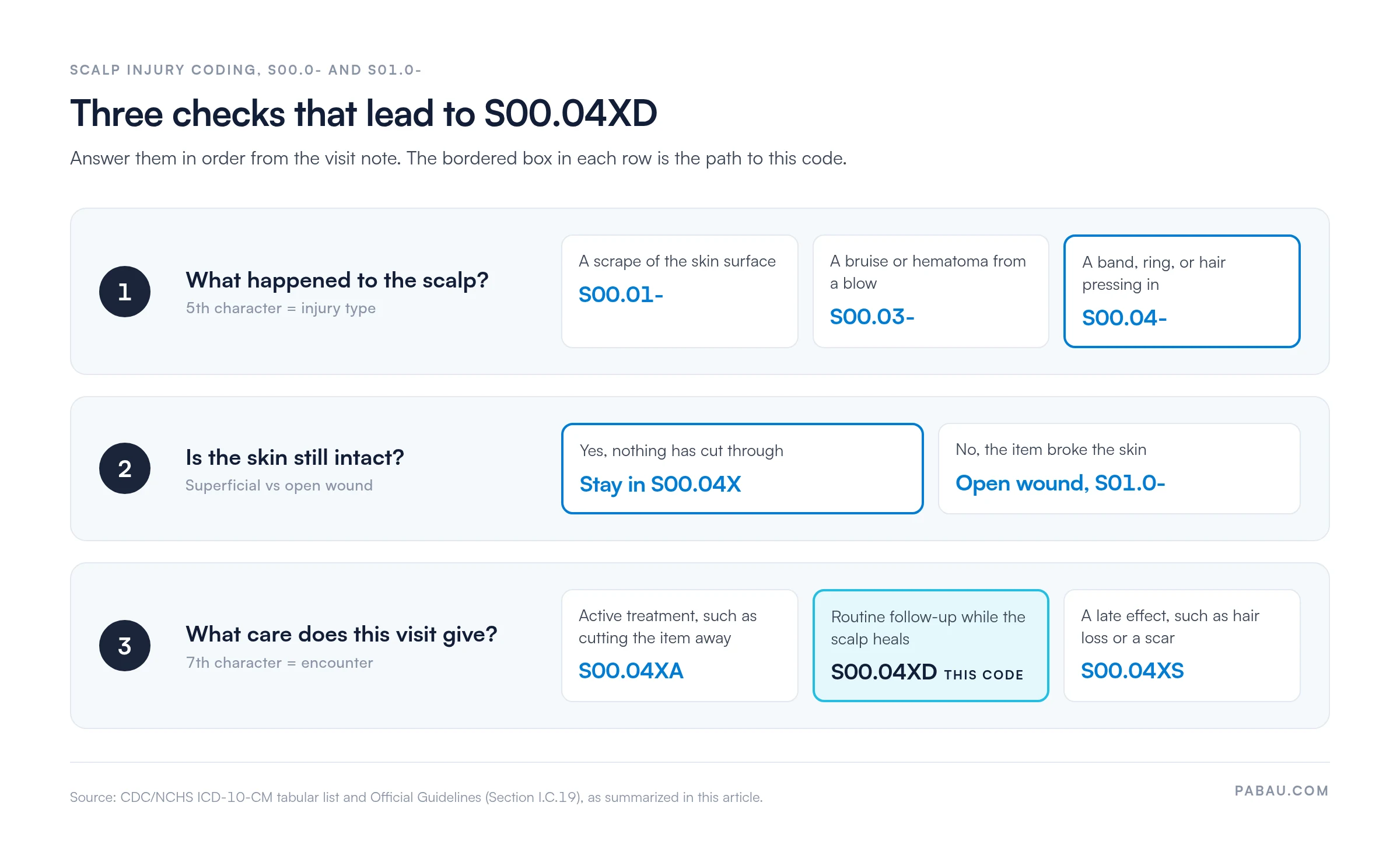
The 5th character is where most errors on this code begin. A 1 in that slot means abrasion, a 3 means contusion, and a 4 means external constriction.
The placeholder X in position 6 is mandated by the ICD-10-CM Official Guidelines (Section I.A.4). Without it, the 7th character D would fall in position 6, creating an invalid code. Coders cannot omit the X even though it carries no clinical meaning on its own.
The 7th character D in ICD-10-CM indicates that the patient is receiving routine care during healing or recovery, not active treatment. Per the CDC/NCHS ICD-10-CM guidelines, D applies after active treatment is complete.
At that point the provider is monitoring progress, rechecking the injured area, or adjusting aftercare instructions rather than starting definitive care.
Three questions clarify which 7th character to assign:
The switch from A to D does not hinge on the number of visits. A patient who sees a second provider for the first time during active treatment still gets the A character. A patient who returns two days after a hair tourniquet was cut away gets D. Active treatment ended when the hair came off.
The three encounter variants of external constriction of part of the scalp share the base code S00.04X and differ only at the 7th character. The visit note decides which one applies, so a wrong choice here is an avoidable denial.
When the sequela code applies, the late effect itself, such as the hair loss or scar, is sequenced first and S00.04XS follows it. S00.04XD and S00.04XS are never reported together for the same encounter.
Six neighboring codes are the usual mix-ups on this claim. The distinctions are straightforward once the note names the injury type and states whether the skin is intact.
S00.01XD is the swap to watch. Category S00.0 is titled “Superficial injury of scalp,” so a coder who stops at the category title can attach the wrong subtype. A note that describes a scrape supports S00.01XD, while a note that describes a band, hair, or ring pressing into the scalp supports S00.04XD.
When the constricting item has broken the skin, look at the open-wound codes in S01.0-. The ICD-10-CM guidelines (Section I.C.19.b.1) say a superficial injury is not coded when it is associated with a more severe injury of the same site. If the note does not say whether the skin is intact, query the provider.
Put together, the injury type, the skin check, and the encounter type form three questions, answered in the order below.
Add an “item removed on” date field to your follow-up note template. With that date in the record, the D character is easy to defend if a payer questions the visit.
The medical record must establish two facts: the injury is an external constriction, and this visit is routine follow-up after active treatment.
Payers deny S00.04XD claims when the note reads like a first presentation or never names the constricting item. Practices that align their medical billing compliance workflows with CMS documentation guidelines reduce this exposure.
Required documentation elements:
Per CMS documentation guidelines, the encounter type is determined by the care provided at that specific visit, not by the overall treatment timeline. A provider who starts new treatment on a healing area at a follow-up visit may need to recode that encounter as A.
S00.04XD is a low-acuity code. Medicare and most commercial payers do not typically require pre-authorization for routine follow-up at this severity level. Local and national coverage determinations (LCDs and NCDs) still vary by payer, so confirm the rule for each plan. Submitting a clean claim for this code requires attention to three pairing considerations.
ICD-10-CM has no national requirement to report external cause codes, so check your payer contracts and state rules. Separately, diagnosis codes should be reported to the highest documented level of specificity. Using S09.90XD or S00.00XD when the record clearly describes a constriction is a specificity failure that payers flag on post-payment audits.
Claim denials for this code cluster around a small set of preventable errors. Coding audits and documentation templates prevent most of them. Understanding denial management workflows helps practices catch these patterns before claims are submitted.
Wrong 7th characters and wrong injury subtypes are usually workflow problems. Coders who know the rules still pick the wrong code when the prior visit and the clinical note sit apart from the claim.
Pabau, the practice management and billing platform we build, keeps visit history, clinical notes, and claims management software on one patient record. The coder sees the original encounter before choosing between A and D.
For practices billing US payers, Pabau connects to the Claim.MD clearinghouse, which processes claims to thousands of US payers. Its pre-submission edits catch 7th character errors, missing encounter qualifiers, and specificity failures before claims leave the practice. Eligibility checks and ERA (835) remittances run through the same integration, which cuts manual reconciliation for billing staff.
Documentation templates in Pabau’s clinical notes can prompt providers for the constricting item and the date it was removed. They can also ask for the healing status payers look for on S00.04XD claims. Understanding the full scope of medical billing workflows helps practices build those prompts around payer edit criteria rather than generic checklists.

Pabau keeps diagnosis codes, encounter notes, and clearinghouse submission in one place. Your practice catches 7th character errors before they reach the payer.

S00.04XD is straightforward once it is anchored to the right injury. A band, ring, or strands of hair compressed part of the scalp, and the patient is back for routine care while it heals. Denials come from picking A instead of D, confusing an abrasion with a constriction, or omitting the removal visit.
The fix sits in the follow-up note. When providers name the constricting item and the removal date every time, the right subtype and 7th character follow from the record. So does any appeal.
Pabau’s claims workflow and Claim.MD connection give coding teams pre-submission edit checks that catch these errors before a payer sees them. To see how the workflow fits your practice, book a demo.

Looking for the full US clearinghouse picture? Medical claims clearinghouse guide explains how clearinghouses process ICD-10-coded claims and where edits fire.
ICD-10 Code S00.04XD means external constriction of part of scalp, subsequent encounter. It applies when a patient returns for routine follow-up while the scalp heals. Before that visit, a constricting item such as a tight band, ring, or hair tourniquet was removed.
Yes. S00.04XD is a valid, billable code in the current ICD-10-CM revision. Reimbursement depends on payer policy and on documentation showing a follow-up visit during healing, not an initial active-treatment visit.
S00.04XA covers active treatment of the scalp constriction, such as cutting away the item and assessing the tissue. S00.04XD covers later visits for routine follow-up while the scalp heals. The trigger is the type of care at the visit, not the number of visits.
No. A scalp abrasion at a follow-up visit is coded S00.01XD, Abrasion of scalp, subsequent encounter. S00.04XD is reserved for external constriction, where an item such as a band or strands of hair compressed part of the scalp.
Use the 7th character D when the patient is receiving routine care during the healing or recovery phase rather than active treatment. The switch from A to D occurs when active treatment is complete and the provider is monitoring healing, removing sutures, or rechecking the injured area.
The X in position 6 of S00.04XD is a mandatory placeholder required by the ICD-10-CM Official Guidelines (Section I.A.4). It lets the 7th character D occupy the correct position. It carries no clinical meaning, and a code submitted without it triggers an invalid-code edit at the clearinghouse.
The most common denial reason is reporting S00.04XA on a follow-up visit where S00.04XD is correct. Other triggers include a scalp abrasion billed as S00.04XD instead of S00.01XD and missing documentation of the prior encounter. A 6-character code or an unsupported visit level also draws denials.