ICD-10 Code V09.01XS: Pedestrian injured in nontraffic accident involving military vehicle, sequela
ICD-10 Code V09.01XS: Code description and clinical meaning ICD-10 code V09.01XS...

Last Updated: Oct 26, 2026
Billable Code Specific Code
V68.1XXD is the billable ICD-10-CM code for passenger in heavy transport vehicle injured in noncollision transport accident in nontraffic accident, subsequent encounter.
It covers a truck passenger hurt without a collision, such as an overturn, somewhere other than a public highway. Use the D suffix for routine follow-up care after active treatment, and report V68.1XXD secondary to the injury code.
Let Pabau's smart automation suggest the right codes, reduce claim denials, and keep your practice compliant—effortlessly.
Automate repetitive tasks and focus on what matters most—your patients.
Reduce coding errors and ensure compliance with the latest regulations.
Clean claims, fewer denials, and faster reimbursements.
Powerful insights and reporting to help your practice thrive.
HIPAA compliant SOC 2 certified GDPR-compliant Trusted by 4,000+ clinics worldwide

V68.1XXD codes a heavy transport vehicle passenger injured without a collision, such as an overturn, in a nontraffic accident off the public highway.
Traffic status decides the code. The same noncollision accident on a public highway is V68.6XXD, and a collision with a car, pick-up truck or van moves to V63.-.
ICD-10-CM assumes a vehicle accident happened on the public highway unless the record names another place, so V68.1XXD needs a documented off-highway location.
The 7th character D marks a subsequent encounter: routine care during healing or recovery, after the patient has completed active treatment.
V68.1XXD is always a secondary external cause code. The injury S-code goes first, and both codes carry the same 7th character.
Pabau, the practice management platform we build, keeps the injury code and its external cause code in one claim, sequenced in the right order.
ICD-10 Code V68.1XXD describes a passenger in a heavy transport vehicle injured without a collision, away from the public highway, at a follow-up encounter.
It sits in the V60-V69 block, which covers occupants of heavy transport vehicles injured in transport accidents. Each character carries a specific meaning, so misreading one of them sends the wrong code.
Official descriptor: Passenger in heavy transport vehicle injured in noncollision transport accident in nontraffic accident, subsequent encounter. The code is valid and billable in the current ICD-10-CM code set. It applies to ICD-10-CM only, not ICD-10-PCS. You can confirm it in the CDC/NCHS ICD-10-CM web tool and browse related injury codes in our ICD-10-CM code library.
V68.1XXD applies only when the accident happened entirely away from a public highway. The ICD-10-CM tabular list defines a nontraffic accident as any vehicle accident that occurs entirely in any place other than a public highway. A traffic accident is one on the public highway, including one that starts, ends or partly involves it.
The default runs against V68.1XXD. The classification assumes a vehicle accident occurred on the public highway unless another place is specified. A note that says only “truck rollover” therefore points to V68.6XXD, the traffic code, rather than V68.1XXD.
Nontraffic settings that support V68.1XXD include:
The second condition is that no collision took place. Category V68 includes “overturning heavy transport vehicle NOS” and “overturning heavy transport vehicle without collision.” A collision with a car, pick-up truck or van moves the passenger to category V63. The code is V63.1XXD for a nontraffic accident or V63.6XXD for a traffic accident.
Other collisions have their own categories in V60-V67. For example, V64 covers a collision with another heavy transport vehicle or bus, and V67 a collision with a fixed or stationary object. The decision tree below runs both questions in order.
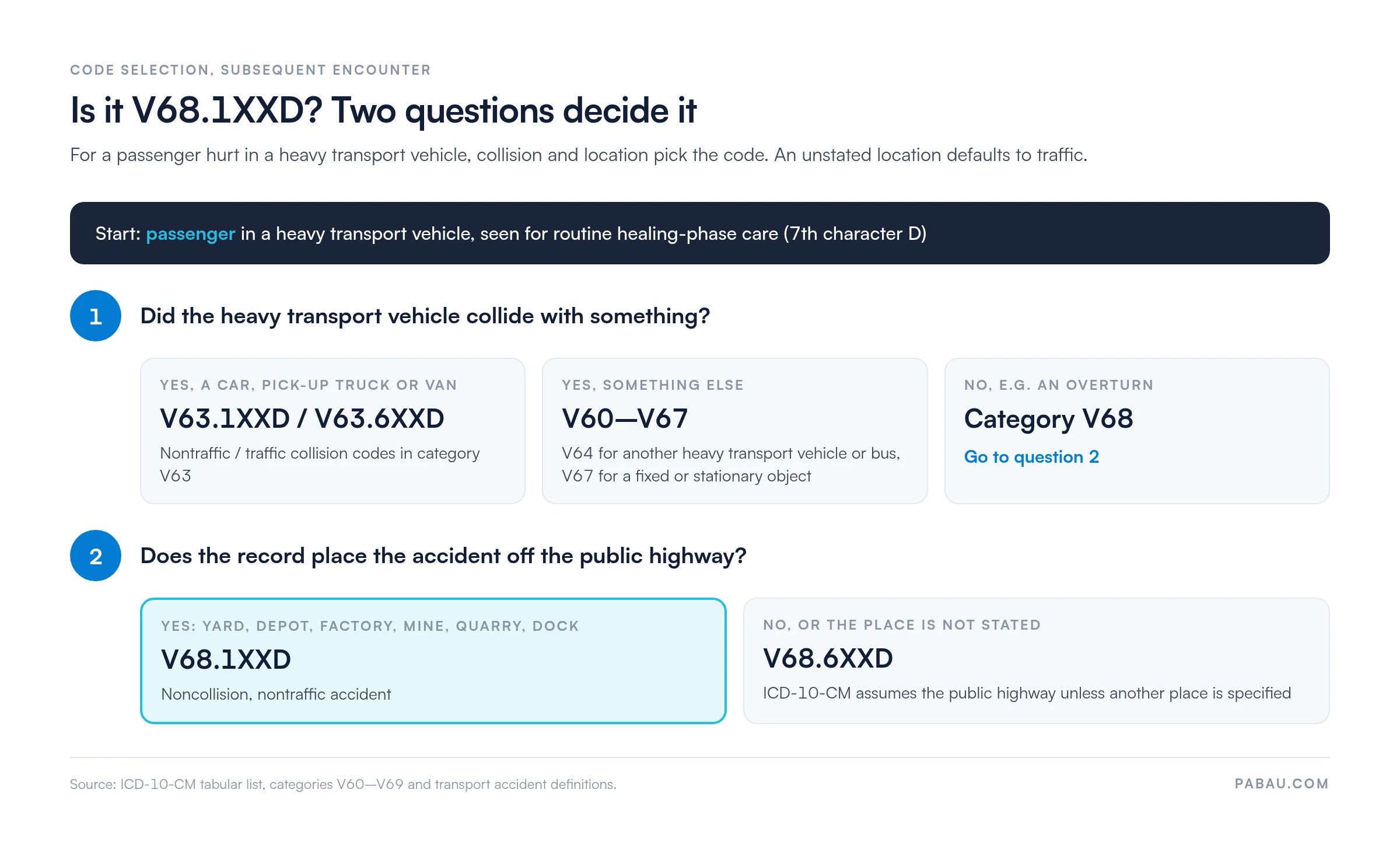
The 7th character D marks a subsequent encounter. Per the ICD-10-CM guidelines, D applies after the patient has completed active treatment and is receiving routine care during healing or recovery. “Subsequent” refers to the encounter type, not to a worsening of the injury or a new event.
A, D and S differ by phase of care. The table below shows when each one applies.
The D suffix stays the same when a different provider sees the patient. It reflects the phase of care, regardless of who is treating. Per CMS ICD-10-CM guidance, the initial encounter (A) covers active treatment, such as the emergency department visit and surgical care. Once the patient moves on to routine healing-phase care, D applies.
The guidelines add one more rule. The external cause code’s 7th character must match the 7th character of the injury code for the same encounter.
A heavy transport vehicle, per the ICD-10-CM transport accident definitions, is a motor vehicle designed primarily for carrying property. It meets local criteria for classification as a heavy goods vehicle by weight, and it requires a special driver’s license.
Included vehicle types (V60-V69 inclusion note):
Vehicles outside the heavy transport vehicle definition (classified elsewhere):
Bus and motorcoach is the only formal Excludes1 note at the V60-V69 block. The other vehicles above fall outside the definition, so they code to their own blocks.
A person’s role matters as much as the vehicle. V68.1XXD codes a passenger riding inside the heavy transport vehicle. The driver is V68.0XXD, and a person riding on the outside is V68.2XXD.
Notes attach to V68.1XXD at three levels: the V00-V99 transport accident section, the V60-V69 block, and the V68 category. Each one limits how the code combines with others.
The section also carries one Excludes2 note: transport accidents due to cataclysm (X34-X38). Both codes may be reported together when the record supports each one.
The street-or-road note seldom fits a nontraffic accident, which by definition happens off the public highway. Choose the Y92 place code that names the location stated in the record instead.
Per the AAPC ICD-10-CM code reference, external cause codes in the V-block are always supplementary. They describe the cause of injury, not the injury itself. The primary injury code (an S-code) must always accompany V68.1XXD in the claim.
Category V68 splits by the injured person’s role and by traffic status. The two mix-ups to watch are nontraffic V68.1 vs traffic V68.6, and a collision coded as a noncollision accident. The table lists the official descriptors.
ICD-10-CM Official Guidelines Section I.C.20 establish that an external cause code can never be a principal (first-listed) diagnosis. V68.1XXD is always reported as a secondary code, after the injury it explains. Sequencing it first on a claim invites a rejection.
Coders cannot assume subsequent-encounter status or nontraffic status. The medical record must cover the following four points:
Run a pre-submission check on every heavy transport vehicle claim. Confirm the principal diagnosis is an S-code injury and V68.1XXD is listed secondary. Then check that the note places the accident off the public highway and the 7th character matches the encounter phase. Sequencing is the first check to run.
External cause code mandates vary by payer. Medicare allows external cause codes but does not universally require them. State workers’ compensation programs and many commercial auto-liability payers do require them for motor vehicle injury claims. The specific requirements differ by state and plan. Coders should verify requirements with each payer before submitting.
Whether or not a payer mandates external cause codes, an incorrectly reported V68.1XXD can trigger a denial or an audit flag. These are the patterns to check for:
Effective denial management on external cause code claims starts before submission. Submitting a clean claim the first time saves working the denial afterward. That means correct sequencing, a complete code and a matching injury code.
V68.1XXD is always submitted as a secondary code. Every claim using it must include a primary injury code, and some encounters also call for supplementary codes.
Place of occurrence, activity and external cause status codes, such as Y99.8, are reported once, at the initial encounter (A). On subsequent encounter (D) claims, the injury S-code and V68.1XXD are typically all that is required, unless the payer specifies otherwise. Review ICD List’s full ICD-10-CM code database to verify companion code validity for the specific injury type before submitting.
Pabau’s claims management software holds every code for an encounter in a single record. Coders pair V68.1XXD with its injury S-code and set the sequence before the claim leaves the practice. That cuts the manual lookups and ordering errors that lead to external cause code rejections.
For US claim submissions, Pabau integrates with the Claim.MD clearinghouse. It runs eligibility checks and validates each claim before it reaches the payer queue. An incomplete code or a missing injury code gets caught while it is still quick to fix.
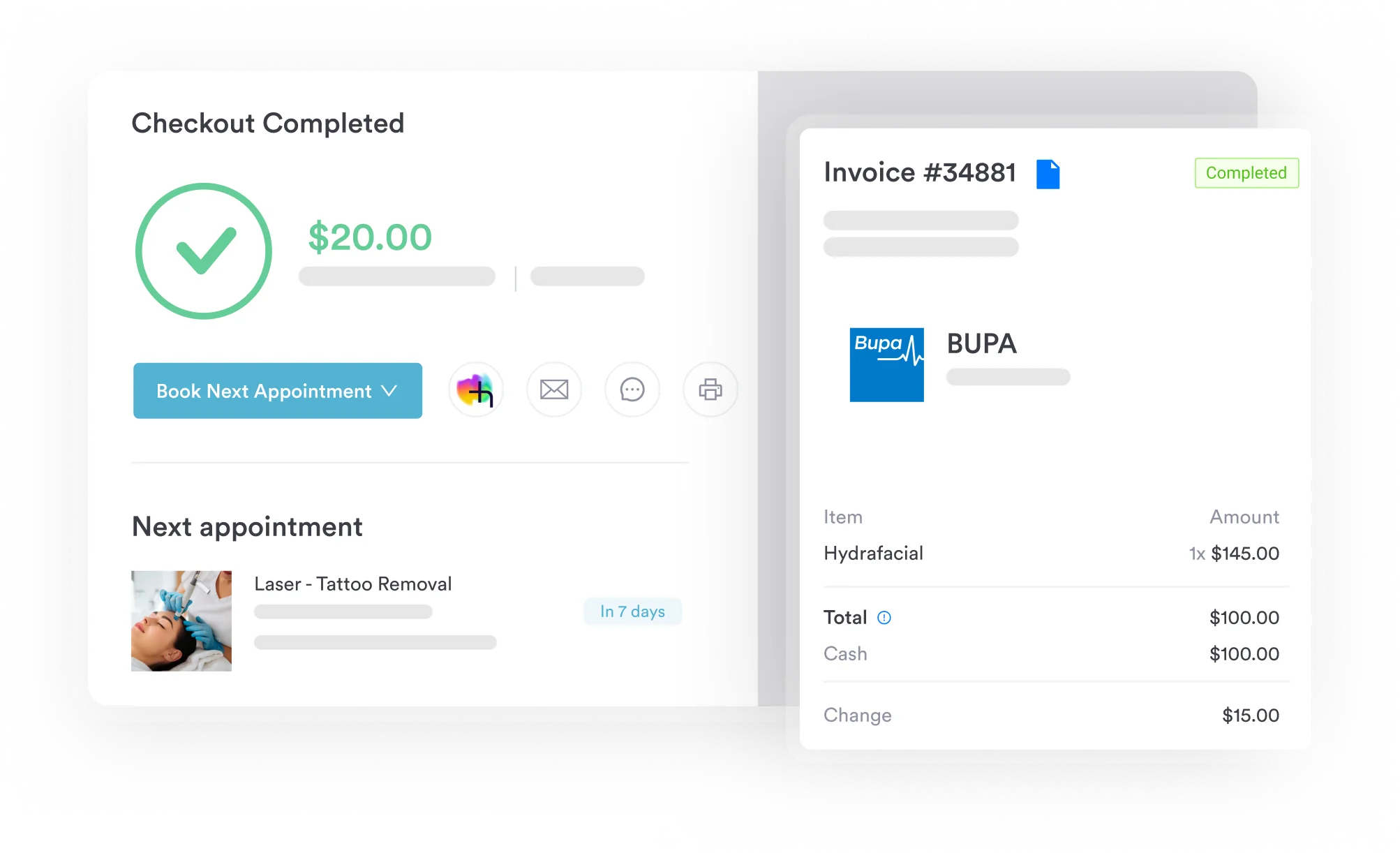

Pabau’s claims management workflow helps coders build correctly sequenced claims for external cause codes like V68.1XXD, so fewer reach the payer with avoidable errors.

V68.1XXD is a narrow code. It fits only a truck passenger hurt without a collision, away from a public highway, at a healing-phase visit. When the record does not support all three facts, query the provider before choosing between V68.1XXD, V68.6XXD and V63.1XXD.
Once the code is right, the claim mechanics are simple. The injury S-code goes first, V68.1XXD follows, and both carry the same 7th character. Practices handling injury claims at volume can build that order into their medical billing workflow. Book a demo to see how Pabau keeps external cause claims clean from the first submission.

Need to understand how clearinghouse submissions work for injury claims? Medical claims clearinghouse guide explains the claim validation and submission process from code entry to payer acceptance.
Working through a denial on a motor vehicle accident claim? Denial codes in medical billing covers the most common CARC reason codes and how to respond to each.
Want to verify ERA and remittance handling for injury claim payments? Electronic remittance advice covers how 835 remittance files work and how to reconcile them against submitted claims.
ICD-10 Code V68.1XXD is the billable ICD-10-CM code for a heavy transport vehicle passenger injured in a noncollision, nontraffic accident, at a subsequent encounter. Noncollision means no collision took place, as in an overturn. Nontraffic means the accident happened entirely off the public highway. It is always a secondary external cause code, reported after the injury S-code.
The difference is where the accident happened. V68.1XXD is a nontraffic accident, entirely off the public highway, while V68.6XXD is a traffic accident on a public highway. ICD-10-CM assumes a traffic accident unless the record names another place, so an unstated location points to V68.6XXD.
Use V63.1XXD when the heavy transport vehicle collided with a car, pick-up truck or van in a nontraffic accident. V68.1XXD applies only when no collision occurred, such as a truck overturning on its own.
V68.1XXD (7th character D) covers routine follow-up care during healing, after the patient has completed active treatment. V68.1XXS (7th character S) covers complications or conditions that arise as a direct result of the injury. Using S while the patient is still in routine healing-phase care is a common coding error.
V68.1XXD requires a primary injury code (an S-code) to be billable. External cause codes in the V-block are supplementary by definition and cannot stand alone as the principal diagnosis. Submitting V68.1XXD without an accompanying S-code will result in a claim rejection at the payer or clearinghouse level.
Requirements vary by payer. Medicare allows but does not universally mandate external cause codes. Many state workers’ compensation programs and commercial auto-liability payers do require them for motor vehicle injury claims. Verify requirements with each payer, as mandates differ by state and plan. Even where not required, V68.1XXD helps document the cause of an injury that still needs follow-up care.
The most common reason is V68.1XXD sequenced as the principal diagnosis instead of a secondary code. Others are a wrong 7th character, missing placeholder X characters, and no companion S-code on the claim. Coding errors also arise when a traffic accident or a collision is coded to V68.1XXD. Correcting the sequence and the code choice resolves most of these before resubmission.