ICD-10 code V43.42XS: Car boarding injury, sequela
ICD-10 code V43.42XS covers the late effects of a car boarding injury ICD-10 cod...

Last Updated: Oct 7, 2026
Billable Code Specific Code
V67.9XXA is the billable ICD-10-CM code for an unspecified heavy transport vehicle occupant hurt in a fixed-object collision in traffic, initial encounter. Picture a truck that hits a wall, tree or other stationary object on a public road, where the chart never says who was driving.
It's an external cause code, so it always follows the injury code and never leads the claim. The code sits in block V60-V69, category V67. Wrong sequencing, a missing X placeholder or the wrong 7th character can trigger a rejection or edit. Below, you'll see how each character works, which neighbor code fits a clearer chart and what to check before you submit.
Let Pabau's smart automation suggest the right codes, reduce claim denials, and keep your practice compliant—effortlessly.
Automate repetitive tasks and focus on what matters most—your patients.
Reduce coding errors and ensure compliance with the latest regulations.
Clean claims, fewer denials, and faster reimbursements.
Powerful insights and reporting to help your practice thrive.
HIPAA compliant SOC 2 certified GDPR-compliant Trusted by 4,000+ clinics worldwide

V67.9XXA codes an unspecified heavy transport vehicle occupant hurt when the vehicle hits a fixed or stationary object in traffic, initial encounter.
It’s an external cause code, so it always follows the injury code and never leads the claim.
Both X placeholders are required, because the 7th character has to land in position seven.
Use V67.5XXA for a documented driver and V67.6XXA for a documented passenger. The 9 is for charts that name neither.
The code is valid in the current fiscal year, so recheck it each October when the ICD-10-CM update takes effect.
ICD-10 code V67.9XXA is a billable code for a truck occupant hurt when the truck hits a fixed object on a public road. The chart doesn’t say whether the patient was driving, riding as a passenger or on the outside of the vehicle. The final A marks the initial encounter, while the patient is still in active treatment.
The official wording comes from the CDC/NCHS ICD-10-CM tabular list. The code is valid in the current fiscal year. Check it again each October, when the annual update takes effect.
Read the code from left to right and you get the whole accident in seven characters.
The two X characters are placeholders, not clinical data. The 7th character must sit in position seven. V67.9 has only four characters, so X fills positions five and six. A claim that reads “V67.9A” is an invalid string, and the payer will reject it. Always submit V67.9XXA in full.
V67.9 takes one of three 7th characters. Each one maps to a phase of care.
Here’s how that plays out for one patient. A truck occupant breaks a wrist when the truck hits a bridge pier on the highway. The ED visit and the surgery both take V67.9XXA, because treatment is still active.
The cast check six weeks later switches to V67.9XXD. If stiffness brings the patient back a year on, the stiffness code leads and V67.9XXS follows it.
The classic slip is keeping A on every visit after the ED. A means active treatment, not “first time this provider sees the patient.” The same surgeon can report A one week and D the next.
ICD-10-CM defines a heavy transport vehicle as a motor vehicle built mainly to carry property. It meets local weight rules for heavy vehicles and needs a special driver’s license.
Within V67, the 4th character records two facts at once. One is the patient’s role. The other is whether the crash happened on a public road. Nontraffic codes run 0 to 3, traffic codes run 5 to 7 plus 9, and 4 covers boarding or alighting.
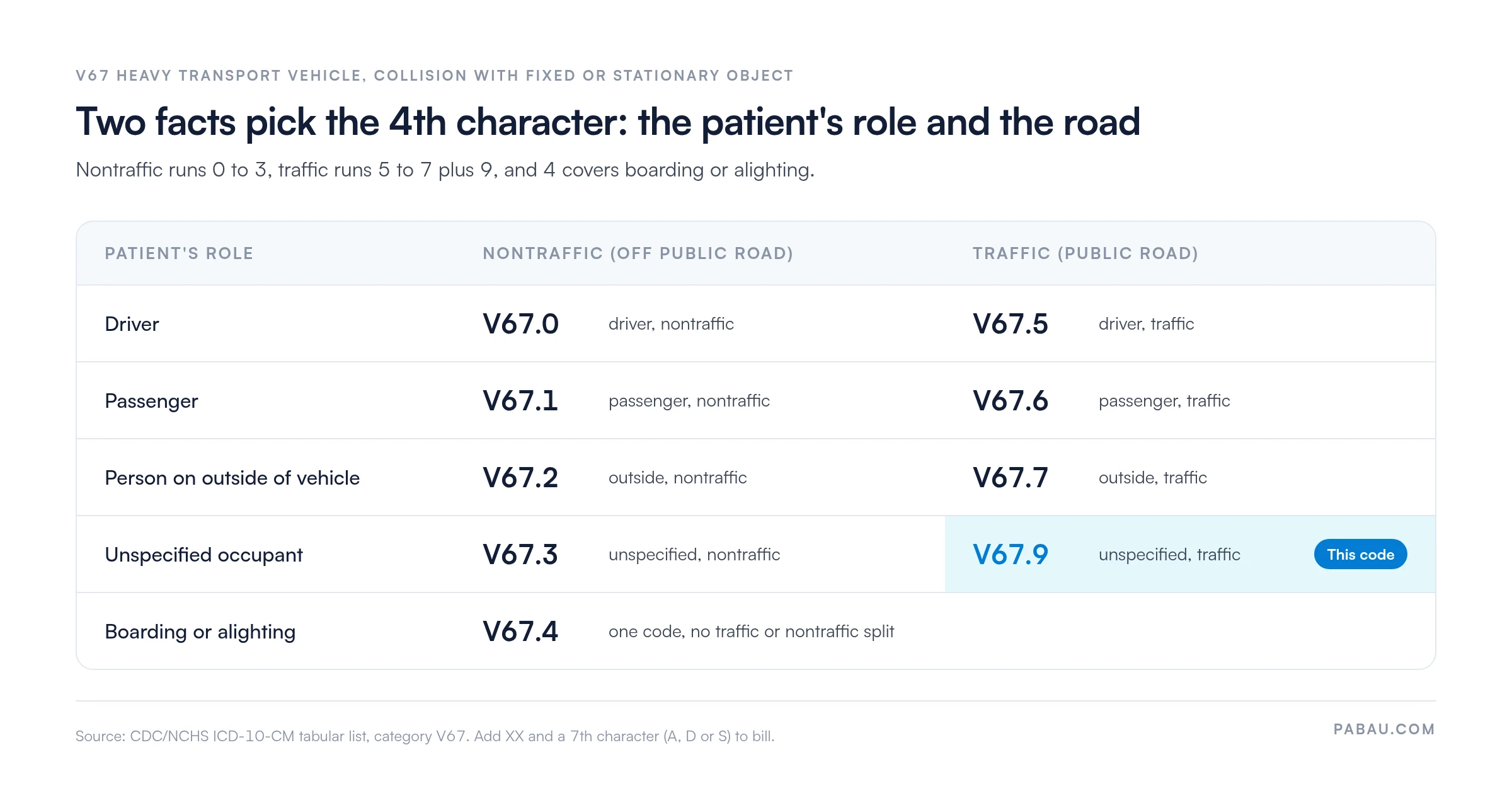
Save the 9 for charts that can’t identify the patient’s role. If the record says “truck driver” or “riding in the cab,” query the provider and use the specific code. Some payers ask for more detail on unspecified codes, especially on liability and workers’ comp claims.
Before you assign V67.9XXA, read the accident narrative in the ED or admission note. Ambulance reports, police records and triage notes often name the patient’s role. A documented driver codes to V67.5XXA and a passenger to V67.6XXA, which cuts payer queries on liability claims.
Two layers of tabular notes apply before you assign any V67 code.
Excludes1 means the two codes never appear together. A crash meant as self-harm codes to X82, not V67.9XXA.
When the record adds detail, one of these neighbors usually fits better:
Traffic versus nontraffic decides half the code. V67.9XXA is the traffic version, for crashes on a public road. A truck that clips a loading dock in a warehouse yard is a nontraffic accident. Those codes use 4th characters 0 to 3.
V67.9XXA is never the principal diagnosis. ICD-10-CM Official Guidelines Section I.C.20 make external cause codes secondary. They sit alongside the injury code, never in its place. Listing V67.9XXA first breaks the sequencing rules and trips claim edits.
Follow three steps:
For inpatient stays, the Uniform Hospital Discharge Data Set (UHDDS) defines the principal diagnosis. An external cause is never the reason for admission under those rules. Outpatient claims follow the same order: the injury code leads and V67.9XXA follows.
A coder can’t assign V67.9XXA from a vague chief complaint. To meet medical billing compliance standards, the chart needs these details:
Sometimes the chart confirms a truck crash on a public road but never says what the truck hit. V67.9XXA doesn’t fit that record. Code V69.9XXA instead, which covers a heavy transport vehicle occupant in an unspecified traffic accident.
Build a query template for transport accident encounters. Ask providers to record the vehicle type, the patient’s role, the traffic context and what the vehicle hit. Those four details decide which V code applies, so you skip the rework later.
A minute with this list saves a resubmission later.
V67.9XXA rejections tend to repeat a handful of patterns. Spotting them early strengthens your denial management workflows. The medical billing denial codes reference helps you read what came back.
A clearinghouse checks claim format before the payer sees it. It won’t decide whether V67.9XXA is the right code, so the coder still owns the pairing. Meeting clean claim standards on the first pass keeps accident claims out of rework.
External cause codes don’t get the same treatment from every payer. What one accepts without question, another may query.
Payer policies change each plan year. Check payer portals or clearinghouse edit libraries before you send a large batch of accident claims.
Accident claims often stall on admin work. Staff retype patient details into the claim form, chase missing policy numbers and check claim status by phone.
Pabau, the practice management platform we build, pre-fills the claim from the patient record. Its claims management software includes an ICD-10-CM code library for lookups. It won’t send a claim until the required fields are complete.
In the US, claims go out through the Claim.MD clearinghouse, with eligibility checks, ERA posting and status tracking built in. Choosing V67.9XXA and pairing it with the injury code stays with your coder. Pabau takes the retyping and chasing off their plate.

Pabau pre-fills claims from the patient record and checks required fields before you send. US claims go out through Claim.MD, with eligibility checks and ERA posting built in.

Treat V67.9XXA as a fallback for charts that can’t name the patient’s role. Each time it appears, it tells the payer that detail is missing.
The fix sits upstream. Build the role, the road and the object into your accident intake questions. Many of these claims will then code to V67.5XXA or V67.6XXA instead.
When V67.9XXA is the right answer, it only works behind the injury code with both placeholders intact. Book a demo to see how Pabau pre-fills accident claims from the patient record and sends them through Claim.MD.

Need to understand how clearinghouse validation works? Medical claims clearinghouse guide walks through how clearinghouses catch code errors before claims reach payers.
Looking for a denial code reference? Electronic remittance advice explained covers how to read ERA files and identify the CARC denial reasons behind rejected accident claims.
Want to improve your accident claim submission rate? Superbill guide explains how a well-structured superbill captures external cause codes alongside procedure and diagnosis codes at the point of care.
No. Occupants of pickup trucks and vans code to V50-V59. Heavy transport vehicles are trucks built mainly to carry property, such as 18-wheelers, armored cars and panel trucks. If a pickup hits a wall on a public road, look in category V57.
Bus occupants code to V70-V79, not the heavy transport block. A bus hitting a fixed or stationary object falls under category V77. For an unspecified occupant in a traffic accident, the initial encounter is V77.9XXA.
Not directly. External cause codes carry no CC or MCC status, so they don’t change an MS-DRG. There’s also no national mandate to report them. Their value is in the claim’s story, because liability and workers’ comp carriers use them to tie the injury to the accident.
Yes. V67.9XXA is billable in the current fiscal year. ICD-10-CM updates take effect each October 1, so confirm the code in the CDC/NCHS tabular list after every release.