ICD-10 Code S42.444P: Medial epicondyle fracture, right humerus
ICD-10 Code S42.444P: full descriptor and code validity ICD-10 Code S42.444P car...

Last Updated: Oct 13, 2026
Billable Code Specific Code
V55.4XXD is the billable ICD-10-CM code for a person injured while boarding or alighting a pick-up truck or van. The vehicle had collided with a railway train or railway vehicle, and this is a subsequent encounter.
Coders trip on it at two points. The first is using the A suffix when the patient has already moved into follow-up care. The second is omitting the paired primary injury diagnosis, which sends the claim straight to denial.
Let Pabau's smart automation suggest the right codes, reduce claim denials, and keep your practice compliant—effortlessly.
Automate repetitive tasks and focus on what matters most—your patients.
Reduce coding errors and ensure compliance with the latest regulations.
Clean claims, fewer denials, and faster reimbursements.
Powerful insights and reporting to help your practice thrive.
HIPAA compliant SOC 2 certified GDPR-compliant Trusted by 4,000+ clinics worldwide

V55.4XXD is a billable ICD-10-CM external cause code for follow-up care, not a standalone diagnosis.
The 7th character D means subsequent encounter: active treatment is complete and the patient is receiving routine or ongoing care.
Always pair V55.4XXD with a primary injury diagnosis code; claims submitted with only this external cause code will be denied.
Pabau’s claims management software flags missing paired codes and tracks external cause code requirements by payer before submission.
ICD-10 Code V55.4XXD is the billable ICD-10-CM code for a follow-up visit after a pick-up truck or van collided with a railway train. It applies when the patient was boarding or alighting the vehicle at the moment of impact, and active treatment has since concluded.
The code sits in Chapter 20 of ICD-10-CM, which covers external causes of morbidity (V00-Y99). Within that chapter it belongs to the V50-V59 block for occupants of pick-up trucks and vans. Like every external cause code, V55.4XXD is supplementary only.
V55.4XXD is a seven-character code, and every position carries a specific meaning defined by the CMS ICD-10-CM coding system. Understanding each position prevents the most common assignment errors, particularly the placeholder X characters that confuse new coders.
The placeholder X characters are a structural requirement of ICD-10-CM. When a parent category code such as V55.4 runs shorter than six characters, the system pads positions 5 and 6.
The letter X fills them, which lets the 7th character extension be assigned. Omitting either X produces an invalid code string, and most billing platforms reject it at scrubbing.
The 7th character D means the patient is receiving routine or ongoing care after the active treatment phase has ended. The three 7th character options for V55.4 codes map to distinct clinical stages, and each one calls for different documentation.
The ICD-10-CM Official Coding Guidelines define “subsequent encounter” as any encounter after the patient has received active treatment for the condition.
This includes physical therapy visits, fracture rechecks, wound care appointments, and medication management following the accident. The original injury can still be present at a subsequent encounter. The encounter type is determined by the stage of care, not by whether the injury has resolved.
Document the care phase explicitly. A note reading ‘Active treatment concluded [date]. Patient presenting for follow-up fracture management’ supports D. Vague wording that could describe either active or follow-up care creates audit exposure and invites payer scrutiny.
V55.4XXD applies to a narrow and specific set of circumstances. All four conditions below must be met for this code to be correct.
Follow-up visits coded with V55.4XXD look like this in practice:
In each case the treating clinician is managing a condition that began with the accident. Emergency and surgical care have already ended.
The V50-V59 block covers a range of occupant positions and accident types. Understanding what V55.4XXD includes and excludes prevents the most common miscoding scenarios.
Reach for a different code when any of the following applies.
If the injured patient was an occupant of the train rather than the pick-up truck or van, the claim moves to the V81 family. A nontraffic follow-up visit in that family takes V81.0XXD.
Where the pick-up truck or van struck a fixed object instead of a railway vehicle, coding moves to the V57 block. An unspecified occupant seen at a follow-up visit there takes V57.9XXD.
V55.4XXD is always a supplementary code. It documents the external cause of an injury, not the injury itself. A primary injury diagnosis, such as a fracture code from Chapter 19, must accompany it on every claim.
This rule holds without exception under the ICD-10-CM Official Coding Guidelines. Those guidelines come from the Centers for Medicare and Medicaid Services (CMS) and the National Center for Health Statistics (NCHS). HIPAA mandates them for all covered entities.
V55.4XXD sits within a grid of related codes. Selecting the wrong occupant position or encounter suffix is one of the most common errors in this code family. The table below covers the V55.4 encounter variants and the key V55.x occupant positions, as verified in the CDC/NCHS ICD-10-CM web tool.
Change the collision type and the occupant role together, and the code leaves the V55 family altogether. A seated passenger injured when a pick-up truck collided with a pedal cycle off public roads takes V51.1XXS at the sequela stage, not D.
Four confusion patterns cause the bulk of miscoding on V55.4XXD claims. Recognizing them before submission protects revenue and reduces audit exposure.
This is the single most common error. The A suffix (initial encounter) should only appear when the patient is receiving active treatment for the injury. Once the patient is in the follow-up phase, the code must shift to the D suffix.
Many practices default to A across all visits because it is the first code entered at presentation, then never update it. Payer audits routinely flag repeated A-suffix codes across multiple claims for the same patient and injury event.
The S suffix (sequela) applies only when a new residual condition has emerged from the original injury as a late effect. Chronic radiculopathy developing months after the accident is one example.
If the patient is still being treated for the original fracture or soft tissue injury, S is incorrect. The original injury and the sequela are coded separately when both are present, per ICD-10-CM guidelines.
V52.4XXD covers boarding or alighting from a pick-up truck or van that collided with a two- or three-wheeled motor vehicle. The codes look nearly identical in structure but describe completely different accidents.
The documentation has to match the collision type. V55 needs a railway train or railway vehicle. V52 needs a motorcycle or a similar two- or three-wheeled vehicle. Selecting the wrong parent category invalidates the entire external cause claim.
External cause codes cannot stand alone on a claim. V55.4XXD must always be accompanied by the principal injury diagnosis. A claim carrying only V55.4XXD is denied by every payer, including Medicare and state workers compensation programs.
The Chapter 19 injury code belongs in the first diagnosis position. The two claim lines below show what that ordering looks like, and what a payer sees when it is missing.
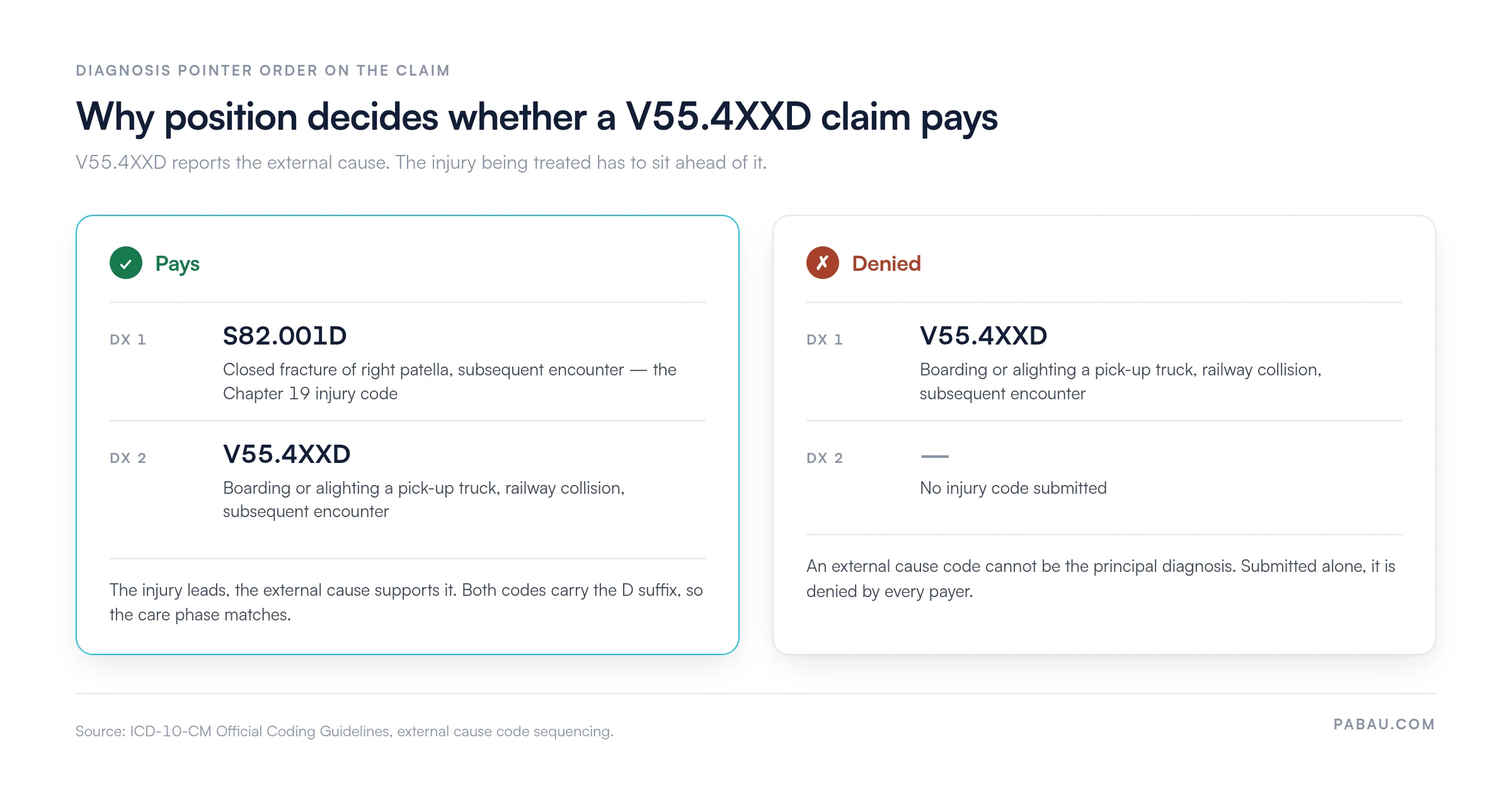
Correct claim submission for a subsequent encounter after a pick-up truck and railway collision follows a set sequence. Practices handling injury claims at volume run this check inside software for billing teams, so pairing is validated before the claim is transmitted.
Practice management software like Pabau flags any claim where the external cause code has no paired injury diagnosis.
The provider’s record must contain specific elements for V55.4XXD to withstand payer scrutiny. Missing any one of them is a common denial trigger and a compliance risk under both Medicare and workers compensation audits. Solid documentation also supports a clean claim submission that clears scrubbing without manual intervention.
Documenting external cause codes to this standard protects practices during retrospective audits. Payers increasingly run those audits on transport accident claims linked to liability or workers compensation files.
Transport accident external cause codes generate a distinct set of denials. Reading the common denial codes alongside the scenarios below helps a billing team build a targeted pre-submission checklist.
Practices managing high volumes of injury coding can build payer-specific rule sets that validate external cause code submissions before they leave the practice. Reading the remittance advice that comes back also surfaces recurring denial patterns in the V55 family. A billing team can then fix the cause rather than appeal claim by claim.
Build a pre-submission checklist for V55.4XXD and run it before every claim leaves the queue. Field 1 carries the primary injury code. The encounter suffix matches the care phase. The note names a pick-up truck or van, and records the patient boarding or alighting.
In most practices the pairing error surfaces after the payer has already said no. The remittance comes back weeks later, a biller reopens the record, adds the Chapter 19 injury code, and resubmits. The visit gets paid in the end. The cost sits in the rework, and it rarely shows up anywhere the owner would see it.
Practice management software like Pabau keeps the coding and the claim in one place. The diagnosis codes recorded against a treatment note carry through to the claim. The injury code and V55.4XXD stay attached to the same visit instead of being typed in twice. Claims then route out through a clearinghouse, where payer-level edits are applied before submission.
That matters most on codes like this one, where the error is structural rather than clinical. A biller who never has to retype the external cause code never drops it, and never leaves it standing alone in the first diagnosis position.

Pabau’s claims management workflows flag missing paired diagnosis codes and validate encounter suffixes before submission, so V55.4XXD claims go out clean the first time.

Two decisions carry almost all the risk on a V55.4XXD claim. The first is the encounter suffix, which follows the care phase rather than the calendar. The second is the paired injury diagnosis, which has to lead the claim.
Practices that write the care phase into the note and check pairing before submission rarely see this code denied. Practices that default to the A suffix pay for it in rework rather than lost revenue. That cost seldom appears on a report, which is why it persists for years.
Book a demo to see how Pabau validates external cause code pairing before a claim leaves your practice.

Want to understand how clearinghouse submission works for external cause codes? Pabau’s Claim.MD clearinghouse integration explains how electronic claim routing and real-time payer edits catch errors before they reach the payer.
Looking for the broader billing compliance picture? Superbill documentation outlines what a compliant superbill must contain to support external cause code claims in both professional and institutional settings.
ICD-10 Code V55.4XXD is the billable external cause code for a follow-up encounter after a pick-up truck or van collided with a railway train. The patient was boarding or alighting the vehicle at the time of the collision. It is a supplementary code and must always be paired with a primary injury diagnosis from Chapter 19 of ICD-10-CM.
Yes, V55.4XXD is a billable, valid ICD-10-CM code for the current fiscal year. It cannot be submitted as the only code on a claim. A principal injury diagnosis must accompany it. Verify annual validity using the CDC/NCHS ICD-10-CM web tool for the date of service in question.
V55.4XXA is the initial encounter code, used when the patient is receiving active treatment (emergency care, surgery, or new diagnosis). V55.4XXD is the subsequent encounter code, used once active treatment has ended and the patient is in the follow-up, rehabilitation, or routine monitoring phase. The distinction is care phase, not time elapsed since the accident.
The D suffix means the patient is receiving routine care for the original injury after active treatment is complete. The S suffix means a residual or late-effect condition has developed from the original injury. Chronic nerve pain emerging months after the accident is one example. If the original injury is still the focus of treatment, use D. Use S only when a new, separate residual condition is being treated.
Yes, always. V55.4XXD is an external cause code that describes the mechanism and circumstances of an injury. It cannot appear as the sole code on a claim. The principal diagnosis must be the specific injury being treated (e.g., a fracture or contusion code from ICD-10-CM Chapter 19). Submitting V55.4XXD without a paired injury code results in a denied claim from virtually every payer.
Most commercial payers, Medicare, and Medicaid accept but do not universally require external cause codes on professional claims. Workers compensation programs in many states mandate them. Requirements are state-specific, so verify them with each payer before submission. Some facility and institutional payers require an additional modifier alongside external cause codes on UB-04 claims. Review individual payer billing manuals, or use a clearinghouse that applies payer-specific edit rules automatically.